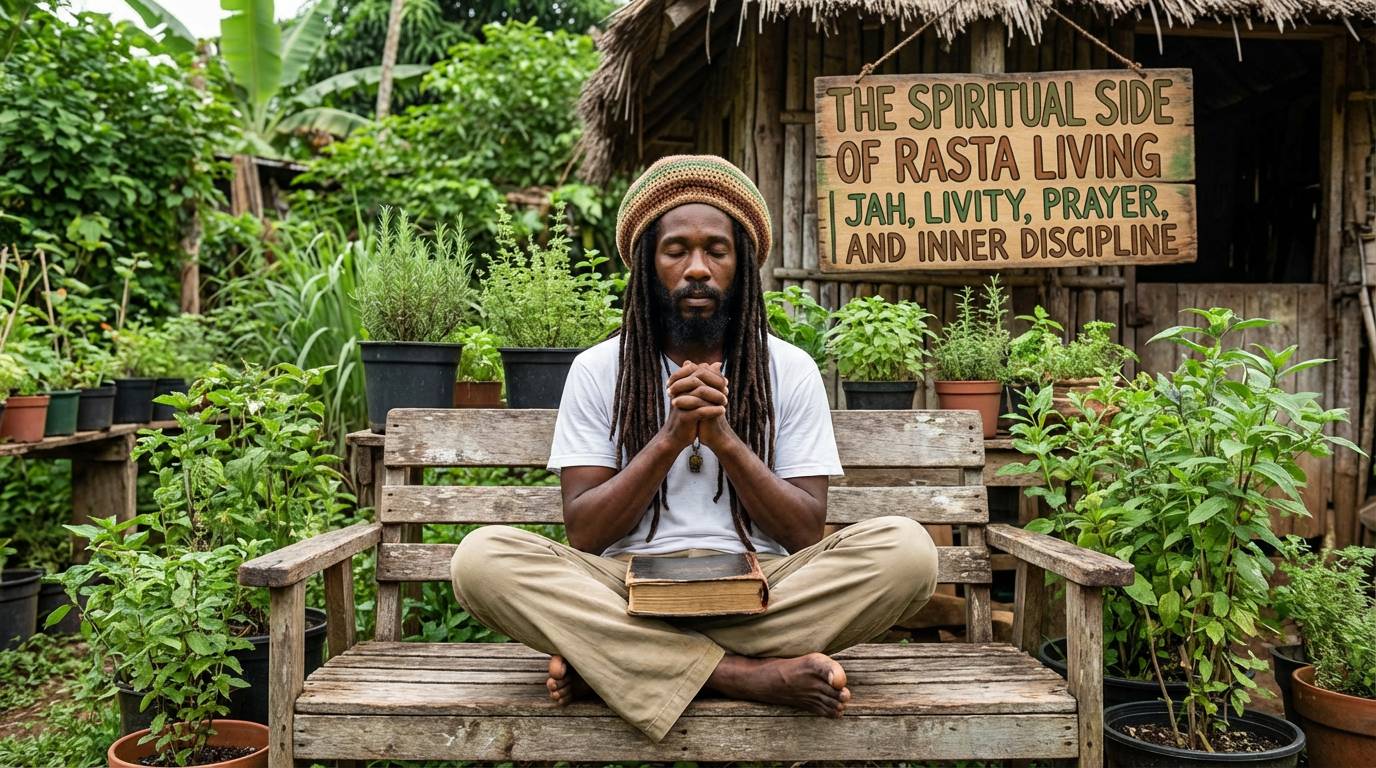
History explains where Rastafari came from, but spirituality explains how it lives. Without the spiritual dimension, the Rasta lifestyle can be misunderstood as a cultural posture, a form of social resistance, or a set of visible traditions without an inner core. Yet for those who live the path seriously, spirituality is not one layer among many. It is the ground beneath everything else. It shapes how a person speaks, eats, reasons, rests, gives thanks, carries pain, seeks wisdom, and understands their place in creation.
This is why the spiritual side of Rasta living cannot be treated as optional. The language of Jah, livity, Zion, Babylon, and righteous living only makes full sense when seen through a spiritual lens. The lifestyle is not meant to be mechanical. It is meant to be alive. It is meant to carry a sense of sacred presence through ordinary life. It is meant to remind the person that daily action is never completely separate from spiritual reality.
In modern culture, spirituality is often reduced to vague inspiration or occasional ritual. It may be treated as private emotion, personal comfort, or an aesthetic mood detached from discipline. The Rasta worldview moves differently. It insists that spirit and conduct are bound together. It does not ask only what a person believes in theory. It asks how that belief is embodied in food, speech, relationships, gratitude, restraint, humility, and moral direction.
This is where the word livity becomes especially important. Livity is more than a slogan. It points toward the quality of one’s life-force, one’s way of moving, one’s alignment between spirit and action. In many ways, livity is the felt expression of inner spirituality in outer life. A person with livity is not simply performing culture. They are carrying a certain energy shaped by truth, awareness, reverence, and discipline.
To understand the spiritual side of Rasta living, then, is to understand how the lifestyle breathes from within. It is to see that prayer, meditation, reasoning, stillness, and self-control are not extra pieces added later. They are part of the center. They make it possible for the outward life to remain connected to something sacred rather than drifting into performance.
Understanding Jah in the Rasta Worldview
Any discussion of Rasta spirituality must begin with Jah. The word itself carries deep reverence. It is not simply a label or a cultural marker. It points toward divine presence, sacred relationship, and a spiritual understanding of life that refuses to reduce reality to what is merely visible or material. In the Rasta worldview, Jah is not an abstract concept held at a distance. Jah is living reality, the source of life, truth, and higher order.
Jah as Divine Presence
One of the defining features of Rasta spirituality is the sense that divine presence is near, living, and active rather than remote. This changes the tone of the lifestyle. Life is not understood as random motion inside an empty universe. It is approached with reverence. The person is invited to live as though their actions matter beyond social appearance. Gratitude, humility, and awareness all grow from this understanding.
Divine presence also creates moral seriousness. If life is sacred, then how one speaks and behaves cannot be treated casually. A person begins to ask whether their conduct reflects righteousness or confusion, truth or vanity, life or corruption. This is not only about fear of judgment. It is also about honoring sacred order. In that sense, spirituality becomes deeply practical.
The nearness of Jah also gives comfort. In struggle, a person is not left only with their private strength. They are reminded that suffering does not erase sacred meaning. Faith becomes a way of remaining upright even when the outer conditions are harsh. This is one reason spiritual language in Rasta culture often carries both reverence and endurance at the same time.
Faith as Living Force
Within the Rasta path, faith is not meant to remain a verbal declaration without embodiment. It must become a living force. A person may say holy words, but the real test is whether those words are shaping conduct. Faith becomes visible in how one responds to pressure, temptation, conflict, hunger, or success. Does a person become more grounded, more truthful, more disciplined, and more compassionate? Or do they drift into pride, excess, and disorder?
This living quality of faith is important because it protects spirituality from becoming decorative. In every tradition, there is a temptation to perform holiness outwardly without allowing it to change inner life. The Rasta emphasis on livity challenges that temptation. It says, in effect, that spirit must move through the whole person.
Faith also gives the person a frame for reading life. Joy becomes something to give thanks for. Struggle becomes something to endure with purpose rather than only despair. Discipline becomes something more than self-denial. It becomes a form of alignment. In this sense, faith is not merely belief about Jah. It is a changed relationship to life itself.
What Livity Really Means
Few words are as central to Rasta spiritual life as livity, and few are as easy to repeat without fully understanding. Livity points beyond doctrine into the quality of lived being. It refers to a spiritual vitality expressed in conduct, consciousness, speech, energy, and relationship to the world. It is one of the clearest ways Rastafari connects inward spirit to outward life.
More Than a Word
In everyday speech, it can be tempting to treat livity as a simple term of encouragement or a broad expression of positive energy. But in the deeper sense, livity is more demanding. It asks whether the life being lived is actually aligned. It asks whether the person is carrying truth or merely borrowing a tone. It asks whether one’s habits are feeding clarity or confusion.
The power of the word comes from its refusal to separate essence from action. A person cannot speak of livity responsibly while living in ways that consistently destroy peace, dignity, honesty, or balance. Livity is not image management. It is not spiritual language used to decorate ordinary disorder. It is about living from a center that has been shaped by reverence and self-knowledge.
This is also why livity can be felt in presence. A person with deep livity may not always say much, but how they carry themselves tells a story. There is steadiness. There is awareness. There is restraint without coldness, warmth without chaos, seriousness without performance. Livity makes itself known through atmosphere.
Alignment of Spirit, Body, and Action
One of the most important things about livity is that it is integrative. It does not treat the spirit as disconnected from the body, or the body as disconnected from conduct. It recognizes that what a person consumes, repeats, tolerates, and practices all influences the quality of their life-force. Food matters. Company matters. Thought patterns matter. Speech matters. Habits matter.
Modern culture often thrives on fragmentation. People are encouraged to think of the body as separate from morality, thought as separate from energy, and spirituality as separate from daily repetition. Livity resists this split. It insists that life is whole, and that wholeness must be protected.
In that sense, livity is not passive. It requires active guarding of the inner life. A person must become aware of what weakens their clarity. They must notice what turns them toward restlessness, pride, false appetite, or numbness. And they must cultivate what restores peace, grounding, gratitude, and righteous direction.
What Livity Points To
- Spiritual vitality expressed in conduct, energy, and daily awareness.
- Alignment between inward belief and outward life.
- A refusal to separate spirit from food, habits, speech, and moral direction.
- A living quality that can be felt in presence, discipline, and calm strength.
Daily Spiritual Practice in the Rasta Lifestyle
Spirituality becomes real through practice. Without practice, even powerful beliefs can remain distant. The Rasta lifestyle therefore gives importance to daily actions that cultivate reverence, inner stillness, moral awareness, and connection to Jah. These practices are not always rigidly identical from person to person, but certain patterns appear again and again: prayer, gratitude, meditation, reasoning, and a general effort to keep one’s spirit from being overtaken by noise.
Prayer and Giving Thanks
Prayer in Rasta living is not only a formal exercise. It is often deeply woven into daily rhythm. Giving thanks is central. A person may give thanks upon rising, before eating, in moments of protection, after difficulty, or simply when becoming aware of the gift of life itself. Gratitude becomes spiritual orientation.
This is significant because gratitude resists a mindset of constant hunger and complaint. It shifts the person away from entitlement and toward reverence. It also strengthens awareness. When a person gives thanks, they are reminded that life is not self-created. They are reminded that blessings, breath, food, and endurance all carry something sacred within them.
Prayer also becomes a means of correction. In times of confusion, it can recentre the heart. In times of sorrow, it can keep despair from taking full control. In times of pride, it can restore humility. This is why prayer is more than language. It is relationship. It is dependence without humiliation, reverence without passivity.
Meditation and Stillness
If prayer is one way of speaking toward the sacred, meditation is one way of listening. The Rasta lifestyle values stillness because stillness reveals much that noise conceals. In silence, a person can become more aware of their own inner state. They can begin to notice restlessness, vanity, fear, agitation, or distraction that might otherwise go unnamed in a busy day.
Meditation does not always require elaborate techniques. Sometimes it begins simply with stepping away from the rush, quieting the mind, breathing deeply, and allowing attention to settle. Nature often plays an important role here. The natural world can restore rhythm to a person whose inner life has become scattered by artificial speed. The sound of wind, water, birds, or evening quiet can become part of meditation’s work.
Stillness is especially radical in a distracted age. Many people have forgotten how to be present without stimulation. The Rasta spiritual path pushes back against that condition. It encourages a person to cultivate an inward life strong enough to remain steady without constant entertainment or digital agitation. That capacity is not weakness. It is strength.
Reasoning as Spiritual Exchange
Distinctive features of Rastafari is the importance of reasoning. Reasoning is more than conversation. It is a mode of serious exchange oriented toward truth, reflection, and shared insight. It allows spirituality to become collective without losing sincerity. People gather not only to talk, but to think together, challenge one another, clarify principles, and deepen understanding.
This matters because spiritual life can easily drift into isolation or self-deception when it is never tested in honest dialogue. Reasoning provides a corrective. It helps protect the path from ego and confusion. It also creates community around shared searching rather than around empty performance.
In true reasoning, the goal is not to dominate or impress. It is to reach clarity. That requires humility, patience, and the willingness to hear something deeper than one’s first reaction. This quality of exchange is one reason reasoning carries spiritual importance in the Rasta way of life.
Inner Discipline and Character
Spiritual life without discipline often becomes sentiment. It may feel sincere in certain moments, but it lacks the strength to shape character consistently. The Rasta path places great importance on inner discipline because discipline guards the spirit against drift. It turns intention into pattern. It makes it possible for reverence to survive pressure.
Humility and Self-Control
Humility is one of the most essential spiritual virtues in Rasta living. It protects the person from mistaking image for growth. It creates openness to correction. It helps a person remember that spiritual seriousness is not the same as self-display. A humble person does not need to announce depth constantly. Their steadiness speaks for itself.
Self-control belongs closely to humility. Without self-control, a person becomes easy prey for appetite, distraction, anger, pride, and confusion. Self-control is not repression for its own sake. It is the ability to guide the self rather than be governed by every impulse. This matters spiritually because what controls the person’s inner life will eventually shape the outer life as well.
Speech is one area where self-control becomes especially visible. A person may speak carelessly, boastfully, or cruelly without recognizing how much such habits weaken their spirit. The Rasta lifestyle encourages greater awareness here. Words are not empty. They shape atmosphere, relationship, and consciousness.
Purposeful Living
The discipline of the Rasta path is not only about avoiding wrongdoing. It is also about living with purpose. A purposeful person does not drift through life as though days have no spiritual shape. They try to move with awareness. They ask what habits are worthy of repetition. They guard what enters their mind and body. They keep sight of larger values even when ordinary pressures pull toward compromise.
Purposeful living gives moral weight to the everyday. Rising, eating, working, resting, reasoning, and speaking all become opportunities to live more consciously. This does not make life rigid. Instead, it makes life more awake. The person stops sleepwalking through their habits and begins to inhabit them deliberately.
This is one of the most practical gifts of spiritual discipline: it rescues the person from fragmentation. It gathers life back toward center. The more centered one becomes, the less dependent one is on chaos, approval, or excess to feel alive.
The Spiritual Meaning of Simplicity
Simplicity is often misunderstood. Many people hear the word and imagine deprivation, dullness, or lack. But within the Rasta worldview, simplicity is closer to clarity than scarcity. It is not about emptiness for its own sake. It is about making room for what is essential by loosening attachment to what only distracts, inflates, or corrupts.
Freedom From Distraction and Greed
One reason simplicity matters spiritually is that greed and distraction consume inner energy. A person can become so entangled in chasing appearance, status, or appetite that they lose the ability to hear their deeper self. Simplicity breaks some of that spell. It reminds the person that much of what the world sells as necessity is merely pressure wearing a polished face.
This does not mean all possessions or comforts are evil. The deeper point is about relationship. Does one own things, or do things begin to own the spirit? Does consumption support life, or does it become endless hunger? Simplicity creates the space to ask such questions honestly.
In spiritual terms, simplicity protects receptivity. A cluttered, frantic life often leaves little room for gratitude, reflection, or reverence. By contrast, a simpler rhythm can make it easier to notice what is sacred in ordinary moments.
Sacredness in Ordinary Life
The Rasta spiritual path often finds depth not by escaping ordinary life, but by entering it more consciously. Food can be prepared with reverence. A walk can become meditation. A conversation can become reasoning. A morning greeting can become thanksgiving. Simplicity makes these possibilities easier to perceive because the person is less numbed by constant stimulation.
This is one reason simplicity and livity belong together. A life overfilled with noise struggles to carry deep livity. A life with more space for presence can begin to hold stronger spiritual energy. The ordinary becomes less empty because the person has become more aware.
Spiritual Challenges in Modern Times
The modern world creates conditions that make spiritual discipline harder. Speed is praised. Distraction is normalized. Appetite is constantly fed. Image competes with truth. Even when people long for peace, they often live inside systems designed to keep them restless. This makes the spiritual side of Rasta living especially relevant, because it offers practices and values that resist these pressures directly.
Noise, Speed, and Digital Restlessness
One of the great dangers of modern life is spiritual fragmentation. People are flooded with information, comparison, opinion, urgency, and entertainment. Their attention is pulled in every direction. Under such conditions, the inner life becomes weak unless it is intentionally protected.
The Rasta emphasis on prayer, stillness, nature, gratitude, and reasoning offers an answer to this problem. It does not remove the world’s noise automatically, but it gives the person tools to keep from being ruled by it. It teaches a different rhythm. It teaches that not every signal deserves entry into the spirit.
This is also where inner discipline becomes so important. Without it, a person may admire spiritual values while being practically shaped by distraction every day. Discipline helps close that gap.
Consumer Culture Versus Spiritual Focus
Another challenge is the pressure of consumer culture. Modern systems often encourage people to locate meaning in acquisition, novelty, or display. That pressure does not remain external. Over time, it can train the heart to seek excitement rather than truth, performance rather than rootedness.
The Rasta path resists this by teaching that life has higher measures. Character matters more than display. Peace matters more than constant stimulation. Integrity matters more than applause. The spirit must not be sold for comfort or trend.
In this way, spiritual discipline becomes an act of resistance. It refuses to let the world’s loudest values become the soul’s deepest ones.
Spiritual Lessons for Daily Life
- Jah is approached as living divine presence, not distant abstraction.
- Livity joins spirit, body, conduct, and energy into one lived reality.
- Prayer, gratitude, meditation, and reasoning all help sustain spiritual clarity.
- Humility and self-control guard the person from pride, chaos, and drift.
- Simplicity creates room for sacred awareness in ordinary life.
- Modern distraction makes inner discipline more necessary, not less.
Living From the Inside Out
At its strongest, the spiritual side of Rasta living teaches a person to live from the inside out. Instead of building identity around reaction, image, or public approval, the person seeks a stronger center. That center is nourished by faith, shaped by discipline, and expressed through livity. It does not eliminate hardship, but it changes how hardship is carried. It does not erase ordinary life, but it fills ordinary life with greater seriousness and meaning.
This is why the spiritual dimension cannot be separated from the rest of the Rasta lifestyle. Without it, dread becomes hairstyle, ital becomes diet trend, reasoning becomes talk, and culture becomes performance. With it, each of these areas reconnects to something larger. They become part of a moral and spiritual whole.
To live from the inside out is also to recognize that transformation does not happen only through dramatic public gestures. It happens through repeated daily alignment. It happens when gratitude becomes natural, when speech becomes more careful, when appetite loses some of its control, when stillness becomes less frightening, when reverence begins to shape habit.
That is the deeper power of this path. It changes the quality of presence. A person becomes less divided, less performative, less dependent on noise. They begin to carry more steadiness. That steadiness is one of the most visible signs of inner spirituality, even when it is not loudly named.
Conclusion: The Spirit That Gives the Lifestyle Life
The spiritual side of Rasta living is the force that keeps the whole way of life from becoming hollow. Through Jah, livity, prayer, meditation, reasoning, gratitude, humility, and inner discipline, daily life is drawn into sacred relationship. The person is reminded that how they live matters, not only publicly but inwardly. Spirit is not reduced to mood. It becomes order, presence, and direction.
This is why Rasta spirituality remains so compelling. It does not ask people to divide themselves into separate compartments. It asks them to live as whole beings. What they believe, eat, speak, practice, honor, and resist all belong to one larger path. That wholeness is rare in a fragmented age, and that is part of its power.
Yet spirituality in the Rasta lifestyle does not remain abstract. It also shapes how the body is treated, how nourishment is understood, how herbs, food, rest, and natural living become part of disciplined life. In other words, the spiritual path continues through the body as well as the mind. That is where the next part of this series turns: into Ital living, natural wellness, simplicity, and the care of the body as part of sacred living.