Reggae Dread · Reggae Beyond the Record · 08
The Harder They Come: Music and Survival
Perry Henzell's film asks what happens between possessing a voice and having the power to make a living from it.
A song can open a door without keeping it open
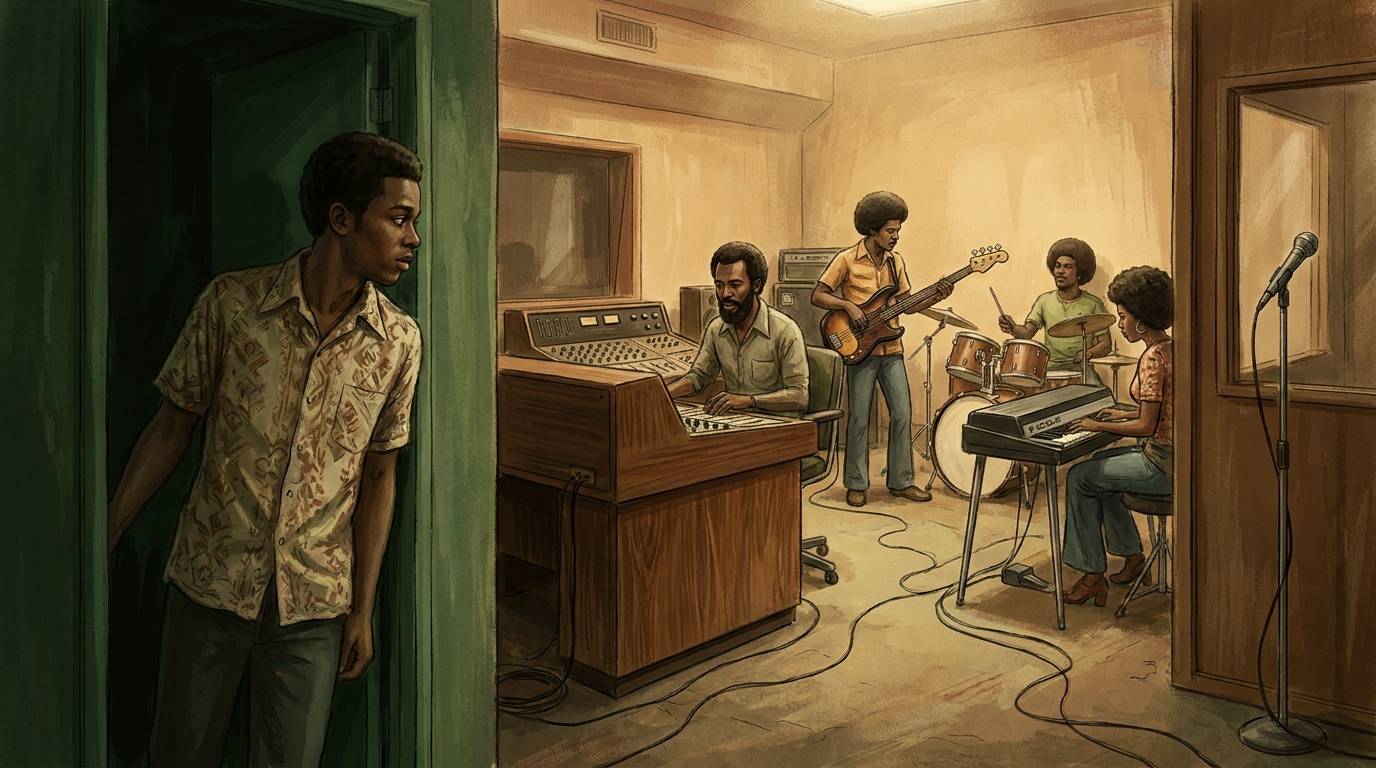
In a recording-studio scene in The Harder They Come, Ivan watches the Maytals perform “Sweet and Dandy.” The musicians are already doing the thing he wants to do. Their voices turn a room of equipment and working people into a place of possibility. For an aspiring singer standing nearby, the distance between wanting and belonging seems almost close enough to cross. 1
That encounter offers a useful entrance into Perry Henzell's 1972 film. Music appears as an activity with a location, participants and conditions of entry. Someone has obtained the room. Someone operates the equipment. People have practiced, developed a sound and come together to make a recording.
Ivan hears a future for himself. The viewer can also see a workplace.
The distinction matters because the film's soundtrack has a life of its own. A listener can meet Jimmy Cliff's title song, the Maytals, the Melodians or the Slickers through an album, a compilation or someone else's selection. The songs can give pleasure before the listener knows anything about Ivanhoe Martin.
Watching the film brings those recordings into another relationship. The sound accompanies a young man's attempts to find employment, make a record and claim a place in Kingston. It also accompanies choices that hurt other people and help destroy him.
This essay discusses the film's story, including its ending.
A performer and a character share the screen
Jimmy Cliff plays Ivan. Perry Henzell directed and co-wrote the film with Trevor D. Rhone. The credits name many other workers, including art director Sally Henzell and cameramen David MacDonald, Peter Jessop and Franklyn St. Juste. The finished work belongs to a collaboration, even when the singer's presence holds our attention. 2
Cliff was already an established recording artist when he took the role. Ivan is trying to become one. That difference creates a productive tension: we encounter the ability of a real musician inside the vulnerability of a fictional newcomer.
We can believe the desire because the performance gives it substance. Yet the singer's gift does not make his character's later actions admirable or inevitable. The film allows attraction and discomfort to occupy the same viewing.
The first audience was close to the world on screen
In her account of the production, Justine Henzell emphasizes her father's decision to make the film for Jamaican viewers. Its later overseas reach grew from a work whose initial point of address was local. 3
That choice changes how an overseas viewer might approach the film. A conversation, joke or social distinction can have meaning for people within the setting before it becomes fully legible to a newcomer.
Let that difference encourage attention. Follow the dialogue with subtitles where useful, listen to the delivery and resist expecting every detail to pause for explanation. An encounter with another place can begin with recognizing that its people already have ways of speaking to one another.
Begin by looking at the work
The studio sequence can be approached through a simple question: what has to happen for music to reach a listener?
A voice matters enormously. So do the people and arrangements around it. The room has to be available, the recording has to be made and the result has to circulate. A person can succeed at singing while remaining in a weak position when those other decisions are made.
Our earlier article, Behind the Voice: The People Who Built Roots Reggae, follows the wider field of musical collaboration. Henzell's film gives that subject a dramatic pressure. The question becomes whether the opportunity Ivan sees will provide a workable life.
The journey to Kingston is a search for a livelihood
Ambition arrives with ordinary needs
Ivan travels from the countryside to Kingston after his grandmother's death. He hopes to make music, but the city also presents immediate questions of money, shelter and employment. His arrival is followed by the loss of his possessions and the discovery that his mother has limited means to support him. 1
These details give the ambition material weight. He cannot spend an unlimited period waiting to be discovered. He needs somewhere to sleep and something to eat while asking people to take him seriously.
The journey therefore carries two expectations that do not fit comfortably together. Kingston appears to contain opportunities unavailable at home. At the same time, entering the city does not give him access to the resources needed to pursue them.
The film keeps returning to that gap. A person may be willing to work and still depend on somebody else's decision to offer a job. He may possess confidence without possessing a useful introduction. He may reach the right building and remain outside the relationship that makes the building usable.
Refusal has a different weight when there is little to fall back on
The job-seeking episodes place Ivan before people who can dismiss him. His time is spent trying to persuade others that he can be useful. “Many Rivers to Cross” accompanies this part of the story, bringing the singer's emotional force into contact with the character's uncertain prospects. 1
A refusal can be a small event for the person giving it and a consequential one for the person receiving it. The film's interest in unequal power begins in these ordinary exchanges, before the story becomes a pursuit.
Consider how much of Ivan's day other people can determine. Somebody can tell him to come back, give him a task, decide he is unsuitable or make an offer he cannot easily replace. His movement through the city is repeatedly interrupted by another person's authority.
This makes his insistence on recognition understandable. It also helps explain the appeal of music as a way of being heard. A song seems to promise an audience beyond the individual who has just refused him.
Understanding an appeal is different from excusing every response to frustration. Ivan's later violence damages lives. The film's social criticism becomes less useful if we flatten him into either an innocent emblem or a person whose circumstances no longer matter.
Other people have to live beside the ambition
The credits identify Janet Bartley as Elsa and Ras Daniel Hartman as Pedro. Giving those characters names is a small way of resisting the pull of a story organized so strongly around one man's desire. 2
Watch for the moments when another person's needs enter the picture. A relationship asks something of Ivan beyond the wish to be admired. Someone else's room, attention or practical help has a cost, even when he experiences it primarily as assistance along his own journey.
That offers another measure of survival. A person may imagine freedom as escaping everybody else's authority, while the people close to him need reliability, consideration or a reduction in the danger he brings with him.
The question also reaches the viewer. Are we following the ambition so eagerly that we stop noticing the lives beside it? A second viewing can make space for those people without losing sight of the central performance.
Countryside and city remain connected
Ivan's move is one fictional journey. It should not become a template for every Jamaican who left a rural community. People moved for different combinations of family, work, schooling and artistic possibility.
The film makes a particular route vivid. Its force comes from the pressures placed on this character, rather than from demonstrating that every country person has the same experience.
There is also no need to turn the place he leaves into an effortless refuge. A home can contain affection, knowledge and obligations while offering limited employment. A city can contain exploitation and genuine creative relationships. Each place has more than one meaning.
Rural Jamaica in Reggae: Land, Labour and the Idea of Home develops that question through songs and artist accounts. Beside Ivan's story, those accounts help restore the variety that a single dramatic journey cannot carry.
The recording business is a question of access
The session and the bargain are different achievements
When Ivan records the title song, the performance briefly seems to settle the question of his ability. The room responds to music that works. The difficulty arrives in the proposed terms: Hilton offers him twenty dollars. Making the recording has not given the singer control over the conditions under which it will reach an audience. 1
The amount functions dramatically as a measure of the imbalance. Ivan values the song as an opening into a new life; Hilton can treat it as one more transaction within a business he understands and controls.
For the viewer, the sequence separates several things that are easy to collapse when listening to a finished record. There is the ability to write and perform. There is access to a recording facility. There is the power to issue, promote and supply the recording. There is the question of what the artist receives.
Success at one stage does not settle the others. A convincing performance cannot negotiate by itself. Applause in a studio does not feed someone through the following month.
The person who controls a route can shape the choice
Ivan wants the public to hear his record. Hilton's authority matters because the character needs the route to that public as much as he needs the recording itself.
Read the conflict through the alternatives available to each person. Someone with money, stock and established contacts can wait, reject an offer or work with another singer. Someone who needs immediate income and has few connections may find refusal much harder to sustain.
The film concentrates those inequalities in a memorable business relationship. Hilton becomes a dramatic figure through whom the audience can feel how limited a newcomer's options are.
That concentration is part of storytelling. A screen character cannot provide a complete account of all Jamaican producers, retailers or distributors. To turn Hilton into a description of an entire industry would erase the differences that historical research needs to recover.
The companion article Women Who Kept Reggae Moving: Shops, Labels and Distribution follows actual decisions by Patricia Chin and Sonia Pottinger. Their separate histories give the viewer a way to move from a powerful fictional confrontation into documented working relationships.
A real recording exists inside the fiction
Justine Henzell explained in her Criterion interview that the title-song session shown in the film was the actual recording. She also described her father's method of setting up situations and allowing performers latitude within them. 3
Cliff's own account identifies musicians including Gladstone Anderson, Winston Wright, Hux Brown, Jackie Jackson and Winston Grennan around that recording. Their work is part of the sound through which Ivan appears to prove himself. 4
This is one of the film's richest crossings. A genuine musical performance supplies the substance of a fictional breakthrough. The character gets the attention, while the recording preserves a collaboration extending beyond him.
Give that collaboration room when watching. Notice the difference between following Ivan's hopes and following the people making the track possible. Both kinds of attention can coexist.
Jackie Jackson's Basslines and Reggae's Living Memory offers another route into the work behind a familiar singer. A film performance can lead us toward the musicians whose contributions remain audible after the screen has gone dark.
A soundtrack changes when images give it circumstances
Encouragement can become a difficult promise
“You Can Get It If You Really Want” offers one of the soundtrack's clearest statements of determination. David Katz's essay for the Library of Congress points to the tension between that confidence and the obstacles placed before Ivan. 5
He wants something deeply. Wanting does not remove the need for money, employment or access to a business relationship. The film invites us to hear encouragement within conditions that the encouraging words cannot simply change.
That tension gives the song more than one possible effect. On its own, it can support a listener facing a difficult day. Beside Ivan's setbacks, its assurance can raise an uncomfortable question about how much success is within a person's control.
Neither response cancels the other. A listener may need the song's hope and still recognize an unfair arrangement. The film makes those experiences available at the same time.
A song carries a history beyond its scene
Cliff's “Many Rivers to Cross” had a history before it became part of Ivan's experience. Katz connects its creation with the singer's disappointments while trying to establish himself in Britain. A recording can enter a film with earlier circumstances already attached to it. 5
That matters when we hear the performance as the character's emotional voice. The song fits his isolation, but it was made by a real person whose life did not follow Ivan's plot.
The distinction gives the soundtrack depth. These recordings were drawn from a musical world with its own artists, audiences and working histories. Henzell assembled relationships among songs and images; he did not create that whole world for the film.
Justine Henzell describes the album's diversity and the way songs and sounds supply mood without a separate conventional dramatic score. Her account encourages us to consider music as part of the film's construction, with different recordings doing different kinds of work. 3
The pleasure of the album may come partly from that variety. A complete listening session can move between resolve, faith, uncertainty and danger, even when the listener is not picturing a sequence from the film.
The title song can outlive the person the story follows
The title track has an especially complicated role because Ivan appears to make it within the story. We see a performance become something that can travel beyond the room and beyond his immediate control.
The voice can circulate while the character's situation deteriorates. Musical recognition and personal security no longer move together. A recording's increasing public life cannot guarantee the safety of the person associated with it.
That separation is one reason to resist treating fame as the film's uncomplicated solution. Attention may amplify an image while failing to improve the conditions of a life.
The story's later interest in notoriety sharpens the question. What do audiences want from the person they hear about? Do they want a song, an outlaw, a photograph, a story they can repeat? The same name can connect those different kinds of demand without making them equivalent.
The soundtrack is also a selection
Hearing the film's music as a gateway into reggae should make us curious about what lies beyond the selection. The soundtrack offers particular artists and recordings, assembled for a particular work.
Return to one name you know less well. Follow the Maytals beyond their two contributions, or spend time with the Melodians as performers in their own right. Let the film open a catalogue rather than stand in for an entire musical culture.
The Reggae Record Shop: Where Music Became Community follows another way listeners encountered unfamiliar names. A film, an album and a recommendation can each start a musical relationship; the relationship grows through further listening.
Watch again for the distance between being heard and being free
The ending returns us to the audience
The film links Ivan's final confrontation with his earlier encounter with a screen Western. Tony Rayns's contemporary review, reprinted in the BFI programme notes, draws attention to the character imagining himself as an invincible movie hero in his last moments. 2
The connection asks us to consider how a person learns to picture recognition. Ivan wants to be someone the public notices. The cinema offers a ready-made image of the exceptional man who survives because the story belongs to him.
His body remains vulnerable. The image of the hero cannot protect him from the consequences of the world around him or from the choices he has made.
The ending also places responsibility with the viewer. It is possible to enjoy the force of a performance while recognizing the cost of the fantasy attached to it. The film does not require us to surrender one perception in order to hold the other.
A short second-viewing record
Choose three sequences and make notes after each. Use the edition you can access through an authorized release; record its running time rather than borrowing timestamps from another copy.
| Sequence | Follow the practical situation | Follow the music and image |
|---|---|---|
| Ivan watches the Maytals | Who is already inside the workplace, and what does Ivan hope to enter? | How does watching musicians change the meaning of his ambition? |
| The title-song session and its aftermath | What has he achieved, and what must still be agreed? | Where does the pleasure of the performance meet the pressure of the bargain? |
| The final confrontation | What options remain, and who has power over his movement? | How does the imagined screen hero affect the way we see the vulnerable person? |
An official Shout! Studios clip of the Maytals sequence provides one starting point. For a complete viewing, consult the Criterion film page or an authorized edition available in your territory. Access and availability can change.
Keep the observation specific. A look toward another person, a pause before an answer or a change from performing to negotiating may carry more meaning than a general statement that the film is about resistance.
Read the credits as part of that second encounter. Choose one person whose work you noticed and record the role exactly as it appears in your edition. Then separate that credit from any additional story you find about the person.
A production photograph, an interview and a later tribute may add useful context, but they answer different questions. Who Keeps Reggae’s History? Flyers, Family Photographs and Living Memory gives a practical method for keeping an object together with the source of its description. The same care can make a film's working history easier to follow.
Bring the distinction back to the record
After viewing, play a song without the film. Notice what the performance gives you now that you know something of the circumstances in which the story uses it.
You may retain the pleasure of the track while hearing a new question about work. You may become more attentive to the musicians. You may want to learn about an actual artist's arrangements rather than assume the fictional transaction explains them.
Keep those questions connected with people. The Harder They Come makes musical ambition vivid because it gives that ambition a body moving through rooms, streets and unequal encounters. The soundtrack preserves voices that continue to reach other bodies in other places.
The film's lasting invitation is to hear more than a promise of success. Hear the skill, the collaboration and the desire for a life in which a person's work has value. Then ask what would have to change for being heard to become a dependable way of living.
Sources and further reading
- Recording Academy: The Harder They Come, a song-by-song account — scene descriptions, Cliff testimony and soundtrack context. Registry-date claims on this page are not used here.
- BFI Southbank programme notes and production credits — credits and Tony Rayns's August 1972 review. The programme's 1973 territory/release listing is distinguished from the film's 1972 Jamaican release.
- Criterion: Justine Henzell on the film at fifty — production testimony, casting, the real title-song recording and musical construction.
- JamaicansMusic: Jimmy Cliff on making the title song — Cliff's account of songwriting and the musicians at the session.
- Library of Congress: David Katz's soundtrack essay — the songs' histories and their relationships with the narrative.
- Shout! Studios: official “Sweet and Dandy” clip — an authorized excerpt from the film.
- Criterion: The Harder They Come — film identification and edition information.