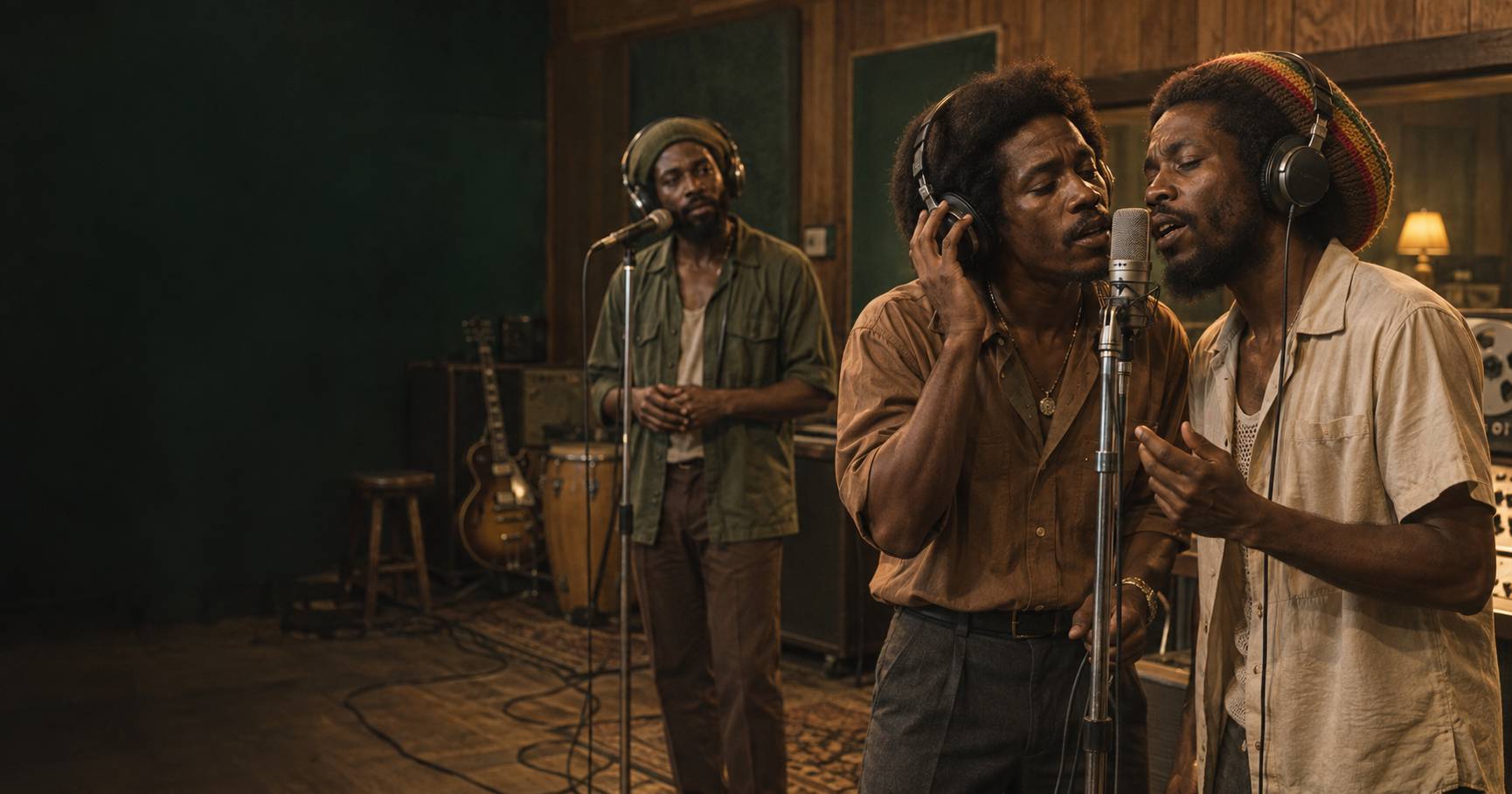
Behind the voice Roots Reggae. The next time Joseph Hill’s voice comes through the speakers, listen for the people around it. Follow the answering voices. Notice what the rhythm leaves open. Consider the choices that make a phrase feel urgent, a chorus feel shared, or a moment of quiet feel charged with expectation. A familiar recording begins to reveal another story when the most recognizable singer no longer occupies all of our attention.
Culture offers a particularly clear place to begin. The original trio brought Hill together with Albert Walker and Kenneth Dayes; producer Joe Gibbs and engineer Errol Thompson were central to its breakthrough recording history. Naming those contributors changes the picture from a solitary messenger to a collaboration. The message still belongs to the experience of hearing Hill, but the recording belongs to a much larger account of creative work. [1][2]
Roots reggae has often asked listeners to remember people excluded from official histories. Its own history deserves the same care. The musicians behind an unforgettable bass figure, the women whose harmonies reshape a chorus, and the engineer deciding how a voice occupies the mix should not become anonymous simply because another name is printed more prominently.
This is an invitation to hear more, and to give credit with greater precision. Appreciation becomes richer when it can explain who contributed, what they contributed, and which parts of the story still require evidence.
Culture: Hearing a Group Inside a Famous Voice
On Two Sevens Clash, released in 1977, the name Culture refers to three singers rather than a solo performer. VP Records identifies Hill, Walker, and Dayes in its account of the album’s creation with Joe Gibbs. That simple fact should travel with every introduction to the record. [1]
The useful listening question is not which voice matters most. It is how the voices create meaning together. An answering phrase can confirm a statement, complicate its emotional color, or transform an individual declaration into something resembling public agreement. A sustained harmony can give a restless lead line a place to return. These are possibilities to investigate in the recording, not a substitute for hearing the singers themselves.
Try one complete listen while following Hill. On the next, follow the other voices whenever they enter. Notice whether your sense of the song changes. Does its confidence become more communal? Does a repeated phrase acquire a different weight? You do not need to identify a musical interval to recognize that another person is shaping what you feel.
The point also reaches beyond this particular trio. A group name can hold a history that a celebrity-centered introduction accidentally removes. Recognizing Hill’s stature and remembering Walker and Dayes are compatible acts. Together, they offer a fuller account of why Culture became meaningful to so many listeners.
For the wider biography, return to Joseph Hill of Culture, then revisit a recording with the harmony singers deliberately in mind.
Harmony Is Creative Work
The word “backing” describes a musical role, but it can carry an unintended suggestion of lesser importance. A singer positioned behind a lead performer may be doing work essential to the identity of the whole performance. Placement onstage and placement in cultural memory need not follow the same hierarchy.
Harmony requires decisions. Singers must coordinate beginnings and endings, shape vowels, judge intensity, and understand how their line sits against another line. Agreement is not automatic merely because people are singing the same words. A convincing blend can depend on considerable attention to small differences.
An audience may remember the resulting sound without consciously separating its parts. That is one reason such work becomes easy to overlook: successful collaboration can make effort feel inevitable. The recording seems simply to exist in its finished form. Yet an arrangement is a set of choices made by people, not a natural property of a song title.
There is no need to invent a rehearsal story to acknowledge this. Where interviews or session documentation survive, they can show how particular performers worked. Where they do not, the responsible approach is to distinguish general musical explanation from claims about a specific session.
A useful habit is to replace “and backing singers” with actual names whenever those names are documented. Then take the further step of listening to those singers in other settings. Recognition becomes substantial when it opens a path toward their own work, rather than ending with a courtesy mention.
The I-Threes and the Limits of the Supporting Role
Rita Marley, Marcia Griffiths, and Judy Mowatt brought their voices together as the I-Threes. Bob Marley’s official history places them within the change represented by Natty Dread in 1974. The earlier Wailers vocal partnership with Peter Tosh and Bunny Wailer and the later configuration with the I-Threes should be understood as different chapters, not collapsed into one timeless lineup. [3]
The women also had musical identities beyond their association with Marley. A label-published account of the I-Threes traces their individual careers and the group’s recordings, providing a route beyond the familiar concert image. [4]
That route matters. Describing a woman principally through the celebrated man beside her can restrict how readers understand her work. The corrective is not to remove the collaboration; it is to place the collaboration within a larger career. A musician can make an important contribution to another artist’s recording and remain an artist whose own catalogue deserves attention.
When listening to Natty Dread, give the vocal arrangement the same concentration normally reserved for the lead. Ask how the relationship between voices changes the emotional scale of a passage. Then choose a separate recording by one of the I-Threes and approach it without expecting her to reproduce the supporting role.
This is a practical form of cultural respect. It expands the listener’s world, makes women’s creative labor more visible, and weakens the habit of telling reggae history through a narrow succession of male frontmen.
Burning Spear Was Also a Vocal Ensemble
The name Burning Spear is closely associated with Winston Rodney, yet Marcus Garvey belongs to a period when the act was a vocal trio. Accounts of the album identify Rupert Willington and Delroy Hinds alongside Rodney, with Jack Ruby producing. Some sources vary the spelling of the harmony singers’ names; that is a reason to compare credits carefully rather than turn variant spellings into different people. [5]
The recording therefore offers another exercise in hearing the ensemble. Begin with Rodney’s statement, then shift attention toward the voices that surround it. Instead of deciding in advance what they must be doing, ask what their presence contributes to the passage’s emotional character.
The album’s connection to historical remembrance makes the exercise especially appropriate. A work associated with keeping Marcus Garvey’s name alive should also encourage care for the names involved in making it. Historical attention need not stop at the subject of the lyrics.
This does not require a contest between frontman and collaborators. The argument is additive: a more complete account helps explain the achievement. A powerful central voice may depend on an arrangement that gives it contrast, response, and space. The listener can recognize the central force while also recognizing the structure around it.
Explore this period through Reggae Dread’s Marcus Garvey era article. Bring the names of the vocal contributors into that reading, and allow the biography to become a story of relationships as well as individual conviction.

Bass and Drums: The Relationship Beneath the Song
The Barrett brothers provide another clear example of why individual names matter. Aston “Family Man” Barrett played bass and Carlton Barrett played drums in the Wailers’ history. Bob Marley’s official account also connects the brothers with the group’s work alongside Lee Perry. [3]
A rhythm section is more than two instruments operating at once. Bass and drums establish relationships among movement, emphasis, and anticipation. A bass phrase may travel while a drum pattern holds a recurring point of reference. A brief interruption can become meaningful because the listener has learned what usually happens around it.
To hear that relationship, spend part of a song following only the bass. Then listen again for the drums. Finally, let them come back together. You may notice how one part seems to answer a gesture in the other, or how a repeated figure leaves room for the voice. These observations are more useful than assuming that every reggae recording follows a single formula.
They also prevent “reggae rhythm” from becoming an anonymous effect. A style can be widely recognizable while its individual practitioners make distinct choices. The fact that a listener can identify a genre does not mean every musician working within it is interchangeable.
Credit, here, is connected to hearing. Once a player has a name, it becomes possible to follow that player across recordings, compare contexts, and learn how collaboration changes the result. An apparently simple accompaniment can become the beginning of a substantial musical education.
The Other Instruments Deserve a Hearing
Bass and drums attract justified attention, but a recording may also depend on guitar, keyboards, percussion, and horns. The safest way to connect those sounds with people is through the credits for the actual recording or edition under discussion.
Culture’s Africa Stand Alone offers a useful example. The label’s reissue page names Clynton Rowe on bass, Glen Washington on drums, Merrick Dyer on guitar, Phillip Williams on keyboards, and Bernard Shaw and George Subratie on percussion. It identifies Sylvan Morris with engineering and mixing at Harry J’s. These details belong to that project; they should not be copied indiscriminately onto another Culture album. [6]
A credit list becomes more useful when paired with a question. What does the guitar add during a vocal pause? Does a keyboard sound hold a chord or introduce a brief response? How does percussion alter the feeling of movement without becoming the loudest element? You can investigate those questions without pretending to isolate every instrument perfectly.
Avoid turning confidence into certainty. If a sound is hard to identify, describe what you hear and leave its source open. A bright repeated accent is an observation; assigning it to a particular player requires additional evidence.
This combination of attention and restraint honors musicians more effectively than a long list of famous names attached to the wrong session. Accurate modesty is preferable to impressive but unsupported detail.

Sonia Pottinger and the Work of Making Records Possible
Culture’s recordings for Sonia Pottinger’s High Note label form a major part of the group’s history. Cherry Red’s Children of Zion collection gathers Jamaican singles and extended mixes from that relationship. Its track list makes clear that this body of work extends beyond the few titles most likely to appear in a brief introduction. [7]
Pottinger’s presence also challenges a familiar imbalance in music writing. Producers may be celebrated as visionaries when they are men and treated as incidental business figures when they are women. A more careful account begins with the documented work and asks the same substantive questions of everyone involved.
What conditions allowed performances to be recorded? How was material developed and presented? Which collaborators worked on the release? What can original credits, interviews, and release histories establish about those decisions? These questions are more revealing than a vague statement that a producer “helped” an artist.
A producer’s precise responsibilities can vary from project to project. The title alone does not tell us who suggested every arrangement or made every sound. That variation makes specificity important. Credit Pottinger with the productions documented in her catalogue, while avoiding invented scenes that claim to reveal her decisions in the control room.
For listeners, the practical next step is straightforward: explore a selection of those recordings as a body of work. Let the producer’s name become a route through music, much as an artist’s name already is. That is one way to make recognition active rather than ceremonial.
Channel One and the Mighty Diamonds
The Mighty Diamonds’ Right Time provides another path into the relationships behind a roots recording. The trio consisted of Donald “Tabby” Shaw, Fitzroy “Bunny” Simpson, and Lloyd “Judge” Ferguson. The artist release page dates the album to 1976, while published recording credits identify Joseph Hoo Kim as producer and Ernest Hoo Kim and Ossie Hibbert as engineers. [8][9]
Already, a short introduction has become more informative. The singers, the producer, and the engineers occupy distinct places in the account. We can appreciate how an ensemble and a recording environment meet without collapsing them into a single person’s achievement.
For a first encounter, choose “Right Time” or “I Need a Roof,” then continue through the album. The benefit of listening beyond one song is that it gives recurring qualities time to emerge. You can ask whether the voices are presented similarly, whether the emotional atmosphere shifts, and how the sequence changes your understanding of the group.
Do not confuse familiarity with documentation. A listener who knows a producer’s usual collaborators may still need to check the personnel for a specific record. Studio histories overlap, musicians move between sessions, and later editions can add material with different origins.
A listening culture that respects those distinctions becomes better at noticing how records were made. It also gives the reader a practical method: begin with a release, establish the names, listen for relationships, and keep track of what remains uncertain.
Lee Perry, the Congos, and the Studio as a Creative Place
Heart of the Congos, released in 1977, is associated with Lee “Scratch” Perry’s Black Ark studio. VP Records’ edition names Perry as producer and supplies an extensive contributor list, including Boris Gardiner, Ernest Ranglin, Watty Burnett, and additional musicians and vocalists. [10]
The long list should not become an excuse to assign every credited person to every track. It demonstrates the breadth of the album’s credited participation. Track-level assertions require track-level evidence.
The album nevertheless offers an excellent starting point for thinking about production. A recording is not only a performance captured at a distance. Choices about balance and presentation influence how close a voice seems, how one instrument sits against another, and which details command attention. Those choices help shape the listener’s experience even when their maker remains invisible.
Begin with “Fisherman.” On one pass, follow the vocal interplay. On another, notice the apparent space around the sounds. You do not have to reconstruct the equipment chain to become aware that the record presents a particular world. Description can remain grounded in perception: close, distant, dense, open, abrupt, lingering.
Perry’s reputation should lead the listener toward this work rather than substitute for it. Calling someone a genius tells us little unless we become curious about the recordings and the collaborators through which that reputation took shape. Admiration becomes more substantial when it teaches us how to pay attention.
Engineers, Mixes, and the Danger of Assuming
The engineer’s contribution is especially vulnerable to disappearance because the finished recording can conceal the labor of making it intelligible and expressive. Microphone placement, recording balance, editing, and mixing involve different tasks; depending on the session, those tasks may be shared among several people.
Dub makes the question of presentation particularly visible. Through the removal and return of elements, changes in balance, and the use of effects, a mix can direct attention toward relationships that a vocal version makes less obvious. The underlying performance and the new arrangement of attention become part of the same encounter.
Even here, famous names can mislead. Pressure Sounds’ account of Dubbing in the Backyard, issued under King Tubby and the Aggrovators, identifies the mixes with Prince Jammy. A name associated with a studio or release does not automatically identify the person responsible for every mix. [11]
That example is a valuable corrective to casual certainty. Before praising a particular engineer’s touch, check whether the source actually attributes that recording to them. If the evidence identifies a studio but not the individual mixer, preserve that distinction in the description.
Careful crediting does not drain the mystery from music. It separates the pleasure of listening from the temptation to invent an explanation. We can hear a striking effect, admire it, and still be honest about what the surviving documentation allows us to say.
Recognition, Songwriting, and Ownership Are Different Questions
A listener may know who sang a record without knowing who wrote the composition. A sleeve may identify a producer without explaining who controls the master recording today. A distributor may make an edition available without being the person who financed the original session. These labels answer different questions.
For readers, the practical distinction is between describing a contribution and making a claim about ownership. The first may be supported by a clear performance credit. The second calls for evidence that a personnel list cannot supply. This article does not infer anyone’s contractual rights or royalty share from the prominence of their name.
The same discipline applies to commercial support. Buying a release from an official or authorized source is a sensible starting point, but the public listing alone may not reveal how every participant is compensated. Avoid promising that one purchase reaches everyone involved unless the relevant arrangements are documented.
Cultural recognition still has value. It helps listeners discover overlooked careers, gives educators more accurate teaching material, and encourages publishers to maintain better records. Yet recognition should not be presented as though it automatically settles the economic questions.
Reggae’s concern with justice makes both tasks important: remember people accurately, and ask precise questions about the structures carrying their work. Neither task becomes stronger when uncertainty is concealed beneath an attractive story.
What a More Attentive Listener Can Do
Start with one recording rather than a giant list. Find a reliable release page, read the credits, and write down three names you did not previously know. Listen again with those people in mind. A small discovery that changes how you hear is worth more than a long catalogue of names you never connect to sound.
Keep a simple record of the edition. A remaster, compilation, live performance, or extended mix may not be identical to the version described in an article. Recording the album title and source link makes it easier to revisit a question or correct an attribution later.
When sharing music, include one concrete contribution alongside the famous name. Mention the harmony trio, the documented producer, or the credited engineer. Avoid copying uncertain claims simply because they appear repeatedly online. Repetition can spread a mistake as efficiently as it spreads knowledge.
Finally, let listening lead toward further learning. Explore a collaborator’s own recordings, read an interview, visit a reliable archive, or use the Reggae Dread Academy to connect music with history. A cultural community grows when discovery becomes something people share carefully.
Return to the recording that began this exercise. The lead voice may be just as powerful as before. Now, however, it arrives with company: people whose attention, imagination, and skill helped make the encounter possible. Remembering them is part of hearing the music fully.
Which harmony singer, musician, producer, or engineer changed the way you hear roots reggae? Name the person and a recording that shows why.
Sources and Listening References
These sources support names, roles, and release information. Listening exercises and the discussion of cultural responsibility are Reggae Dread’s editorial interpretation. Album-level credits are not presented as complete track-by-track personnel lists.
- VP Records: Culture’s Two Sevens Clash.
- Reggae Vibes: Joseph “Culture” Hill — Mr. Music.
- Bob Marley official history.
- uDiscover Music: The I-Threes.
- uDiscover Music: Burning Spear’s Marcus Garvey.
- Culture / VP Records: Africa Stand Alone, credits and listening.
- Cherry Red: Children of Zion — The High Note Singles Collection.
- Mighty Diamonds: Right Time, artist release and listening.
- Qobuz: Right Time, recording credits.
- VP Records: Heart of the Congos, credits and listening.
- Pressure Sounds: Dubbing in the Backyard, production notes and listening.