Reggae Dread · Reggae Beyond the Record · 05
Jamaica to Britain: Reggae Records and Lives
Follow a recording across borders, then listen to the people who made new musical lives around it.
1. One record, more than one address
Look at the British singles chart for the week of 16–22 April 1969. At number one is “The Israelites,” credited to Desmond Dekker and the Aces. The chart places a Jamaican recording among the records being bought in Britain at that moment. 1
A second detail makes the journey more tangible. Official Charts identifies the single's label as Pyramid and its catalogue number as PYR6058. Those small pieces of print belong to the practical route by which music became available in another market. 2
The song had a life before that chart position and many lives afterward. Dekker and producer Leslie Kong were part of its Jamaican history. Singers, musicians, record businesses and audiences participated in the process that brought it to a wider public. A chart records one part of that process: popularity within a defined market and period. 3
It cannot tell us what the song meant in a particular kitchen, on a particular street or to a family whose members lived in different countries. Those meanings developed through use.
Listen: Desmond Dekker and the Aces — “Israelites,” on Trojan Records' official channel.
Let the recording play before looking for a chart statistic. Notice the voice, the rhythm and the answering parts. Then consider how many different circumstances could bring someone to that same sound.
Follow the recording and its releases
The Israelites album offers another part of the journey. Trojan's account of a later reissue identifies a 1969 British LP on Doctor Bird's Pyramid label and says the album was licensed internationally, appearing under different imprints and sleeve designs. 4
The single and the album are different releases. Both help us see how a recording can acquire new addresses: another catalogue, another label, another shop and another listener.
This article follows those relationships through records, sound systems, homes and British musical creation. The larger subject is how people kept connections alive while making lives in new surroundings.
2. How records and knowledge travelled
A record needs a route
A performance has to become obtainable before it can become familiar. In the era of the seven-inch single, that involved physical work: making a recording, pressing copies, arranging supplies and getting them to places where people could hear or buy them.
Different people could undertake different parts of the process. A producer might arrange a session. A company might issue the record for a particular territory. A distributor might supply shops, while a retailer decided which records to order.
These distinctions matter when a label name changes between releases. A British imprint can identify the issue in a listener's hand without explaining every earlier step in the recording's creation. A later reissue adds another stage.
For the listener, those arrangements could be experienced quite simply: a record was available nearby, had to be ordered or could be obtained through someone with a useful connection. Behind that experience was a network of decisions.
Our earlier article, The Reggae Record Shop: Where Music Became Community, looks closely at the counter. Here, the counter is one point in a route extending across the Atlantic.
Skills crossed the water too
People carried knowledge as well as objects. A person who had selected records in Jamaica could arrive in Britain with an understanding of how to judge a room, build a sequence and respond to dancers.
London Museum's account of Vincent Forbes, known as Duke Vin, identifies him as a selector in Kingston before his arrival in Britain in 1954. It traces the establishment of his sound system to 1955. This history begins before reggae emerged as a named style, and later accounts should not make all the music of those early years sound identical. 5
The important connection is the movement of a practice. Selecting music, arranging equipment and bringing people together were skills that could be used in a new place. They helped create occasions at which records acquired social meaning.
A sound system also required practical cooperation. Someone had to obtain the music, maintain equipment, organize an event and communicate with the people attending. The finished evening rested on work that a record label rarely lists.

Relationships made catalogues usable
A catalogue offers titles, but a person can help another listener navigate them. Someone familiar with a label may connect a requested singer with a producer or recognize that the customer wants a particular version.
London Museum's collecting work describes the significance of Peckings and its association with Studio One records in Britain. That connection gives us an example of how a Jamaican catalogue became available through people and a particular place. 6
For a listener, the result might be the chance to hear more of a musical world already partly known. A favorite track could lead to another singer. An instrumental could make a musician's contribution easier to follow. A new arrival could become the record someone played for friends that evening.
The relationship could work in the other direction too. Customers brought requests, memories and knowledge of what was being played elsewhere. Their interest gave a retailer information about what people wanted to hear.
Every movement involved choices
We should make room for the ordinary circumstances behind musical exchange. Money, travel, storage, access to a player and the ability to reach a shop influenced what people could obtain.
A family could value a record without buying every new release. A young person might hear it through a relative's collection. Someone living far from a specialist shop could depend on a different route from a person in a busy London neighborhood.
These possibilities are questions to bring to family histories and archives, rather than details to assume about every migrant household. Ask how one person obtained one record. A specific answer can show us something a general celebration of global music misses.
3. A room where listening became social
The home as a musical place
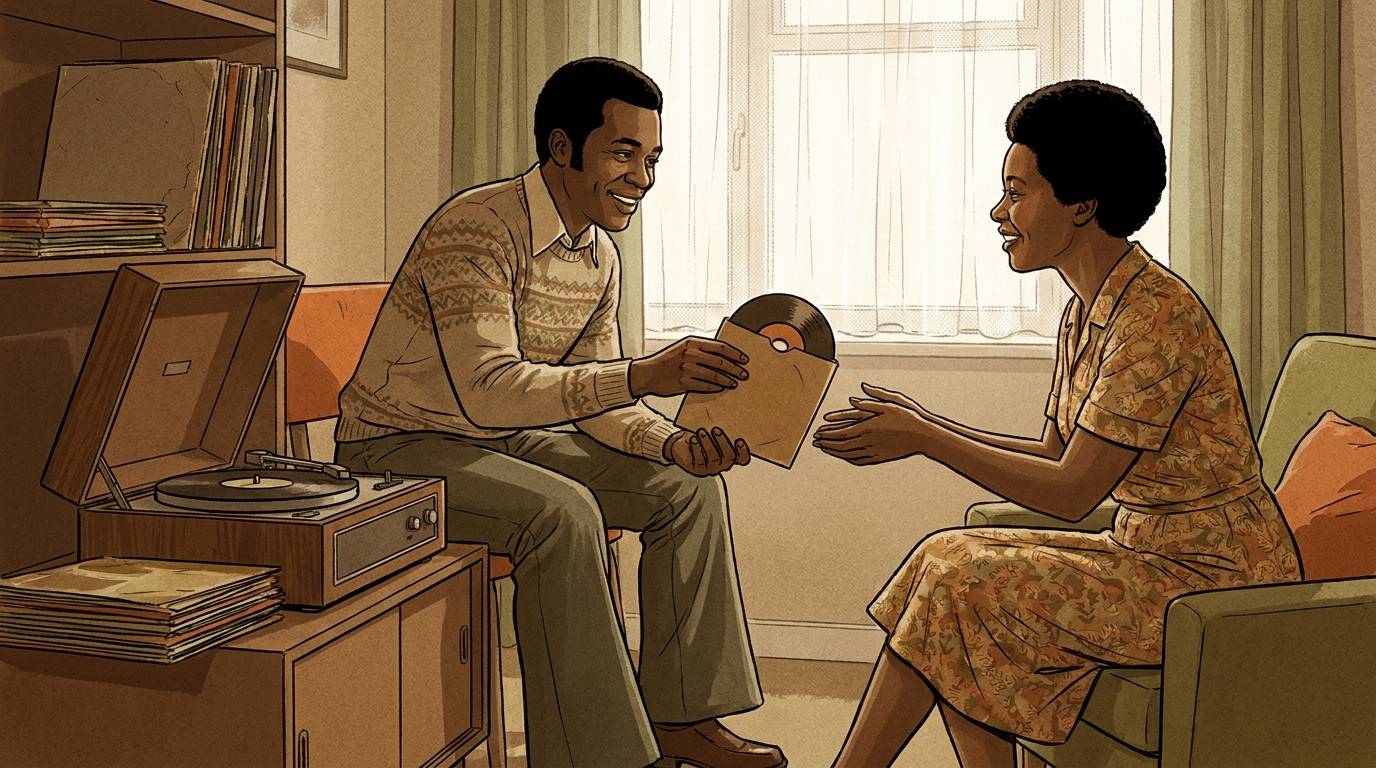
A record changes when it enters a home. People can choose when to play it, what to place beside it and whether to listen alone or with others. A familiar voice can accompany work, rest, affection or disagreement.
For someone living away from a place they once called home, music may carry a remembered relationship. For a child raised in Britain, the same record may belong first to family life there. Those meanings can overlap without being identical.
That is why it helps to ask where a person first heard a song. A recording made in Jamaica may have entered one listener's life in Birmingham, another's in London and another's through a family visit years later.
The route is part of the history. So is the way a listener describes what happened after the record arrived.
Gathering required a place to gather
London Museum's account of dub and sound-system culture describes house parties and informal venues alongside clubs and carnival. It also places Black Londoners' use of homes and unofficial spaces within a history of racism and exclusion. 7
That context gives musical gathering a practical weight. A room needed to be found, prepared and maintained. Someone decided who could come, how the music would be heard and how the evening would be managed.
Community did not appear automatically when a record began. It was made through behavior: welcoming people, taking responsibility for the space, responding to the room and negotiating differences.
A remembered gathering can therefore tell us several stories at once. It may reveal friendship and pleasure, the work of organizing and the limitations people faced beyond the door.

A family collection can contain several generations
A collection may include music from different stages of a life. Records purchased in one country can sit beside records found later in another. A parent's favorites may share shelf space with a child's discoveries.
What looks like an inconsistent collection from the outside may make perfect sense to the people who use it. Music is acquired through relationships, occasions, curiosity and changing taste.
Ask about the record that surprised the household. Which singer did a younger family member introduce? Which song remained popular with everyone? Which record did somebody borrow and never return?
Those questions give the history movement. They allow people to change and to make choices beyond the role of preserving an inherited culture.
Pleasure deserves a place in the account
Migration histories often concentrate on hardship because the hardships were consequential. Musical history also needs room for the pleasure people made: dancing, singing together, dressing for an evening and finding companionship.
A record chosen for romance can reveal as much about a community's aspirations as a record chosen for protest. The situations differ, and both involve people claiming time and space for parts of their lives.
Why Love Songs Belong in Reggae History develops that subject through lovers rock. The connection here is the route from a recording to a setting where listeners gave it meaning.
When someone remembers a dance fondly, ask what made the evening work. The answer may include a selector's judgment, the people present, an anticipated tune or simply the relief of being able to enjoy themselves.
4. British voices made the connection their own
Janet Kay and a new generation of choices
Janet Kay's official biography describes a London-born singer with Jamaican parents, an interest in Motown and a route into recording through an introduction to Alton Ellis. Her early career brings several musical relationships into one person's story. 8
That combination is useful because it gives a younger generation a full creative role. Family connection, music heard while growing up and the opportunities available in Britain could meet in a new recording.
A singer did not have to reproduce one inherited model exactly to participate in a tradition. Choosing repertoire, developing a delivery and working with musicians were ways of contributing to it.
The resulting record could belong to a British musical setting while remaining connected to Jamaican experience and other sounds. Culture moved through the choices people made with what they knew.

A drum pattern with several histories
Dennis Bovell's conversation with Paul Gilroy at UCL offers a particularly specific account of creative work. Discussing “Silly Games,” Bovell describes bringing ideas associated with disco, calypso and Afrobeat into a drum pattern, and working with Drummie Zeb to realize it. 9
The account brings us close to a musical decision. A record's place in history can be heard in the relationships among sounds, alongside what we know about its release and audience.
Listen with that possibility in mind. A familiar style can contain choices drawn from several sources. Musicians may hear connections that a category on a record-store shelf does not make obvious.
Bovell's recollection is his account of the session and his intentions. It helps direct our attention toward the rhythm while leaving the performance itself available for each listener to explore.
Set his account beside Kay's biography and the map becomes wider. The connection between Jamaica and Britain existed within a larger field of musical relationships. A singer's interest in Motown and a producer's attention to calypso or Afrobeat brought different histories into the work they made together.
Keep those references specific. It is more revealing to ask what Bovell wanted a drummer to play than to describe the result as a mixture of everything. The detail gives the participating musicians judgment and agency. They were choosing among possibilities, with their own ears and experience, in the process of making a particular record.
The exercise from The Version Side: How to Listen Beyond the Lead Vocal can help here. Follow bass and drums for a complete play, then return to the singer with those relationships in mind.
Linton Kwesi Johnson: voice, place and an independent route
Linton Kwesi Johnson's official biography traces his movement from Jamaica to London in 1963 and the development of his poetry through political and cultural activity in Britain. It also records the establishment of LKJ Records in 1981, beginning with singles by Jamaican poet Michael Smith. 10
That history joins migration with new artistic and organizational work. A person who moved between places could become an artist describing the society around him and someone building a route for other voices to be heard.
The record label matters alongside the performance. It represents decisions about what to issue and how to make it available. The act of recording a voice and the act of circulating it are connected forms of responsibility.
This is also a reminder to keep language within the discussion. A voice carries rhythm, pronunciation, memory and a relationship with its audience. Listeners can learn to hear those qualities without expecting every artist to address them in the same way.
The counter could lead back to the studio
The history of Fashion Records gives the exchange another physical setting. In a 2012 interview, founders John MacGillivray and Chris Lane described the relationship between their Dub Vendor record business, a basement studio and the deejays they heard performing in Britain. The people serving customers were also involved in making new records. 11
Their recollection of hearing Smiley Culture perform “Cockney Translation” at the People's Club brings the process into focus. A live performance attracted their attention; they later worked with him on the recording's structure and delivery. The record emerged through a particular artist, occasion and collaboration. 11
That is a more detailed picture of musical change than a simple arrow from Jamaica to Britain. A British performance could become a record through businesses and techniques connected with Jamaican music. Local knowledge was part of the creative material.
It also gives the listener a different way to hear a voice. An artist's language can carry the places and relationships through which they grew up. The decision to bring that voice into a recording allows an audience to encounter something particular about a life.
Follow that chain on a record you enjoy. Who performed it before it was recorded? Who recognized its potential? What work did a producer, engineer or label undertake to make the release possible? The answers will differ, and some may be unavailable, but the questions keep musical development connected with people.
When a record later travels elsewhere, the process begins again. Another listener hears a voice from a place they may never have visited. They can enjoy it immediately and, with time, learn the local references that gave it its character. Circulation creates an opportunity for understanding; the listener still has to take that opportunity.
A connection that kept developing
Jamaican and British musical life did not stop exchanging ideas once a particular style became established. Artists, listeners and businesses continued to respond to recordings made in different places.
An imported record could influence local work; a British production could become part of a wider reggae conversation. The exact route should be followed record by record, rather than assumed from a broad label.
The people organizing those routes deserve attention. Women Who Kept Reggae Moving: Shops, Labels and Distribution examines the work of Patricia Chin and Sonia Pottinger, whose careers give different views of the decisions surrounding recorded music.
Their stories help us see circulation as something people made possible. Records traveled through relationships, agreements, labor and the judgment of people willing to put particular music before an audience.
5. Follow a record through your own life
A useful way to continue this history is to begin with one recording you know. Choose a particular release or listening edition and gather what you can establish about it.
| Part of the journey | What to record |
|---|---|
| The performance | Song title, performer and the recording you actually heard. |
| The release | Label, catalogue number, format, territory and the date supported by the source. |
| The route to you | Shop, person, broadcaster, performance, collection or digital service. |
| The setting | Where you listened and who was there. |
| The relationship | What the recording connected you with: a person, place, memory or new discovery. |
| The uncertainty | Details you remember imperfectly or have not yet verified. |
Keep the release history and your personal history beside one another. A catalogue can identify an issue; it cannot supply the memory of who played it for you. A family recollection can explain the encounter; it may need help from a label or dated document to settle a year.
Ask for an account with room for detail
Instead of asking whether reggae was important to a relative, ask about one record. Where did you get it? Who else liked it? Did you know the singer's name? Was there another side you played more often?
Allow time for an unexpected answer. Someone may remember a shop worker, the journey to a dance or an argument about which record should come next. Those details can reveal how people organized pleasure and knowledge.
A person may also prefer to keep a memory private. Ask how an account may be used before publishing it. A story shared at home is still connected with the person who chose to tell it.
Look at the sleeve as part of the route
Trojan's account of the Israelites LP describes international issues with different artwork. That gives a listener another question: how did a sleeve introduce the same musical material to a different audience? 4
A photograph, title or label logo may guide expectations before the music begins. A reissue may frame an artist through a later understanding of their importance. Those decisions are part of the record's continuing life.
Reading a Reggae Album Cover: Art, Identity and First Impressions offers a way to examine that visual work. Start with what is visible, then compare it with the credits and the edition's history.
More than one place can remain present
The journey of “Israelites” into the British chart gives us a documented public milestone. Duke Vin's work, the life of a family collection and the recordings of British artists show other scales of connection.
Together, they encourage us to hear migration as a process involving skills, relationships and new decisions. People carried parts of earlier lives with them while responding to the places where they lived.
A record could help someone remember home, meet another listener or recognize a new voice. It could also become part of a household's ordinary routine, cherished without being discussed as a historical object.
Return to one of those records with its route in mind. Hear the performance, identify the people who helped it reach you and ask someone else what they remember. The connection becomes more useful when it gives another person room to speak.
Sources and further reading
- Official Charts: Singles chart, 16–22 April 1969 — Desmond Dekker and the Aces at number one.
- Official Charts: “The Israelites” — Pyramid label and catalogue number for the 1969 single.
- Jamaica Observer: Desmond Dekker — Jamaican Israelite — the recording, Leslie Kong and its international reception.
- Trojan Records: Israelites LP — the 1969 album, international issues and later reissue.
- London Museum: Duke Vin — the museum's account of Forbes's migration and sound-system work.
- London Museum: Ten records that tell the story of Dub London — Peckings and the circulation of Studio One music.
- London Museum: Dub in London — sound systems, gathering places and the social setting.
- Janet Kay: Official biography — family background and early musical relationships; no chart ranking is taken from the promotional biography.
- UCL: In conversation with Dennis Bovell — Bovell's firsthand account, recorded with Paul Gilroy in 2020.
- Linton Kwesi Johnson: Official biography — migration, artistic work and the beginnings of LKJ Records.
- United Reggae: Interview with Fashion Records — MacGillivray and Lane on the shop, studio and Smiley Culture.