Reggae Dread · Reggae Beyond the Record · 06
Women in Reggae: Patricia Chin and Sonia Pottinger
Patricia Chin and Sonia Pottinger offer two distinct routes into the decisions that helped Jamaican recordings reach listeners.
Begin with a decision about a record
Patricia “Miss Pat” Chin remembered callers asking to speak to a man when they wanted to order records in the United States. In her 2021 conversation with The Arts Fuse, she explained that she had already spent years working at the record counter, playing music and speaking with musicians. The caller's assumption did not reflect the knowledge she brought to the job. 1
That recollection gives us a useful place to begin. A person needed help finding music. The woman answering the phone had the experience to provide it. The exchange became a question about who was expected to possess expertise.
Reggae history is full of decisions that are difficult to hear directly in a song. Someone chooses a recording to issue, recognizes a singer's potential, decides what to stock or works out how a record will reach another market.
Those decisions have people behind them. Naming the people helps us understand how the music became available and why particular artists or releases entered a listener's life.
Patricia Chin and Sonia Pottinger make that work easier to see. Both were connected with shops, labels and Jamaican recording culture. Their careers developed through different businesses, relationships and choices.
Two careers, several kinds of authority
Chin's history includes Randy's Record Mart and the family business that became VP Records. Pottinger's includes the Tip Top Record Shop and labels such as Gay Feet and High Note. Their work crossed the boundaries between selling music, organizing it and helping new recordings reach an audience.
The word producer can hide as much as it explains if we use it without asking what happened on a particular project. A producer may participate in musical decisions, organize sessions, bring people together or undertake business responsibilities. The evidence for those roles needs to be followed release by release.
The same care applies to distribution. Making a recording and making it obtainable are connected tasks with different demands. A record can be admired by a small group of people and still require considerable work to reach listeners elsewhere.
Following Chin and Pottinger gives us a way to appreciate the relationships among those tasks. It also brings women's authority into the story through specific work rather than a list of honorifics.
Patricia Chin: knowledge across the counter
A business built around listening
VP Records' company history traces the family's beginnings to used records obtained through Vincent Chin's work servicing jukeboxes. Patricia and Vincent developed Randy's in Kingston, eventually working from North Parade with the recording space known as Studio 17. 2
The counter gave Patricia Chin a demanding education in music. Customers wanted records by many different artists and producers. To serve them well, she needed to recognize titles, understand requests and keep track of a changing flow of releases.
That kind of knowledge can be easy to underestimate because it develops through daily repetition. A person learns by hearing records, handling them, talking with customers and noticing which questions return.
The work also requires judgment. A customer may know a singer but not a title, remember a rhythm rather than a lyric or want a particular version. A useful answer connects the request with the right recording.
Our earlier article, The Reggae Record Shop: Where Music Became Community, explores that meeting place. Chin's career asks us to look more closely at the authority exercised by the person behind the counter.
An idea for bringing recordings together
In her Arts Fuse interview, Chin recalled the idea of gathering hits from different producers onto one album. She described persuading producers to participate and agreeing on a way to share proceeds. It is her account of a business decision and the trust needed to carry it through. 1
A compilation can look straightforward once it is on a shelf. The listener sees a group of songs. Before that point, someone has to choose them, identify the relevant people and make the arrangements needed for a release.
Selection is part of the creative work. The order of tracks can introduce relationships among voices and styles. A title or sleeve can suggest how an audience should understand the collection.
The business work is just as consequential. The people participating need to know what they are agreeing to, and the release has to be manufactured and made available. A successful idea depends on more than recognizing that several good songs belong together.
Chin's recollection makes her an active decision-maker within that process. It also gives us a way to ask better questions about compilations we own: Who selected the recordings? Who arranged the release? How does the edition explain the people involved?
Carrying a business into another setting
After the family's move to New York in the late 1970s, the business developed in Queens. VP's history describes continuity between the retail and distribution work in Jamaica and the operation built in the United States. 2
A move changes the setting in which knowledge is used. New customers may ask for unfamiliar combinations of music. Established relationships with producers can remain valuable, while a business needs new ways to obtain stock and reach listeners.
The work requires attention to both continuity and change. A person may know an extensive Jamaican catalogue and still need to learn the preferences of people living in another city.
Chin's own account of the telephone callers belongs within that experience. It should not be expanded into a claim that every place treated women in the same way. It tells us what she remembered encountering and how the assumption clashed with her expertise.
That is a meaningful form of evidence: a woman describing the conditions under which she did her work.
Choosing how different listeners encounter a release
Chin also described distributing explicit and clean editions, explaining the decision in relation to artists' expression and younger listeners. Her account makes the choice of edition part of the business's responsibility to its audience. 1
Consider what that decision asks of the people handling a release. The edition needs to be identified clearly enough that a retailer can order the intended version and a listener can recognize what they are buying. Artwork, catalogue information and communication with the customer become practical parts of the same task.
A person recommending the music also needs to understand the difference between the editions. Familiarity with an artist's name alone will not answer every question about the contents of a particular release.
The example brings authority into everyday focus. Distribution involves judgments about how music meets people in different settings. It requires a business to understand the recording, its presentation and the audience being addressed.
These are useful questions to bring to a collection now. If two editions have the same main title, what information distinguishes them? Does the sleeve explain the difference? An attentive answer can prevent a mistaken purchase and help a listener find the experience they intended.
Keeping the person visible
A family business can accumulate a public identity that makes individual contributions harder to distinguish. A company name may contain several generations of work, and its story may be told through its most famous releases.
Chin's testimony helps us keep a person within that larger history. We can ask what she knew, what she decided and how she described the development of the business.
Those questions also prevent a simple success story from absorbing everyone else. Artists, producers, employees, customers and family members contributed to the musical world in which the business operated. Identifying Chin's role should make the wider network clearer.
Sonia Pottinger: building opportunities to record
The shop and the audition
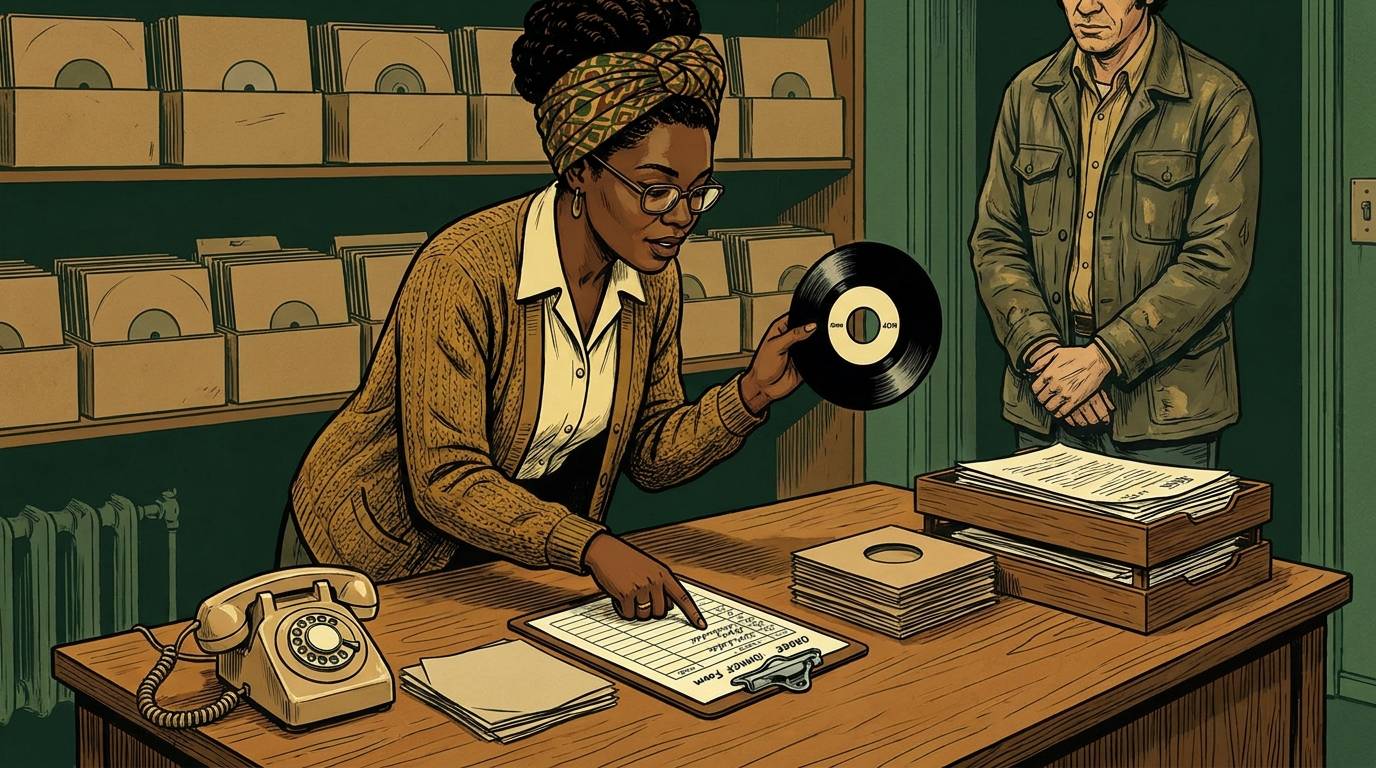
A 2002 Jamaica Observer profile places Sonia Pottinger's Gay Feet and High Note businesses at her Tip Top Record Shop on Orange Street in Kingston. It describes her auditioning singers and groups after the shop closed. 3
That detail connects retail with the possibility of recording. A shop was a place where music already in circulation could be encountered; an audition gave a performer a chance to present something that might become a new release.
Recognizing potential is a consequential act. An artist needs someone to listen, but the response must lead to practical decisions if a record is to be made. Who will participate? What resources are available? How will the project be organized?
The surviving profile does not give us a session-by-session account of those decisions. It gives us a setting in which Pottinger exercised judgment and a route by which performers could come into contact with her business.
Gay Feet and an early catalogue
Doctor Bird's reissue account places the launch of Gay Feet in the mid-1960s and identifies “Every Night” by Joe White and Chuck as an important early release. Its expanded Gay Feet Every Night collection gathers recordings associated with that early catalogue. 4
A catalogue is built through repeated choices. One recording can lead to another working relationship; an instrumental, a vocal duo and a solo singer may each bring different requirements into a project.
Listening across such a collection can help a reader notice the range of activity behind a producer's name. Begin with one track and identify the performers credited to it. Then ask what changes when the next recording brings another voice or ensemble into focus.
The producer's role should be considered alongside the artist's performance. A strong melody, a convincing delivery and the contribution of musicians remain part of what a listener encounters. Production authority does not erase those separate forms of creativity.
Marcia Griffiths and a relationship described by the singer
Marcia Griffiths offers a firsthand view of working with Pottinger. In a 2017 interview with Angus Taylor, she recalled feeling comfortable with her and identified Naturally and Steppin' as the two albums they made together. 5
Griffiths's official discography dates Naturally to 1978 and Stepping to 1979, crediting Pottinger as producer. A later Doctor Bird edition brings the albums together under the title Naturally / Steppin'. 6 7
The singer's recollection and the release information answer different questions. One tells us about a remembered working relationship. The other identifies albums, repertoire and a production credit.
Together, they help us see trust and organization within musical work. A performer may feel able to bring an interpretation into a project because of the relationship with the person helping make it possible.
Griffiths also spoke about revisiting songs. That practice gives a producer and singer another kind of decision: how to approach material that already has a history. A new performance can retain a connection with earlier work while bringing different timing, tone or accompaniment.
Follow those musical routes in the Marcia Griffiths Listening Guide. Let the singer's decisions remain central as you consider the setting Pottinger helped provide.
An artist's view of the studio
Ken Boothe remembered Pottinger as someone present during recording sessions who understood the music and could recognize a promising song. His comments were reported by the Jamaica Observer after her death in 2010. 8
His account gives substance to a production credit. It points toward participation in a working environment, rather than treating the credit as an abstract title.
A recollection still has its limits. Boothe was speaking about what he knew and remembered. We should not use it to assign Pottinger every arrangement or engineering choice on every record in the catalogue.
Instead, it encourages further attention. Listen to the performance, identify the edition and look for the people named around it. Where testimony exists, let it add detail to the credits.
Culture and Sonya Spence: a wider listening field
The High Note catalogue offers further routes into Pottinger's work. Doctor Bird's Children of Zion collection gathers Culture's High Note singles, including vocal sides, versions and extended mixes. The track list distinguishes Culture from contributors such as the Revolutionaries. 9
Those distinctions make collaboration visible. A producer's catalogue can contain several kinds of performance and several ways of presenting related musical material. Our guide to The Version Side offers a practical method for exploring those relationships.
Choose a vocal and an associated version from the collection, using the track notes to establish the relationship. Hear each in full. On the second play, follow the accompaniment through the places where the singer would usually direct your attention. Make a note of which contributions become easier to hear.
Return to the credits after that comparison. The producer's name now sits beside a more detailed musical experience, with room for singers, players and studio workers. Where the notes identify a person, connect the name with the stated role. Where they do not, keep listening without inventing an attribution.
Sonya Spence's In the Dark / Sings Love provides another entry point. The later two-disc edition combines her albums with a selection of Pottinger-produced recordings by other women, including Judy Mowatt, Marcia Griffiths, Lorna Bennett and Barbara Jones. 10
The collection can open doors to individual artists. Give Spence time as a singer before moving to the wider group of recordings. Then choose one unfamiliar name and follow it beyond the compilation.
That approach allows the producer's work to help us hear more people. It keeps a catalogue from becoming a way of naming its organizer while leaving the performers in the background.
4. Follow the work from performance to listener
Different jobs make different contributions
Chin and Pottinger show why musical history benefits from precise verbs. A person sang, selected, produced, recorded, issued, distributed or sold a record. The verbs help us understand what the person did.
| Kind of work | What it helps make possible | Evidence to look for |
|---|---|---|
| Performance | The voice and instrumental parts heard on a recording. | Artist and musician credits, session accounts and the recording itself. |
| Production | Decisions and organization involved in bringing a project into being. | A production credit, testimony and project documentation. |
| Label work | Issuing recordings under a particular imprint. | Labels, catalogue numbers, release information and business records. |
| Distribution | Supplying a release to places where listeners can obtain it. | Distribution credits, catalogues and documented business accounts. |
| Retail | Helping a customer find and buy a recording. | Shop histories, advertisements, receipts and people's accounts. |
| Reissue work | Bringing earlier material into a later edition. | Source notes, track lists, artwork and edition credits. |
One person may perform several of these jobs. Several people may also share a single kind of work. A clear account can hold both possibilities.
The table is a guide to inquiry, not a claim that every surviving sleeve contains every answer. Some work goes uncredited, and some descriptions become clearer only when people explain what they witnessed.
Credit, control and payment require different questions
A name on a sleeve is valuable evidence of a credit. It does not, on its own, reveal every agreement surrounding a composition or sound recording.
Ask separately who did the work, who is credited, who controlled a particular release and what information exists about payment. A satisfactory answer to one question does not automatically answer the others.
That distinction matters when discussing women whose contributions deserve wider recognition. Praise can make work visible, but it cannot stand in for an account of how a project was organized or who benefited financially.
It also helps us read company histories carefully. Such histories provide useful information and a public account of a business's development. Artist testimony, release documentation and other records can add perspectives that a company summary leaves out.
For a fuller examination, continue with Sonia Pottinger: The Producer, the Catalogue and the Work Behind Jamaican Music.
A reissue is another set of choices
The reissues discussed here were assembled after the original recordings. Someone chose what to include, how to order it and how to describe its relationship with earlier releases.
Those choices affect discovery. A collection can make scattered recordings easier to hear together and make a production credit more visible. It can also introduce an artist to a listener who knew only one famous name.
Read the edition notes as part of the experience. Identify which information concerns the original release and which concerns the later collection. Keep the people responsible for both stages visible.
Reading a Reggae Album Cover: Art, Identity and First Impressions follows the same question through visual design: how does an edition introduce the music before the listener presses play?
5. Make the contribution easier to hear and remember
A useful response to these histories is to spend time with a recording and describe the work around it accurately.
Choose one release connected with Chin's or Pottinger's business. Record the artist, title, label and edition. Then add the people whose roles you can identify from dependable sources.
Keep a space for the source of each entry. An artist's recollection, a contemporary label and a later reissue note may each contribute something useful. Where they disagree, leave the difference visible until further evidence helps explain it.
Give the artist a full listening session
Play a complete track before reading a summary of its importance. Listen to the singer's timing and the relationship with the musicians. A production history becomes more meaningful when it leads back to the sound.
Then return to the credit. What does knowing the producer, label or distributor help you understand? Does it connect this record with another singer or another part of the catalogue?
A good historical connection should encourage more listening. It should give the people represented a fuller presence within your enjoyment of the music.
Ask whose work remains difficult to see
Chin and Pottinger are recognizable names, but their stories can help us look for other workers. A shop assistant, an office worker, a musician, a photographer or someone maintaining a collection may hold knowledge that has not been widely recorded.
Ask specific questions about what a person did. What did they order? What happened during a session? Which records did customers request? How did they keep track of the releases?
Those questions respect expertise by giving it a practical shape. They also make it easier for someone to correct an account or add a detail.
The story connects with Jamaica to Britain: How Reggae Records Connected Lives: music reached new settings because people did the work of making and moving it.
Patricia Chin's knowledge at the counter and Sonia Pottinger's production relationships offer distinct examples of that responsibility. Follow their decisions, hear the artists around them and carry the names forward with the music.
Sources and further reading
- The Arts Fuse: Talking to Miss Pat about her Reggae Music Journey — Chin's firsthand recollections of expertise, callers and compilation work.
- VP Records: Company history — Randy's and the development of the family business; the page gives differing years for aspects of the New York move.
- Jamaica Observer: Sonia Pottinger honoured — Tip Top, labels and auditions.
- Doctor Bird: Gay Feet Every Night, expanded edition — early catalogue context and track list.
- United Reggae: Marcia Griffiths in Kingston, Part 2 — Griffiths's recollection of working with Pottinger.
- Marcia Griffiths: Official music and discography page — artist-published dates and Pottinger production credits.
- Doctor Bird: Naturally / Steppin' — the paired-album edition and repertoire.
- Jamaica Observer: Sonia Pottinger remembered — Ken Boothe's firsthand recollection.
- Doctor Bird: Culture, Children of Zion — High Note singles, versions and edition credits.
- Doctor Bird: Sonya Spence, In the Dark / Sings Love — the albums and supplementary selection of women-led recordings.