Reggae Dread · Reggae Beyond the Record · 10
Preserving Reggae History: Flyers and Photos
A practical guide to keeping one object, the account around it and the questions that remain unanswered.
A flyer can survive longer than the information around it
Black Cultural Archives' online collection includes a flyer for Eek-A-Mouse and his band. Its descriptive record leaves the provenance and estimated date unknown, while the accompanying curator's text places it broadly in an early-1980s context. The page preserves an object and makes the remaining gaps visible. 1
That combination is a useful starting point for anyone keeping reggae history. You do not need every answer before an item deserves care. You do need a way to distinguish the information you have from the information you would like to find.
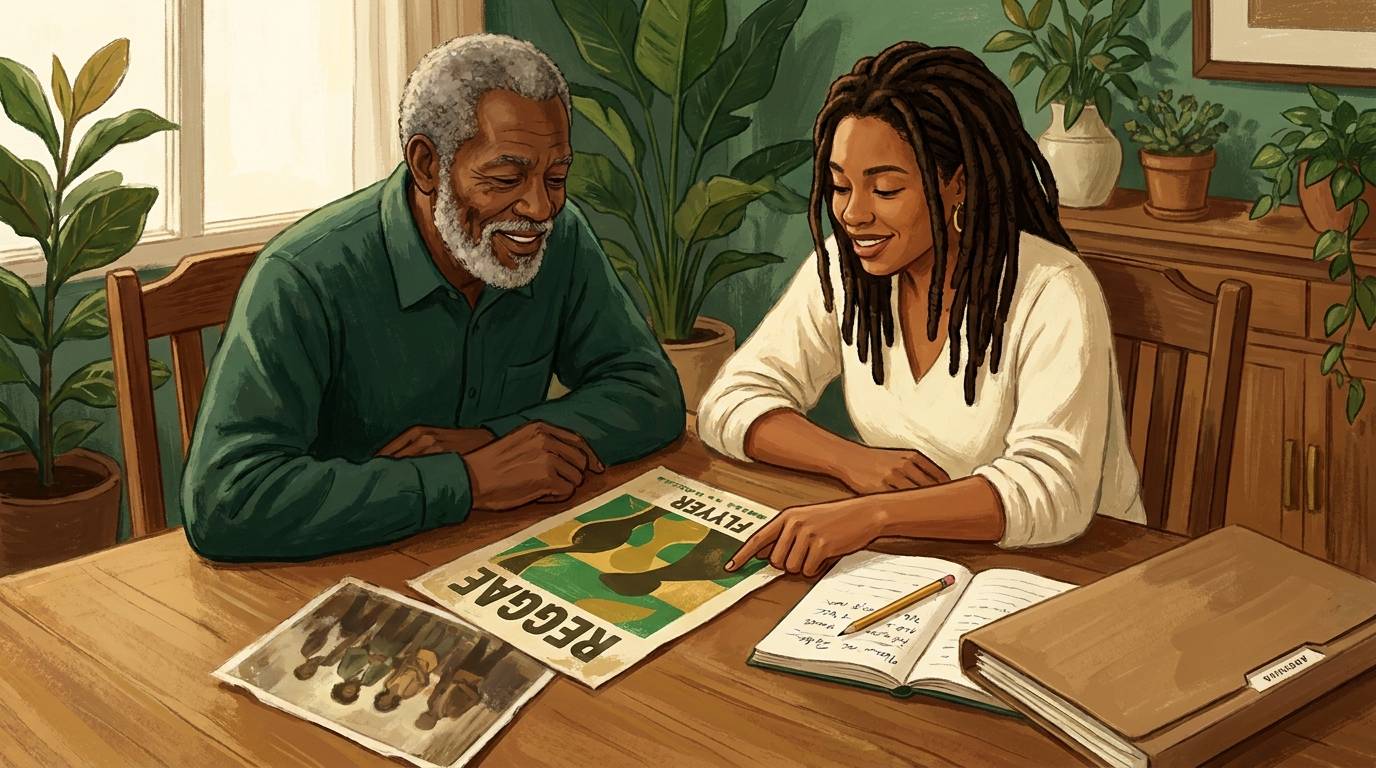
A flyer may survive in a drawer after the person who brought it home has forgotten the year. A family photograph may show a familiar gathering without naming the photographer. A handwritten note inside a sleeve may identify a shop that no longer appears in a search result.
These objects can connect a public musical history with someone's ordinary life. They may reveal who travelled to a dance, who made a recommendation or who kept a collection through several moves.
Their usefulness depends partly on what accompanies them. A clear note can preserve a relationship that the image alone cannot establish. A careless caption can turn an uncertain memory into an apparently settled fact.

Keeping history begins with a manageable responsibility
You do not have to build a museum in a weekend. Start with one item you can handle safely and one short description you can complete.
The purpose is to make it more likely that another person will understand what the item is, where it came from and how the accompanying information was obtained. A private family record can achieve that purpose. Public posting is a separate decision.
Choose something whose connection you can explain: a flyer you picked up, a photograph someone has agreed to discuss, an annotated record sleeve or a ticket saved after an event.
Then begin with a modest question. What would become harder to know if this object and its story became separated?
Let the object answer only the questions it can support
A flyer tells us what was announced
A flyer can give names, a venue, a date, prices, a printer or a promoter's contact details. Its layout can show which names were given prominence and how an event was presented to a potential audience.
That is valuable evidence of promotion. It is not, on its own, proof that every advertised performer appeared or that the event happened exactly as planned.
Someone who attended may add an account of the evening. A dated newspaper report, a photograph or another document may supply further information. Keep each contribution associated with its source so a later reader can follow the connection.
The Eek-A-Mouse page illustrates why the distinction matters. Its catalogue fields, curatorial interpretation and visitor memory occupy different parts of the record. They can be read together while preserving the differences between an identified detail, an estimate and a remembered encounter. 1
A photograph shows a moment with a frame around it
Begin by describing what is visible: several people beside a speaker cabinet, a singer at a microphone, a table with records or a storefront sign.
Then add names and circumstances only where there is a basis for them. A relative may recognize someone from personal knowledge. A note on the back may identify a location. A matching dated programme may help narrow the period.
Write down how the identification was made. “Identified by her sister during our conversation” tells a future reader something different from “name written on the reverse.”
An appearance-based guess should not become a person's identity. Clothes, hairstyle and a familiar face can prompt research; they do not reliably settle who someone is, their beliefs or the exact year.
The National Library of Jamaica's digital collections bring photographs together with programmes, manuscripts and other documentary material. Those different kinds of records can help people research a connection while keeping each object's contribution distinct. 2
A sleeve contains more than its front image
For a record sleeve, include the back, spine, inner material and centre labels where you can do so without damage. A small production or distribution credit may help identify the edition.
Keep any associated note in context. If someone stored a shop receipt inside the sleeve, record that relationship before separating anything for photography or storage. Do not assume the receipt proves where the record was first bought unless the information supports that conclusion.
Reading a Reggae Album Cover: Art, Identity and First Impressions offers a companion method for looking at editions and credits. Here, the aim is to preserve enough context for that close looking to remain possible.

3. Make a description that another person can follow
Give one item a simple identity
Choose an identifier such as RGH-001. Use it in the description and the names of the digital copies. Put it on the enclosing folder or a separate note, rather than marking the object itself.
An identifier is simply a way to keep related things together. It can connect a photograph of the front, a photograph of the reverse and the account supplied by a participant.
The National Archives recommends descriptive information covering who, what, where and when when digitizing family material. The following record adds two equally useful questions: where did the item come from, and how do we know what we have written about it? 3
| Field | What to enter |
|---|---|
| Item ID and short title | A stable identifier and a plain description. |
| Object | Flyer, photographic print, ticket, sleeve or other material; note front and back. |
| Origin and custody | Who supplied it, how they obtained it if known, and who holds the original. |
| People and place | Names and location, with the source of each identification. |
| Date | Printed date, remembered period or another supported estimate; keep them distinct. |
| Account | Who provided information, when and in what form. |
| Files and location | Digital filenames, backup locations and the original's storage location. |
| Access and permission | What may be kept, shared or published, and any conditions agreed. |
| Open questions | What remains unidentified, uncertain or in need of checking. |
Keep observation, memory and interpretation visible
Consider this invented example of a family photograph. The reverse says “summer,” with no year. A relative remembers it as a gathering before a family move, which they place around 1988. No document yet establishes the date.
A careful description could read: “Gathering beside a sound system; location not yet confirmed. ‘Summer’ written on reverse. Family member recalls the photograph being taken before a move around 1988; account recorded on [date]. Photographer unknown.”
That record is more useful than assigning “Summer 1988” as a settled date. It preserves a lead and explains its limits.
If later evidence supplies a year, add the update with its source and date. Keep the earlier account so someone can understand how the description developed.
The same approach works for a name. “Possibly the selector called X, according to Y” should remain a provisional identification until something further supports it. A useful archive gives people room to correct it.
Preserve the wording that already belongs to the item
Copy a handwritten caption as it appears, identifying it as a transcription. Put your own explanation in a separate sentence. That prevents an interpretation from being mistaken for the original writer's words.
For printed information, check the digital image against the object. Automatic text recognition can misread small type, unusual lettering or a damaged edge. An attractive scan is not a guarantee of an accurate transcription.
If you make a cropped, brightened or restored version, keep it separately from the initial capture and record what changed. An image completed or sharpened by an automated tool should not supply evidence for an unreadable name or an unidentified face.
The object may remain incomplete. Preserving its actual condition and a dependable description gives future research a sounder beginning than silently filling the gaps.

Ask for a specific account and agree how it may be used
Begin with what the person wants to share
Before recording, explain what you are doing, where the recording and notes will be kept and whether you hope to share any part publicly. Ask the person what they are comfortable discussing and how they would like to be named.
The Oral History Association places informed consent, preparation, preservation and access within the same process. Its guidance also recommends giving narrators an opportunity to review material before public release where possible. 4
A relative agreeing to talk at home has not necessarily agreed to a public video, a blog quotation or a social-media post. Make the intended use clear rather than allowing the equipment to determine the relationship.
For a short private project, write down the agreement in ordinary language and retain it with the account. If the project grows into a public collection, consult the chosen repository about its documentation and access arrangements.
Use the object to open the conversation
Ask questions that allow the person to describe an experience:
- How did this item come into your hands?
- What do you recognize in it, and how do you recognize it?
- What were you doing that day or during that period?
- Who else might remember something about it?
- Is there anything here you would prefer to keep private?
Allow an unexpected answer. You may be interested in the singer, while the person remembers the friend who drove, the clothes they made or the work involved in preparing the venue.
Those details can widen musical history. A gathering depended on people who collected tickets, looked after equipment, carried records, prepared food or made sure others got home.
Avoid turning the conversation into a test of perfect recall. Ask whether a detail was witnessed, heard from someone else or inferred later. The distinction can be recorded without making the person feel their whole experience is being dismissed.
Keep the account connected with its speaker
If permission is given to record, begin by stating the date, the participants' agreed names and the item being discussed. Check that the recording is audible, then allow the conversation to develop.
Make a short summary afterwards and identify useful moments with time references. Offer the speaker a chance to correct names, add context or set an agreed restriction before sharing.
Keep the original recording and the summary as separate files. A summary helps someone find information; it cannot replace the speaker's tone, qualifications or sequence of thought.
Joe Higgs: The Singer, the Teacher and the Music shows why remembered relationships matter to musical history. Teaching and encouragement can leave their clearest traces in what people say happened between them.
Preserve one item today, then make care repeatable
A practical session: about forty-five minutes
Choose one stable paper item or loose photographic print. Leave a stuck photograph, a fragile album or a damaged recording for a conversation with an appropriate archive or conservator.
First ten minutes: prepare and describe. Clear a dry work surface, put food and drinks elsewhere and assign the item an ID. Record who holds it and the basic information you can establish. For paper, use clean, lotion-free hands. The National Archives recommends gloves for photographs and negatives to prevent fingerprints; handle their edges and support them carefully. 5
Next fifteen minutes: make a complete copy. Scan the front and reverse if the item fits safely, or photograph it squarely in even light with the whole item visible. Check focus and legibility before putting it away. Keep the original after digitizing. Do not force a binding or send fragile material through an automatic-feed scanner. 3
Next ten minutes: attach the account. Complete the description, including the source of names and dates. If someone has contributed a recollection, record the agreed use and any questions still open.
Final ten minutes: store and back up. Put the original in a suitable enclosure and make copies of the digital files and description. Choose a date to check them again.
The timing is a starting point. Stop when an item needs more care than you can provide, or let a willing participant's conversation take longer. Completing one dependable record matters more than meeting a stopwatch.
Give the original a place it can remain safely
National Archives guidance recommends well-fitting, suitable-quality folders, boxes and photograph enclosures, with storage away from heat, damp and likely leaks. Keep items supported without forcing them to fold or bending them into a container. 6
For photographs, look for enclosures intended for photographic storage, including materials that have passed the Photographic Activity Test. Keep the storage location in your description so someone else can find the original.
A folder does not need a dramatic title. A clear ID and a note linking it with the digital files do more practical work than a decorative label.
Make the files recoverable
Use consistent filenames such as RGH-001-front.jpg, RGH-001-back.jpg and RGH-001-description.txt, retaining the actual file format of each capture. Keep an unchanged first capture and separate copies for editing or sharing.
The National Archives recommends the 3-2-1 approach: three copies, on two kinds of media, with one copy off site. A working computer folder alone is not a backup. 3
The Library of Congress also recommends descriptive filenames, copies in different places and periodic checks that the files can still be opened. Put a review date in a calendar and tell another trusted person how to find the collection and its access notes. 7
Remember the description when copying. A high-quality image separated from its account can lose much of the context you worked to preserve.
Test the arrangement with the item you have just completed. Open the front image, reverse image and description from a backup location. Check that the files are legible and that the description points to the correct original. A copy that has never been checked may hide a missing side or an incomplete transfer.
Then ask a trusted person to follow the record without your explanation. Can they identify which details are confirmed, who provided the memory and what may be shared? Can they find the original or tell who currently holds it?
If the answer is unclear, improve one sentence or add the missing location. This small exercise tests the real purpose of the work: keeping information understandable when the person who assembled it is not present to explain everything.
Let the next person understand what you kept
If you later approach a community archive, library or museum, send a concise description first. Ask whether the material fits its collecting interests, what it can accept and what arrangements would apply. An institution's ability to take one collection should not be assumed from its general interest in reggae.
Jackie Jackson's Basslines and Reggae's Living Memory connects this work with the wider task of keeping contributors visible. A musician's legacy may be strengthened by a clearly identified session photograph, a remembered working relationship or a document whose small print names the people involved.
Across this series, records have led us to teachers, shops, kitchens, migration, business decisions, artwork, film and rural livelihoods. Preserving one item gives those connections somewhere to remain accessible.
Keep the flyer. Record the name when someone can explain it. Leave the uncertain date uncertain. Make a copy, protect the original and agree what may be shared. The result is a modest act of care that gives another person a better chance to hear the history with its people still present.
Sources and further reading
- Black Cultural Archives: Eek-A-Mouse with his band — the flyer, catalogue gaps, curatorial account and visitor memory.
- National Library of Jamaica: Digital collections — access to digitized photographs, programmes, manuscripts and other documentary material.
- US National Archives: Digitizing family papers and photographs — safe copying, descriptive information, keeping originals and the 3-2-1 backup approach.
- Oral History Association: Best practices — consent, preparation, review, preservation and access.
- US National Archives: Handling family papers and photographs — work surfaces, clean hands and photograph handling.
- US National Archives: Storing family papers and photographs — storage environments, enclosures and the Photographic Activity Test.
- Library of Congress: Keeping personal digital photographs — naming, organization, multiple copies and continuing checks.