Reggae Dread · Reggae Beyond the Record · 03
Reggae Record Shops and Community
From Kingston to London, the record counter connected listeners, artists and the people who helped music travel.
1. Begin at the counter
Start at 17 North Parade in Kingston. There was a record shop downstairs and, in time, a studio associated with the business above it. A listener might come looking for a favorite singer; someone working in music might have another reason to visit. Both would encounter a place where records, knowledge and people could meet.
This was Randy's, the business built by Vincent “Randy” Chin and Patricia “Miss Pat” Chin. According to VP Records' history, the Chins began by selling used records at 36 East Street in the late 1950s, moved to 17 North Parade in 1962 and later developed the recording space known as Studio 17. 1
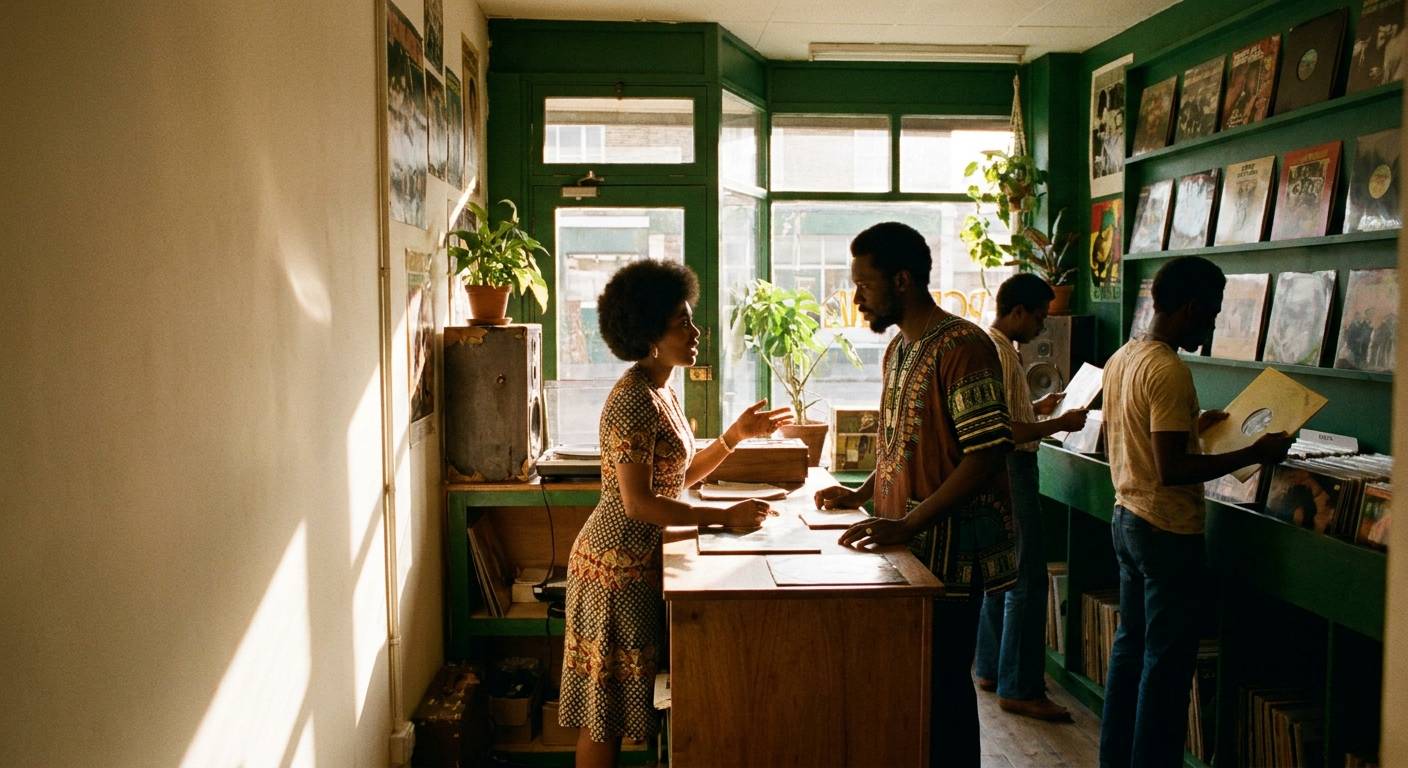
A shop is easy to describe as the point where a record changes hands. That exchange matters: a customer pays, a business earns and music finds a listener. But a counter can also be a place where someone asks a question, hears an unfamiliar singer or learns which rhythm connects two records.
The person behind the counter may know what has just arrived, what a particular customer enjoys and which edition contains the song being requested. The person on the other side may carry knowledge from a dance, a family collection, a sound system or another city. A conversation can move in both directions.
This article follows three examples: Randy's in Kingston, Peckings in west London and Dub Vendor in south London. They had different owners, histories and roles. Together, they help us consider how a record shop could become part of the life around reggae.
A place with more than one purpose
To understand a shop, ask what happened there as well as what was sold. Was it primarily a retail counter? Did the people running it also produce, distribute or record music? Did customers listen in the store? Which activities are documented, and which are simply possibilities?
Those distinctions protect the individuality of each place. A record shop and a recording studio are different businesses even when they share a building. A retailer may carry a label's records without owning the recordings. A producer may make a record without controlling every later edition.
They also make the story more interesting. Once we can see the separate jobs, we can see the relationships among them.
2. Randy's: a Kingston counter and the work around it
From used records to North Parade
VP's company history traces Randy's beginnings to records Vincent Chin obtained through his work servicing jukeboxes. He and Patricia sold used records, then developed the shop that moved to North Parade. The company's account places Studio 17's operation in the later 1960s and describes the business as part of a growing Jamaican recording and export economy. 1
That history begins with a practical observation: records that had finished one job could still be valuable to another listener. A jukebox operator's discarded stock could become a customer's discovery. The sale required a place to find the music, someone to organize it and people willing to return for more.
As Jamaican recording expanded, the relationships around the shop expanded too. A record could involve a singer, musicians, a producer, a studio, a pressing operation, a distributor and a customer. Each participant saw a different part of the process.
The counter offered a particular view. Customers could ask for a singer by name, describe a song they heard elsewhere or seek the other side of a single. The people serving them had to connect those requests with the records they could obtain.

Miss Pat's knowledge
Patricia Chin's work deserves attention on its own terms. In an interview about her career, she described the knowledge built through selling records: knowing artists, producers and rhythms because of the time spent working with customers. Her account makes the counter a place of listening and expertise. 2
That knowledge was practical. A person who understood what people requested could help a newcomer find a starting point and help an experienced listener identify a familiar sound. The ability to make connections among releases had value for customers and for the business.
Chin also remembered early visits by Bob Marley and the Wailers in an excerpt from her memoir published by VP Records. Her account places the young musicians within a working environment where records were sold and sessions were being made. Like any personal recollection, it gives us one perspective on events and relationships. 3
It is worth noticing whose name becomes attached to a business and whose daily work is less visible. A shop's history can emphasize a founder, a producer or a famous customer. The work of ordering, recognizing, selling and explaining records deserves attention too.
Women participated in Jamaican music in many roles, including singing, producing, retail and distribution. Their experiences were not identical. Miss Pat's account offers one specific route into that larger history.
Upstairs and downstairs
Studio 17 and the shop invite us to think about proximity. A recording space and a sales counter in the same business could bring different kinds of knowledge close together. Musicians worked on performances; customers asked for records; the business had to make decisions about what to offer and how to reach an audience.
Proximity alone does not tell us the details of every session or sale. It does, however, provide a useful question: how might knowledge gained in one part of a musical business influence decisions elsewhere? To answer it for a particular recording, we would need the people involved to tell us or the surviving documents to show us.
The broader lesson is about musical labor. The singer's name is often the first thing a listener remembers. The route to that listener may also involve session musicians, engineers, producers, people in shops and people who carry records between places.
That network is central to Behind the Voice: The People Who Built Roots Reggae, where the focus moves from the counter to the collaborators who make a recording possible.
3. Across the Atlantic: Peckings and Dub Vendor

Peckings and the value of a connection
George “Peckings” Price is closely associated with the movement of Jamaican records into Britain and with the Peckings shop on Askew Road in west London. London Museum describes the shop's relationship with Studio One records and its significance to listeners seeking Jamaican music. 4
The shop's own account identifies Price and his connection with the Studio One catalogue. Accounts differ on the exact opening year, so it is more careful to place the shop's early history in the 1970s than to force a single date from conflicting sources. 5
A connection with a label could help listeners find more than an individual hit. Someone who liked one singer might be introduced to another record from the same studio or producer. A sound-system selector might want an edition that a general music shop did not carry. A customer with a fragment of a title could ask a person who knew the catalogue.
The shop's history also continued through Price's family. The Nubian Jak Community Trust, which commemorated George Price with a plaque, describes the involvement of his sons in the shop and the Peckings label. The family story points to the work needed to keep musical knowledge and a business moving across generations. 6
A shop in Britain could connect listeners with music from Jamaica while also becoming a place where British musical life developed on its own terms. Migration brought people, records and memories into new surroundings; the people living there made new choices about what to play, buy, produce and share.
When a business moved with its listeners
The Chins' story also crossed the Atlantic. VP Records' history describes the family's move from Kingston to New York and the development of a shop and distribution business serving Caribbean music listeners in Queens. The company's page contains different years in different passages for aspects of that move, so this account keeps the timing to the late 1970s. 1
Moving a business to another city required more than taking a name along. A shop needed premises, stock, customers and ways to obtain new releases. The people running it also had to learn what listeners in the new location wanted and how those requests connected with music being made elsewhere.
For a customer, a familiar record could sit beside something newly encountered. A family might bring memories of one place to the counter while children or neighbors introduced another set of preferences. Those possibilities do not describe every customer, but they help us ask what a record shop offered to people building lives across more than one place.
This movement did not run in only one direction. Jamaican music reached listeners in Britain and the United States, while artists and communities in those places developed their own practices. A complete account needs to follow the people as well as the records.
Dub Vendor: from a stall to a wider operation
Dub Vendor traces its beginnings to a Clapham Junction market stall run by John MacGillivray and Chris Lane in 1976. Its own history describes the business growing into retail, mail order and the Fashion Records label. London Museum identifies the opening of the Clapham Junction flagship shop in 1982. 7 8
The movement from stall to shop and label reveals several connected forms of work. Selling a record is a retail decision. Mailing a record extends the relationship to a customer who may live far away. Running a label involves choices about recording, production, manufacture and distribution.
In a 2012 interview with Angus Taylor, MacGillivray and Lane described how the shop helped them understand what listeners wanted. They also discussed developing a studio in the basement and hearing British deejays perform in sound-system settings. Their account shows a conversation between the counter, the dance and the studio. 9
The sequence matters. A request in a shop was information. A performance at a dance was another form of information. A recording session could bring those observations into a new project. None of those steps guaranteed a successful record, but each involved people listening to one another.
Lane explained that MacGillivray's view from the counter helped him recognize what customers were buying or asking for, while Lane spent time with studio and technical work. Their partnership illustrates how commercial knowledge and musical skill can meet without becoming the same job. 9
London Museum's account of reggae and dub shops adds another part of the picture: shops could be places to hear records arriving from Jamaica and to connect with other listeners. British artists also made their own music within this network. 8

4. What a record shop made possible
Recommendation as an act of care
Think about the difference between receiving a list of titles and having a conversation about a record. A person behind a counter can ask what a customer already enjoys, listen to the answer and suggest a connection. The customer can disagree, ask for something else or return with a new question.
A recommendation is a small act of interpretation. It depends on what the recommender has heard and what the listener is ready to try. It can open a door to a singer, a label, a rhythm or a period that was unfamiliar a few minutes earlier.
There is also power in that exchange. A shop decides what it can stock and what it chooses to bring forward. Availability, cost, distribution and personal taste all influence which records a customer encounters. The counter can widen a listener's options while reflecting the limits of the business and its supply.
That is one reason to ask whose records were easy to find and whose were harder to obtain. It is also a reason to pay attention to the knowledge of shop workers who learned to answer requests across a changing catalogue.
The label, the price and the choice
Look closely at a record offered for sale and several kinds of information appear at once. A label can name an artist or producer. A catalogue number may help identify a particular issue. The price tells you what a seller asks at that moment; it does not, by itself, explain how much the performers were paid.
An original single and a later reissue may both offer a way to hear a song. They may differ in sound, artwork, track pairing, credits and cost. A buyer can decide which qualities matter for the intended use: a listening copy for a family collection, an edition for study or a record a selector hopes to play in public.
The shop worker's knowledge can make that decision easier. A good answer might identify the available edition, point out an uncertainty and help the customer find the sound they came looking for. The exchange becomes a small lesson in how a recording moves through time.
The other side of the record
A seven-inch record can contain more than the song that prompted a purchase. Turn it over and there may be a version, a dub or another performance. The object gives a listener a reason to make a connection between the two sides.
Hackney Museum's 1975 Safari single by Louisa Mark is a documented example. Its A-side carries “Caught You in a Lie”; its B-side is identified as “Pt. 2 Caught Dubbing.” The museum's catalogue preserves the titles, label and associated people for that particular copy. 10
A knowledgeable seller could help a listener understand why the other side was worth hearing, but we should not invent a conversation about this specific copy. The record itself provides a more reliable starting point: two related sides made available on one physical object.
Our companion guide, The Version Side: How to Listen Beyond the Lead Vocal, offers a practical way to compare a vocal with a documented dub. Bring the questions from that guide back to the counter: Which release am I holding? What is on each side? Who is credited?
A place for new and experienced listeners
A good musical community can hold more than one kind of knowledge. An experienced selector may recognize a rhythm after a few seconds. A younger listener may discover the singer's voice first. A shop worker may know the label and catalogue number. A family member may remember the record from a gathering years earlier.
None of those experiences is the whole story. Together, they can help a record become more than an isolated track in a catalogue.
The shop can also make room for disagreement. Customers may prefer different cuts, different singers or different uses of the same rhythm. Someone might value a record because it fills a dance floor; another person might cherish it because of a quiet memory at home. A respectful conversation can hold both responses.
Access was never equal or automatic. A shop had rent, limited space and stock to pay for. Customers had different amounts of money and different ways to travel. Some people lived far from a specialist shop. Mail order could extend access, but it brought its own costs and delays.
Remembering those practical limits helps us appreciate the work involved. Community was sustained through people making decisions, meeting expenses and returning to places that mattered to them.
5. Carry the knowledge beyond the counter
From a shop to a home
When records travel, they enter lives that the people who made or sold them may never see. A single can become part of a family gathering, a late-night conversation, a sound-system set or a private moment after work. Its later meaning grows through use.
That is why the story of distribution belongs in reggae history. Music has to be available before it can become familiar. Someone has to choose what to order, arrange transport, keep a record in stock, tell a listener about it or make it available again in another format.
Digital catalogues can make a great deal of music easier to reach. They also invite the same questions a careful shopkeeper might ask: Which recording is this? Who released it? Is the version the one the listener meant to find? Can the people who made it be identified?
A digital listing, like a paper sleeve, is evidence with limits. It may contain useful credits and dates, but it may also omit information or describe a later reissue. Taking a moment to read those details can turn a quick search into a more informed encounter.
A record-shop memory exercise
Choose one record, shop or person connected with music in your own life. Write down what you know before looking anything up.
- What record do you remember, and which edition or format was it?
- Who introduced it to you, sold it to you or played it nearby?
- Where were you, and what other sounds or people do you associate with that place?
- Which details are clear memories, and which would you need to check?
- Is there someone you could ask for another perspective?
If you have a sleeve, receipt or photograph, record the information visible on it. A label name or address may help you identify a place; a photograph may show who was present without explaining their relationship. Ask permission before publishing another person's photograph or story.
You can begin this exercise with Joe Higgs. Our first article, Joe Higgs: The Singer, the Teacher and the Music, follows a singer whose recordings and teaching offer different routes into Jamaican musical history. Imagine the questions a new listener might bring to a knowledgeable shop worker after hearing one of his songs.
The counter continues
Randy's, Peckings and Dub Vendor show how much activity could gather around a record. Their stories include business decisions, artistic relationships, movement between places and the patient work of helping someone find music.
The counter is also a reminder to listen to the people who remember these places. A shop owner, worker, customer or neighboring business may recall a different part of the same history. Their accounts can enrich one another when we keep the place and the person specific.
A record shop cannot contain every story in the music. It can give someone a place to begin. The next discovery may come from a sleeve, a conversation, a second side or a name offered by someone who has spent years listening.
Sources and further reading
- VP Records: Company history — the Chins, Randy's, North Parade and Studio 17. The page gives differing years for aspects of the move to New York; this article avoids choosing between them.
- Vogue: An interview with Patricia Chin — Chin's recollection of knowledge gained at the record counter.
- VP Records: Patricia “Miss Pat” Chin on Bob Marley's early days — a memoir excerpt and personal recollection.
- London Museum: Ten records that tell the story of Dub London — Peckings and its Studio One connection.
- Peckings Records: Community page — the shop and family's own historical account. Sources differ on the exact opening year.
- Nubian Jak Community Trust: George “Peckings” Price — the commemorative plaque and family history.
- Dub Vendor: About the shop — the business's account of its origins.
- London Museum: Dub in London — shops, sound systems and British dub.
- United Reggae: Interview with Fashion Records — John MacGillivray and Chris Lane on the shop, studio and customers.
- Hackney Museum: “Caught You in a Lie” single — the documented Safari vocal and dub pairing.