No serious understanding of the Rasta lifestyle is complete without history. The values, symbols, and spiritual outlook that define Rastafari did not emerge in a vacuum. They were shaped by the hard pressures of colonial society, by the unfinished legacy of slavery, by the search for Black dignity in a world structured by racial domination, and by a growing hunger for identity that could not be satisfied by the systems already in place. What later became visible as a distinct way of life began first as a response to conditions that were historical, political, emotional, and spiritual all at once.
That is one reason the roots of Rastafari matter so much. Without history, the culture can be mistaken for a style. Without history, the language of livity can sound abstract. Without history, symbols such as Ethiopia, Babylon, Zion, or even the reverence shown toward Haile Selassie I can appear strange or detached from reality. Yet once the historical ground is understood, these ideas begin to make sense as parts of a wider struggle over identity, truth, memory, and liberation.
Rastafari was born out of a condition of pressure. Colonial Jamaica was marked by inequality, racial hierarchy, poverty, dispossession, and social institutions that taught large numbers of Black people to see themselves through systems that were never designed to honor them fully. Under these conditions, the question of who one was could not remain theoretical. It became urgent. The search for spiritual meaning and the search for human dignity met one another. The search for Africa became inseparable from the search for self.
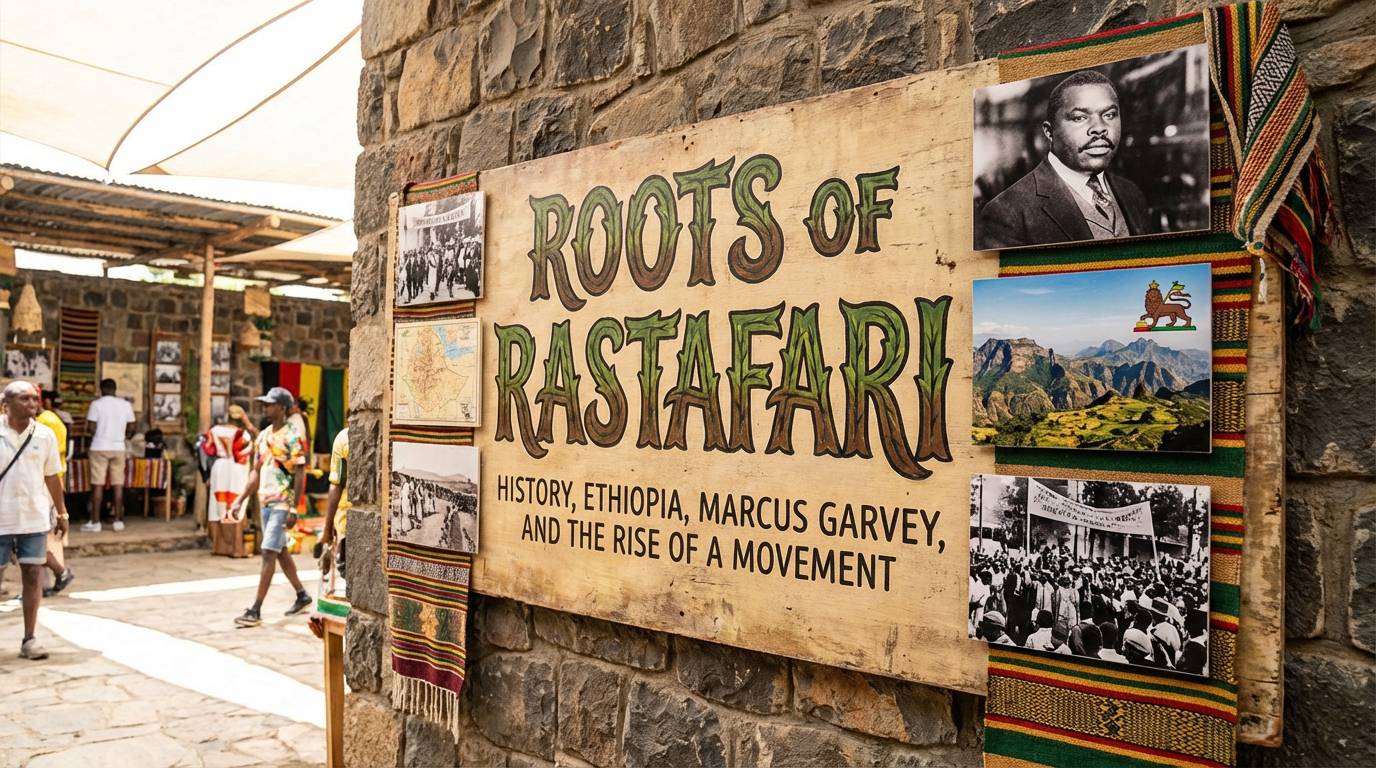
This is where the historical story becomes powerful. Rastafari did not only react against injustice. It also created another language for understanding life. It offered a vision. It re-centered Africa as a source of meaning rather than absence. It reimagined Ethiopia not merely as geography but as a living symbol of sovereignty and spiritual direction. It absorbed the influence of Marcus Garvey’s call for pride, unity, and self-determination. And in the aftermath of the coronation of Haile Selassie I in 1930, it found a focal point around which many hopes, beliefs, and interpretations gathered.
To trace the roots of Rastafari, then, is to do more than build a timeline. It is to see how a people under pressure fashioned a language of resistance and faith. It is to understand why the Rasta lifestyle carries such seriousness in its symbols. It is to recognize that what later became global culture began as grounded historical struggle.
Jamaica Before the Rise of Rastafari
The movement that became Rastafari emerged in Jamaica, and Jamaica’s history shaped it deeply. To understand the rise of this movement, it helps to remember that colonial societies do more than govern land. They also shape imagination. They rank people, define value, control resources, and teach certain groups to see themselves through distorted mirrors. That kind of domination leaves marks long after the official language of slavery or empire changes.
Colonial Pressure and Social Conditions
In the early twentieth century, Jamaica was still carrying the social and economic weight of British colonialism. The plantation order had formally shifted, but its consequences remained. Wealth and power were unevenly distributed. Large portions of the Black population lived with poverty, limited opportunities, and social systems that preserved hierarchy rather than dignity. Colonial structures affected work, education, land, religion, and self-image. Even after emancipation, the deeper logic of inequality continued.
This matters because movements do not arise only from ideas. They also arise from conditions. When people are pushed to the margins and taught to regard their roots as inferior, the question of identity becomes central. In Jamaica, the daily realities of deprivation and racialized hierarchy created the setting in which alternative visions could become necessary rather than optional. People were not simply looking for a new slogan. They were looking for an explanation of their condition and a framework for recovering dignity.
Colonial rule also created a spiritual tension. Many of the official institutions in colonial society offered religion, but not always liberation. They often taught obedience within an unjust order. For people searching for a faith that could speak to suffering, memory, and freedom, this was not enough. The search began for a spiritual language that could name oppression clearly and still offer hope beyond it.
The Search for Identity in a Colonial World
Colonial societies frequently weaken a people’s sense of historical continuity. They fragment memory. They teach distance from ancestry. They elevate foreign norms as the standard of civilization. Under such conditions, to ask “Who are we?” becomes a political and spiritual act at once. In Jamaica, many Black people were already wrestling with this question long before Rastafari became organized or widely recognized.
The search for identity involved more than pride in the abstract. It involved rejecting narratives of inferiority and beginning to see Africa not as absence, shame, or backwardness, but as origin, depth, and possibility. This reversal was profound. It changed the emotional map. A people who had long been told to look away from their roots began to look back toward them with seriousness.
That longing for identity also helped prepare the ground for movements that linked spirituality with Black consciousness. Rastafari would eventually do this in a distinctive way, but the desire itself was already present. People were reaching for a framework in which they could be both historically rooted and spiritually alive.
Marcus Garvey and the Power of Vision
No discussion of the roots of Rastafari can ignore Marcus Garvey. His influence on the mental and emotional climate out of which the movement grew was enormous. Even where later Rastafari thinkers interpreted his message in their own ways, Garvey’s call for Black pride, self-determination, and global African unity helped change the imaginative landscape. He gave language to longing. He gave dignity a public voice.
Garvey’s Message of Black Pride
Marcus Garvey’s message struck with force because it answered wounds that colonial systems had deepened for generations. He insisted on Black worth in a world built to deny it. He spoke of race pride, self-reliance, independence, organization, and world-making. Rather than asking Black people to seek acceptance only within existing hierarchies, he called them to recover their own sense of value and collective destiny.
This was not a small shift in tone. Garvey spoke with breadth and urgency. He invited people to imagine themselves as part of something global rather than trapped within local humiliation. He drew attention to Africa not merely as a distant land, but as a source of pride, inheritance, and political significance. That mental reorientation mattered greatly. Once people begin to imagine themselves differently, a new type of movement becomes possible.
The emotional force of Garveyism also cannot be overstated. It encouraged people to stand upright in a world that preferred them bent inward. It taught that dignity should not depend on colonial validation. It made Black history and Black possibility feel central rather than peripheral. In that sense, Garvey’s message helped prepare the psychological soil in which Rastafari could take root.
Africa for the Africans
One of Garvey’s most powerful themes was the idea of “Africa for the Africans.” However differently that phrase was interpreted across time, it carried a deep charge. It urged people of African descent to see themselves as connected to a larger historical and geographic reality. It challenged the fragmentation that colonialism had imposed. It encouraged collective identity across borders.
For many in Jamaica and beyond, this call restored a sense of historical direction. It suggested that Black people were not rootless, and should not accept a rootless future. Even when material return to Africa was difficult or impossible for many, the symbolic power of Africa intensified. Africa became linked to restoration, sovereignty, and possibility. Ethiopia, in particular, would later emerge as a special focus within this wider horizon.
Garvey did not create Rastafari directly in the sense of founding it as a formal religion. But his message helped shape the field of meaning in which the movement could emerge. He expanded the moral imagination. He normalized the language of Black nationhood and African destiny. He made certain ideas speakable with strength.
Prophetic Echoes and Lasting Influence
In later Rastafari memory, Garvey is often treated with an almost prophetic importance, not because every phrase attributed to him can be historically verified in a simple way, but because his role in preparing consciousness was undeniable. His influence moved beyond speeches and organizations. It entered the atmosphere of the time. He helped create a frame in which Africa mattered differently, in which Black identity could be interpreted with greater grandeur, and in which history itself could be reread.
That lingering influence is one reason Garvey remains central in discussions of Rastafari roots. He did not hand the movement its complete theology. What he helped provide was vision: a wider mental horizon in which people could begin to see themselves, and their future, through another lens.
Key Historical Forces So Far
- Colonial Jamaica created the conditions of inequality, dispossession, and identity crisis.
- Black dignity and historical self-knowledge became urgent social and spiritual questions.
- Marcus Garvey helped reshape consciousness through race pride, self-reliance, and African unity.
- The idea of Africa as source and destiny became increasingly powerful in Jamaican thought.
Ethiopia and Its Deep Symbolism
Within Rastafari, Ethiopia carries extraordinary importance. Yet to understand why, one has to move carefully. Ethiopia is not meaningful only as a modern nation-state, though it certainly exists in that reality. In the imagination of Rastafari, Ethiopia also functions as symbol, sacred geography, historical reminder, and sign of African sovereignty. Its significance operates on multiple levels at once.
Africa as Homeland and Spiritual Source
For descendants of a people violently scattered through slavery and colonialism, the idea of homeland carries immense emotional and spiritual weight. Africa became more than a continent in this context. It became a site of memory, longing, correction, and return. Not every person related to that return in the same literal way, but the symbolic force was undeniable. Africa represented origin where colonial life had imposed fracture.
Ethiopia emerged with special intensity because it stood as one of the rare African polities associated in the global imagination with sovereignty, antiquity, kingship, and independence. In a world where Black peoples were routinely depicted through colonial stereotypes, Ethiopia offered a counter-image: strength, continuity, and sacred significance. That image mattered.
The biblical imagination also contributed to this meaning. Ethiopia had long occupied a notable place in the religious consciousness of many African-descended communities. References to Ethiopia in scripture helped charge the name with prophetic resonance. Thus when people in Jamaica turned toward Ethiopia, they were not only turning toward a map. They were turning toward a site already alive with symbolic power.
Why Ethiopia Became Central
Ethiopia’s role in Rastafari thought cannot be reduced to politics alone. It became central because it answered several needs at once. It gave a scattered people a direction of imagination. It countered colonial narratives of Black inferiority. It linked African identity with sacred history. It provided a language of kingship and sovereignty in opposition to colonial humiliation. And it allowed spiritual hope and historical memory to meet.
Zion, in the Rasta imagination, often overlaps with this symbolic field. Zion is not only a literal place. It is also an idea of return, belonging, divine order, and liberation from oppressive systems. Ethiopia and Zion become intertwined in this way: one historical, one spiritual, both charged with hope and restoration.
The importance of Ethiopia also reveals something larger about Rastafari. The movement did not accept the terms by which colonial modernity told Black people to understand themselves. It reached elsewhere. It sought sacred and historical frameworks in which Black dignity could be affirmed rather than denied. That search gave the movement its emotional and spiritual force.
The Coronation of Haile Selassie I
If the cultural and psychological ground for Rastafari had already been prepared by colonial conditions, Garveyite thought, and the symbolic pull of Africa, then the coronation of Haile Selassie I in 1930 acted as a catalytic event. It did not create all the longing already present, but it gave many people a focal point for interpreting that longing in new ways.
A Defining Moment
The coronation of Ras Tafari Makonnen as Emperor Haile Selassie I of Ethiopia resonated far beyond the borders of Ethiopia itself. Titles associated with the coronation carried immense symbolic weight. For people already attuned to biblical language, African sovereignty, and the search for signs of restoration, the event appeared charged with more than political importance. It felt revelatory.
In Jamaica, this coronation was received by some as confirmation that the old order of colonial thought was not final. Here was an African emperor crowned with grandeur at a time when Black dignity was systematically denied in much of the colonial world. The symbolic impact was powerful. It opened interpretive space. It invited new theological readings. It intensified the sense that history itself might be moving in a different direction.
It is important to understand that the meanings drawn from the coronation were not simply imported as official doctrine. They were interpreted by communities, preachers, early believers, and reasoners in Jamaica who were already asking deep questions. The event mattered because it entered a field already charged with expectation.
Ras Tafari and the Name of a Movement
The name Rastafari itself is drawn from the pre-coronation title Ras Tafari. That alone shows the intimate connection between the movement and the figure of Haile Selassie I. But the importance of this connection goes deeper than naming. For many early adherents, Haile Selassie’s identity was tied to spiritual meaning, kingship, prophecy, and the possibility of divine revelation in history.
Outsiders often struggle with this dimension because they approach it only through modern secular categories. Yet movements born in conditions of deep social pressure rarely stay within neat intellectual boxes. They blend history, hope, scripture, longing, and symbol. Early Rastafari interpretation did exactly that. The coronation was read not only as news, but as sign.
Whether one studies Rastafari from the inside or the outside, it is impossible to ignore the transformative effect this event had on the movement’s development. It helped crystallize a new identity. It gave language and image to forces already gathering. It intensified belief that a divine and historical turning point had been reached.
Early Rastafari Communities in Jamaica
Movements become real through people. After the symbolic power of the coronation and the influence of wider Black consciousness, Rastafari took shape through early communities, teachers, street preachers, and small circles of believers in Jamaica. These were not large institutions in the beginning. They were often marginal, improvised, and socially vulnerable. Yet they carried an energy that would outlast repression.
The First Voices and Teachers
Early Rastafari took form through the work of individuals who interpreted current events, scripture, and African-centered thought in ways that spoke directly to the condition of Black Jamaicans. These voices were not always uniform in teaching, but they shared a serious effort to articulate a new understanding of identity, divinity, and liberation.
Preaching, public reasoning, and grassroots teaching became important. Ideas moved through speech, gatherings, and informal communities rather than official channels alone. This matters because it shows the movement’s bottom-up character. Rastafari did not emerge first as elite doctrine. It emerged among people working out new spiritual and historical meanings in ordinary spaces.
These early communities were also sites of experimentation. Language changed. Symbols took on clearer shape. Practices developed. Interpretations deepened. Over time, the movement formed a distinct identity, but in the beginning it was already held together by a powerful combination of African consciousness, biblical imagination, social critique, and spiritual seriousness.
Resistance and Repression
From early on, Rastafari faced hostility. This is not surprising. Any movement that challenges dominant norms, questions colonial values, and offers marginalized people a new language of dignity is likely to be treated as threatening. Early Rastas were often ridiculed, monitored, excluded, and misrepresented. Their appearance, speech, beliefs, and practices could all be targeted.
Repression did more than create suffering. It also revealed how deeply the movement unsettled existing power. When a society built on hierarchy sees an alternative vision emerging among those it has marginalized, it often responds defensively. Rastafari’s refusal to conform was not read as harmless difference. It was read as challenge.
Yet repression did not erase the movement. In some ways, it strengthened its sense of distinct identity. The very fact that early Rastas persisted under pressure added weight to their witness. A movement that can survive ridicule and force without surrendering its symbols or beliefs gains a different kind of seriousness.
Why History Still Matters Today
It can be tempting, especially in a global media age, to treat Rastafari as a set of floating cultural signs: reggae, locks, colors, herbal imagery, rebellion, spiritual language. But history interrupts that simplification. It reminds us that the movement came from pain as well as hope, from social conditions as well as mystical interpretation, from colonial injury as well as visionary imagination. To forget that is to hollow out the culture.
Without Roots, Lifestyle Becomes Imitation
The Rasta lifestyle can only be understood properly when rooted in the history that produced it. Without that grounding, people may borrow what is visible and lose what is essential. They may enjoy the sound without hearing the message. They may wear the symbols without carrying the memory. They may speak of “roots” without any sense of what had to be reclaimed.
Historical understanding protects against this kind of dilution. It reminds readers and listeners that the movement did not emerge as decoration. It emerged because people needed another way to understand themselves and another language with which to confront an unjust world.
History as Protection Against Commercial Dilution
As elements of Rasta culture have traveled globally, they have also become vulnerable to commercialization. Whenever a culture is widely recognized, there is pressure to separate its most marketable features from its historical depth. That process can make the culture easier to consume, but less truthful. History resists that erosion.
By returning to the roots of Rastafari, one remembers that the movement carried pain, defiance, faith, reverence, and collective memory. It was not built to flatter the world. It was built to challenge and heal within it. This is why history remains relevant even for readers who encounter Rastafari first through music, lifestyle interest, or spiritual curiosity. The roots change how everything else is read.
The Importance of Remembering Struggle and Vision
History does not only tell us what went wrong. It also tells us what people built in response. Rastafari is a testimony to vision under pressure. It reveals what can happen when a people refuse imposed inferiority and begin to interpret themselves through another center. It shows how longing can become movement. It shows how memory, scripture, symbol, politics, and spirituality can converge into a way of life.
That lesson remains meaningful today. Modern societies still produce disconnection, hierarchy, confusion, and spiritual hunger. The roots of Rastafari remind us that new forms of life can emerge when people refuse to accept the world’s diminished view of them. They remind us that resistance can be sacred as well as social.
Why These Roots Matter
- Rastafari grew out of concrete historical conditions, not abstract symbolism alone.
- Colonial Jamaica, African memory, and Black identity struggles all shaped the movement.
- Marcus Garvey widened the horizon of dignity, pride, and African-centered consciousness.
- Ethiopia became a powerful symbol of sovereignty, sacred history, and return.
- The coronation of Haile Selassie I gave many early believers a defining sign.
- Early Rastafari communities survived repression and helped turn hope into lived movement.
From Historical Roots to Spiritual Center
By now, the deeper outline of the story should be clearer. Rastafari rose from the meeting of history and spirit. Colonial injustice created the need for another vision. Garveyite thought expanded the imagination. Africa, and especially Ethiopia, became charged with meanings of origin, kingship, and restoration. The coronation of Haile Selassie I intensified that field of meaning. Early communities in Jamaica gave the movement language, practice, and endurance.
Yet history alone does not explain everything. A movement can begin in social struggle and still become much more than a social reaction. That is what happened here. The roots of Rastafari are historical, but the life of Rastafari also moves through prayer, gratitude, reverence, discipline, and a distinct sense of livity. The next layer of understanding, then, is spiritual.
To see how the Rasta lifestyle lives from within, we now have to move from the outer story of origins into the inner story of consciousness. We have to ask what Jah means in Rastafari, how livity functions in daily life, why prayer and meditation matter, and how spiritual discipline gives the movement its living heart. That is the path of the next article.