Every serious way of life eventually has to answer a practical question: how is it lived when there is no stage, no ceremonial gathering, and no audience watching? The Rasta lifestyle meets that question in everyday reasoning and daily rasta practice. It is not sustained only by history, spirituality, food, style, or music taken one by one. It is sustained by how people gather, speak, listen, work, care, correct themselves, raise children, relate to elders, and order the small habits of ordinary life. This is where the path stops being theory and becomes conduct.
Modern culture often makes private life feel shapeless. People may hold values in the abstract, yet their routines are ruled by distraction, isolation, hurry, and convenience. Belief becomes fragmented from habit. Identity becomes performance rather than discipline. The Rasta approach resists that split. It insists that values should show themselves in daily rhythm. Community should not be replaced by endless individualism. Wisdom should not be discarded because speed is more fashionable. And livity should not remain a beautiful word without visible practice behind it.
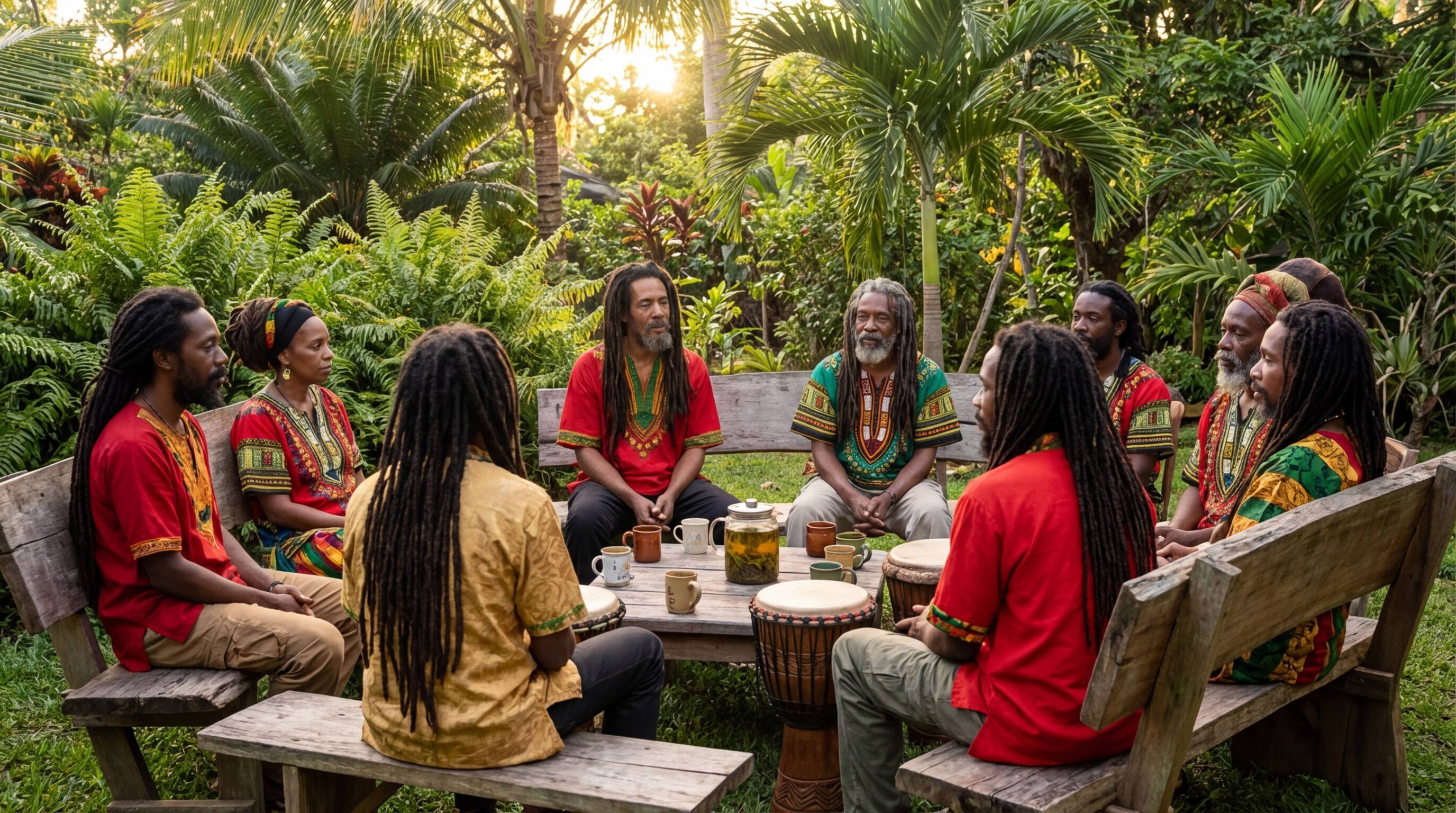
This is why community matters so much. Rastafari is not merely an internal feeling a person carries in total isolation. It is also something strengthened through company, conversation, correction, and shared memory. People learn from one another. They reason together. They observe how elders move. They inherit language, stories, warnings, and examples. In this way, the lifestyle is not only chosen privately. It is also carried socially.
Reasoning plays a central role here. As discussed earlier in the series, reasoning is more than ordinary conversation. It is disciplined exchange aimed at truth. It helps prevent the spiritual life from becoming vague or self-serving. But reasoning also lives inside community. It happens between people, within relationships, and often across generations. Through it, the culture keeps sharpening itself rather than dissolving into isolated opinion.
Daily practice then becomes the proving ground of all of this. Gratitude in the morning, respect in speech, humility in conflict, intention in work, order in the home, care in nourishment, time for prayer and stillness, steadiness in struggle, restraint under pressure, and loyalty to rooted values even when outside culture moves in another direction — these are the kinds of things that reveal whether livity is actually being lived.
Why Community Matters in the Rasta Lifestyle
The modern world often encourages a version of selfhood that is radically individual. People are told to invent themselves privately, define their own truth without reference to wiser voices, and rely on independence as though it were the highest human good. While autonomy has its place, the Rasta worldview reminds us that no one becomes grounded entirely alone. Community matters because people need one another for memory, correction, support, and shared strength.
No One Lives the Path Entirely Alone
A person can certainly begin a journey of consciousness through solitary reflection, but without community there is a risk of becoming self-enclosed. One may mistake personal preference for wisdom. One may imagine progress where there is actually drift. One may lose the strength that comes from being among others who are also trying to live with discipline and roots. Community reduces that danger.
In the Rasta lifestyle, community offers more than companionship. It offers shared values made visible. It helps a person remember what matters when the wider world is pushing them toward other standards. This does not mean community is always easy. Communities can contain tension, disagreement, weakness, and conflict like any human gathering. But even so, a rooted community provides a context in which the person’s life can be shaped by something larger than private mood.
Community also protects against forgetting. Cultural memory is rarely preserved by isolated individuals alone. It is preserved by people who keep meeting, speaking, singing, eating, teaching, and marking time together. Through community, traditions survive beyond one person’s lifespan.
The Role of Elders and Example
One of the most valuable aspects of community in the Rasta path is the place given to elders. Elders are not important merely because of age. They matter because they have walked longer, endured more, seen cycles repeat, and often developed steadier judgment through lived experience. Their value lies partly in the fact that they embody what the culture looks like over time.
An elder can teach through speech, but also through bearing. Younger people watch how an elder reasons, how they handle conflict, how they respect others, how they keep discipline without needless harshness, how they remain rooted in times of change. These lessons are not always formal. Often they are absorbed through observation.
Respect for elders also serves as a check against cultural amnesia. It reminds the community that wisdom did not begin with the latest trend, the loudest voice, or the most visible personality. It came through people who held on through pressure. That kind of continuity is precious.
The Tradition of Reasoning
Reasoning is one of the most distinctive practices within the Rasta lifestyle because it turns conversation into a discipline. In an age where talk is often shallow, reactive, and dominated by ego, reasoning offers another model. It values truth over performance, insight over noise, and attentive exchange over empty debate.
What Reasoning Is
Reasoning is not small talk, and it is not argument for argument’s sake. It is a mode of thoughtful exchange in which people gather around themes of life, spirit, history, conduct, and reality. The purpose is not simply to prove cleverness. It is to seek greater clarity. The tone may be passionate, but its deeper aim is understanding rather than domination.
This matters because how people speak to one another shapes the culture they create. If every disagreement must become warfare, if every conversation becomes self-display, or if no one listens long enough to learn, then community weakens. Reasoning protects against this by insisting that truth requires patience, humility, and willingness to consider more than one’s immediate reaction.
It also means that knowledge is not held only in books or institutions. Wisdom is circulated in spoken exchange. People sharpen each other. They remember together. They test ideas against experience. They build collective understanding rather than only isolated opinion.
Why Reasoning Matters
Reasoning matters because culture is always vulnerable to distortion. Symbols can become shallow. Language can be copied without meaning. Younger generations can inherit fragments without the framework needed to understand them. Reasoning helps repair this. It creates a living space where ideas can be explained, challenged, refined, and handed on.
It also helps the individual grow. A person may think they are being disciplined, conscious, or humble until they encounter others who expose the gaps in their understanding. This is not humiliation when done rightly. It is education. Through reasoning, the self is corrected without being discarded.
In this sense, reasoning is one of the great practical tools of livity. It keeps the inner life from becoming self-invented fantasy. It binds spiritual seriousness to intellectual honesty.
Family, Respect, and Responsibility
A lifestyle becomes credible when it enters relationships. It is easy to speak beautifully about truth and dignity in the abstract. It is harder to practice those things in family life, in the raising of children, in partnership, and in the repeated small tests of ordinary conduct. Yet this is exactly where the Rasta lifestyle expects its values to become real.
Living Values in Relationship
Relationships reveal the quality of a person’s discipline. How do they speak under pressure? How do they handle disagreement? How do they show care? How do they carry themselves when no public recognition is attached to their behavior? Family life brings all of these questions into focus.
Within the Rasta worldview, family is not only private arrangement. It is a site where values are either passed on or neglected. Children learn not just from instruction, but from atmosphere. They absorb what they see modeled: respect or disrespect, steadiness or chaos, gratitude or entitlement, discipline or drift. This makes responsibility in the home deeply important.
Family responsibility also means understanding that personal freedom is not the only measure of a good life. Care matters. Duty matters. Reliability matters. A person who talks of consciousness but cannot be trusted in the responsibilities closest to them is living in contradiction.
Respect for Elders, Children, and One Another
Respect is not a decorative virtue in the Rasta lifestyle. It is structural. Without it, community breaks down, reasoning becomes ego contest, and family life becomes unstable. Respect for elders has already been noted, but respect also extends horizontally and downward. It shapes how one treats peers, children, and strangers.
To respect children is to recognize that they are not empty vessels or inconveniences. They are lives in formation, absorbing the moral and spiritual atmosphere around them. To respect peers is to refuse needless humiliation, manipulation, or vanity-driven speech. To respect a partner is to recognize that loyalty and honesty are part of livity, not burdens opposed to it.
This broad culture of respect allows everyday life to become more human. It pushes back against the brutality and cynicism that often pass for realism in wider society.
What Community Practice Protects
- Memory and wisdom are preserved through people, not just ideas.
- Reasoning keeps truth alive through shared, disciplined exchange.
- Family life is where values become visible or collapse into contradiction.
- Respect is foundational for elders, children, peers, and everyday conduct.
Daily Habits That Reflect Livity
The strongest communities are still made up of daily habits. No person becomes rooted by accident. Repeated practices create atmosphere. A day shaped by gratitude, intention, nourishment, stillness, and respectful conduct feels different from a day ruled by impulse and noise. Livity becomes visible through repetition.
Rising With Purpose
Morning rhythm matters because it sets the tone for consciousness. A person who rises with gratitude, prayer, stillness, or deliberate attention begins differently than one who wakes into immediate noise and agitation. The first moments of the day often reveal what governs the inner life.
Rising with purpose does not mean every morning must be elaborate. It means one does not surrender the opening of the day entirely to distraction. A brief giving of thanks, a few minutes of stillness, an intentional meal, a clearing of the mind, or even a short recognition of Jah’s sustaining presence can begin to shape the whole day differently.
Over time, such practices do more than improve mood. They reinforce identity. The person learns that life is not something to stumble into half-conscious. It is something to enter deliberately.
Daily Rhythm and Grounding
The rest of the day also matters. Work, food, speech, movement, rest, and community contact all become part of spiritual and practical rhythm. A grounded life is rarely made of dramatic moments alone. More often it is built through simple consistency. Regular nourishment. Respectful speech. Order in one’s space. Thoughtful use of time. Enough quiet to hear oneself think. Enough discipline to resist drift.
This daily rhythm protects the person from fragmentation. Many people are not undone by one dramatic failure, but by hundreds of small careless patterns. The Rasta lifestyle responds by strengthening the small patterns in the other direction. Consciousness is built into habit.
That is why livity in practice can sometimes look ordinary from the outside. It may be found in modest gestures: how a meal is prepared, how a room is kept, how elders are greeted, how conflict is de-escalated, how words are chosen, how evenings are quieted. But over time these modest gestures create a different kind of life.
Challenges of Living Consciously Today
Of course, living this way is not simple in the modern world. Community is often weakened by mobility, technology, distrust, and economic pressure. Families are stretched. Time is fragmented. Attention is sold. People may long for rootedness while living inside systems designed to keep them scattered. That tension has to be named honestly.
Isolation, Distraction, and the Pressure to Conform
One challenge is isolation. Even in crowded cities or online networks, many people are profoundly alone. They lack circles where truth is spoken carefully, where elders are listened to, where reasoning can happen, or where shared moral rhythm exists. Without such spaces, sustaining livity becomes harder.
Distraction compounds the problem. When every spare moment is consumed by screens, entertainment, or digital argument, the deeper habits of reflection and relationship weaken. People may feel informed while becoming less wise. They may feel connected while becoming less grounded. The Rasta emphasis on daily discipline and community becomes especially relevant here because it resists this flattening of attention.
There is also the pressure to conform. A rooted lifestyle often looks unfashionable to a world moving quickly toward surface and speed. Respect, modesty, rhythm, and loyalty do not always attract applause. In some environments, they may even be mocked. Living consciously therefore requires courage. The person must be willing to remain steady without constant validation.
Balancing Modern Life With Rooted Values
Very few people can withdraw entirely from modern systems. Most must work, travel, manage technology, navigate institutions, and move within societies that do not share their deepest values. The challenge is not simply to escape the modern world, but to remain rooted while living inside it. This is where daily practice becomes so important. It creates islands of order within wider disorder.
A person may not be able to control every environment they enter, but they can still shape certain rhythms: how they rise, what they consume, how they speak, how they gather with others, what kind of sound fills their home, whether they leave room for prayer and stillness, how they treat elders and children, and how much of their life is handed over to mere reaction. These choices matter.
In this way, rooted living does not require perfect conditions to begin. It requires seriousness. It asks the person to build what they can where they are, and to keep returning to center when the world pulls outward.
Building a Rasta-Inspired Daily Practice
For readers seeking to understand how the Rasta lifestyle takes practical form, it can help to think in terms of repeated anchors rather than dramatic declarations. A rooted daily practice does not need to begin with complexity. It begins with sincerity and repetition.
Small Daily Choices
Small choices are where livity becomes durable. Greeting others respectfully. Beginning the day with gratitude. Making time for stillness. Keeping food simple and nourishing. Listening to conscious music instead of feeding the mind only with noise. Speaking more carefully. Limiting gossip. Making space for elders. Protecting time for reasoning. These may seem modest, but they build character over time.
The power of small choices lies in their cumulative effect. They establish a moral and spiritual atmosphere. One thoughtful choice may not change life immediately, but repeated thoughtful choices begin to create a person who is more steady, more grounded, and less available to confusion.
Returning to Truth Repeatedly
No one lives perfectly. Every serious lifestyle must make room for correction, fatigue, and failure without collapsing into cynicism. The strength of the Rasta approach lies partly in its insistence that one can keep returning. Return to prayer. Return to gratitude. Return to natural rhythm. Return to respectful speech. Return to elders. Return to community. Return to reason. Return to the body’s needs. Return to Jah.
This repeated return is vital because modern life is designed to scatter attention again and again. Without a practice of return, the person can drift far before realizing it. With such a practice, correction remains possible. One does not need to dramatize every failure. One simply comes back to center and begins again.
Living Principles Consistently
Principles only gain force when they survive inconvenience. It is easy to value respect when one is calm, community when one feels welcomed, or discipline when conditions are easy. The deeper test is whether these values remain alive under strain. Can one speak carefully in anger? Can one remain loyal in difficulty? Can one maintain rhythm under pressure? Can one reason instead of react? These questions reveal the depth of practice.
A consistent life is not a flawless life. It is a life in which direction remains visible. Over time, such consistency becomes one of the strongest markers of character. People know what to expect. They know the person is not built only from mood. That stability itself becomes part of community strength.
Livity in Everyday Form
- Daily practice matters as much as public identity.
- Community and elders help preserve memory, correction, and grounded values.
- Reasoning protects truth from becoming shallow or purely individual.
- Family and relationship conduct reveal whether values are truly lived.
- Small repeated habits build rootedness more reliably than dramatic declarations.
- Living consciously today requires both discipline and repeated return to center.
When the Lifestyle Becomes Visible in Ordinary Life
Perhaps the clearest sign that a lifestyle is real is that it becomes visible in ordinary life without needing constant announcement. The person’s speech grows calmer. Their habits become more deliberate. Their respect for others becomes more consistent. Their home carries a different atmosphere. Their relationship to food, sound, elders, and time becomes more conscious. Community becomes less optional. Reasoning becomes more natural. This is how livity takes practical shape.
Such visibility is powerful precisely because it is not theatrical. It does not rely on performance. It emerges from pattern. A person who lives this way does not need to claim depth every moment. Others can often feel the steadiness in how they move. That steadiness becomes a form of cultural witness. It shows that another rhythm of life is possible.
In a fragmented age, this kind of ordinary rootedness may be one of the most radical things a person can carry. It says that life need not be ruled by noise, hurry, ego, and isolated self-invention. It says that people can still gather, reason, remember, respect, and build habits worthy of repetition. The Rasta lifestyle becomes credible here, in the humble strength of daily conduct.
Conclusion: The Path in Practice
Community, reasoning, and daily practice show that the Rasta lifestyle is not sustained by symbols alone. It is lived through relationships, habits, discipline, and shared values strong enough to survive ordinary life. The path becomes real in how one greets the day, nourishes the body, speaks to others, treats family, honors elders, reasons through truth, and returns to rhythm when the world pulls toward confusion.
This is what gives the lifestyle its durability. History provides roots. Spirituality provides center. Ital living provides bodily discipline. Style provides visible language. Music provides vibration and memory. But daily practice is where all of these things prove themselves. Without it, the rest can remain admirable but incomplete.
Yet the series does not end here. The final question still remains: what does it mean to live the Rasta message today, in a global world shaped by commercialization, digital speed, identity confusion, and renewed hunger for authenticity? The last part of this series turns to that question, exploring the modern relevance of the Rasta lifestyle, its cultural influence, and the challenge of carrying roots with integrity in contemporary life.