How Garvey Sparked a Global Black Awakening
When Garvey’s parades marched by day and Harlem’s poets sang by night, a new Black world imagination was born.

In the years after World War I, Harlem became something the world had never seen before: a capital of Black imagination. Street orators, jazz bands, painters, and poets turned the neighborhood into a laboratory of pride. At the same time, Marcus Garvey’s Universal Negro Improvement Association (UNIA) transformed Harlem into the headquarters of a global political movement. Together, these forces formed a double helix of change — one strand cultural, the other organizational — twisting around the same dream of liberation.
This article explores how the UNIA and the Harlem Renaissance interacted, overlapped, and sometimes clashed — yet ultimately helped create a global Black awakening that reached from New York to Kingston, from Lagos to London. It’s about the moment when a neighborhood became a world, and a movement found its soundtrack.
- The UNIA made Harlem a political capital of the African Diaspora.
- The Harlem Renaissance turned Harlem into a cultural supernova of Black art and thought.
- Garvey’s message of race pride and Pan-Africanism seeped into poems, plays, and jazz.
- Women like Amy Ashwood and Amy Jacques Garvey bridged activism and cultural work.
- The fusion of UNIA and Renaissance energy helped shape later movements, from independence struggles to reggae and Rastafari.
- Harlem Emerges as a Black World Capital
- The UNIA Turns the Street into a Stage
- Art Meets Activism: How the Renaissance Echoed Garvey
- The Women Who Wove Culture into the UNIA
- Tensions, Critics, and Creative Crossfire
- From Harlem to the World: A Global Wave of Consciousness
- Lasting Legacy: Why This Convergence Still Matters
Harlem Emerges as a Black World Capital
Before Garvey arrived, Harlem was already changing. The Great Migration brought African Americans from the U.S. South into northern cities, seeking escape from lynching, sharecropping, and Jim Crow laws. At the same time, Caribbean migrants arrived with their own political traditions and literary tastes. Harlem became one of the few spaces where these worlds collided.
By the late 1910s, you could walk a few blocks and hear:
- A Socialist soapbox speech on one corner.
- A sermon on spiritual freedom on the next.
- A calypso band rehearsing for a dance in a basement.
- An amateur poet reciting lines about Africa in a tenement hallway.
When Marcus Garvey chose Harlem as the base for the UNIA’s U.S. work, he was stepping into an environment already primed for new ideas. But he also gave it structure, language, and a sense of global direction.
“Harlem was the first place where Black people from Mississippi and Kingston and Lagos could argue in the same bar about what freedom should look like.” — Reggae Dread Reflection
- Harlem’s diversity made it fertile ground for both Garveyism and the Renaissance.
- Migrants brought different experiences, but shared a desire for dignity.
- UNIA’s arrival turned local conversations into global ones.
The UNIA Turns the Street into a Stage
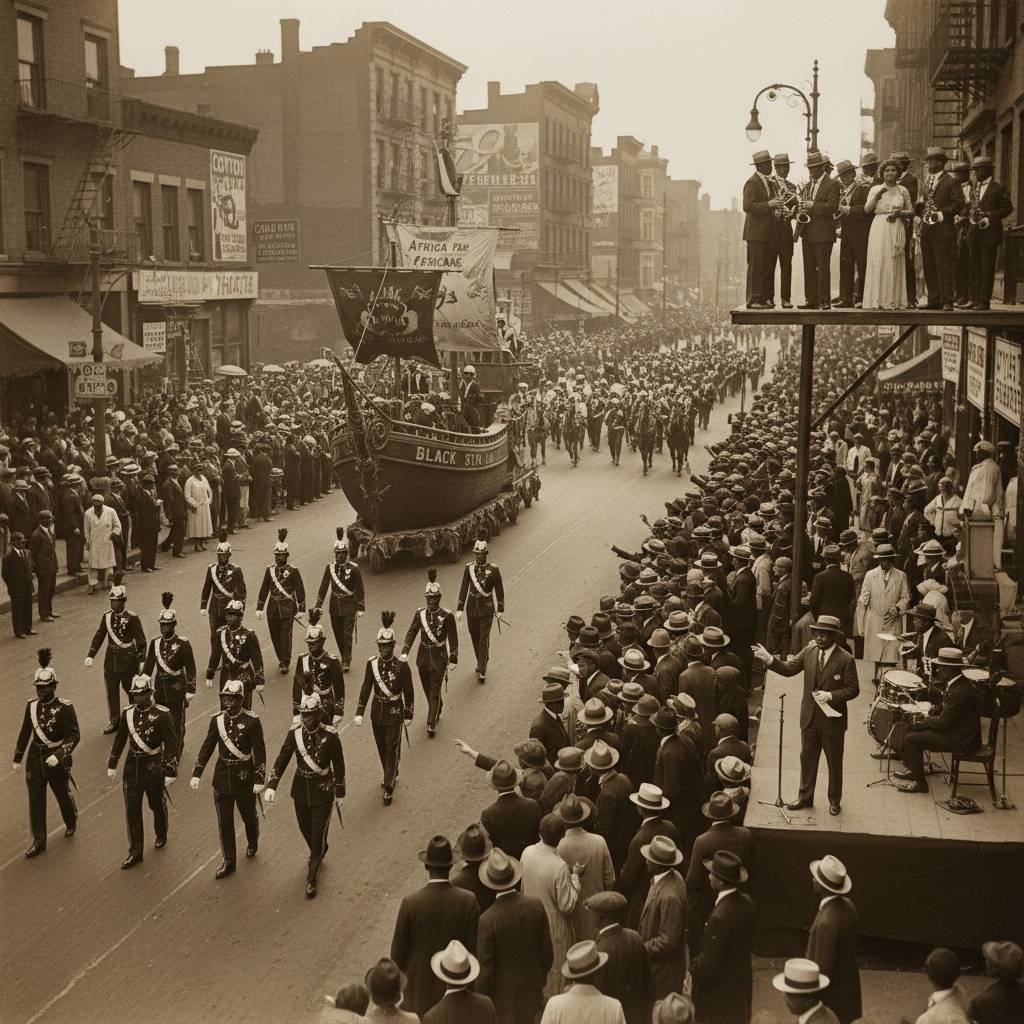
If the Renaissance gave Harlem its music and verse, the UNIA gave it pageantry. Garvey understood the power of spectacle in a world where Black people were routinely portrayed as inferior. He responded by staging grandeur.
Parades as Political Theater
UNIA parades marched down Harlem’s avenues with:
- Marching bands in crisp uniforms.
- Officer corps in plumed hats and sashes.
- Women’s auxiliaries in white dresses and colorful sashes.
- Children carrying the red, black, and green flag high.
For onlookers, this was more than a parade — it was a preview of a future Black nation. Even those who never joined the UNIA absorbed its aesthetic of order, pride, and symbolism.
“Garvey made the sidewalk a stage, and every Black man and woman in Harlem an actor in the drama of freedom.” — Harlem newspaper, 1921
Liberty Hall: The Movement’s Indoor Heartbeat
Inside Liberty Hall, the UNIA’s New York headquarters, speeches alternated with performances. A meeting might include:
- A fiery address from Garvey on Africa’s destiny.
- A choir singing hymns of Ethiopia and Zion.
- A short play illustrating the cruelty of colonialism.
- Announcements of business ventures, from groceries to printing presses.
The line between rally and cultural event blurred. Art reinforced politics, and politics gave art a mission. In this fusion, you can already hear the future of conscious music, theater, and poetry.
- UNIA parades and Liberty Hall meetings turned politics into visible culture.
- Symbols, uniforms, and flags offered a counter-image to racist stereotypes.
- This visual language influenced the style of Harlem’s artists and performers.
Art Meets Activism: How the Renaissance Echoed Garvey
The Harlem Renaissance is often remembered for its great writers and musicians — Langston Hughes, Zora Neale Hurston, Claude McKay, Countee Cullen, Duke Ellington, and many more. While not all were card-carrying Garveyites, many absorbed themes that Garvey popularized: pride in African roots, skepticism of white patronage, and the right to define one’s own beauty.
Poetry and Prose with a Pan-African Pulse
Claude McKay’s sonnets raged against racism with a militant edge that critics sometimes called “Garveyite.” Langston Hughes wrote of rivers older than the world, linking Black life in America back to the Nile and Congo. Novelists experimented with African imagery, folklore, and ancestral memory in ways that answered Garvey’s call to “know your past.”
- Poems invoked Africa not as an abstract symbol, but as a living homeland.
- Short stories explored migration, exile, and the ache of belonging.
- Essays debated whether art should be “for art’s sake” or for racial uplift.
“Garvey did with speeches what the Renaissance did with stanzas: he made Blackness beautiful, urgent, and global.” — Reggae Dread Commentary
Jazz, Blues, and the Soundtrack of Self-Definition
In clubs like the Cotton Club (even with its contradictions) and smaller Harlem venues, musicians improvised new languages. Jazz and blues gave form to migration stories, heartbreak, and urban life. Garvey’s mass meetings and the Renaissance’s jam sessions drew on the same well of experience, even when they did not directly overlap.
Many bands played for UNIA events. Some musicians experimented with “African” motifs in rhythm and percussion. Over time, this sonic exploration would echo in later genres like ska, rocksteady, and reggae — all of which would directly quote Garvey and Harlem decades later.
- Renaissance writers and musicians absorbed Garvey’s themes of race pride and return.
- Artworks helped translate Garvey’s political language into emotional experience.
- The combination of speech and song created a fuller, deeper Black consciousness.
The Women Who Wove Culture into the UNIA
Behind the big speeches was a network of women who understood that a movement needs rhythm as much as rhetoric. They organized concerts, edited newspapers, hosted salons, and ensured that the UNIA’s program reached into homes, schools, and social clubs.
Amy Ashwood and Amy Jacques Garvey
Amy Ashwood Garvey, Marcus’s first wife, co-founded the UNIA and helped shape its early cultural life. In Harlem, she organized events that blended drama, music, and political education. She believed that women should be not just supporters, but leaders and thinkers in their own right.
Amy Jacques Garvey, his second wife, edited the women’s page of the Negro World and later the paper itself. She published essays on:
- Black womanhood and respectability beyond white standards.
- The importance of education and reading for liberation.
- The need to support Black businesses, professionals, and artists.
Through her editorial choices, she created a bridge between activist discourse and the Renaissance’s intellectual climate.
“We are not passive recipients of freedom; we are makers of it, in the home, in the school, and in the street.” — Amy Jacques Garvey, paraphrased
- Women ensured the UNIA’s ideas were lived daily, not only heard at rallies.
- They fostered reading, arts, and debate within the movement.
- Their work paralleled and intersected with women writers of the Harlem Renaissance.
Tensions, Critics, and Creative Crossfire
The relationship between the UNIA and the Harlem Renaissance was not always harmonious. Some Renaissance figures felt that Garvey’s “Back to Africa” rhetoric was unrealistic or too separatist. Some UNIA members viewed certain artists — especially those supported by white patrons — as insufficiently committed to Black autonomy.
Debating the Purpose of Art
A recurring question in Harlem was: Should art be propaganda? Garvey tended to answer “yes”: art should uplift the race and serve the movement. Some artists insisted on the right to explore complexity, ambiguity, and even despair, without being obligated to uplift anyone.
Yet even in disagreement, they shared common ground:
- Both wanted Black people to define themselves, not be defined by others.
- Both challenged the idea that whiteness was the only measure of culture.
- Both contributed to a sense that this was a Black century in the making.
“Harlem’s arguments were a luxury our ancestors never had — the luxury of deciding which road to freedom to take.” — Reggae Dread Reflection
From Harlem to the World: A Global Wave of Consciousness
While the Renaissance lit up Harlem’s night sky, Garvey’s organization built daytime routes across the globe. UNIA divisions appeared in:
- Kingston, Jamaica
- Port of Spain, Trinidad
- Freetown, Sierra Leone
- London and Liverpool in the UK
- Panama, Costa Rica, and Honduras along the canal and railway zones
Members in these places received not only political circulars but also Harlem’s cultural exports: plays, songs, photos of parades, and copies of the Negro World that featured poems and short stories.
Colonial governments in Africa and the Caribbean tried to ban the Negro World because its mix of Garveyism and Harlem creativity was seen as “dangerous to the natives’ loyalty.”
Young activists who would later lead independence movements — from Kwame Nkrumah in Ghana to Nnamdi Azikiwe in Nigeria — spent time in Garveyite circles or were influenced by the diaspora networks that Harlem helped shape.
Lasting Legacy: Why This Convergence Still Matters
The UNIA’s New York chapter declined after Garvey’s imprisonment and deportation, and the Harlem Renaissance faded as the Great Depression hit. But the fusion they created — politics with rhythm, art with agenda, pride with organization — never truly ended.
You can see its fingerprints in:
- Reggae and Rastafari, where Garvey is quoted as a prophet and Africa remains a spiritual homeland.
- Civil rights and Black Power movements, which often paired speeches with music, marches with murals.
- Contemporary Pan-African festivals, where lectures on history share the stage with fashion shows, concerts, and film.
For platforms like ReggaeDread, this history is not dusty archive material. It is the root system of a living tree. When we talk about roots reggae, Afrocentric fashion, or global Black consciousness, we are drawing from the same well that filled Harlem’s streets a century ago.
The UNIA and the Harlem Renaissance prove that liberation is strongest when culture and politics move together — when banners and books, drums and declarations, all beat the same rhythm of freedom.
To see how this cultural awakening intersected with direct confrontation with state power, read the next chapter in the series on Garvey’s clash with U.S. authorities — and how, even when the man was removed, the movement’s music and message played on.
Read next in the “Marcus Garvey in New York (1916–1924)” series: