UNIA Conventions and the Spectacle of Black Empowerment in 1920s Harlem
When Garvey’s UNIA took to the streets, Harlem didn’t just watch a parade — it watched a nation in rehearsal.

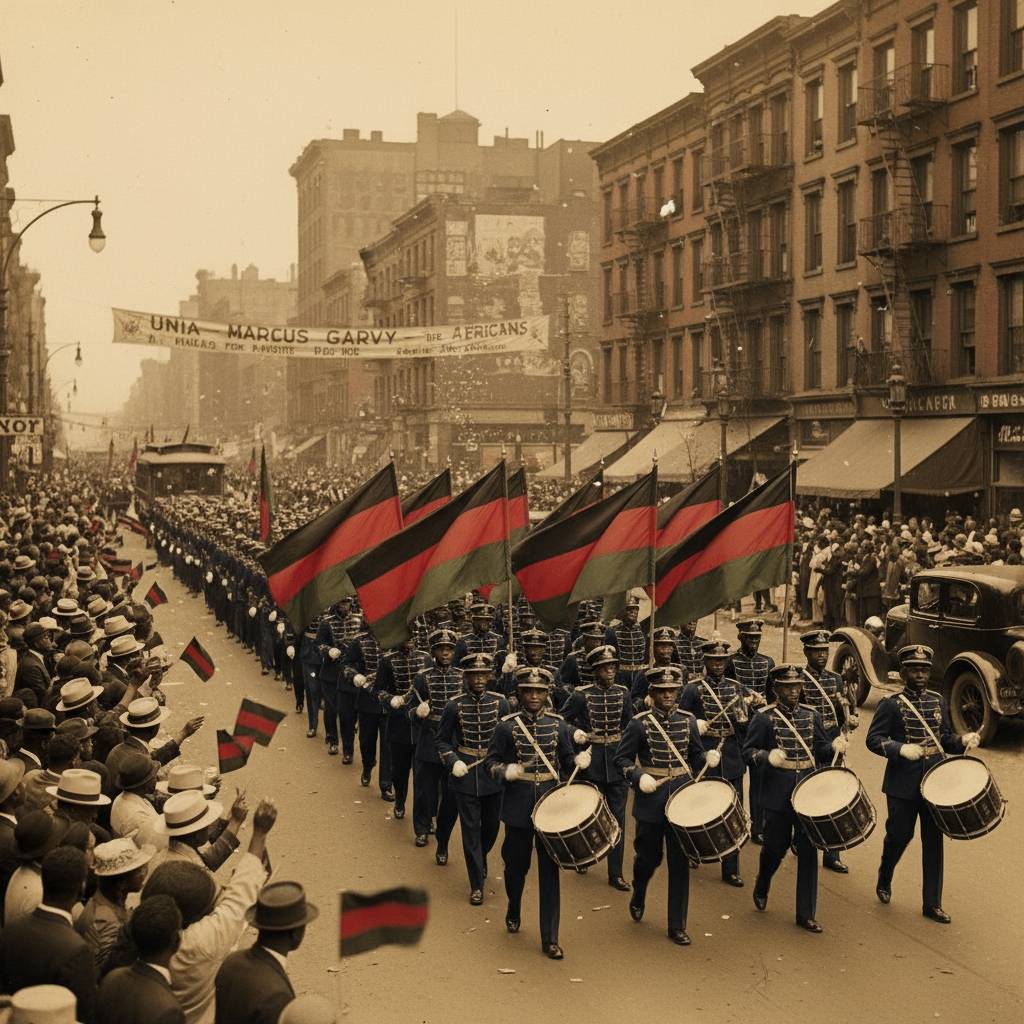
Close your eyes and picture Harlem in the early 1920s. Streetcars rattle by, vendors call out, jazz leaks from open windows — and then, suddenly, the sound shifts. A brass band strikes up a march. Crowds gather on the sidewalk. Down the avenue comes a sea of uniforms, banners, and flags: the Universal Negro Improvement Association (UNIA) is on parade.
For many who lived through it, the UNIA’s conventions and parades were unlike anything they had ever seen. Marcus Garvey’s movement didn’t just ask people to believe in Black pride — it showed them what a proud Black nation could look like in motion. The streets of Harlem became rehearsal space for a future in which Black people would no longer be invisible, but undeniably present, ordered, and powerful.
- The UNIA’s conventions and parades in Harlem drew thousands from across the African Diaspora.
- Garvey used spectacle — uniforms, banners, music — as a tool of psychological liberation.
- The 1920 convention produced the red-black-green flag and the “Declaration of Rights of the Negro Peoples of the World.”
- These events inspired and influenced global Black movements, as well as later cultural expressions in reggae and Pan-African festivals.
- Even as authorities watched nervously, the parades gave everyday people a taste of collective power.
Setting the Stage: Harlem and the UNIA in the 1920s
By 1919, the UNIA had already grown into a major force in Harlem. With branches across the United States and abroad, and the Negro World newspaper circulating widely, Garvey’s message had found fertile ground. But the organization needed moments when that hidden infrastructure could become visible — when the membership could see itself as a united body, not just scattered individuals.
Harlem provided the perfect backdrop. Its broad avenues, dense crowds, and vibrant nightlife meant that anything happening there would be seen, discussed, and remembered. The UNIA’s conventions turned this urban stage into the “capital city” of a Black world in the making.
“For one week, Harlem felt like the capital of Africa and the Caribbean at the same time.” — Visitor recalling a UNIA convention
- UNIA needed public, mass moments to bring its global membership together.
- Harlem’s geography and demographics made it the ideal setting.
- Conventions transformed an ordinary neighborhood into a symbol of global Black unity.
The First Great Conventions
The most famous of the UNIA conventions was held in 1920, often called the International Convention of the Negro Peoples of the World. Delegates came from across the United States, the Caribbean, Latin America, and Africa. Some traveled for days by train or ship to be present.
Inside the meeting halls, delegates debated resolutions, heard speeches, and drafted documents. Outside, Harlem watched waves of visitors in their best clothes, speaking accents from Jamaica, Belize, Panama, Barbados, and beyond. It was one thing to read about Pan-Africanism. It was another to see it, hear it, and walk its streets.
The Declaration of Rights and the Birth of a Flag
During the 1920 convention, delegates adopted the Declaration of Rights of the Negro Peoples of the World, a sweeping document that condemned racism, colonialism, and lynching, and affirmed the dignity and equality of people of African descent. It functioned almost like a Pan-African constitution.
At the same time, the UNIA introduced a new flag: red, black, and green. It would serve as the emblem of the movement and, in Garvey’s words, “the flag of the Black man of the world.” This flag flew above conventions and parades like a promise turned into color.
“Show me the race or the nation without a flag, and I will show you a race of people without any pride.” — Marcus Garvey
- The 1920 convention drew delegates from across the African Diaspora.
- It produced a Pan-African “Declaration of Rights.”
- The red-black-green flag debuted as a formal emblem of global Black identity.
Parade as Political Theater
While the formal sessions of the convention happened indoors, the parades brought its spirit to the public. Thousands lined the streets as UNIA contingents marched in formation, each division carrying banners naming their city or country.
Order, Discipline, and Dignity
The parades were carefully choreographed. Units marched in step. Banners were held straight. Officers saluted as they passed reviewing stands where Garvey and other leaders stood. In a time when popular culture often mocked or demeaned Black people, these images of order and dignity sent a powerful counter-message.
To witnesses, the effect could be breathtaking. Children saw their parents in uniforms, not rags. Workers who were invisible on factory floors took center stage in the street. The message was clear: We are a people. We are organized. We are coming.
“That day, I saw something I didn’t know we were allowed to be — magnificent.” — Harlem resident recalling a UNIA parade
Music, Color, and Movement
Brass bands and drum corps gave the parades a soundtrack. The beat carried down the streets long before the marchers appeared. Women’s groups added splashes of white, gold, and green to the flowing red-black-green of UNIA banners. Children’s units reminded everyone that the movement thought in generations, not election cycles.
Spectators did more than watch. They shouted, clapped, and sometimes joined the march at the end. The line between audience and participant blurred — exactly as Garvey intended.
- UNIA parades were carefully staged displays of discipline and pride.
- They turned everyday workers into visible symbols of a rising nation.
- Music and color made politics feel like celebration and prophecy at once.
Symbols, Uniforms, and the Red-Black-Green Flag
One of the most striking aspects of the UNIA conventions was the range of uniforms and regalia on display. Critics sometimes dismissed this as pomp and pretense. But to many participants, it was a crucial tool for reimagining Black identity.
Why Uniforms Mattered
UNIA uniforms borrowed elements from military dress, fraternal orders, and African royalty. There were:
- Officers in dark jackets with gold braid and epaulets.
- Women in gowns paired with colored sashes and headwraps.
- Youth brigades in matching shirts and caps.
These outfits did three things at once:
- They projected seriousness and organization.
- They offered members a tangible sense of status and belonging.
- They visually broke with the stereotype of the “ragged” Black subject.
“We had worn uniforms in other people’s wars. This time, we wore them for ourselves.” — Former UNIA member
The Flag as Moving Icon
The red-black-green flag was everywhere at the conventions: carried in front of marches, draped behind speakers, pinned on lapels. Its colors carried layered meanings:
- Red — the blood that unites people of African ancestry and the blood shed in struggle.
- Black — the people themselves, in all their diversity.
- Green — the land of Africa, rich and fertile, symbolizing hope and renewal.
Seeing that flag ripple above thousands of disciplined marchers left an imprint on many minds that would resurface decades later in independence movements and Black liberation struggles worldwide.
- Uniforms and regalia were intentional tools of psychological uplift.
- The red-black-green flag condensed complex history into a simple, powerful symbol.
- Visual aesthetics of the parades influenced later Pan-African and Black Power imagery.
The Emotional Impact on Ordinary People
It’s easy, a century later, to focus on dates and documents: when conventions happened, what resolutions were passed. But the real power of the UNIA parades lay in their emotional effect on ordinary people. These were events where someone who felt small on Monday could feel part of something huge by Sunday.
Creating Collective Memory
For many attendees, the parades became lifelong reference points. Years later, they would say things like, “I remember when Garvey rode by in that car,” or “I remember seeing our division’s banner next to people from Africa.” Children who watched from windows carried those images into adulthood, even if they never joined the organization themselves.
That collective memory worked like a reservoir. Later movements — civil rights marches, Black Power rallies, anti-apartheid demonstrations — could tap into it, consciously or unconsciously.
“The day we marched, I walked different ever since. I knew my back could be straight.” — Participant in a UNIA procession
From Shame to Pride
The psychological shift should not be underestimated. Many Black people in the early 20th century had been taught to keep their heads down, to avoid drawing attention. The parades told them the opposite: stand tall, step in time, and let the world see you.
This shift from internalized shame to public pride is one of the most important legacies of Garvey’s spectacle politics — one that still resonates in everything from Carnival bands to Afrocentric fashion shows, from dancehall stages to Pan-African rallies.
- UNIA parades created powerful memories that lived on for decades.
- They helped many shift from a posture of fear to one of pride.
- The emotional impact fueled later struggles and artistic expressions.
Critiques, Fears, and Misunderstandings
Not everyone viewed the UNIA parades positively. Some critics, including other Black leaders, saw them as over-the-top or even dangerous. White authorities watched nervously, unsure whether they were witnessing a cultural festival or the seeds of insurrection.
Internal Black Critiques
Some Black intellectuals argued:
- That money spent on uniforms and spectacle could have gone to schools or businesses.
- That Garvey’s quasi-military style might provoke unnecessary backlash.
- That the focus on empire and titles (like “Provisional President of Africa”) seemed unrealistic.
These critiques weren’t always made in bad faith — they reflected genuine strategic disagreements about how best to pursue Black advancement.
Law Enforcement Suspicion
Police and federal agents monitored the conventions closely, taking note of the size of the crowds and the themes of speeches. Files compiled by the Bureau of Investigation (later the FBI) often mentioned the parades as evidence of Garvey’s ability to mobilize masses — which they viewed as a threat.
This suspicion fed into the wider campaign against Garvey that culminated in his trial and imprisonment, explored in detail in: “Garvey vs. the System: How the FBI and Hoover Tried to Silence a Black Visionary.”
- UNIA’s spectacle drew criticism even from some within the Black community.
- Authorities saw parades as potential evidence of “dangerous agitation.”
- These events played a role in how law enforcement framed Garvey as a threat.
Afterlives of the Spectacle: From Harlem to the World
Although the UNIA’s influence in Harlem waned after Garvey’s imprisonment and deportation, the visual and emotional language of its parades did not disappear. It migrated into other movements, mediums, and eras.
Influence on Independence Movements and Black Power
Later in the 20th century, when newly independent African nations designed flags, uniforms, and national celebrations, Garvey’s colors and aesthetics were often in the background. Ghana’s Black Star, for example, echoes the Black Star Line and the wider Garveyite iconography.
In the 1960s and 70s, Black Power rallies and cultural festivals revived the use of red, black, and green; raised fists; and disciplined marches. Many activists explicitly cited Garvey and the UNIA as inspiration.
Echoes in Reggae, Rastafari, and Global Culture
In Jamaica, where Garvey was born and later deported, memories of UNIA spectacle fed into the rise of Rastafari and the aesthetic of roots reggae. Stage backdrops, album covers, and festival banners often feature red, gold, green, and black — colors that carry both Ethiopian and Garveyite meanings.
Reggae artists like Burning Spear and Bob Marley not only name-checked Garvey in lyrics but also adopted the idea that music shows, like parades, could be rituals of collective uplift — moments when a scattered people felt themselves moving as one.
“The UNIA parades were early versions of the same thing we see at a great reggae show: drums, flags, and a crowd discovering its own power.” — Reggae Dread Commentary
The UNIA’s conventions and parades turned political ideals into living images. Those images traveled through time, influencing everything from national independence ceremonies to reggae festivals — proving that spectacle, when rooted in substance, can be a lasting force for liberation.
To fully appreciate these events, it’s useful to see how they connected to other pillars of Garvey’s work: the Black Star Line, the Negro World, and the showdown with the U.S. government. Together, these stories form a single arc — the rise of a movement that dared to march like a nation, decades before many African and Caribbean nations were officially born.
Read next in the “Marcus Garvey in New York (1916–1924)” series: