Article theme: The history, invention and economic
architecture of Jamaican sound-system culture
Song connection: “Sound System Build Di City”
Reading time: Approximately 14–16 minutes
“Sound system build di city / Grit mek gold outta scarcity.”
The city in “Sound System Build Di City” is not made only from concrete, zinc, asphalt and steel. It is made from frequency. It rises wherever a selector chooses the right record, an engineer sends current through a hand-built amplifier, a boxman braces a speaker cabinet, a singer turns sufferation into testimony, and a crowd answers with a forward.
This is a song about Kingston, but it is also about a different way of understanding invention. Conventional histories often begin with institutions: a government ministry, a corporation, a conservatory, a patented machine or a well-financed studio. Jamaican sound-system history begins closer to the road. Its laboratories were workshops, yards, record shops and dance spaces. Its researchers were radio repairmen, electricians, cabinetmakers, selectors, producers and restless young people searching for a sound powerful enough to meet their reality.
The sound system did not simply entertain the city. It helped organize the city. It connected neighborhoods. It created occupations. It transmitted news, fashion, slang, spiritual conviction and political argument. It trained ears that later guided recording studios. It rewarded experimentation. It gave ordinary people access to a public stage when established cultural institutions were distant, expensive or closed.
That is the meaning of the anthem’s central claim: sound system build di city.

Before Reggae, There Was a Need for Sound
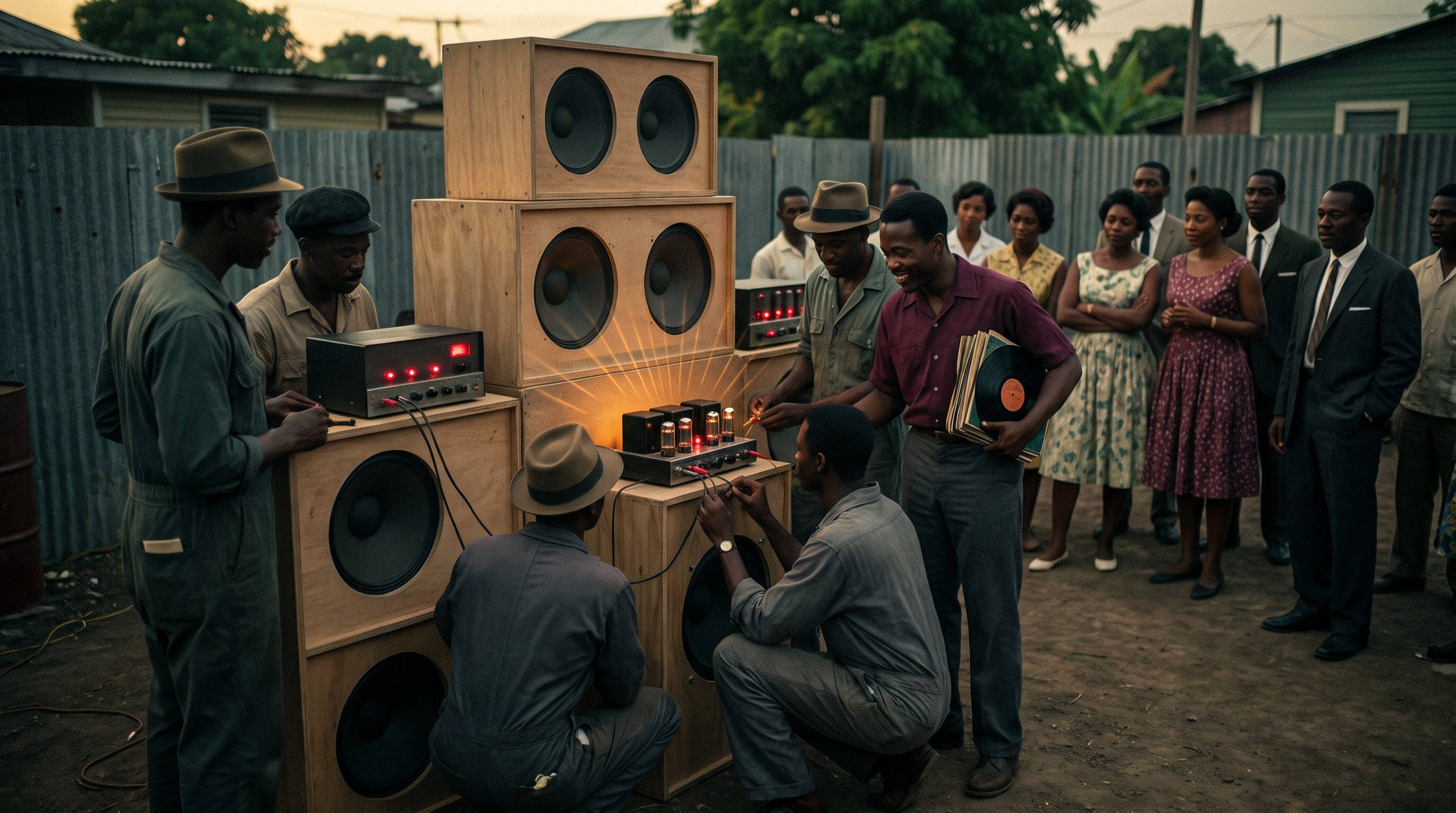
Jamaican sound-system culture developed in postwar Kingston during the late 1940s and 1950s. Early operators used generators, turntables, amplifiers and large speakers to play records for outdoor gatherings and dances. Imported American rhythm and blues was important in the beginning, especially because Jamaican listeners could not depend on local radio to supply all the music they wanted.
But imitation is not an adequate description of what happened. Jamaicans took the available technologies and reorganized them around local social conditions. The equipment had to travel. It had to survive heat, dust, rough roads, unreliable current and the physical demands of repeated assembly. It had to be loud enough to animate an outdoor yard. It needed a bass response that could gather people before they even saw the dance.
This practical pressure encouraged a form of distributed invention. One person might understand valves and circuitry. Another knew wood density and cabinet dimensions. Someone else had access to records. A selector understood sequence and suspense. A sound owner managed money, transport, promotion and rivalry. The crowd acted as the final testing instrument. If the bass did not move the people, no technical explanation could rescue it.
Early commercially successful systems such as Tom the Great Sebastian helped establish the model. Rival sounds associated with Clement “Coxsone” Dodd, Duke Reid and others intensified competition. Each sound wanted greater clarity, heavier bass, rarer records and stronger crowd response. Competition could be rough, but it also pushed technical and musical development.
The lesson is important: the sound system was never only a stack of boxes. It was a network of knowledge.
The Box Was Architecture
A speaker cabinet looks like furniture until the current enters it. Then it becomes architecture for invisible pressure.
That transformation sits at the heart of “Sound System Build Di City.” The carpenter does not merely make a container. The cabinet’s dimensions, ports, bracing and materials help determine how low frequencies travel. The electrician does not merely connect parts. The amplifier must deliver dependable power. The boxman does not merely lift equipment. Placement changes the sound field, the safety of the stack and the physical experience of the crowd.
In many histories of popular music, the star stands at the microphone while technical workers remain outside the frame. Sound-system culture makes that hierarchy harder to maintain. The event cannot exist without coordinated labor. The owner may carry the sound’s name, but its force comes from a crew.
That crew turns hardware into public space.
When the stack is positioned, the dance gains a center. Food vendors choose their places. People identify entrances and boundaries. Dancers discover where the bass hits hardest. The selector gains a visual and acoustic relationship with the crowd. A vacant lot or ordinary roadway becomes a temporary cultural institution.
This is why the anthem calls the sound box a “temple from ply.” The line is not intended to make a machine sacred. It recognizes how humble materials can shelter collective meaning. The cabinet becomes a place where memory is felt through the body.
The Dance Was a People’s University
Sound-system dances taught without resembling classrooms.
They taught musical history because selectors placed songs in relation to one another. They taught technology because youths watched equipment arrive, fail, get repaired and return to service. They taught performance because aspiring deejays and singers learned timing in front of audiences that responded immediately. They taught language because phrases born on the microphone could travel across a district and eventually across oceans.
The dance also taught judgment.
A selector had to understand more than popularity. The right tune at the wrong moment could flatten a session. A familiar record could become new when placed after a surprising version. A dubplate could declare the identity of the sound. A well-timed pull-up told the audience that its response had become part of the performance.
The crowd was not passive. It evaluated selection, clarity, originality, lyrical force and the social standing of the sound. Dancing, shouting, refusing, requesting and leaving were all forms of judgment. The people helped decide what survived.
This relationship created a public research process. Tunes were tested in the dance before or alongside wider distribution. Producers could hear which basslines carried, which vocal phrases connected and which mixes had enough space for a deejay. The dance was therefore a market, laboratory, theater and school at once.
No tuition was required, but education was taking place.
From Selector to Producer
The sound system helped shift Jamaican music from importing records to creating a powerful local recording economy.
When rival operators competed for exclusive selections, they needed material that another sound could not easily obtain. That desire encouraged local recording. A sound owner with knowledge of audience response had a reason to become a producer. A producer with exclusive music strengthened the sound. Studios, labels, pressing, distribution and performance began to reinforce one another.
Clement “Coxsone” Dodd’s path from sound-system operator to the founder of Studio One is one of the best-known examples. Duke Reid likewise moved from operating the Trojan sound and a retail business into influential record production. The precise careers differ, but the larger pattern matters: the dance generated market intelligence that could be carried into the studio.
This was not a neat or automatically fair system. Musicians and singers were not always properly compensated. Ownership arrangements could be informal, unequal or poorly documented. Yet the sound system’s role in creating demand for Jamaican recordings is undeniable.
As local music moved through ska, rocksteady, reggae, dub and dancehall, the sound remained a bridge between creation and reception. It could expose a new singer, break a new rhythm, extend the life of an instrumental or turn a B-side into the foundation for live lyrical invention.
The selector did not merely choose from culture. Selection helped make culture.
Version, Dub and the Art of Making More
One of the most radical Jamaican contributions to modern music is the idea that a recording does not have to be final.
The “version” demonstrated that one rhythm could support multiple experiences. Remove or reduce the original vocal and the arrangement acquires new space. A deejay can toast over it. A singer can introduce a new melody. An engineer can emphasize bass and drums, send fragments through echo, change the balance and make the studio itself audible as an instrument.
Dub deepened this approach. It treated the recorded track as material to be reshaped. Absence became active. A snare could disappear and return through reverb. A vocal phrase could become a ghost. Bass and drum could carry the full dramatic burden while familiar instruments appeared only as flashes.
Economically, version culture made resourcefulness audible. A rhythm represented labor and expense: musicians, studio time, engineering and production. Reusing it could extend that investment. Artistically, however, the result was not merely thrift. A version could reveal possibilities that the original song concealed.
This is why the anthem describes dub as a mint. It “coins” new experiences from shared rhythmic material. The metaphor does not mean every reuse was properly credited or paid. It means Jamaican creators developed a sophisticated practice of multiplication—one that anticipated remix culture across hip-hop, electronic dance music and digital production.
Scarcity did not disappear. It was challenged by imagination.
Bass as a Public Language
The low frequencies of a sound system do more than carry notes. They create a shared physical condition.
People in different parts of a crowd may not hear every lyric with equal clarity, but they can feel the same bass pressure. The body receives the event before the mind explains it. This creates a kind of public language: not universal in meaning, but collective in experience.
Roots reggae gave that physical force moral and spiritual weight. Bass could support lyrics about poverty, colonialism, repatriation, African identity, state violence, faith and liberation. Rastafari language brought a critique of Babylon—the oppressive order—and an affirmation of Jah, livity, dignity and African consciousness.
The dance could therefore hold celebration and reasoning together. A serious message did not require stillness. A heavy bassline did not cancel thought. The body could move while the lyric named injustice.
That combination helped roots reggae travel. The music did not ask listeners to choose between pleasure and conviction. It made rhythm carry argument.
In “Sound System Build Di City,” the bass is described as electricity because it connects separate parts of the social body. It moves through wood, wire, air, chest and memory. It powers no streetlamp, yet it allows people to see their circumstances differently.
Who Worked Around the Sound?
To understand sound-system economics, look beyond the billed performer.
The obvious roles include owner, selector, deejay, singer, engineer, technician and equipment handler. Around them may stand promoters, venue operators, security workers, drivers, printers, sign painters, record sellers, fashion makers, photographers, cooks and vendors.
Some of these roles are formal occupations. Others are temporary, part-time or combined. One person may perform several functions: musician, producer, promoter and distributor. A crew may operate through trust rather than incorporation. Money can circulate quickly but remain poorly recorded.
That informality creates both opportunity and vulnerability.
It lowers barriers for people excluded from conventional employment. A youth may begin by carrying boxes and gradually learn sound engineering. A vendor can convert cooking skill into event income. A selector can turn deep musical knowledge into reputation. But informal arrangements can also obscure payment, ownership, safety obligations and long-term protection.
A 2004 WIPO-commissioned study of Jamaica’s market for music goods and services described a sector built substantially by marginalized groups. It estimated both direct and indirect employment and specifically noted sound-system roles such as owner-manager, selector, DJ, audio technician and equipment handler. Although its figures belong to an earlier period and should not be treated as current statistics, its structural insight remains valuable: music work supports activity in retail, transport, construction and households beyond the visible industry.
The sound can feed more than the person holding the microphone.
Women Were Never Outside the Economy
Popular images of sound-system history often place men at the center: male owners, selectors, engineers and deejays standing before towers of speakers. That picture is incomplete.
Women participated as listeners, dancers, singers, selectors, operators, organizers, vendors, business managers, cooks, designers, record buyers and cultural memory-keepers. Their work was sometimes publicly celebrated and sometimes treated as background support, even when the event depended on it.
The economic story must therefore ask more than who owned the named sound. Who prepared and sold food? Who managed household risk while money was invested in equipment? Who made clothing for dances? Who sold records or handled accounts? Who created safe social networks? Who performed, selected and engineered despite gender barriers?
When “Sound System Build Di City” says “big up sistren—feed di whole picture,” it points toward this larger frame. Feeding may be literal, but it also means sustaining the conditions in which culture can happen.
A future sound-system economy should not romanticize unpaid support. Recognition must include compensation, access to technical training, leadership opportunities, archival visibility and ownership.
If the city was built collectively, its history must be narrated collectively.
From Kingston to Britain and Beyond
Jamaican migrants carried sound-system culture with them. They did not transport only records. They carried methods: how to assemble a mobile system, organize a dance, build anticipation, use a microphone, protect exclusive music and transform an unfriendly environment into a social space.
In Britain, these practices became vital where mainstream clubs and radio did not welcome Jamaican people or music. House parties, community halls, underground dances, record shops and later carnival spaces allowed a displaced population to hear familiar sound and build new local identities.
Duke Vin is widely associated with introducing a Jamaican-style sound system to Britain in the 1950s. Through later decades, sound systems and dub became part of London’s cultural identity. Notting Hill Carnival gave the tradition a huge public presence. The effects spread through punk, jungle, drum and bass, UK garage, grime and other forms.
Similar processes unfolded elsewhere. Jamaican migration and circulation carried the sound through North America, Europe, Africa, Japan, Latin America, Australia and New Zealand. Each destination developed local crews and interpretations.
Influence is not the same as ownership, and transmission is not a simple one-way gift. Local scenes contributed new ideas. Yet the genealogy must remain audible. A global sound-system culture without Jamaica in the story is not cosmopolitan; it is historically incomplete.
The anthem’s passport metaphor captures this movement. A wooden speaker cabinet does not pass through immigration like a person, but the method travels. Bass crosses a border and builds another gathering place.
Roots Reggae, Rastafari and the Moral City
The city built by sound is not automatically just.
Sound-system culture has included rivalry, exclusion, violence, exploitation and lyrical content that can wound as well as uplift. Roots consciousness does not erase these contradictions. It provides a language for judging them.
Rastafari’s influence on reggae brought African identity, anti-colonial reasoning, spiritual discipline and resistance to Babylon into international popular culture. Concepts such as I-and-I challenge extreme individualism by emphasizing a shared divine and human relation. Livity points toward a way of life rather than a weekend costume. Word-sound power treats speech as consequential.
Applied to sound-system economics, these ideas raise practical questions. Does the event strengthen the people who sustain it? Are elders respected materially or only symbolically? Are young people learning skills? Is the message consistent with the working conditions? Does money circulate locally? Are women safe and able to lead? Are artists credited?
The moral city is not created by chanting “Jah” over an unjust arrangement. It is created when spiritual language shapes conduct.
Roots reggae is strongest when consciousness moves from lyric to structure.
The Unpaid Ledger
Jamaican music has generated enormous cultural value, but cultural reach does not guarantee fair income.
Rights may be lost through poor contracts, incomplete documentation, lack of legal advice, unregistered works, inaccurate metadata or deals made under immediate financial pressure. Recordings can be licensed repeatedly while original participants receive little. An artist may be famous yet own neither the master nor a meaningful share of publishing.
The sound-system tradition complicates this further because its creativity is collaborative and frequently live. Who owns a spontaneous deejay performance over another producer’s rhythm? How should a dubplate be documented? Who receives credit when a local phrase becomes an international hook? What happens when photographs, recordings or equipment enter foreign archives?
There is no single solution, but invisibility is not acceptable.
Basic practices matter: written split sheets, performer and producer credits, work registration, accurate metadata, preserved contracts, session logs, digitized archives and accessible legal education. Collecting societies need participation and trust. Artists and heirs need help locating rights. Researchers and platforms must identify sources clearly.
The anthem asks, “If bass a bank, who pocket di key?” That is not a rejection of international success. It is a demand that success be traced through the chain of creation.
Building the Next Sound-System City
Preservation cannot mean freezing the culture in the 1970s. Sound-system culture has always changed with technology.
Today’s builders work with digital controllers, laptops, software effects, streaming platforms, social video and modern power systems. The challenge is to use new tools without allowing platforms to replace community ownership.
A stronger future could include:
- Apprenticeships in cabinet building, electronics, acoustics and live-sound safety.
- Business education covering contracts, accounting, insurance and intellectual property.
- Community-owned venues with reliable permits and fair neighborhood agreements.
- Oral-history projects led with elders rather than merely about them.
- Digitization programs that return usable copies and control to families and communities.
- Youth sound-system labs connected to music, mathematics, engineering and history.
- Fairer festivals that publish local procurement and community-benefit information.
- Africa–Caribbean touring and production partnerships based on shared ownership.
- Health, retirement and emergency-support structures for veteran contributors.
These are not separate from culture. They are how culture acquires durability.
The original sound-system builders joined technical skill to social knowledge. A twenty-first-century institution should do the same. It should know how to tune a cabinet and read a contract, how to archive a dubplate and train a teenager, how to create a powerful dance and keep the surrounding community respected.
UNESCO Recognition Is a Beginning
In 2018, UNESCO inscribed reggae music of Jamaica on the Representative List of the Intangible Cultural Heritage of Humanity. The recognition affirmed reggae’s international influence and its role as a voice for people confronting injustice, resistance, love and humanity.
Such recognition matters. It helps establish reggae as heritage rather than disposable entertainment. It can support education, preservation and international visibility.
But a list cannot pay an elder’s rent. Heritage language cannot substitute for rights, institutions and investment. If recognition increases tourism, festival income, licensing, museum programming or brand value, the next question is who participates in those benefits.
The sound-system city needs both memory and material support.
Celebration must lead to stewardship. Stewardship must include resources. Otherwise, the world may praise the tree while the roots remain thirsty.
What “Sound System Build Di City” Is Really Saying
The song is an anthem, not a textbook. Its job is to compress history into images that can move through a dance.
“Copper vein” turns wire into part of a living body. “Temple from ply” dignifies handmade engineering. “Dub was a mint” presents remixing as productive intelligence. “Bass a bank” asks who controls accumulated value. “Dancehall school” recognizes informal education. “Roots own roots” turns cultural respect into an ownership principle.
Together, these metaphors reject the idea that poverty produces nothing but lack. The people described in the song face scarcity, exclusion and unequal reward, but they are not defined by deficiency. They make systems.
That is why the chorus must feel triumphant. The critique belongs inside celebration because survival itself is worthy of celebration. The city did not wait for permission to hear itself.
Conclusion: Turn Up the History
When a sound system starts, the first deep note can seem to reorganize the street. Conversations shift. Bodies turn. Vendors prepare. The dance acquires gravity.
That physical moment contains a longer history: postwar ingenuity, imported records, local production, fierce rivalry, dub experimentation, migration, roots consciousness and community commerce. It contains people whose names are famous and many whose names were never placed on a sleeve.
To say “sound system build di city” is not to claim that bass replaced housing, roads, schools or formal employment. It is to recognize that a city is also made from relationships, knowledge, memory, enterprise and public expression.
Jamaican sound-system culture built all of those.
The responsibility now is larger than admiration. Name the builders. Preserve the equipment and stories. Pay creators. Train youths. Support women’s leadership. Strengthen Jamaican ownership. Build fair international partnerships. Let the bass continue to travel, but let value travel back toward the source.
The world already received the sound.
Now the roots must receive their due.