Reggae Culture & Conscious Music
Reggae can bring joy into a room within seconds. But beneath its warmth lives a historical memory formed by dispossession, working-class struggle, Rastafari faith and the refusal of marginalized people to disappear.
A reggae rhythm can make the body move before the mind has understood a single word. The guitar strikes the offbeat. The bass enters like a second heartbeat. A singer opens a phrase with enough space for the listener to breathe. This immediate pleasure is one of reggae’s great gifts. Yet the ease with which people enjoy the sound can hide the difficulty of the world that shaped it.
When reggae is reduced to sunshine, beaches, parties, cannabis imagery and a vague instruction to “feel good,” something essential is removed. Joy remains, but its roots are cut away. The music becomes decoration rather than testimony. Its colors are displayed while its history is covered. Its language is borrowed while the people who created that language are treated as background characters.
The song More Than Good Vibes begins with a simple conviction: reggae’s joy and reggae’s struggle cannot be separated. The music did not become powerful because suffering is beautiful. Suffering is not beautiful. Reggae became powerful because people under pressure transformed pain into knowledge, rhythm, community and spiritual resistance. The conditions produced the wound; the people produced the music.
A Beautiful Sound Born Under Pressure
UNESCO’s recognition of reggae as Intangible Cultural Heritage describes its early development within the cultural space of marginalized groups, especially in Western Kingston. That detail matters. Reggae was not invented as a tourism campaign or designed in a corporate office for a global lifestyle market. It grew through communities that needed their own means of expression—communities negotiating poverty, exclusion, political conflict, colonial memory and the unfinished promise of freedom.
None of this means every reggae song must be a political lecture. Jamaican music has always contained romance, humor, dance, rivalry, spirituality and everyday storytelling. But even a joyful song exists within a social environment. A dance can be relief from exhausting work. A sound-system session can create belonging where official institutions offer neglect. A love song can affirm tenderness in a place the outside world describes only through violence. Pleasure itself may become a defense of humanity.
That is why “good vibes” are not the enemy. The problem begins when good vibes become the only acceptable interpretation—when audiences welcome the rhythm but reject the history, celebrate the look but dismiss the faith, or demand comfort from reggae while becoming uncomfortable with its call for justice.
The Plantation Did Not Vanish When Slavery Ended
To understand the pain inside roots reggae, one must look farther back than the recording studio. Jamaica’s colonial economy was organized around plantation production and the forced labor of enslaved Africans. Land, law, wealth and political authority were concentrated in the hands of a planter class serving imperial trade. UNESCO’s description of Jamaica’s historic estate maps notes that these records reveal how enslaved people were restricted from access to land for personal use, both before and after emancipation.
That last phrase—after emancipation—is crucial. Legal freedom did not automatically distribute land, erase racial hierarchy or provide equal access to education, capital and power. A society can change its laws while preserving the shape of an older inequality. People may be declared free but still inherit an economy in which the most valuable ground, institutions and opportunities remain beyond their reach.
These historical arrangements survive as conditions, not merely memories. They appear in who owns land, who controls commerce, whose speech is treated as refined, whose religion is considered respectable and whose suffering is dismissed as disorder. Reggae’s repeated attention to Babylon, captivity, hunger, repatriation and the dignity of the poor is not decorative symbolism. It is a language for recognizing how the past continues to organize the present.
Working-Class Struggle and the Demand to Be Heard
By 1938, Jamaican workers were confronting grossly inadequate wages and punishing conditions. Strikes spread across the island, including major unrest at the Frome sugar estate. The National Library of Jamaica identifies these upheavals as a foundation of the modern labor movement and the growth of trade unions. The protest was not abstract. Workers were demanding the means to live.
The events of 1938 occurred decades before reggae took its recognizable form, yet they belong to the same historical current. The singer denouncing economic exploitation, the deejay describing pressure in the neighborhood and the worker asking for a fair wage all challenge a social order that expects labor without dignity. Reggae inherited a public vocabulary of resistance already present in labor organizing, Garveyism, anticolonial politics, religious revival and community speech.
Jamaica achieved political independence in 1962 after more than three centuries of British rule. Independence was a profound national achievement, but the raising of a new flag could not instantly repair every economic and social fracture. Many people still faced unemployment, poor housing, limited mobility and unequal access to opportunity. Formal sovereignty answered one question—who governed Jamaica—but ordinary people continued asking another: what would freedom mean in daily life?
Reggae’s conviction grew in the distance between freedom proclaimed and freedom experienced.
That distance gave conscious music its urgency. Lyrics could celebrate independence while questioning inequality. They could honor the nation while rebuking leaders. They could call for peace without pretending that injustice had disappeared. The best roots reggae refuses the false choice between love of country and criticism of conditions. It criticizes because the people deserve better.
Kingston, Migration and the Sound-System Public Square
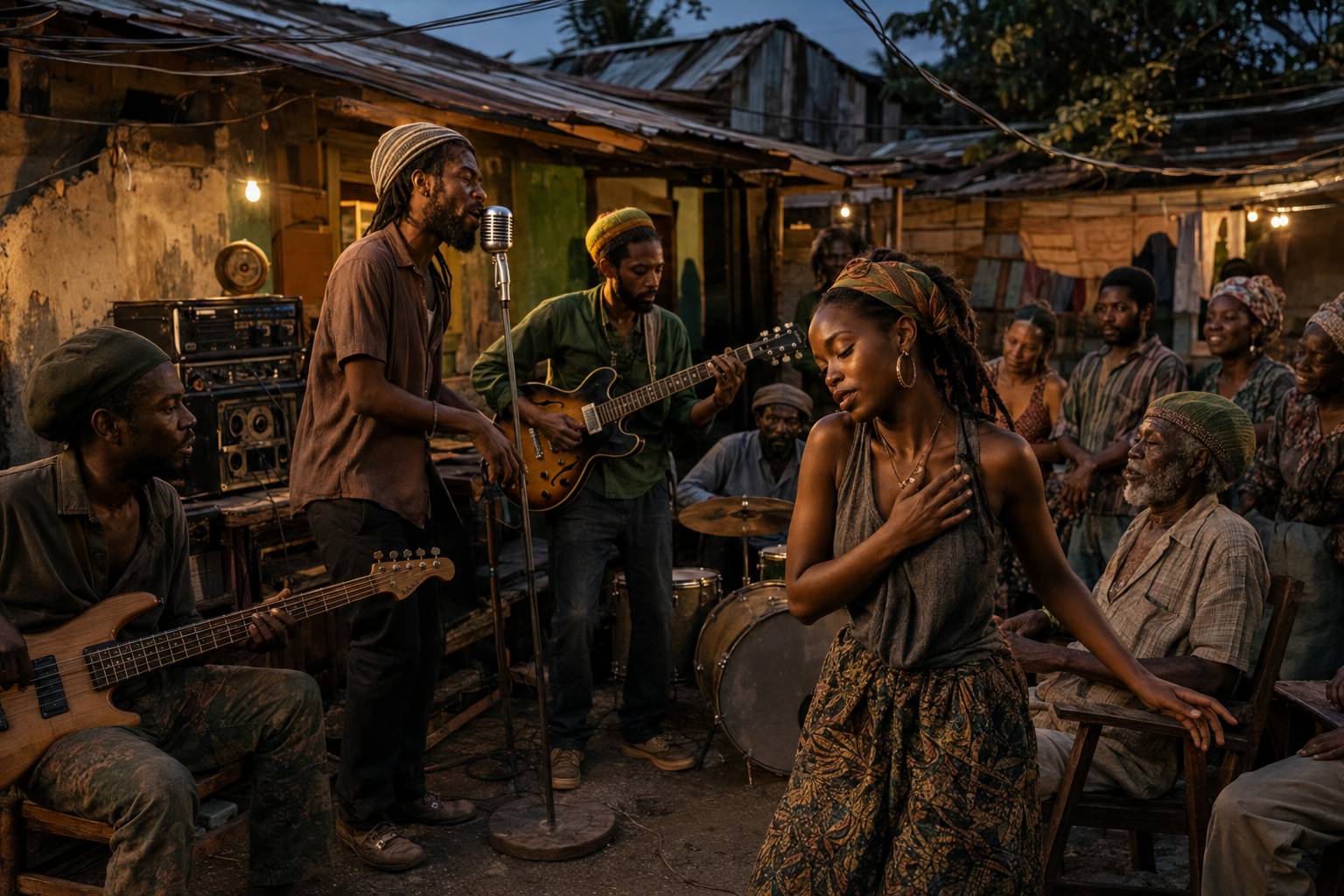
As Jamaicans moved from rural areas toward Kingston in search of work and possibility, the city gathered enormous creative energy alongside overcrowding, insecure employment and political tension. In communities with limited access to formal entertainment venues, the sound system became more than a machine. Speakers, amplifiers, selectors, deejays, record producers, dancers and local audiences created an institution in the street.
WIPO’s history of Jamaican music notes that sound systems emerged in the 1940s and became a primary source of popular entertainment. Their heavy bass, mobile dances and competitive culture helped expand the Jamaican recording industry and launch careers. This was community-built media: people assembled technology, music and language into a platform that did not require permission from elite gatekeepers.
The sound-system dance offered release, but it also produced information. A deejay could name local realities. A singer could turn hunger, romance, police pressure or political frustration into a shared refrain. The crowd did not simply consume culture; it judged records, shaped reputations, created slang and decided which messages lived. Long before social platforms promised “community,” Jamaican neighborhoods were already building participatory networks around sound.
Rastafari: Faith Formed Against Dispossession
Rastafari gave roots reggae much of its spiritual language, African orientation and moral seriousness. Emerging in Jamaica during the 1930s against a background of poverty and oppression, Rastafari challenged colonial definitions of God, civilization, beauty and belonging. It affirmed Africa as homeland, interpreted Babylon as an oppressive system and treated livity as a daily relationship among body, spirit, community and nature.
For marginalized African descendants, this was not a costume. It was a reordering of the world. Locks, ital food, Nyabinghi drumming, biblical reasoning, repatriation and reverence for Haile Selassie I belonged to a framework of identity and survival. The word had force because it disputed a society that had long taught Black people to look elsewhere for sacred authority.
Persecution behind the familiar symbols
Today, dreadlocks and red, gold and green are recognized worldwide. Their familiarity can conceal the hostility Rastafari people endured. They were frequently stereotyped, excluded and treated as dangerous. The 1963 Coral Gardens episode remains one of the clearest examples. Following violence in the Montego Bay area, security forces targeted members of the wider Rastafari community. Survivors described detention, abuse and humiliation.
In 2017, Jamaica’s government formally apologized for state-inflicted violence connected to Coral Gardens and accepted responsibility without equivocation. The apology arrived more than half a century after the event. That long delay demonstrates why cultural memory matters: institutions may move slowly, but communities keep testimony alive.
When a roots singer invokes persecution, the words therefore carry more than dramatic effect. The conviction comes from people defending their humanity while their appearance, faith and speech were used against them. A modern brand may reproduce a lion, a crown or a pair of locks in seconds. The community that gave those symbols meaning paid a far greater price.
Violence, Political Division and the Work of Witness
Reggae matured during periods of intense political division and community violence. In the 1970s, parts of Kingston became associated with partisan conflict, armed groups and the struggle for territorial control. Residents lived with consequences that could not be reduced to campaign slogans: interrupted schooling, fear, grief, unstable work and the loss of friends and relatives.
Conviction does not mean certainty about every political answer. It means refusing indifference. The singer may not control the state, the economy or the gunmen, but the singer can deny them the final word. A record preserves what happened to people whom history might otherwise summarize as statistics.
When the World Buys the Image but Leaves the People
Reggae’s international success is a triumph of Jamaican creativity. The music crossed oceans, influenced genres, strengthened diasporic connections and offered oppressed people across the world a language of dignity. Global appreciation is not automatically exploitation. Cultures grow through exchange, and reggae’s ability to communicate across borders is evidence of its greatness.
The problem is unequal exchange. Jamaican and Rastafari culture can generate attention, tourism, fashion and commercial value while originators receive little ownership or lasting benefit. WIPO has documented the broad commercial use of Rastafari symbols on clothing, jewelry and other products, noting that few such goods are made by Rastafari people and that the resulting income generally does not reach the community.
This is the commercial condition behind the lyric, “They celebrate the image but ignore the living root.” A market can value authenticity as an aesthetic while avoiding responsibility to authentic communities. It can place reggae behind a beverage advertisement, a beach resort or a wellness product because the sound communicates ease. Meanwhile, the same campaign may exclude history, spiritual meaning and Jamaican creative leadership because those elements complicate the sale.
Jamaica’s creative sector has also faced chronic underinvestment, limited financing, gaps in industry infrastructure and difficulties turning worldwide cultural influence into locally retained wealth. The contradiction is painful: a small island creates globally valuable music, yet many of its creators struggle to control catalogs, collect royalties, finance projects, preserve archives or pass stable assets to the next generation.
The digital version of an old imbalance
Digital platforms lowered some barriers to distribution, but they introduced new forms of dependence. Artists can reach international listeners without pressing vinyl or shipping discs, yet visibility is increasingly shaped by algorithms, playlists, short-form trends and platform rules. A song carrying patient historical reasoning competes with content engineered for instant reaction.
The danger is not simply that songs become shorter. It is that culture is separated from context. A fragment of bass, a phrase in Jamaican language or a Rastafari image can circulate widely while the source disappears. Attention accumulates around the user who repackages the symbol most effectively, not necessarily the community that formed it.
For independent reggae publishers, this creates a clear responsibility: build archives, identify originators, link music to history, cite sources, commission Jamaican and Rastafari voices, and develop products that return value to cultural knowledge holders. Digital publishing should do more than chase traffic. It can rebuild context wherever the algorithm removes it.
Joy Is Not an Escape from the Message
After examining so much pain, it would be easy to describe reggae only as protest. That would be another distortion. Reggae’s joy is not a sugary coating placed over struggle. Joy is one of the ways people survive struggle without surrendering their inner life.
To dance after a week of hard labor is to declare that exhaustion does not own the body. To sing harmony in a divided community is to practice a unity not yet achieved in politics. To prepare food, reason with elders, court a lover, laugh at a clever lyric or watch children move to the bass is to protect ordinary life from systems that reduce people to labor, votes, consumers or problems.
This is why the line “Joy is not surrender; dancing is not sleep” belongs at the center of More Than Good Vibes. Consciousness does not require permanent misery. The deepest roots artists know how to place warning beside celebration, mourning beside humor and judgment beside mercy. Their music offers a fuller emotional freedom than branding can provide.
What Respect for Reggae Requires Now
Respect begins with listening, but it cannot end there. Listeners can learn the names of musicians, engineers, producers, sound-system pioneers and communities behind celebrated recordings. Festivals can place Jamaican and Caribbean artists in positions of authorship and decision-making, not only onstage. Publishers can distinguish Rastafari faith from commercial stereotypes. Stores can source goods from makers connected to the culture and explain where products come from.
Artists working in reggae outside Jamaica do not need to imitate Jamaican identity. They need honesty about their own location, curiosity about the music’s history and a willingness to build reciprocal relationships. Influence should lead toward acknowledgement, collaboration and material support—not a claim that rhythm has no origin simply because it now belongs to a global audience.
For ReggaeDread.com, the practical mission is to reconnect sound with meaning. A song can lead to an article. An article can lead to an archive, course, interview or book. A product can introduce the work of a cultural maker. A social post can name an overlooked pioneer. Commerce, education and music do not have to pull in opposite directions when dignity guides the strategy.
The goal is not to police every listener or freeze reggae in the 1970s. Reggae has always changed. Ska became rocksteady; reggae opened into dub; dancehall developed new technologies and vocabularies; artists across Africa, Europe, the Americas and the Pacific entered the conversation. Protecting roots does not mean preventing branches. It means ensuring that growth does not require forgetting the soil.
The Bassline Remembers
Reggae is more than good vibes because the bassline carries lives. It carries the plantation and the strike, the crowded yard and the sound-system dance, the Rastafari reasoning and the political warning. It carries the loneliness of migration, the confidence of African identity, the grief of state violence and the stubborn pleasure of people who kept creating.
When we hear that history, the music does not become less enjoyable. It becomes more human. The sunshine grows warmer because we understand the night people survived. The dance becomes deeper because we know the ground beneath it. The colors become brighter because they are no longer empty decorations.
Reggae invites the world to move, but it also asks the world to remember. Listen to the guitar. Feel the drum. Follow the bass. Celebrate the joy. Then remain present when the lyrics name the wound. That is where good vibes become consciousness—and where entertainment becomes a living message.