Notting Hill Carnival at 60: Jamaican Sound Systems, Community Ownership and the Economics of Culture
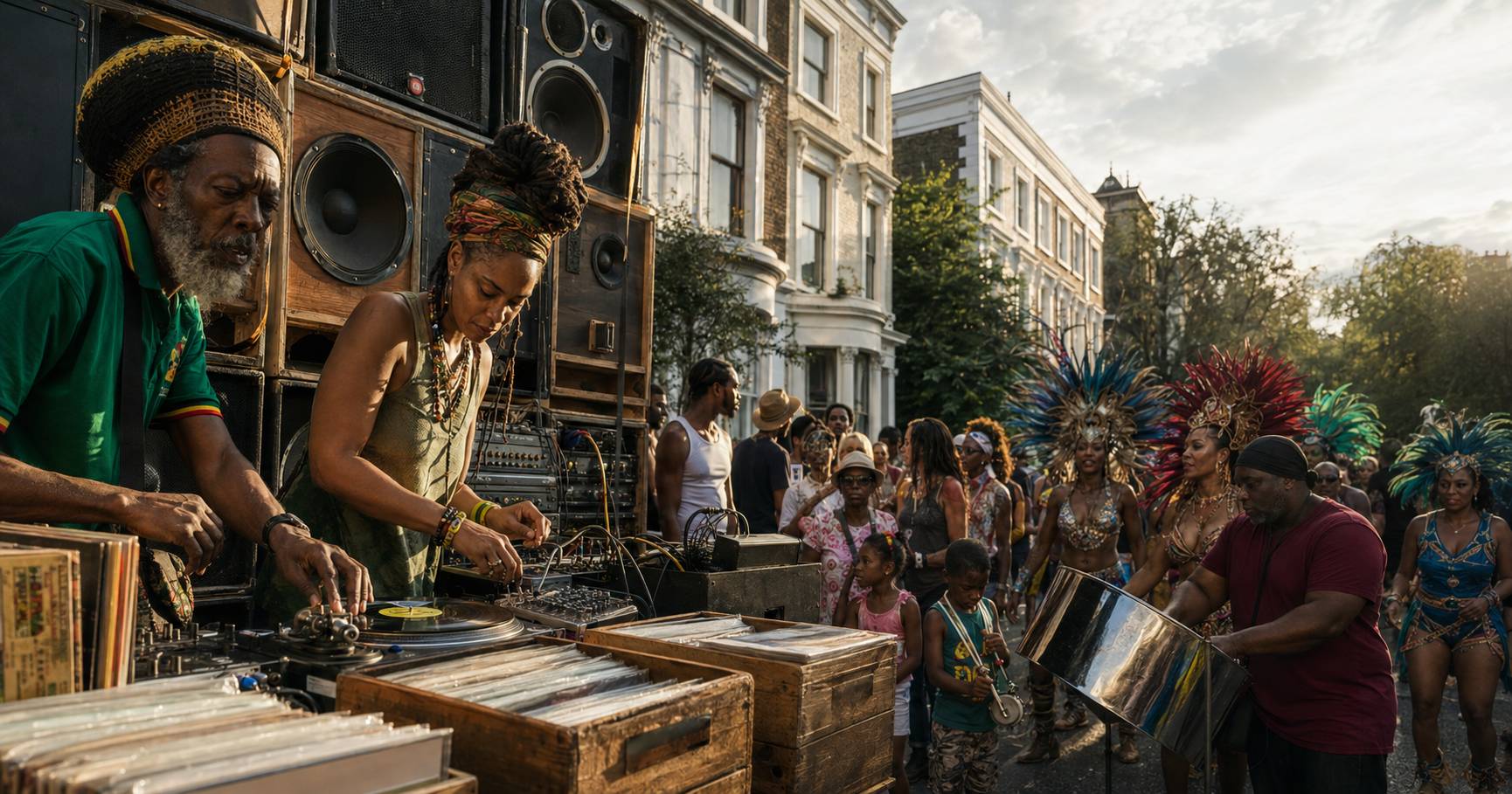
Before the crowd sees the first towering speaker boxes, it feels them. Bass passes through brick, shop shutters, steel barriers and the soles of shoes. A selector changes the record. An operator studies the movement of the street. The microphone voice calls to people who may have travelled from another borough, another country or another generation. For a few minutes, a London road becomes a Jamaican-style dance: public, improvised, physical and shared.
That sound is essential to understanding Notting Hill Carnival at sixty. The Carnival is not Jamaican alone. Its foundations include Trinidadian Carnival, steelpan, calypso, masquerade, anti-racist activism and a neighborhood festival created to bring divided residents together. Yet the Jamaican sound system gave the celebration another engine. It drew Black British youth more fully into the event, turned corners into open-air dancehalls and helped Carnival speak in the changing musical language of postwar Caribbean Britain.
The official Diamond Jubilee programmed describes a festival that has grown from a community street party into one of the world’s great cultural events. The 2026 celebration runs from the Panorama Steelband competition on Saturday, August 29, through Children’s Day and J’ouvert on Sunday, to the main parade on Monday. Sound systems operate on both street days. The anniversary therefore honors more than a date. It marks six decades during which excluded communities built a durable institution out of memory, skill, voluntary labor, family networks and the determination to occupy public space with dignity. The official Carnival 60 program places that community purpose at the center of the celebration.

Sixty Years Is a Celebration—and an Accounting
An anniversary naturally invites a parade of achievements: the handmade costumes, steel orchestras, calypsonians, Soca artists, food vendors, dancers, deejays, sound engineers and millions of visitors. But sixty years should also invite an accounting. Who supplied the unpaid and underpaid work? Who absorbed the risks when public funding was uncertain? Who controls the archive, the trademarks, the visitor data and the story told to sponsors? Which hotels, transport systems, retailers and global platforms benefit? How much of the income generated by Carnival circulates back through Caribbean organizations and the west London communities that carry its cultural responsibilities year-round?
These are not questions designed to diminish the joy. They are how joy is protected. A celebration can be culturally priceless while its practitioners remain financially vulnerable. A free street event can generate enormous commercial activity without producing equivalent security for the people who make the event distinctive. Carnival at sixty offers a rare opportunity to connect heritage with ownership, and recognition with lasting economic power.
The anniversary comes with new possibilities. The 2026 program includes additional public funding, an official app, limited-edition print-on-demand merchandise whose profits after costs are designated for Carnival’s development, and major music and beverage partnerships. Notting Hill Carnival Ltd has also announced a multiyear research collaboration with University College London’s Institute for Innovation and Public Purpose and Emelda CIC. Its stated aim is to demonstrate Carnival’s value and argue that more of the wealth it creates should be reinvested in the enterprises, institutions, workers and innovations that sustain it.
That research is timely because the argument is no longer simply that Carnival deserves to survive. The deeper claim is that the community should have a meaningful share in deciding how it survives, how it grows and where the value goes.
The Roots Before the Jubilee
Claudia Jones and culture as an answer to racism
The history begins before 1966. In 1958, racist attacks scarred Notting Hill. In May 1959, Antiguan carpenter Kelso Cochrane was murdered in a racist attack. This was a Britain that welcomed Caribbean labor while often denying Caribbean people safety, equal housing and full belonging.
Trinidad-born journalist and activist Claudia Jones had already organized an indoor Caribbean Carnival at St Pancras Town Hall on January 30, 1959. It presented calypso, steelpan, dance and Caribbean artistry as an answer to racial hostility and as a declaration of presence. The London Museum’s history identifies Jones’s event as a crucial precursor. It did not simply entertain a displaced population. It created a public image of Caribbean confidence when public life too often represented Caribbean migrants as a problem.
Rhaune Laslett, Russell Henderson and the street
In 1966, local social worker Rhaune Laslett organized the street festival from which today’s Notting Hill Carnival directly developed. Her intention was to bring together a neighborhood divided by poverty, poor housing and racial tension. When Trinidadian musician Russell Henderson and his steel band moved through the streets, residents came out, followed and danced. The procession gave the event a Caribbean pulse and a form that the neighborhood could claim as its own.
It is important to hold these strands together accurately. Claudia Jones helped establish Caribbean Carnival in Britain as cultural resistance. Laslett organized the 1966 Notting Hill street festival. Henderson and other Caribbean artists transformed participation through pan and procession. Later organizers, band leaders, residents and volunteers kept the event alive when its future was never guaranteed. No single personality owns this history. Carnival emerged through overlapping acts of organization and through a community’s repeated decision to continue.
When Jamaica Plugged In
The Kingston blueprint
Jamaican sound-system culture was built for people who could not depend on elite venues, well-funded institutions or national radio to reflect their lives. Beginning in postwar Kingston, sound crews assembled amplifiers, generators, turntables and large speaker cabinets, then carried recorded music into yards and working-class public spaces. A sound was not merely equipment. It had a name, an identity and a crew. The selector chose records; the operator controlled the system; engineers built and tuned boxes and amplifiers; microphone artists addressed the crowd; record producers supplied exclusive material; and the audience judged every decision.
This was cultural expression, but it was also a grassroots business system. Sessions created income through admissions, food, drink, record promotion and reputation. Competition encouraged crews to acquire exclusive recordings and improve their equipment. The need for distinctive material helped stimulate local record production, while the pursuit of greater bass encouraged technical experimentation. Jamaican popular music did not grow only inside studios. It grew through the relationship between studios, sounds and people gathered in front of speaker boxes.
When Jamaicans migrated to Britain, they carried this system of knowledge with them. They brought records, performance practices, technical skills, entrepreneurial habits and a belief that a community did not need to wait for permission to hear itself. In rooms, clubs, blues parties and informal venues where Black music was welcome, sound systems offered connection with Jamaica and created space for a new Black British culture.
Duke Vin, Count Suckle and the Ladbroke Grove foundation
Two pioneering Jamaican selectors, Duke Vin and Count Suckle, were based in the Ladbroke Grove area and placed their systems on the street before sound systems received formal status at Carnival. Their presence matters because it corrects the idea that Jamaican culture was added later as decoration. The culture was already living in the neighborhood.
Vincent “Duke Vin” Forbes had worked with Tom the Great Sebastian in Jamaica before establishing a Jamaican-style sound in Britain. Count Suckle also became a foundational figure in Britain’s sound and club culture. They carried more than records. They carried an organizational model in which music was selected, amplified and interpreted by a crew in direct conversation with a crowd. The speaker stack was the venue, the street was the dance floor and reputation was the currency.
Leslie Palmer and the decisive year of 1973
The formal turning point came in 1973. Trinidad-born organizer Leslie Palmer invited static sound systems into Notting Hill Carnival as a fifth discipline, alongside masquerade, calypso, soca and steelpan. Palmer also extended the route and worked to make the event more broadly pan-Caribbean. According to the official sound-system history, more than thirty static systems now serve audiences ranging from roots reggae and dub to rare groove, jungle, house and hip-hop.
Palmer’s decision was culturally generous and strategically practical. Sound systems attracted young people and increased attendance. The official history notes that funding at the time was connected to audience size, so the Jamaican sound brought both cultural energy and institutional leverage. Here, the artistic and economic stories cannot be separated: the sound systems made Carnival more representative of the Caribbean population around it, and their popularity helped expand the event’s public significance.
They also established a bridge. Trinidadian Carnival arts gave the street its procession, costume, steel and ritual calendar. Jamaican sound systems created stationary zones of bass, selection and lyrical address. Carnival became neither a Jamaican dance nor a Trinidadian parade alone. It became a powerful pan-Caribbean conversation shaped in Britain.
A Sound System Is a Community Enterprise
To describe a sound system as a large set of speakers is like describing a newspaper as a stack of paper. The equipment is visible; the institution is not. Behind a Carnival sound are months and often decades of accumulated knowledge. Crew members transport heavy cabinets, protect rare records, maintain amplifiers, calculate power requirements, negotiate access, complete safety planning, coordinate performers, train younger members and learn how to shape sound within a crowded street.
A good system does not simply make music loud. It makes bass articulate. It balances pressure with clarity. It reads the physical environment and the emotional temperature of the crowd. The selector’s choices can move between remembrance, romance, warning and release. The microphone voice may salute elders, introduce a new artist, calm tension, explain a lyric or bring thousands of people into a shared chorus.
This is why sound culture produces several forms of capital at once:
- Technical capital: knowledge of acoustics, electronics, power, staging and risk.
- Cultural capital: records, musical history, language, performance practice and credibility.
- Social capital: trust between crews, residents, artists, vendors and audiences.
- Human capital: skills passed from elders to young selectors, engineers, producers and organizers.
- Commercial capital: recognizable names, loyal audiences and the ability to draw people toward a place.
Much of this value exists all year, not only over the August Bank Holiday. The official Carnival 60 programme emphasizes that sound systems, steelbands and mas bands teach creative skills and serve their communities throughout the year. The Sound System Futures programme, created by pioneering deejay Linett Kamala, makes that continuity concrete by developing younger leaders in history, creativity, event management, safety and technical setup.
Training the next generation is not a side benefit. It is part of the production system. Without paid pathways into leadership, a tradition can be widely celebrated and still become fragile. Community ownership therefore has to include the knowledge, equipment, rehearsal space and time needed to carry the culture forward.
The Bass That Helped Build Black British Music
Carnival gave Jamaican sound systems a public platform of exceptional scale. In return, the systems helped turn Carnival into one of Britain’s most important spaces for musical discovery. Reggae and dub remained foundational, but sound culture also created conditions in which lovers rock, dancehall, rare groove, jungle, drum and bass, garage, grime, hip-hop and other forms could meet audiences in the street.
The influence is not simply a list of genres. It is a method: independent crews, bass-centered engineering, versions and remixes, microphone improvisation, competitive selection and immediate audience feedback. These practices helped shape British club culture, pirate radio, raving and urban music. Carnival became a living distribution network where a record could acquire meaning through collective response rather than through a marketing department.
Yet influence does not automatically produce ownership. A technique can move from a marginalized community into profitable industries while its originators disappear from the story. Bass may be heard in global advertising, festivals and streaming playlists while the sound crews who developed the culture struggle for storage, insurance, transport, permissions or adequate fees.
Carnival 60 should therefore celebrate Jamaican influence in a way that names people and systems, not merely genres. Duke Vin, Count Suckle and Leslie Palmer belong in the story. So do long-serving and current sounds such as Channel One, Aba Shanti-I, Saxon and the wider membership of the British Association of Sound Systems. So do the women, younger technicians, resident hosts and volunteers whose work complicates the old image of sound culture as an exclusively male space.
The Right to the Street Is Part of Ownership
Carnival’s value cannot be separated from place. A ticketed concert can be copied from one arena to another. Notting Hill Carnival was formed through the streets, housing struggles, migration histories and racial politics of west London. The route holds memories that no neutral venue can reproduce.
This is why proposals to remove, relocate or fully enclose Carnival should be treated as questions of cultural control, not only event management. Safety is essential, and an event of this scale requires expert planning, stewardship and public investment. But safety measures must be designed with practitioners and residents rather than used to sever Carnival from its social geography.
The street has never been politically neutral. In the 1970s, discriminatory policing of Black youth, including use of the “sus” law, intensified tensions. The 1976 Carnival became a major confrontation after an arrest within a climate of deep mistrust. The London Museum account places that conflict within years of unfair targeting. Remembering this history does not excuse violence or reject public safety. It explains why community participation in decisions about policing, surveillance and crowd control remains central to Carnival’s legitimacy.
The 2026 event includes £4.66 million in additional funding from the Mayor of London, on top of support from Kensington and Chelsea and Westminster councils. Organizers say the money is enabling more stewards, specialist crowd-management measures, technology and a greater operational role for Notting Hill Carnival Ltd. That investment acknowledges a basic truth: a public cultural institution of this scale cannot be safely sustained through goodwill alone.
The £400 Million Question
An economic-impact study publicized in 2024 estimated that Notting Hill Carnival generates more than £396 million annually, supports the equivalent of roughly 3,000 full-time jobs and draws about 160,000 international visitors. The Mayor of London now commonly describes Carnival’s value to the London economy as approximately £400 million. Spending flows through accommodation, food, transport, retail, entertainment and tourism. The scale helps rebut a public narrative that measures Carnival primarily through policing, disruption and cleanup.
But the headline number needs careful interpretation. It is an estimate of economic activity, not a bank account controlled by Notting Hill Carnival Ltd, sound systems or band leaders. The official Carnival FAQ states that the organizers, councils and Greater London Authority do not run Carnival as a profit-making event. A visitor may travel by rail, stay at an international hotel, buy from a chain store, purchase a drink connected to a global brand and post content to a platform headquartered elsewhere. All of that activity may be associated with Carnival, but only part of the value necessarily reaches the Caribbean cultural workers who caused the visit.
This is the difference between value creation and value capture. Communities create the reason people come: the costumes, sound, food, language, reputation and atmosphere. Other institutions may capture a large share of the resulting spending because they own property, distribution, transportation, payment systems, data or media platforms.
The contradiction becomes sharp when a festival associated with hundreds of millions in economic activity faces operational uncertainty, while participants face rising costs for fabric, feathers, trucks, fuel, equipment, rehearsal rooms, security and insurance. In 2025, organizers warned that essential operational funding remained a major gap even though Carnival’s wider economic contribution was widely celebrated. The problem was not an absence of value. It was the absence of a dependable mechanism for returning enough value to the cultural system that produced it.
What Community Ownership Should Mean
Community ownership does not require rejecting government support, professional management or commercial partners. An event serving more than a million people needs all three. Ownership means that the communities whose knowledge and labor make Carnival distinct retain real authority over its cultural direction and receive durable benefits from its growth.
First, ownership is governance. Sound-system representatives, mas makers, steelbands, calypsonians, vendors, young carnivalists, elders and local residents need formal routes into decisions. Consultation after priorities are set is weaker than participation in setting the priorities.
Second, ownership is intellectual property. Carnival imagery, recordings, oral histories, brand marks and digital collections have commercial value. Licensing should name contributors, protect cultural context and return income to the people and organizations whose work is used. An anniversary archive should not become a mine from which outside companies extract unlimited content.
Third, ownership is procurement. Public money and sponsorship can be used to buy services from local caterers, Caribbean-owned production companies, printers, designers, transporters, filmmakers and security providers. Every contract kept within the ecosystem increases its capacity for the next year.
Fourth, ownership is infrastructure. Sound systems need storage and workshops. Bands need mas camps and rehearsal space. Archives need preservation facilities. Young people need paid apprenticeships, not only inspirational exposure. Culture cannot be sustained if property costs continually remove the places where it is made.
Fifth, ownership is data. An official app can improve navigation and safety, but it can also produce valuable information about audiences, routes, interests and spending. The community should know what is collected, how it is protected, who can use it and how insights will benefit Carnival organizations rather than only technology and commercial partners.
Carnival 60 as a Culture-to-Commerce Test
The Diamond Jubilee brings several elements of a modern cultural enterprise onto one platform. The official print-on-demand store offers limited-edition merchandise without requiring large speculative inventory; profits after costs are promised for Carnival’s future development. The app is intended to bring maps, news, bands, sound systems and live updates together. Spotify’s Carnival Sounds campaign combines video, playlists, podcasts and audiobooks. Hennessy’s anniversary project uses a community panel to curate sixty influential tracks. Jamaican brands Wray & Nephew and Magnum Tonic Wine are official partners, with Magnum introducing a stage at Powis Square.
Each initiative has potential. Merchandise can convert global affection into direct support. Digital programming can carry history beyond one weekend. Partnerships can pay for production and expand audiences. An app can direct visitors toward independent vendors, less crowded routes, heritage sites and specific sounds.
But sponsorship is not the same as community ownership. A culturally appropriate logo placement is only the beginning. The more important questions concern contract terms, creative control, payments, local hiring, rights to recordings, use of audience data and what survives after the campaign ends. Does a partnership finance year-round apprenticeships? Does it purchase from community businesses? Does it leave an archive under community control? Does it pay practitioners as experts rather than using their credibility as atmosphere?
The UCL and Emelda CIC research collaboration could help move the conversation beyond promotional language. UCL describes its Carnival Economics work as treating Carnival not as a one-off event but as a year-round system of economic, social and cultural production. That approach recognizes public value that receipts alone miss: social cohesion, identity, heritage, technical learning, youth development, health, belonging and the capacity to imagine a shared city.
Measurement will matter only if it changes decisions. The research should lead to visible funding principles, community benefit standards and methods for tracking who captures Carnival-related wealth.
Eight Steps Toward a Fairer Carnival Economy
The following proposals are not claims about policies already adopted. They are practical standards against which the next decade could be judged.
- Publish an annual Carnival value account. Report public funding, commercial income, major cost categories, estimated visitor spending, local procurement and direct payments to cultural organizations. Transparency can show why a £400 million impact does not remove the need for core support.
- Create community-benefit requirements for major sponsors. Each large partnership could include a defined contribution to bands, sound systems, apprenticeships, archives or community facilities in addition to event-day branding.
- Establish multi-year operating grants. Annual uncertainty forces community organizations to spend energy surviving rather than teaching and creating. Three- to five-year support would allow equipment maintenance, staffing and planned succession.
- Adopt local and Caribbean-owned procurement targets. Food, design, printing, film, staging, transport and professional services should become routes through which Carnival spending builds independent businesses.
- Build a community-controlled rights and archive framework. Participants should be credited, consent to reuse and share in licensing income when their performances, designs or histories become commercial media.
- Pay the pathway. Apprenticeships in sound engineering, costume construction, steelpan, production management, digital archiving and safety should include wages, equipment access and recognized credentials.
- Make the app serve the ecosystem. Digital maps can highlight independent traders, heritage stories and official sounds while using privacy-respecting data to help community organizations plan.
- Invest in year-round cultural space. A portion of public and commercial support should strengthen mas camps, rehearsal rooms, sound workshops, archives and community venues threatened by high property costs.
None of these measures would freeze Carnival in nostalgia. On the contrary, they would give younger creators the resources to innovate without separating innovation from history. Community ownership is not a demand that culture never change. It is a demand that change not require the people closest to the roots to surrender control.
How Visitors, Media and Reggae Supporters Can Participate Differently
The public also belongs in the economic story. Visitors can choose independent food vendors, buy official products that support Carnival, learn the names of sound systems, follow bands after the weekend and contribute to community programs. They can treat the street not as a disposable backdrop for personal content but as a living cultural environment.
Media organizations can stop presenting Carnival only through spectacle, crowd size and police statistics. They can commission historians, photograph technical labor, interview wire crews and costume makers, explain how systems are financed and follow the work across the year. A deejay standing before a speaker tower is the visible point of a much larger production network.
Reggae listeners have a special responsibility. Jamaican sound-system culture is sometimes reduced to an aesthetic of large speakers and heavy bass. Its deeper inheritance includes engineering, entrepreneurship, record production, verbal artistry, community organization and the ability to create a public institution with limited resources. To honor that tradition is to credit the makers, support their current work and defend the conditions under which the culture can remain alive.
Brands and sponsors can participate with humility. The best partnership is not the one that most successfully borrows Carnival’s color. It is the one that leaves cultural organizations stronger, workers better paid, young people better trained and archives more secure.
The Bassline Is Also a Balance Sheet
At sixty, Notting Hill Carnival stands as evidence of what Caribbean communities gave Britain: not a single weekend of entertainment, but a public culture. Trinidadian mas, steelpan and calypso joined Jamaican sound-system practice and the creative work of people from across the Caribbean and Black Britain. Together they made a street institution that could answer racism with visibility, isolation with assembly and pressure with invention.
The sound systems made that institution louder, but not merely in volume. They expanded who heard themselves inside Carnival. They brought the logic of the Kingston yard into London: build the equipment, select the message, gather the people and make culture on terms the community can recognize. Their influence now runs through British music far beyond the Carnival route.
The Diamond Jubilee should honor that achievement with more than nostalgia. The next measure of success is whether the creators of Carnival can own more infrastructure, control more rights, receive a fairer share of spending and shape the partnerships built on their credibility. A culture that generates immense value should not have to prove its worth every August or approach survival as an emergency.
When the systems switch on in west London, the bass will carry sixty years of history. It will also carry a question into the next decade: can the economy surrounding Carnival learn to move with the same principle as the music—each part answering the others, pressure balanced with space, and power returned to the people gathered at the source?
Celebrate the spectacle. Honor the Trinidadian foundations. Feel the Jamaican bass. Remember the neighborhood. Then follow the money, protect the knowledge and help keep the culture in community hands.