
Reggae Dread · Reggae Beyond the Record · 09
Rural Jamaica in Reggae: Land and Home
Three recordings lead from a working household to a song of return and the people making a living beside the sea.
Begin with a household, not a postcard
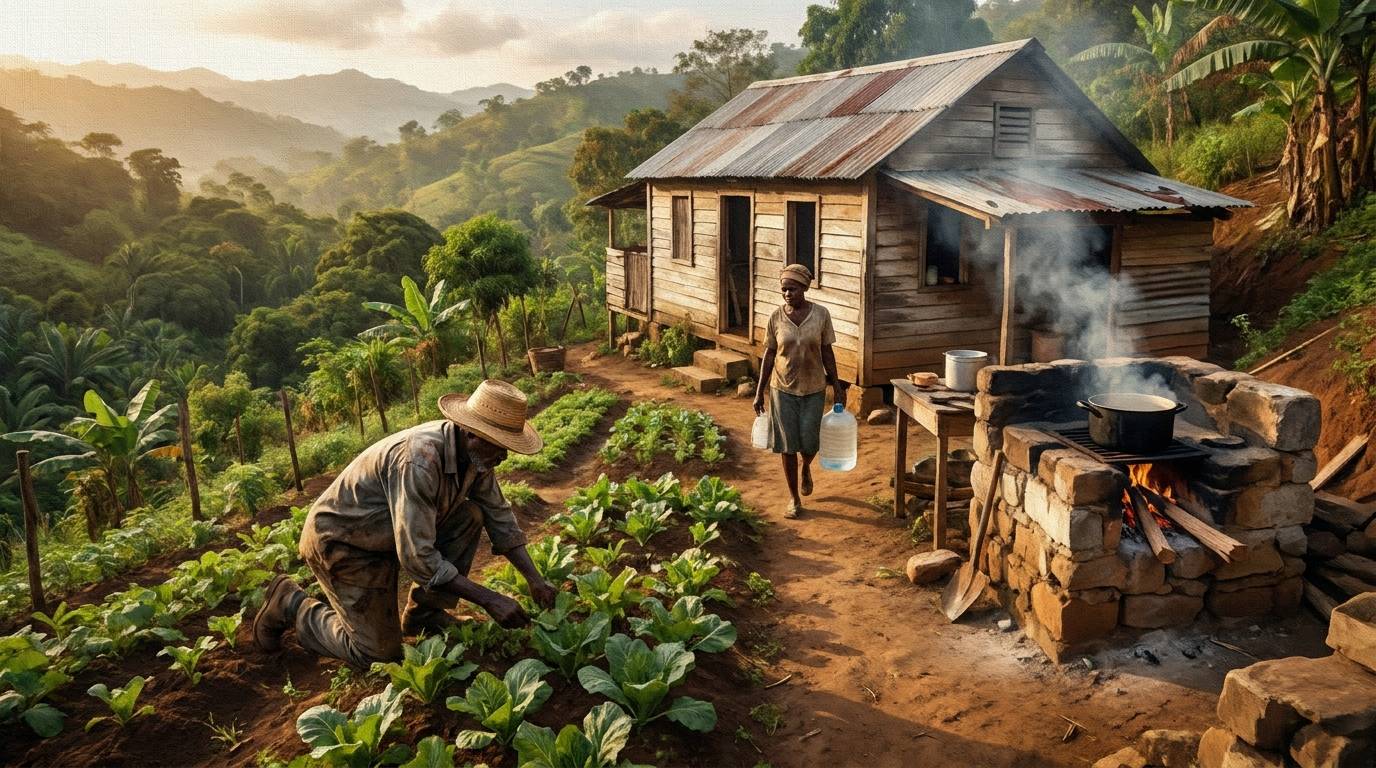
In Burning Spear's “Man in the Hills,” the countryside is full of things that need doing. Water must be carried. Food must be grown and prepared. Family members contribute different kinds of work to the life the singer remembers. The place becomes recognizable through activity and relationships. 1
That is a useful way to enter rural Jamaica through reggae. Begin with the people who use a place, the tasks that connect them and the memories a performer chooses to carry into a song.
A beautiful landscape can be part of the experience. It cannot explain the experience by itself. A hillside may be someone's garden, a route to work, a place of childhood play or land they cannot obtain. The sea may offer pleasure and provide a livelihood whose demands begin long before a visitor arrives.
Music gives us access to some of those relationships. It also changes them into performance. A singer selects details, orders them, repeats them and places a voice against the work of other musicians. The resulting record offers a way of feeling a place, with room for memory and imagination.
Three recordings, three different relationships with home
This article follows Burning Spear's “Man in the Hills,” the Maytals' “Country Road” and the Congos' “Fisherman.” Their differences matter. One turns toward a remembered household, another adapts a widely travelled song, and the third brings coastal livelihood into a distinctive musical world.
| Recording | A place or connection to follow | The question it opens |
|---|---|---|
| Burning Spear — “Man in the Hills” | Winston Rodney's St Ann background and the family's work within the song. | What makes home possible from one day to the next? |
| Toots and the Maytals — “Country Road” | Hibbert's Clarendon upbringing and a song adapted toward a Jamaican homecoming. | How can a borrowed song acquire a new sense of belonging? |
| The Congos — “Fisherman” | Cedric Myton's Old Harbour Bay background and the coastal world associated with the song. | What changes when we hear a landscape as a place of work? |
These examples do not make every Jamaican setting outside Kingston rural in the same way. St Ann contains towns and agricultural areas; a coastal community has relationships with water that differ from a hillside household. Keep the particular setting in view.
Nor does an artist's birthplace explain every part of a recording. People move, learn from others and create material beyond their own biography. The aim is to hear these songs with more specific questions, while allowing each artist the freedom of a musician and storyteller.

“Man in the Hills”: the labour inside a remembered home
Start with the recording you are actually hearing
The UMG-supplied edition of “Man in the Hills” identifies a 1976 recording, with Winston Rodney credited as vocalist and songwriter and Lawrence Lindo as producer. Lindo is better known as Jack Ruby. The song gives its name to the album. 2 1
Listen: Burning Spear — “Man in the Hills,” UMG-supplied audio.
Give the complete performance a first play. On the next, follow the family relationships and actions described. The household has several participants, and its continuity depends on tasks that somebody must undertake.
The memory can sound affectionate without making the work disappear. A listener may feel drawn toward the life being evoked while noticing how much effort sustains it.
That combination is worth holding. Rural beauty and rural labour belong in the same frame. The person carrying water experiences distance differently from someone looking at the river from a comfortable seat.
Water and cooking connect people across a place
The song's account of carrying water and maintaining a cooking fire makes a household extend beyond a building. A task begins in one location and becomes useful in another.
Think about the sequence in ordinary terms. Water has to be reached, collected and brought back. Fuel has to be available when a fire is needed. A crop has to be tended before there is produce to prepare.
Those connections give a place its lived dimensions. The route matters alongside the destination. A source that looks nearby on a map may require time, effort and repeated journeys in daily use.
Listen for the way a family is described through these dependencies. One person's contribution enables another task; several tasks make the meal possible. The household becomes a set of relationships among people, land, water and time.
The song offers selected memories, rather than a complete household account. It does not tell us every arrangement, the ownership of the land or how work was negotiated. Those are useful questions to keep open, not gaps to fill with assumptions.
Affection does not settle who carries the burden
A remembered division of work can be meaningful without becoming an instruction for every household. We can respect the singer's attachment while asking whose effort remains less visible in a familiar picture of home.
Who has time to rest? Who notices when supplies are running low? Who continues working after a meal has been served? Those questions help connect the song with the responsibilities that make daily life possible in many settings.
They also prevent a listener from treating rural living as a ready-made answer to every urban difficulty. A place may offer closeness and belonging while asking considerable work of the people living there.
Ital Beyond the Recipe: Food, Growing and Everyday Livity follows that work through garden, shop, kitchen and shared table. Beside “Man in the Hills,” it gives the music's household details a practical companion.
A musician could remain connected with growing food
Graham Reid's profile, based on a 2000 interview with Burning Spear, reports Rodney tending crops around St Ann's Bay between periods of musical work and selling produce at roadside stalls. It connects his rural life with an activity, rather than using the countryside only as a symbol of authenticity. 3
That detail adds another scale to the artist's career. Touring, recording and growing can belong to different parts of a working life. A return home may involve responsibilities as well as recovery from travel.
It still does not turn the song into a literal diary. The profile and the performance are different sources. Let one establish a reported practice and the other invite attention to what Rodney made of memory through music.
Land means access as well as attachment
A song can make a place feel close without telling us the terms on which someone used the ground. Growing a crop does not, by itself, establish ownership. A person may work land through a family arrangement, rent it or cultivate it within another relationship.
Keep those possibilities as questions rather than assigning one to Rodney's household. Who could decide what was planted? Who could remain there, and what obligations came with that access? An account of the household or a suitable document would be needed to answer.
The distinction gives the idea of independence a practical dimension. A person may take pride in producing food while depending on access, tools, water and other people's cooperation. The dignity of the work remains, and so do the conditions that make it possible.
Listening with those conditions in mind can deepen our response to the affectionate picture. We begin to hear home as something maintained within real arrangements, with security that should be investigated rather than assumed.

“Country Road”: a homecoming made through adaptation
A familiar song arrives with several names behind it
The Maytals' recording is listed as “Country Road” on the linked UMG-supplied Funky Kingston edition. Its songwriting credits name Bill Danoff, John Denver and Taffy Nivert. Toots Hibbert's performance gives their composition a new musical and geographical setting. 4
Listen: Toots and the Maytals — “Country Road,” UMG-supplied audio.
The Jamaican reference in the performance relocates the longing associated with the American song. A listener can recognize a familiar structure and hear it become connected with another home.
The shift is larger than substituting a place name. A singer's timing, tone and interaction with accompaniment help determine how a song feels. The Maytals bring their own musical relationships into the composition.
Hear the performance before asking whether it belongs in one genre or another. A classification can help locate a record on a shelf. It cannot exhaust the choices through which musicians make material their own.
Hibbert described music as something learned within a family
In his final Relix interview, Hibbert remembered singing with his parents and siblings in church in the country. He also described learning from the radio and from singers whose work crossed Jamaican and American musical worlds. He said he wanted to make a new version of “Country Roads” because he valued the song. 5
Those recollections give us a rural childhood with several routes into music. Family, worship and broadcasting could each provide something to hear, practice and develop.
This matters because a countryside background is sometimes imagined as cultural isolation. Hibbert's account describes a person listening widely and developing choices. His later adaptation can be heard as an exercise of that musical knowledge.
The presence of outside material does not diminish the local relationship. A performer can use a composition from elsewhere to express something recognizable to people who share his voice, rhythm or reference points.
The idea of home can travel before a person does
Bill Danoff's interview with the Library of Congress explains that the original song began with the experience of a drive along a Maryland road, even though its famous setting became West Virginia. He described the familiarity of the experience as a central impulse behind the writing. 6
That history gives the Maytals' adaptation another layer. The song's first imagined home was already a construction, made from a feeling, words and a melody. Its power did not depend on functioning as an exact record of the drive that prompted it.
The Jamaican version continues that movement. A recognizable wish to return becomes available to another voice and audience. Music can carry a sense of belonging across places without making the places identical.
We should therefore resist using the performance as a precise route map. It gives us a homecoming in song. Hibbert's accounts provide more specific information about his upbringing and musical formation.
Held together, the sources allow both the emotional experience and the geographical detail to remain useful.
Coming from the country did not mean arriving without knowledge
Enos McLeod remembered the young Hibbert arriving in Kingston from the country and encountering the dismissive attitude a town person might have toward a newcomer. In the same recollection, he emphasized Hibbert's striking guitar playing. Angus Taylor included the account in his 2012 interview feature. 7
The pairing is revealing: a social assumption meets an actual skill. A newcomer can be underestimated because of where he comes from while carrying abilities the people judging him have yet to recognize.
That gives rural-to-urban movement a different emphasis from a simple journey toward discovery. The city does not create all the knowledge that enters it. People bring training, habits, repertories and experience acquired elsewhere.
The Harder They Come: Music, Work and Survival Beyond the Soundtrack explores a fictional newcomer confronting another set of expectations. Hibbert's remembered musical ability helps keep the real range of such journeys in view.

“Fisherman”: the coast as a place of livelihood
Begin at Old Harbour Bay
Cedric Myton's account of childhood takes us to Old Harbour Bay in St Catherine. In an extended interview, he described a family supported partly through beekeeping, including bees kept on Goat Islands. His remembered coast includes work that a visitor looking only for boats might overlook. 8
A 2021 Jamaica Observer profile connects the area's seafaring culture with “Fisherman.” Together, the sources give us a particular setting and more than one way a family or community could earn a living within it. 9
Old Harbour Bay is a coastal town. It should not be made to stand in for a hillside farm or every community outside Kingston. Its inclusion here helps us examine how a broad idea of country life can conceal distinct local economies.
The useful connection is livelihood. Land, water, access and skill shape what people can do, while musical memory carries selected parts of those relationships into a recording.
Hear a working figure within a made musical world
“Fisherman” opens Heart of the Congos, the 1977 album produced by Lee “Scratch” Perry. VP's catalogue identifies the album with the Black Ark studio and supplies the listening edition linked here. 10
Listen: The Congos — “Fisherman,” through VP Records.
The song invites attention to a working person and to the need for food. Those immediate concerns occupy a sound world with its own vocal relationships, rhythm and studio atmosphere.
Begin by following the voices. Notice how the lead presence sits beside the other vocal parts, and where your attention moves when a phrase returns. Then follow the accompaniment for another complete play.
The exercise keeps the fishing image connected with an actual recording. We are hearing musicians and a producer make something, alongside hearing a song about another kind of work.
Those two kinds of making need not be separated. A record can transform daily experience into a spiritual or imaginative encounter while retaining the force of an ordinary need.
Memory includes the viewpoint of the person remembering
Myton's childhood recollection is affectionate. He also explained that as a child he had felt provided for, without yet understanding how hard life could be for people elsewhere. That distinction is built into his own account of remembering. 8
It gives a careful listener a valuable approach to nostalgia. A memory can be truthful to a child's experience while leaving parts of the adults' labour outside the child's awareness.
We can honour the remembered security and still ask what made it possible. Who had the knowledge to maintain a livelihood? How did the family manage a difficult season? What work happened before the child understood that work had costs?
Those questions need a person's account or other evidence. They should not be answered by deciding that an affectionate memory must conceal misery, or that happiness proves circumstances were easy.
An account becomes richer when its perspective remains visible. Myton describes what he remembers and what he later came to understand. The movement between those positions belongs to the history.
The atmosphere was also a musical decision
In the same extended interview, Myton discussed approaching songs with different vocal attitudes and recalled “Fisherman” being tried again with different musicians. The sound was developed through choices within a studio, rather than arriving fully formed from the landscape. 8
That account helps resist another easy assumption: that a record's atmosphere is a natural property of where the singer was born. Artists carry experience, but they also revise, experiment and collaborate.
Give Myton that creative agency when listening. His background can deepen an encounter with the song without becoming an explanation that makes his actual musical decisions disappear.
The same applies to the other people at the session. A coastal subject recorded in Kingston brings different forms of knowledge together. The countryside, town and studio are connected through the people working among them.
Home can remain divided across places
In a separate 2012 interview, Myton spoke of an interest in farming and fishing while also describing family members living in America and his own movement between countries. His account places the attachment to those activities within a mobile life. 11
A person can maintain a strong relationship with a place without remaining there continuously. Work and family can create more than one point of attachment.
Jamaica to Britain: How Reggae Records Connected Lives follows another set of movements. Beside Myton's account, it helps us hear home as something sustained through relationships, sometimes across considerable distance.
Listen again with a more particular sense of place
The three recordings offer different ways to approach the relationship between a place and a song. A household is remembered through tasks. A composition travels and becomes a homecoming for another audience. A coastal livelihood enters an intricate musical setting.
The connections become more useful when we keep their differences. “Man in the Hills” is not an agricultural survey. “Country Road” is not Hibbert's complete autobiography. “Fisherman” cannot document every working life around Old Harbour Bay.
Each can nevertheless help us notice something we might otherwise pass over. A family role becomes visible. A singer's adaptation becomes a choice. A shore becomes a place where people work and depend on one another.
Make a place-and-listening record
Choose one of the songs and complete the following short record. Keep the source beside the statement it supports.
| Listen or investigate | Write down |
|---|---|
| Identify the performance | Artist, track title and the edition or link you used. |
| Follow the song | Two actions, relationships or images it brings to your attention. |
| Locate the connection | A place identified by an artist's account or dependable release history. |
| Describe the work | What someone has to do within the song or the associated account. |
| Hear the making | One vocal or instrumental relationship that shapes your response. |
| Keep the distinction | What belongs to the song, what comes from testimony and what remains your interpretation. |
If the recording prompts a family memory, ask a specific question. Who collected the water? What did someone grow for sale? Where did a person hear their first record? Let the answer establish its own place and period.
Record a change as well as a continuity. A route may have altered, a household may have moved or a livelihood may have become harder to maintain. Remembering can include the work of explaining what is different now.
Bring the landscape back into daily life
For a reader who grows food, these songs may direct attention toward the labour behind a meal. For another listener, the strongest connection may be a journey home, a family voice or the experience of being underestimated after moving somewhere new.
Those responses can begin a conversation without making every life the same. A foothill garden in California and a remembered Jamaican household have different histories, climates and arrangements of access. The useful connection lies in asking clearly what a place requires and what people make possible within it.
Rasta Lifestyle in the Foothills vs City takes that comparison further. Here, return first to the recordings and the people speaking through the accompanying accounts.
Hear the water being carried, the wish to return and the person working beside the sea. Let the music give the landscape inhabitants, responsibilities and particular names. Home becomes more than an attractive idea when we recognize the relationships and labour that keep it alive.
Sources and further reading
- AllMusic: “Man in the Hills,” song account — the recording's family-work imagery and release context.
- UMG / Burning Spear: “Man in the Hills” — supplied audio and recording credits; the year is used without treating a digital catalogue's January 1 placeholder as an exact release day.
- Graham Reid: Burning Spear, interviewed in 2000 — interview-based profile and reported cultivation around St Ann's Bay; posted online in 2010.
- UMG / Toots and the Maytals: “Country Road” — the listening edition, song title and Danoff/Denver/Nivert credits. This later digital album configuration is not presented as the original Funky Kingston track list.
- Relix: Toots Hibbert's final interview — family singing, rural upbringing, listening and his decision to adapt the song.
- Library of Congress: Bill Danoff interview — the original song's development and its relationship with place. Its passing quotation of the Jamaican adaptation is not used to establish that version's wording.
- United Reggae: Toots Hibbert, 2012 — Enos McLeod's recollection of Hibbert arriving in Kingston with musical skill.
- Reggae-Vibes: extended Cedric Myton interview — Old Harbour Bay, family beekeeping, childhood perspective and studio choices.
- Jamaica Observer: Cedric Myton on top — the connection between local seafaring culture and “Fisherman.”
- VP Records: Heart of the Congos — album date, track list, production context and listening access.
- United Reggae: Cedric Myton, 2012 — farming and fishing interests, family and movement between countries.