Rasta Lifestyle
How countryside and city environments shape Rastafari LivityRasta life in the countryside and foothills can create room for growing food, working with the seasons, and finding quiet for spiritual reflection. Metropolitan life can bring people closer to fellow Rastas, cultural institutions, employment, and opportunities to organize. Each setting offers possibilities, and each places demands on the people trying to live with purpose there.
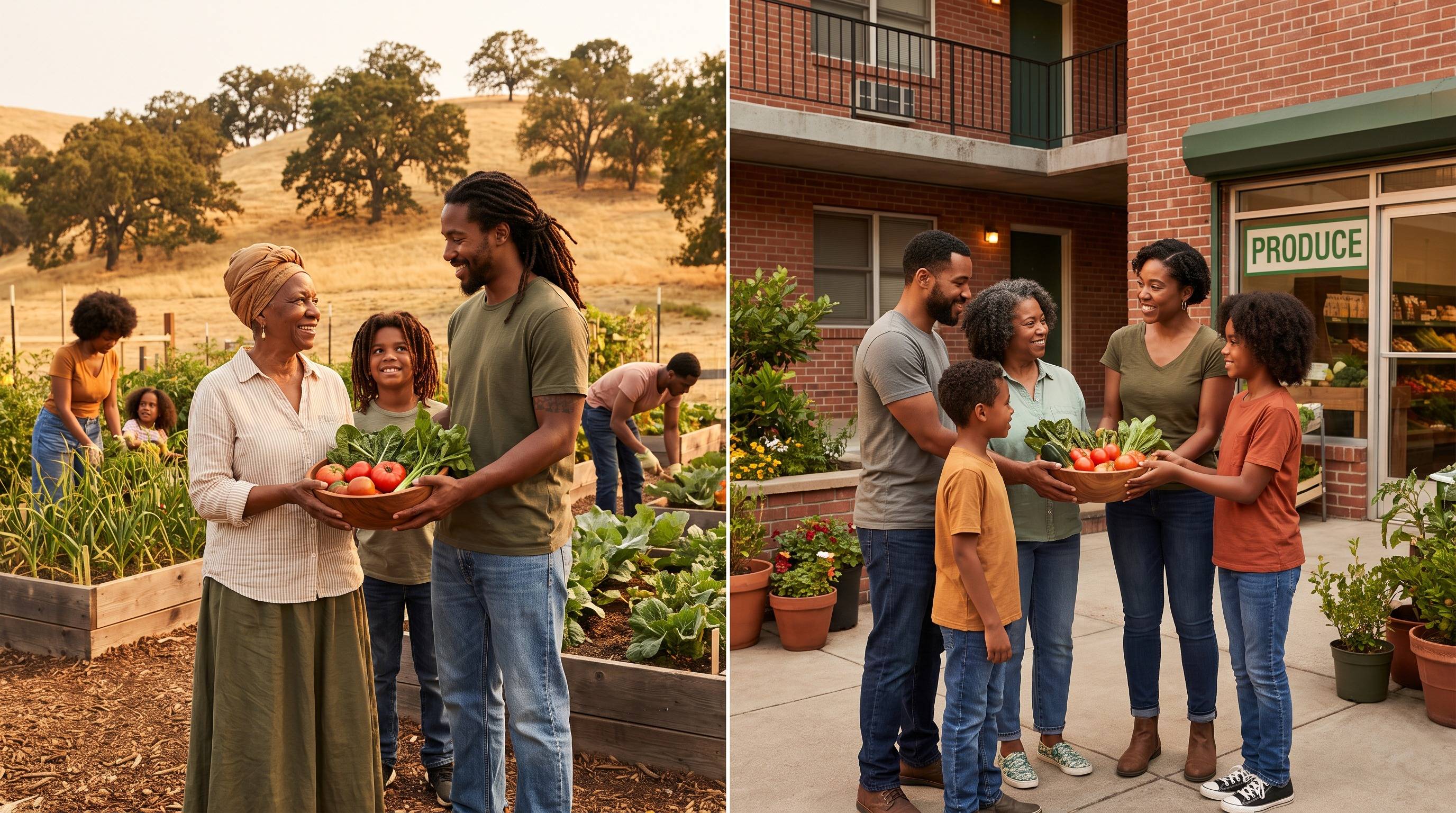
Imagine a foothill household preparing vegetables gathered from a small garden. Elsewhere, a city household carries produce home from a neighborhood market before an evening reasoning session. These imagined scenes show how similar commitments can take different practical forms. The setting influences the choices available, while the meaning of those choices comes from the people making them.
Comparing the two requires attention to history, money, access, and belonging. A person with secure housing and supportive neighbors has options that someone facing displacement may lack. A beautiful view cannot answer every need, and a busy neighborhood can hold deep relationships. Understanding those differences helps us appreciate how Rastafari livity is sustained across places, including Jamaica, its wider diaspora, and the Northern California foothills.
What Rastafari Livity Means
Livity gives this discussion its foundation. The term describes a spiritual way of life, connecting belief with everyday conduct. Rastafari also contains different houses, often called mansions, including Nyahbinghi, Bobo Shanti, and the Twelve Tribes of Israel. Their practices and interpretations vary, as do those of individuals and households. Geography alone cannot explain these differences. [1]
Rastafari emerged in Jamaica within a history of slavery, colonial rule, racial hierarchy, and African resistance. Connections to Africa, Ethiopian sovereignty, Marcus Garvey, and Emperor Haile Selassie I have shaped its religious and political imagination. Any discussion of gardening, simplicity, or natural living needs to retain those historical foundations. [2]
That history gives ordinary decisions a wider significance. Preparing food can express care for the body and gratitude for life. Sharing knowledge can strengthen collective independence. Teaching children about Africa can challenge inherited accounts that diminish Black achievement. These are ways to understand the relationship between principle and action; their expression differs among practitioners.
Rastafari language also identifies Babylon with oppressive structures rooted in colonialism and racial domination. That understanding directs attention toward power, treatment, and responsibility wherever people live. [3] A household in the hills still encounters employers, lenders, markets, and government institutions. A household in a city can develop meaningful independence through cooperation. The useful comparison concerns the conditions that support these efforts and the obstacles that make them harder.
Rastafari History in the Countryside and the City
Pinnacle and Rural Community
The countryside holds a significant place in Rastafari history. In 1940, Leonard Howell established Pinnacle in Saint Catherine, Jamaica. Smithsonian documentation describes a rural community where followers developed an African-oriented, independent way of life. Land and collective residence provided a setting in which religious conviction could influence everyday social organization. [4]
Pinnacle also experienced colonial repression. The community timeline produced for Rastafari in Motion records repeated pressure and the destructive 1954 raid. Its history therefore carries questions about the security of land, the treatment of Black religious communities, and the limits authorities placed on their autonomy. [5]
Kingston and the Urban Diaspora
Urban communities contributed their own foundations. Smithsonian anthropological writing describes Kingston yards and camps as important settings for the development of Nyahbinghi ceremonies during the mid-twentieth century. Rural migration and networks linking town and country helped shape these communities. [1] The movement grew through people's journeys and relationships across these environments.
Diaspora cities extended that exchange. Rastafari in Motion documents organizing in London and Birmingham, including cultural institutions, community services, and public protest. Its timeline records the Rastafarian Women's Organization providing social services from 1981. [5] These examples place community care within the history of urban Rastafari.
This history helps explain why any present-day comparison should leave room for movement. Someone may work in a city, visit relatives in the countryside, attend gatherings elsewhere, and support projects in Africa. A household's address captures only one part of its cultural geography. Family connections, religious commitments, and shared work often reach much farther.
Spiritual Practice in the Foothills and the City
Quiet Space and Rural Responsibilities
Quiet is one attraction of foothill living. Where housing and surrounding land permit it, a person may have space to pray outdoors, read without interruption, or sit with the changing light. Working in a garden can make seasonal change part of daily attention. These opportunities can give spiritual practice a dependable place in the household routine.
But the time must still exist. A long drive to work, repairs, irrigation problems, or caring for relatives can fill the day. Owning more space often creates more maintenance. A household that imagined a slower life may discover that its responsibilities require deliberate boundaries around rest and reflection.
City Routines and Shared Reasoning
City residents face different pressures. Shared walls, traffic, shift work, and crowded rooms may limit solitude. A regular early-morning practice or an agreed quiet period at home can help protect attention. Access to a nearby community may also make collective study or worship easier to sustain than it would be across long rural distances.
Reasoning offers another way to consider the comparison. As discussion about faith and life, it depends on listening, trust, and time together. Those conditions can develop around a country kitchen table or in an urban community room. The practical question is whether people can participate regularly and speak without being hurried or dismissed.
For either household, spiritual rhythm becomes more sustainable when responsibilities are shared. Someone must prepare the meal, provide transport, or watch the children. Making that work visible gives more people the opportunity to participate fully in the practices the community values.

Ital Food and Access to Land
Food brings the differences between locations into sharp focus. Ital connects eating with Rastafari understandings of natural living. Vegetarian practice is an important tradition, although observance varies. The Smithsonian's terminology guide explicitly acknowledges that variation. [3] A thoughtful comparison therefore begins with a household's actual commitments and circumstances.
Growing and Buying Food
Suitable land can make growing vegetables and herbs part of everyday life. Harvesting ingredients offers direct knowledge of their cultivation and an opportunity to teach children. Yet land area alone says little about what a garden can produce. Sunlight, usable soil, water, physical ability, and time all matter. A modest garden that receives steady care may serve a family better than an ambitious plot they cannot maintain.
City households may find ingredients through produce markets, Caribbean shops, buying groups, or community gardens. These resources are unevenly distributed. Living in a large metropolitan area does not guarantee an affordable shop nearby, and a journey involving several buses can turn food shopping into a substantial task.
Seasonal planning also matters. A garden may provide abundant tomatoes for a few weeks while the household still buys beans, grains, and produce through winter. Keeping a simple record of what gets eaten, what is shared, and what goes unused can guide the next planting. Food independence becomes more realistic when it accounts for the whole year. Preserving surplus requires its own time, equipment, storage, and suitable preparation skills.
Food Sharing as Community Practice
In its own account of community life, Jamaica's Rastafari Indigenous Village connects gardening and an Ital kitchen with craftwork, drumming, and learning from elders. [6] It offers one example of how food can belong to a wider cultural practice. Individual households will organize those relationships differently.
Cooperation can help in both settings. A rural grower might share seasonal greens with friends who contribute staple ingredients or help with transport. Apartment neighbors might coordinate purchases and cooking. These arrangements acknowledge that feeding people requires several kinds of work. A good harvest becomes more useful when someone has the time, knowledge, and equipment to turn it into meals.
Work Housing and Rasta Independence
Country Costs and City Opportunities
Rural life can make certain forms of independence visible. Growing food, repairing equipment, making crafts, and managing household resources can reduce particular expenses or create income. There can be satisfaction in understanding how something works and being able to maintain it. Those abilities also become valuable when shared with neighbors.
However, a realistic household account includes transport, tools, utilities, housing payments, and maintenance. Producing some food rarely removes the need for income. Country residents may depend on employment in nearby towns, customer orders, or remote work. Each arrangement carries requirements that deserve attention before a household commits to it.
Cities may offer a larger range of employers, collaborators, and customers. A cook, teacher, musician, or tradesperson may benefit from being close to the people who need their work. The same density can bring expensive premises, high rents, and fierce competition for customers. Access to opportunity and the ability to afford participation are separate questions.
Fair Pay and Secure Housing
For a Rasta business, values can become concrete through clear pricing, fair payment, honest descriptions, and respectful working relationships. These are practical standards a community can discuss and assess. Rural location provides no automatic guarantee that a business follows them, while an urban storefront can put them into daily practice.
Mutual support also needs boundaries. If every cultural activity depends on unpaid labor, the people with the least spare time can become excluded. Paying a cook, driver, teacher, or sound engineer recognizes the work that makes a gathering possible. Independence grows more durable when the people providing essential skills can sustain their own households.
Security of housing deserves equal attention. A renter may have limited control over planting, storage, or gathering space in either location. A homeowner may have more control but substantial ongoing costs. Before treating a move as liberation, a household can examine what choices the arrangement actually provides, how long those choices are secure, and whose labor will maintain them.
Community Belonging and Racial Dignity
Rural Relationships and Cultural Isolation
A small country community can offer close relationships built through repeated contact. Neighbors may notice when someone needs help, lend equipment, or share local knowledge. For a Rasta household, those relationships can make a new place feel familiar. Their quality depends on how people actually treat each other.
Where few neighbors share African diasporic experience or understand Rastafari, isolation is also possible. Repeatedly explaining one's hair, food, faith, or cultural interests can become tiring. A Black Rasta family may need to assess racial attitudes alongside housing and employment. A peaceful setting has limited comfort if people feel unwelcome in everyday public spaces.
Urban Networks and Everyday Inclusion
Some metropolitan neighborhoods offer established Black, African, Caribbean, and Rastafari networks. A person may find shared references and people who understand family traditions without lengthy explanation. Such networks can provide support during difficult periods, although physical proximity alone does not create trust. Relationships still need care and reciprocal effort.

When assessing a place, look beyond its cultural imagery. Ask who organizes events, whose knowledge receives credit, and whether residents feel comfortable participating in ordinary civic life. A town's enthusiasm for reggae can be an opening for conversation. Deeper understanding develops when people also engage with Rastafari history and listen to the experiences of those living the faith.
Belonging also has practical requirements. An elder who no longer drives may need reliable transport to gatherings. A parent may need child-friendly meeting times. Someone with limited mobility may need an accessible room and bathroom. These details determine who can participate, regardless of how welcoming an invitation sounds.
Consider two imagined situations. A foothill household has ample outdoor space but lives far from its closest Rasta friends. A city household has limited space but meets trusted community members each week. Their needs differ. The first might prioritize regular visits and shared transport; the second might seek occasional access to land. Each can identify what is missing without dismissing the strengths it already has.
Reggae Nyahbinghi and Cultural Responsibility
Creative Space and Access to Audiences
Music connects many people to Rastafari, and the settings in which it is made affect both creative possibilities and livelihoods. A country home may offer room for writing or recording. Distance from audiences and collaborators can make rehearsals, performances, and equipment repair harder to arrange. Space is useful when people can also reach it.
Cities may bring musicians, studios, promoters, and listeners into closer contact. A conversation can become a rehearsal, and a rehearsal can become a paid performance. Yet commercial expectations may push artists toward familiar images or messages that are easier to sell. Cultural independence requires decisions about who controls the work and how its meaning is presented.
Respecting Sacred Practice and Cultural Work
Nyahbinghi also deserves recognition within its spiritual context. Smithsonian documentation describes its gatherings, drumming, and chants as elements of religious life. [1] A public reggae event and a sacred gathering can involve different expectations. Visitors and organizers should learn those expectations from the people responsible for the occasion.
For community events in either setting, respect becomes practical through credit, payment, consent, and preparation. Ask before recording a ceremony. Identify musicians and craftspeople accurately. Agree on fees before announcing a performance. Plan a sound level and schedule that participants and neighbors can reasonably accommodate.
A foothill gathering could give city musicians space for a workshop, while an urban venue could introduce country-based artists to new listeners. Such exchanges work best when the terms are clear. Cultural appreciation has greater substance when the people carrying the knowledge retain a voice in how it is shared.
Raising Children and Caring for Elders
Learning Through Land and Community
Country living can create opportunities for children to participate in growing food, observing wildlife, and caring for a place over time. A child who plants seeds and helps prepare the harvest can understand the effort behind a meal. That learning becomes more meaningful when adults explain its relationship to gratitude and responsibility.
Urban childhood can offer frequent contact with cultural programs, libraries, musicians, and families whose experiences broaden a child's understanding. A neighborhood project may teach cooperation through preparing food or helping an elder. These opportunities depend on affordability, accessibility, and the time adults have to accompany young people.
In either setting, cultural education benefits from room for questions. Children can learn about Jamaica, Africa, colonial history, and Rastafari through books, music, conversation, and relationships with knowledgeable people. They also need opportunities to express their own experiences, including what feels difficult about being visibly different at school or among friends.
Sharing Responsibilities Across Generations
The adults providing that education deserve attention too. Preparing meals, arranging visits, managing money, and caring for relatives are substantial contributions. Sharing those responsibilities can widen participation in study, music, and leadership. It also gives children a practical example of fairness within the household.
Families change over time. A setting that suits young children may present different challenges when teenagers seek training or elders need more frequent care. Reviewing those needs together allows a family to adapt its arrangements while preserving the relationships and practices that matter most.
Young people should have a part in those conversations. They may value the quiet of home while wanting more contact with peers, or enjoy city friendships while asking for outdoor experience. Listening can reveal workable adjustments, such as regular visits, apprenticeships, or shared projects. Cultural continuity gains strength when young people can contribute to its daily expression.
Rasta Life in the Northern California Foothills
Northern California offers a useful local perspective, but its foothills have conditions distinct from Jamaica's. UC Cooperative Extension describes how elevation, microclimate, soil, water availability, and access to markets affect farming in the Sierra foothills. Nearby properties can have different growing conditions. [7] A household garden also benefits from careful observation of its own site.
Local Growing Conditions and Water
For someone developing an Ital garden, that means learning which foods can grow reliably within the available conditions. Begin with crops the household will eat and a manageable area. Observe seasonal sun, frost, drainage, and irrigation needs. Local growing knowledge helps translate a commitment to food independence into a routine the household can maintain.
Water deserves particular attention. The region's dry summers make irrigation an important consideration for many crops, even where winter rainfall is substantial. [7] Garden size should fit the water and labor available. A smaller productive plot can support the kitchen while leaving time for family and community activities.
Wildfire Awareness and Land Care
Land care also includes wildfire awareness. UC Agriculture and Natural Resources explains that vegetation and other combustible materials can create pathways toward a home. Plant placement and ongoing maintenance influence that exposure. [8] Growing food and appreciating natural surroundings therefore need to sit alongside informed care for the space around buildings.
For a household teaching others, these responsibilities can become shared learning. A garden visit might explore how to grow useful food with the resources available, while a separate discussion considers care for the surrounding property. Local expertise and Rastafari reflection can inform the conversation in different ways. The aim is a relationship with place grounded in observation and continued work.
Connecting Rural and Urban Rasta Communities
The comparison becomes most productive when it leads to relationships. A foothill household might have growing space and practical skills to share. City friends might have teaching contacts, cultural resources, customers, or access to a venue. Each contribution can help meet a need the other household cannot easily address alone.
Practical Exchanges and Shared Decisions
Start with an arrangement small enough to sustain. That could be a monthly produce exchange, a shared journey to a gathering, or an occasional workshop with agreed payment. Talk about costs and responsibilities beforehand. A generous idea becomes dependable when everyone understands what they are offering and what they can realistically continue.

Keep decision making reciprocal. The person providing land should help shape how visitors use it, while visiting teachers should decide how their knowledge is presented. Discuss photographs, recordings, expenses, and credit before the gathering begins. Afterwards, ask what worked and what created an unfair burden. Those conversations make the next exchange easier to organize and more respectful of everyone's contribution.
Keeping Relationships Strong Across Distance
Communication matters between visits as well. Regular calls can maintain friendships and give isolated elders a place in ongoing discussion. Shared reading or listening sessions can connect households across distance. Digital contact works best when it supports relationships people also care for through practical help and personal attention.
For anyone considering a change of setting, the most revealing questions concern ordinary life. How will the household earn enough, obtain food, reach care, and remain connected to people it trusts? Who will do the additional work? Answering those questions honestly creates room for spiritual commitments to become part of a workable daily life.
Rastafari has traveled through rural communities, city yards, migration routes, and gatherings across the world. People continue that work when they make their knowledge useful to one another. A shared meal, a paid teaching session, or a reliable ride can strengthen the relationships through which livity is carried into another day.
Sources and Further Reading
- Smithsonian National Museum of Natural History. AnthroNotes Volume 26 Number 2, Fall 2005. Discussion of Rastafari livity, houses, Nyahbinghi, and rural and urban networks.
- Smithsonian Education. Dread History The African Diaspora Ethiopianism and Rastafari.
- Smithsonian Education. Dread History Terminology.
- Smithsonian Education. Brother Edgar Reid and the Pinnacle community.
- Rastafari Regal Livity. Rastafari in Motion materials and timeline co-curated with Rastafari elders.
- Rastafari Indigenous Village. About the community.
- Hardeep Singh, UC Cooperative Extension. Guide for prospective farmers in the Central Sierra, July 1, 2026.
- UC ANR Fire Network. Prepare Your Landscaping.