One Box Feed a Thousand
Article theme: How one neighborhood sound can nourish a much larger social and economic world
Song connection: “One Box Feed a Thousand”
Reading time: Approximately 14–16 minutes
“One box feed a thousand soul / One bassline mek di broken whole.”
The title “One Box Feed a Thousand” sounds impossible if the box is understood only as wood, wire, magnets and speaker cones. A cabinet cannot cook rice. An amplifier cannot pay school fees by itself. A bassline cannot repair a roof.
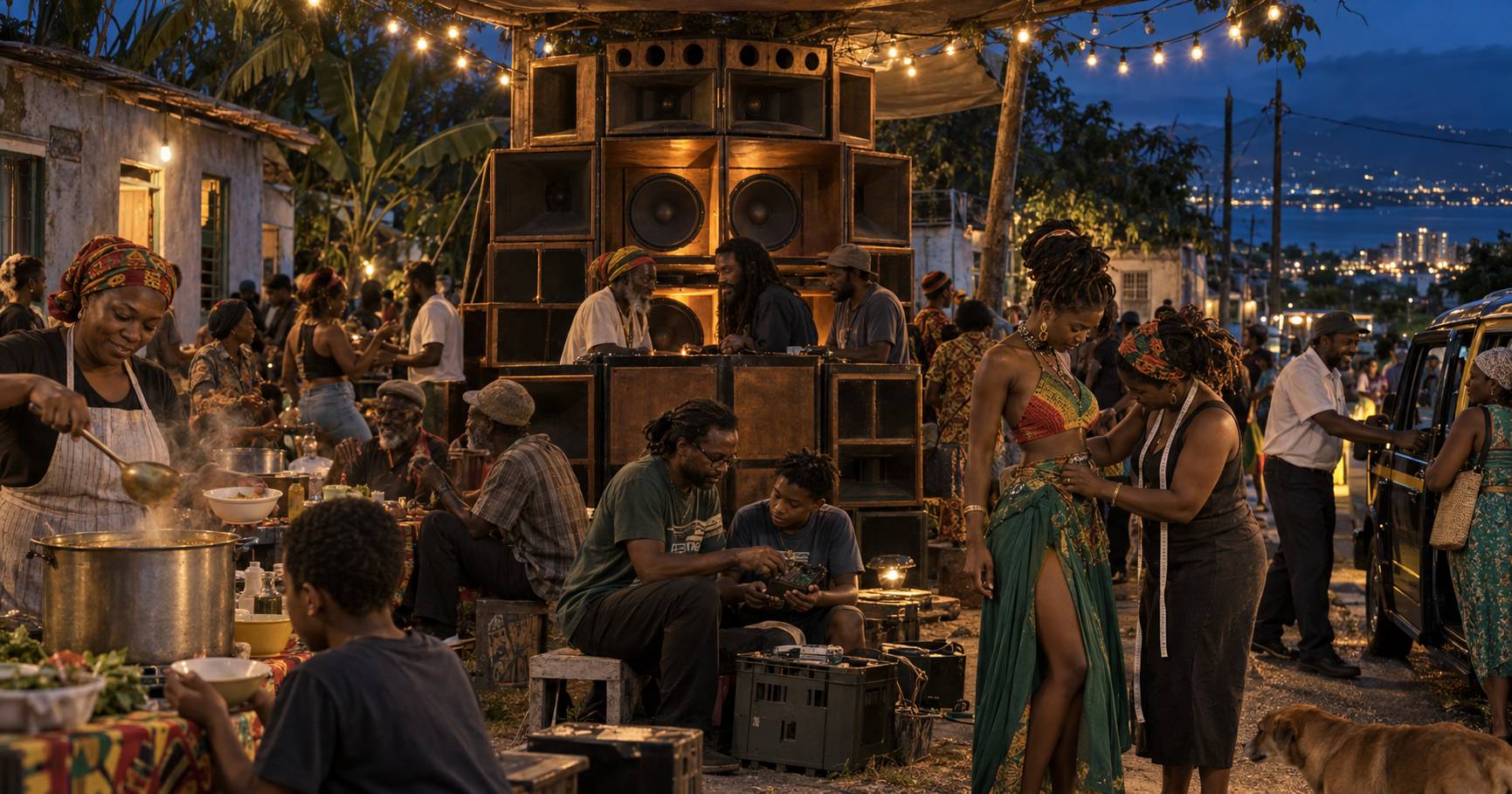
Yet anyone who has seen a community gather around music understands the larger truth inside the metaphor. One sound system can activate many forms of work. It can draw customers toward a cookshop, create a fare for a taxi driver, give a selector a stage, give a singer an audience, give a technician a problem worth solving, and give a neighborhood a reason to gather on its own terms.
The box “feeds” because it helps organize relationships.
This article is not an argument that cultural activity can substitute for stable employment, public services, safe housing or economic justice. A dance cannot solve structural poverty. It is an argument that communities facing exclusion often build practical systems of survival inside culture. Jamaican sound-system history offers a powerful example.
“One Box Feed a Thousand” looks at that history from ground level. Its central figures are not only famous producers or headline singers. They are the people arriving before the first tune and leaving after the cable is coiled: the cook, driver, boxman, printer, mother, apprentice, vendor, dancer, selector and elder.
The song calls their shared practice livity.
What Does It Mean for a Sound to Feed?

Feeding begins with food, but it does not end there.
At a session, literal nourishment matters. Vendors may prepare soup, fish, roasted food, drinks, ital dishes or late-night plates. Cooking requires ingredients, fuel, containers, transportation, labor and knowledge. When people gather, a small food enterprise gains a market.
But a sound also feeds skill. A youth helping to move equipment learns how the system is assembled. Curiosity about why one cabinet produces cleaner bass than another can lead toward acoustics and electronics. Watching a selector can teach timing, musical history and crowd reading. Holding a microphone can reveal that performance requires breath, memory, rhythm and nerve.
The sound feeds identity. Hearing Jamaican speech, proverbs, humor, spiritual language and social commentary amplified in public says that local experience deserves volume. That matters especially where official institutions treat poor communities as problems to be managed instead of sources of knowledge.
The sound feeds memory. Records connect the present dance to singers, musicians, producers, engineers and struggles from earlier decades. An elder can hear a song tied to youth. A younger listener can discover that today’s rhythm carries an older root.
Finally, the sound can feed income. Not everyone becomes wealthy. In many cases, earnings are modest or uncertain. Yet a network of small payments can matter greatly in households where every dollar must work.
One box feeds through many channels.
The Yard as a Community Institution
Early Jamaican sound-system dances often transformed accessible outdoor or semi-public spaces into temporary institutions. The venue might not possess the formal architecture of a concert hall, but it performed several institutional functions.
It gathered people at a known time. It created roles and rules. It circulated information. It rewarded skill. It produced reputation. It established a local calendar. It made the community visible to itself.
This transformation helps explain the song’s opening scene. Evening settles behind a zinc fence. Two youths push a speaker cabinet on wheels. Cable stretches “like a village vein.” A bare bulb comes on. These small acts prepare the social body.
The image refuses glamour at first. There is no giant festival stage or corporate sponsor. The equipment is scarred. The location is ordinary. But anticipation changes the place. A vacant lot can become a dancehall because people recognize what is about to happen.
Community institutions do not always begin with a charter. Sometimes they begin with repeated practice. If the sound returns, if people trust the operator, if vendors can prepare, if youths can learn, and if elders know what the gathering means, continuity develops.
The danger is romanticizing informality. A recurring dance still needs safety, sanitation, fair payment, noise management and respectful relationships with residents. The absence of bureaucracy does not eliminate responsibility.
The strongest sound is not only loud. It is accountable to its place.
Sufferation Is the Pressure, Not the Identity
Roots reggae often speaks about sufferation: the lived pressure produced by poverty, racism, inequality, state violence, colonial inheritance and daily struggle.
In “One Box Feed a Thousand,” sufferation appears through concrete household details. The rent man knocks. The cupboard echoes. A school shoe tears. A mother counts coins. These images are intentionally small because economic pressure is often experienced through ordinary decisions.
Can the rent be paid? Can the child attend school properly equipped? Is there enough food until the next income arrives? Can pride survive another rejection from an employer?
Yet the song does not define the community by suffering. People continue to act. Someone tunes the cone. Someone lends a microphone. Someone seasons the pot. Someone sweeps the lot. Collective preparation becomes an answer to pressure.
This distinction matters. Stories about marginalized communities can easily turn people into symbols of deprivation. Roots consciousness demands a different view. It names oppression without denying creativity. The sufferer is not empty. The sufferer reasons, builds, organizes, worships, laughs, dances and invents.
Sufferation is the weight pressing down.
Livity is how the people choose to stand beneath it.
Livity Is More Than a Mood
The word “livity” is sometimes reduced to a general feeling of natural wellness. Within Rastafari thought, it carries greater depth. It points toward a lived relationship among spirit, body, conduct, community, nature and Jah.
In a song about sound-system economics, livity should not function as decorative vocabulary. It should affect the values of the gathering.
Does the session affirm life or treat people as disposable? Does the business arrangement honor the worker? Does the music deepen consciousness or merely borrow Rasta imagery? Are elders valued? Are women able to participate safely and lead? Is the natural environment respected? Is the community strengthened after the speaker boxes leave?
Livity also challenges the separation between sacred and ordinary life. Feeding a child, sharing knowledge, repairing equipment carefully, telling the truth in a contract and preserving an elder’s story can all become expressions of right relation.
The dance itself can hold spiritual energy without becoming a religious service. A roots tune may call Jah’s name, invoke Africa, condemn Babylon and ask listeners to examine their lives. The bass makes the message bodily. The crowd becomes a temporary congregation, but no single response is forced.
This is why the song compares the opening sound to a “Zion door.” The session does not literally transport the crowd to Zion. It creates a moment in which another order can be imagined—one based on belonging, dignity and collective care.
The Community Economy Around the Session
A sound-system event concentrates attention, and attention creates economic possibility.
The visible transaction may be admission at the gate, but money moves through many other hands. A promoter rents or prepares the venue. A crew transports equipment. Technicians assemble and test it. Printers or digital designers promote the event. Vendors acquire ingredients. Tailors, barbers and stylists help participants prepare. Record sellers and producers benefit when a tune becomes desirable.
The effect is not unlimited. Money can also leave the community through equipment imports, external owners, distant platforms, alcohol distributors or unfair contracting. Some sessions lose money. Some rely on unpaid labor. Some generate conflict with residents.
Still, the basic mechanism is worth studying. Culture creates demand across sectors.
A WIPO-commissioned study published in 2004 identified occupations within sound systems and examined links between Jamaican music, retail, transport, construction and household income. Its numbers are historical rather than current, but the framework remains useful. Music should not be measured only through record sales or famous artists. Its indirect and induced activity matters.
“One Box Feed a Thousand” turns that framework into characters. Miss Ivy sells soup. The taxi carries people uphill. The tailor sews an outfit. The barber prepares a crown. The printer makes a flyer. The carpenter constructs another cabinet. The gate worker buys a book for his daughter.
No individual transaction proves prosperity. Together, they reveal an ecosystem.
Why the Dutch Pot Is the Right Metaphor
The revised chorus calls the speaker box warm “like a dutch-pot coal.” The comparison joins two forms of transformation.
A dutch pot converts separate ingredients through heat, timing and practiced judgment. A sound system converts records, electricity, speech, engineering and crowd energy into an event. In both cases, the container matters, but the container alone is not the meal.
The cook knows that ingredients must enter in relation. Too much heat can burn the bottom. Poor timing can leave food unfinished. The selector faces an equivalent problem. A session needs pacing. A tune must be introduced at the right moment. Intensity cannot remain at its peak indefinitely. The crowd must be fed different emotional textures.
The dutch-pot image also protects the economic story from becoming abstract. Creative-industry policy often speaks in the language of exports, intellectual property and gross domestic product. Those measures matter, but community members experience the economy through dinner, transportation, rent, medicine and education.
If culture is valuable, its value should reach the pot.
That sentence is not anti-business. It is a test of whether business remains connected to life.
The Sound as a Public Well
The chorus also compares the sound to a deep well during Babylon’s pressure.
A well gathers a resource below the visible surface. It must be dug, maintained and protected. The water is drawn repeatedly, yet careless use can contaminate or exhaust it.
Culture works similarly.
The songs played at a session draw from generations of language, rhythm, belief, struggle and invention. A new performer may appear spontaneous, but the performance rests on a deep reservoir. The audience also contributes memory. It recognizes quotations, riddims, gestures and responses.
Calling the sound a well emphasizes access. A community well exists to sustain many people, not to decorate one person’s property. But collective benefit requires stewardship. Someone must maintain the structure. Rules may be needed to keep the water clean.
In cultural terms, maintenance includes archives, apprenticeships, rights registration, accurate credits and respectful transmission. If everyone draws from the well while no one funds its care, the resource becomes vulnerable.
This is a central contradiction in reggae’s global success. Countless artists, brands, festivals and listeners draw energy from Jamaican culture. That influence can be a source of pride. But the cultural well cannot be treated as infinitely available while originators struggle for recognition and income.
Take water. Give water.
That is livity expressed as cultural stewardship.
The Breadfruit Tree and Intergenerational Wealth
A tree offers another model. It takes time to mature. Its roots remain largely unseen. Its fruit can feed people who did not plant it.
Sound-system culture has become such a tree.
Early builders could not have predicted every branch. Their work contributed to ska, rocksteady, reggae, dub and dancehall. Through migration and influence, sound-system methods helped shape hip-hop, jungle, drum and bass, garage, grime, remix culture and contemporary bass music.
The world enjoys the fruit. The question is whether the root system receives water.
Intergenerational wealth requires more than celebrating pioneers. It means transferring assets, knowledge and control. A veteran engineer’s techniques should be documented with consent. A family should know what rights an artist owned. A young selector should learn both music and business. A community archive should have resources, climate control, digital backups and governance.
The tree metaphor also warns against impatience. Youth programs cannot be judged only by immediate commercial hits. Technical skill, historical knowledge and trusted networks develop gradually. A teenager who learns cable safety today may become an engineer, venue manager or educator years later.
Planting is not glamorous. Neither is maintaining roots. But without that work, there is no future harvest.
Women’s Work and the Invisible Foundation
The song deliberately names market sistren, mothers and women whose labor sustains the gathering. This is necessary because cultural histories often treat support work as natural rather than skilled.
Food does not appear by magic. Children do not care for themselves while adults attend or operate events. Accounts do not balance automatically. Clothing, styling, promotion, singing, selection and organization all require labor.
Women have long participated throughout Jamaican music and sound-system culture, yet male-centered images can hide both their creative leadership and the unpaid work surrounding the scene. Correcting the record involves more than adding names to a commemorative poster.
It requires practical change:
- Technical training designed to welcome women and girls.
- Safe reporting and enforcement systems at events.
- Equal access to microphones, selection, engineering and ownership.
- Archival projects that actively collect women’s testimony.
- Vendor arrangements that are transparent rather than exploitative.
- Child-care and scheduling practices that widen participation.
- Fair credit for management, design, cooking and organizing.
A community economy is not fair simply because it is local. Patriarchy can operate at neighborhood scale. Livity asks the culture to examine its own structure.
If one box is to feed a thousand, it must not consume the invisible labor of half the community.

Youth Apprenticeship: From Carrying Box to Carrying Knowledge
Sound systems can become powerful apprenticeship environments because the work is concrete and immediate.
A young person sees the result of correct wiring. They hear distortion when gain is poorly managed. They learn that heavy equipment requires teamwork and safe lifting. They discover that a late crew can damage an entire event. They watch a selector recover when a tune fails.
These are technical lessons and character lessons.
Historically, people often entered the culture informally—helping an older relative, carrying equipment, observing sessions or experimenting with discarded parts. That pathway remains valuable, but it can be strengthened through structured education.
A community sound-system program could combine:
- Electronics and basic circuit theory.
- Cabinet design and acoustics.
- Hearing protection and sound-level management.
- Music history and Jamaican cultural studies.
- Performance, breath and lyrical composition.
- Event production, budgeting and marketing.
- Copyright, publishing, contracts and metadata.
- Conflict resolution and community accountability.
- Food vending, sanitation and small-business planning.
- Archiving, oral history and digitization.
The program should not turn living culture into a sterile classroom exercise. Young people need real sessions where their decisions have consequences. But guidance can reduce preventable exploitation and injury.
The goal is not to produce only entertainers. It is to reveal the full range of occupations inside cultural work.
The Session as Newsroom and Reasoning Ground
Before social media, sound systems already practiced rapid public communication.
The microphone could announce events, identify community concerns, celebrate individuals, spread slang and comment on political conditions. Songs carried messages about poverty, injustice, love, faith, repatriation and daily conduct. The selector’s choices created an editorial sequence.
This did not make every claim accurate or every message healthy. Rumor, prejudice and harmful lyrics could also travel through amplified speech. Word-sound power includes responsibility precisely because words produce effects.
A reasoning ground is not a place where everyone agrees. It is a place where questions can be held in public. Roots reggae contributed to that practice by placing social analysis inside memorable choruses. A listener might arrive for dancing and leave carrying a phrase about Babylon, Africa or equality.
“One Box Feed a Thousand” treats communication as nourishment. People need more than calories. They need truthful language for their circumstances. They need stories in which their lives are visible. They need warnings, humor, memory and possibility.
At its best, the sound system helps the community speak to itself without waiting for a national broadcaster to approve the message.
Migration and the Need to Hear Home
When Jamaican migrants established sound systems in Britain and elsewhere, the gatherings met needs intensified by displacement.
Mainstream radio often ignored Jamaican music. Pubs and clubs could be hostile. Housing discrimination and racism shaped daily life. A house party or community dance therefore offered more than entertainment. It created an environment where familiar speech, food, fashion and music could be publicly shared.
The sound became a portable piece of home, but it did not remain unchanged. New surroundings produced new relationships. In London, dub and sound-system culture interacted with punk and later influenced jungle, garage and grime. Caribbean communities created spaces that eventually reshaped British music far beyond their original audiences.
This expansion demonstrates how a cultural institution can serve both preservation and invention. The diaspora dance protected memory while generating new forms.
Yet migration also complicates economic benefit. A thriving overseas scene may create income for local promoters and artists without returning resources to Jamaica. Conversely, diaspora networks may finance families, recordings, tours and community projects at home.
The question is not whether culture should travel. It is how relationships can remain reciprocal.
The lighthouse metaphor in the final chorus speaks to this. A light guides a vessel without preventing its journey. Roots provide orientation, not confinement.
The Limits of the Celebration
An honest article must say what the anthem cannot solve.
A successful session cannot replace labor rights. Small-scale vending cannot carry the full burden of unemployment. Informal apprenticeships cannot substitute for accessible education. Community pride cannot repair dangerous infrastructure. Spiritual language cannot excuse poor financial management.
The sound-system economy can also produce harms. Excessive noise can damage hearing and neighborhood trust. Events can become unsafe. Workers can go unpaid. Informal cash arrangements can conceal exploitation. Rivalry can become violence. Women and LGBTQ people can face harassment or exclusion. Lyrics can reinforce stigma.
Celebration must therefore be paired with governance.
Organizers can use sound-level plans, hearing protection, safe transport, transparent vendor fees, written agreements, emergency procedures and community consultation. Artists can reject dehumanizing lyrics. Crews can adopt codes of conduct. Local government can create workable licensing systems rather than treating culture only as a nuisance.
Roots consciousness should make accountability stronger, not optional.
The box feeds only when the system around it refuses to feed on the people.
A Practical Livity Model for Community Sound
The song’s values can be translated into a practical model.
1. Feed the body
Reserve fair, affordable vending opportunities for local cooks. Provide water, sanitation and waste management. Include ital and non-alcoholic choices rather than allowing beverage sponsorship to define the whole event.
2. Feed the worker
Put duties and payment in writing. Pay setup and breakdown labor, not only visible performance. Establish when and how vendors, artists, technicians and security staff receive money.
3. Feed the youth
Attach apprentices to skilled adults. Give them defined tasks, safety training and documented learning rather than using “experience” as a reason for free labor.
4. Feed the memory
Record oral histories with permission. Preserve flyers, photographs, dubplate information, equipment stories and set lists. Return copies to participants and families.
5. Feed the future
Place a portion of proceeds into equipment maintenance, emergency support, education or a community cultural fund. Even a small consistent percentage creates a habit of reinvestment.
6. Feed the spirit
Protect time for conscious music, elder recognition and community reasoning. A roots session should offer more than branding; it should create space for reflection.
7. Feed the relationship
Communicate with residents, clean the site and address complaints. Livity is tested after the crowd leaves.
What the Song Is Really Asking
“One Box Feed a Thousand” asks listeners to see abundance where conventional economics sees only informality.
Its metaphors—dutch pot, well, breadfruit tree, village lung and harbor light—describe different community functions. The pot transforms resources. The well preserves a shared source. The tree connects generations. The lung creates collective breath. The light helps travelers retain direction.
None of these images belongs to an isolated hero. Each depends on relationship.
That is why the chorus shifts from one box to a thousand hands. The box may be the visible center, but the community completes its meaning.
The deepest line may be the simplest: “One bassline mek di broken whole.” Music cannot erase loss, but collective rhythm can briefly reconnect people separated by pressure. It can remind the unemployed worker that he still possesses knowledge. It can let the overburdened mother dance. It can allow a young person to hear an elder not as a relic but as a source.
Wholeness here is not perfection. It is renewed relation.
Conclusion: When the Box Rolls Home
The final scene occurs at dawn.
The last pot is empty. The first bus is running. The crew coils cable. The speaker cabinet rolls away. On the surface, the institution disappears.
But not everything leaves.
The vendor carries earnings home. The apprentice remembers how the crossover was connected. The dancer carries a new phrase. The selector has learned which tune moved the crowd. A school book can be bought. A friendship has been strengthened. An elder’s song has entered a younger ear.
This is how one box feeds a thousand—not through magic, but through circulation.
The model deserves celebration, preservation and improvement. Communities should not be forced to survive forever through improvisation. Yet their improvisation contains knowledge that formal institutions often lack: how to gather people, create value from limited resources, transmit memory and make education feel alive.
Livity asks that the knowledge serve life.
Build the sound. Feed the people. Pay the workers. Teach the youth. Honor the elders. Protect the roots. Clean the yard when morning comes.
Then wheel up the tune and begin again.