The Rhythm Returns to Africa Jamaica–Africa Reconnection
Repatriation, Citizenship, and Rebuilding the Global African Family

Imagine the rhythm returns to Africa from the Caribbean before anyone calls the journey a return.
It crosses the Atlantic in the opposite direction of the ships that carried captive Africans toward plantation colonies. It arrives through records, radio, cassettes, touring musicians, students, sailors, political movements, and the voice of Bob Marley singing to a continent that already recognizes something inside the bass. Young people in Abidjan, Accra, Lagos, Nairobi, Harare, Johannesburg, Conakry, and Addis Ababa do not hear a foreign curiosity alone. They hear a Jamaican creation carrying African memory in transformed form.
Then they answer.
They sing in Dioula, French, English, Zulu, Amharic, Swahili, and local languages. They bring kora, balafon, horns, hand drums, highlife guitar, township harmony, Afrobeat propulsion, and their own histories of colonialism, independence, military rule, liberation, corruption, war, migration, and hope. Reggae does not return unchanged. It becomes a conversation.
This possibility offers one of the strongest futures for reggae. If commercial markets have reduced the music to lifestyle, an African-centered renewal could restore political seriousness, spiritual inquiry, historical memory, and collective purpose. Yet the word “return” must be handled with care. Africa is not an empty ancestral stage waiting for the diaspora to arrive. It is a vast, internally diverse continent of living peoples who possess their own music, religions, languages, institutions, conflicts, and visions of the future.
The goal cannot be Jamaica replaced by Africa. That would repeat the logic of displacement under a different flag. The goal is a durable relationship among Africa, Jamaica, the wider Caribbean, and the global African diaspora—a relationship in which reggae remains recognized as a Jamaican creation while its African inheritance becomes the basis for new cultural, economic, and civic work.
Completing the Historical Circle
Reggae did not come directly from an untouched African past. It emerged in Jamaica through centuries of rupture and creativity. Enslaved Africans and their descendants retained and reinvented rhythms, spiritual practices, language patterns, communal forms, and ways of knowing under conditions designed to erase them. These inheritances encountered European instruments, Christian traditions, Caribbean exchanges, American rhythm and blues, jazz, radio, urban technology, and the particular social conditions of twentieth-century Jamaica.
The result was not an African copy. It was Jamaican modernity.
This distinction protects both histories. To call reggae African in a general sense should never erase the Jamaicans who created ska, rocksteady, reggae, dub, deejay practice, and sound-system culture. To call reggae only Jamaican should not hide the African continuities that gave Rastafari, rhythm, call-and-response, spirituality, and Pan-African thought much of their force.
The circle is therefore not a line back to a pure beginning. It is an exchange among relatives changed by separation.
Africa Has Already Answered Reggae
African reggae is not a future invention. Artists across the continent have used the form for decades. South Africa’s Lucky Dube brought reggae into dialogue with apartheid, township life, exile, family, and social conflict. Côte d’Ivoire’s Alpha Blondy and Tiken Jah Fakoly made reggae a major language of political criticism, Pan-African consciousness, war, corruption, and popular experience. Other artists in Ghana, Nigeria, Senegal, Guinea, Kenya, Ethiopia, Cabo Verde, and beyond have localized the music.
Côte d’Ivoire offers a particularly important example. Reggae did not remain a Jamaican costume placed over Ivorian experience. Artists used local language and political reality to address African urban youth. Traditional instruments and regional musical knowledge entered the arrangements. The form became credible because it spoke from where the artist stood.
This is the lesson for any Africa-centered renewal: roots are not preserved by imitation. They are preserved through truthful transformation.
Africa Must Become More Than an Image
International reggae has often invoked Africa as mother, promised land, source, and spiritual home. These images answered a genuine historical injury. Colonial education taught African-descended people to despise Africa. Reversing that contempt was a revolutionary act.
But romantic reversal can also flatten reality. “Africa” becomes one village, one landscape, one drum, one people, and one uncomplicated welcome. The continent’s many nations, ethnic groups, religions, classes, languages, and political systems disappear beneath a symbol created for diaspora longing.
An accountable return begins with learning specificity. Ethiopia is not Ghana. Ghana is not Kenya. Kenya is not Côte d’Ivoire. A Caribbean artist entering an African community should arrive prepared to listen, not to perform an imagined Africa back to Africans.
Rastafari in Conversation with African Realities
Rastafari gave Ethiopia and Africa sacred importance within a Jamaican struggle against colonial degradation. That history deserves respect. It does not mean every Ethiopian or African interprets Haile Selassie I, repatriation, or Black identity in the same way. African Christian, Muslim, traditional, secular, royalist, republican, socialist, and other perspectives will not collapse into a diaspora theology.
This difference should not be feared. It can deepen the movement. Jamaican Rastas can share the spiritual and political work Ethiopia performed within Caribbean consciousness. African partners can speak from their own histories and present conditions. Genuine reasoning allows reverence and complexity to sit together.
If Africa is allowed to answer rather than merely symbolize, reggae becomes more intelligent.

From Symbolic to Practical Repatriation
Repatriation has carried multiple meanings within Rastafari and Pan-African thought. For some, it is physical return to Africa. For others, it includes spiritual orientation, cultural recovery, political solidarity, or economic participation. These meanings need not cancel one another.
The next stage should move from indefinite longing toward practical pathways. A song can open the imagination, but people returning or building transcontinental lives encounter immigration law, citizenship, land policy, employment, education, healthcare, taxation, language, local custom, and community relationships.
Romance ends quickly at an administrative desk. A serious repatriation movement prepares people for the desk without surrendering the dream.
Citizenship and Residency Initiatives
African governments and Caribbean institutions could develop transparent programs for people of African descent seeking residence, long-term cultural work, investment, study, or citizenship. Such programs must define eligibility, rights, obligations, costs, and safeguards clearly. They should avoid becoming luxury pathways available only to wealthy diaspora applicants.
The African Union already identifies the African diaspora as an important participant in building the continent. Recent Africa–CARICOM cooperation has emphasized political, economic, social, and cultural ties alongside reparatory justice. These frameworks create an opening. Reggae can provide a popular cultural language through which policy becomes understandable to ordinary people.
Citizenship, however, should not be presented as a souvenir of ancestry. It is a legal relationship involving responsibilities to a society. Diaspora participants must ask what they will contribute, how they will relate to local communities, and whether their investments increase access or displace residents.
The Right to Return and the Duty to Relate
Historical displacement gives moral force to claims of return. Yet ancestry does not automatically provide knowledge of a present-day locality. Return must be practiced through relationship: learning language, respecting law, understanding land, employing fairly, listening to neighbors, and resisting the temptation to reproduce foreign privilege.
A Caribbean entrepreneur who arrives with stronger currency can unintentionally contribute to rising prices or unequal land access. A project described as “diaspora development” may ignore local expertise. Good intention cannot replace accountability.
The duty to relate protects repatriation from becoming a new form of extraction.
Jamaican–African Artist Exchanges
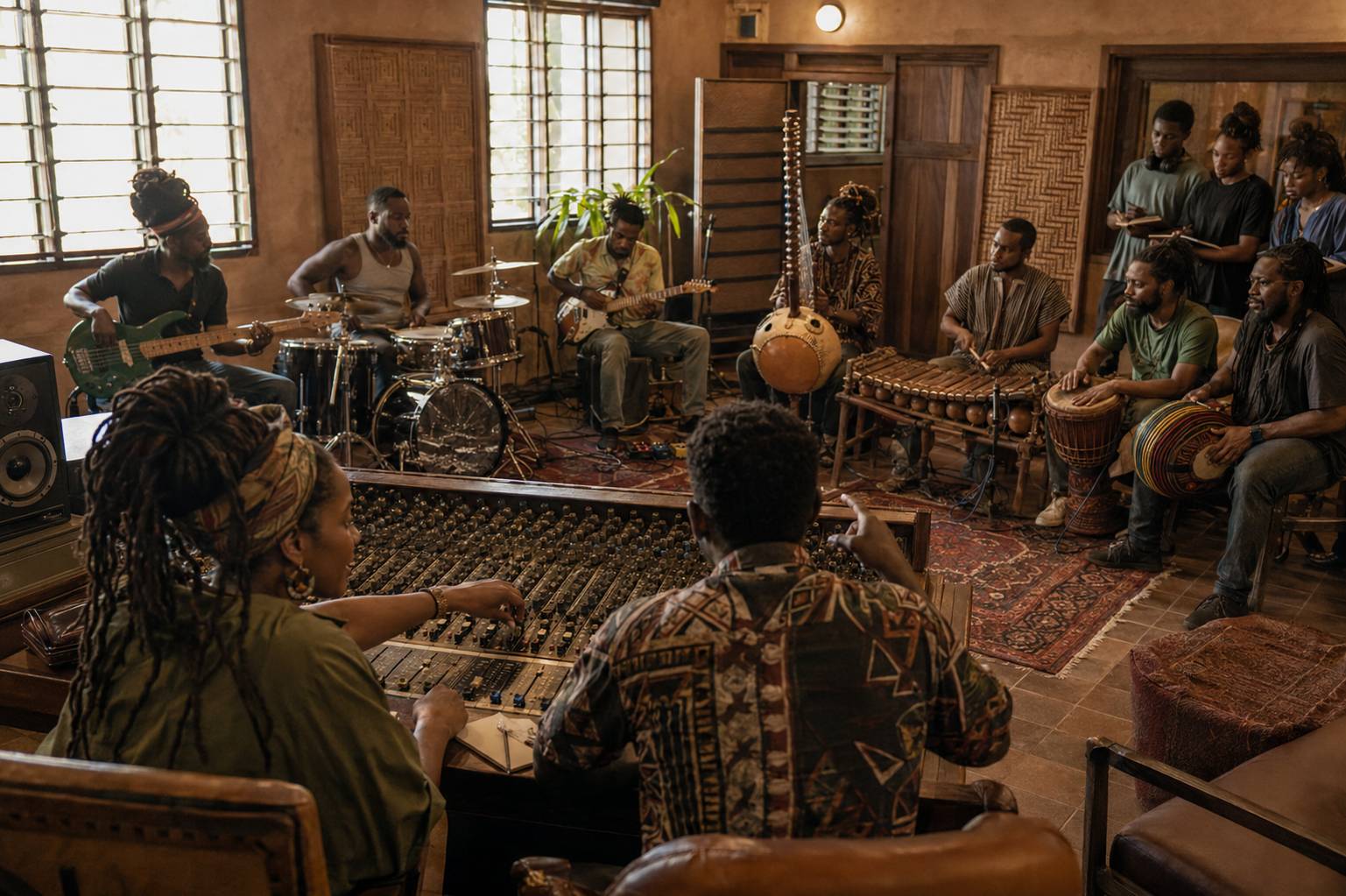
Artist exchange is one of the most immediate ways to make reconnection real. Collaboration already occurs, but too often it is organized around a single feature, festival appearance, or publicity moment. A deeper model would give artists time to learn one another’s creative environments.
Residencies in Both Directions
A Jamaican singer might spend six weeks in Accra working with highlife musicians, historians, farmers, and producers. A Ghanaian percussionist and songwriter might then work in Kingston, visit sound-system builders, study studio history, and collaborate with Jamaican rhythm sections. The exchange should move both ways so that no side becomes merely host, teacher, or source material.
Residencies could include:
- Collaborative composition and recording
- Public reasoning sessions
- School and community workshops
- Visits to heritage sites
- Technical training in production and live sound
- Study of copyright, publishing, and management
- Performances presenting work in progress
- Documentation controlled jointly by participants
Time matters. A two-day collaboration can produce a track; a sustained residency can produce understanding.
Language as Creative Knowledge
Artists should be encouraged to work across languages without treating translation as a problem to eliminate. Jamaican Patwa carries history, rhythm, class experience, and resistance to linguistic hierarchy. African languages carry their own worlds of proverb, tone, memory, and social relationship.
A multilingual reggae movement may not offer every listener immediate comprehension. It can offer something more valuable: the recognition that global art does not need to pass entirely through standardized English to matter.
Translation can live in liner notes, subtitles, educational content, and performance introductions. The music does not need to make itself culturally thin in order to travel.
Shared Authorship, Not Decorative Features
Collaborations should establish publishing shares, master ownership, credits, budgets, and promotional responsibilities before release. An African artist should not become a rhythmic accessory to a Jamaican claim of return. A Jamaican artist should not become a certificate of authenticity on an African project. Both must enter as authors.
The contract is part of the cultural relationship. A song about unity produced through unequal terms contradicts itself.
Reggae as a Language of Reparatory Justice
Africa–Caribbean cooperation has recently placed reparations and reparatory justice at the center of official dialogue. The second Africa–CARICOM Summit in 2025 emphasized a transcontinental partnership involving Africans, Caribbean states, and people of African descent. In 2026, African Union and CARICOM reparations mechanisms held a first joint meeting under that developing framework.
These are institutional steps, not completed transformation. Official declarations can remain distant from daily life unless communities understand, debate, and organize around them. Reggae has a role here because it has long translated large historical questions into popular language.
A new generation of songs could explore reparations beyond payment alone: land, education, health, archives, cultural property, debt, climate vulnerability, return, and institutional repair. Artists can question governments as well as former colonial powers. They can ask whether reparations programs reach working people or become another field controlled by elites.
Reggae should not become official propaganda. Its value lies partly in its ability to remain close enough to the people to criticize every institution, including those speaking in the name of liberation.
Building an Africa–Caribbean Cultural Route
One exchange is an event. A route is an institution.
The long-term vision should connect cities, festivals, universities, studios, museums, farms, and community organizations across Africa and the Caribbean. Artists could move through a planned calendar rather than negotiating isolated opportunities. Shared equipment and local production teams would reduce costs. Educational partners could host workshops between performances. Tourism organizations could support travel while cultural leadership remains with artists and communities.
Possible Regional Hubs
The route might begin with a manageable group of hubs rather than claiming the entire continent and Caribbean at once. Kingston could anchor sound-system history, production, and Jamaican archives. Bridgetown or Port of Spain could broaden the route beyond a Jamaica-only Caribbean story. Accra could connect diaspora-return initiatives and West African creative industries. Abidjan could contribute its established reggae tradition. Addis Ababa could support Ethiopia-centered history and African Union relationships. Nairobi or Johannesburg could connect East and Southern African markets.
The purpose of naming hubs is not to create a permanent hierarchy. It is to establish functioning corridors that can expand.
Movement Beyond the Stage
Touring delegations could include educators, visual artists, farmers, chefs, archivists, instrument builders, legal experts, and youth representatives. Reggae has always belonged to a broader culture. A route limited to evening performances would miss opportunities for durable relationship.
During the day, participants might visit a community garden, hold a publishing clinic, record an elder, teach sound engineering, or discuss citizenship policy. At night, the music gathers the larger public. Each activity reinforces the others.
The Risks of a New Center
Every renewal carries danger. An African-centered reggae movement could be captured by state tourism campaigns, wealthy diaspora investors, political parties, or international corporations. Africa might become fashionable branding while African musicians remain underpaid. Caribbean artists might arrive as cultural authorities without respecting local creators. Men might dominate leadership while women perform the labor. Major cities might receive investment while rural communities become scenery.
There is also a risk of historical competition. Some may argue that because reggae contains African inheritance, Jamaica’s authorship is secondary. Others may defend Jamaican origin by minimizing Africa. Both positions mistake relationship for a contest.
The safeguards are practical:
- Joint governance with transparent decision-making
- Equal publishing and ownership where contributions are equal
- Local community consultation
- Gender and generational representation
- Public budgets for funded cultural projects
- Protection against land displacement
- Independent artistic freedom
- Clear acknowledgement of reggae’s Jamaican origin
- Serious engagement with specific African cultures
- Evaluation based on local benefit, not publicity alone
The language of unity should never be used to avoid these details.
A Global African Family with Many Homes
The African Union’s diaspora language imagines people of African origin outside the continent as participants in Africa’s development and integration. Caribbean history adds moral and cultural depth to that idea. The descendants of people violently removed from Africa created societies, religions, political movements, foods, languages, and music that now belong to the global African inheritance.
Reconnection should therefore not imply that the Caribbean is an incomplete place waiting to be abandoned. Jamaica is not merely a temporary station between Africa and the future. It is a homeland created through survival. Caribbean people can return, relocate, collaborate, invest, or build spiritual relationship without denying the reality of Caribbean belonging.
The global African family can have many homes.
This understanding releases repatriation from a false choice. One can honor Africa and defend Jamaica. One can build in Ghana and remain responsible to Kingston. One can learn Ethiopia’s history without turning a Jamaican interpretation into the only African truth. One can celebrate reggae’s African inheritance while naming every Jamaican studio, yard, and sound system that shaped the form.
Preparing the Next Generation for Relationship
The reconnection will fail if it depends only on famous performers, government ceremonies, and occasional heritage tours. Young African and Caribbean people must be able to meet one another before stereotypes become permanent. Many have consumed each other through fragments: a song, a social-media argument, an inherited family story, a film, or an image produced for foreign audiences. Contact without preparation can reproduce misunderstanding as quickly as it creates friendship.
Schools and community organizations could establish paired learning programs. A Jamaican class studying Garvey might exchange research with students in Ghana examining Pan-African movements and local independence history. Ethiopian students could explain the political and religious complexity surrounding Haile Selassie I, while Rastafari youth describe how Ethiopia functioned as a source of dignity under colonial Jamaica. Neither side would be required to surrender its interpretation. The educational achievement would be learning how the same history carries different meanings across location.
Digital Exchange Before Physical Travel
Not every young person can afford an international journey. Digital studios, shared online classrooms, radio links, and collaborative archives can make exchange more accessible. Students could build a joint playlist with historical notes, record interviews with elders, compare proverbs, exchange drum patterns, or produce a short documentary across two locations.
Digital access should lead toward, not permanently replace, physical encounter. A scholarship fund could select participants from working-class and rural communities rather than only those already connected to elite schools. Travel programs should include host-family relationships, local language preparation, safeguarding standards, and projects that continue after the visitors return home.
Correcting the Direction of Knowledge
Colonial education trained many Caribbean people to seek recognized knowledge in Europe and North America. African students faced similar pressure. An Africa–Caribbean educational route changes the direction of intellectual travel. Kingston becomes a place to study sound technology and cultural entrepreneurship. Accra becomes a place to study diaspora policy and Pan-African history. Abidjan becomes a place to examine African reggae’s political development. Addis Ababa becomes a place to engage continental institutions and Ethiopia’s layered history.
Universities could offer jointly supervised certificates in music business, heritage preservation, sound engineering, sustainable agriculture, and diaspora studies. Community experts must teach alongside academics. A sound-system builder who never received a formal degree may possess technical and cultural knowledge unavailable in a lecture hall. An elder farmer may understand seed, soil, and medicinal plants in ways a visiting program must respect.
Education makes return less vulnerable to fantasy. It gives people language for difference, skills for cooperation, and relationships that survive the closing performance. Most importantly, it prevents the movement from becoming a project conducted on behalf of youth while excluding them from design.
When the Rhythm Becomes a Bridge
The strongest future for reggae is not a return to purity. It is a movement toward accountable connection.
Commercial lifestyle reggae made the music easy to consume by removing many of its obligations. An Africa–Caribbean renewal can reverse that process. It can place Garvey beside institution-building, repatriation beside citizenship policy, Africa beside actual African people, and “one love” beside economic reciprocity.
The music will change in the process. That is not a loss. A rhythm that enters dialogue with highlife, Afrobeat, kora, balafon, Ethiopian modes, township harmony, Caribbean percussion, dub technology, and languages from both sides of the Atlantic may produce forms no existing category can hold. The new sound will remain rooted if the relationships behind it are just.
Jamaica should be respected not as a museum but as a living originator. Africa should be engaged not as a fantasy but as a living partner. The diaspora should serve not only as an audience but as a bridge of skills, resources, memory, and accountability.
Then the circle becomes more than a poetic image.
A young Jamaican engineer works in an Abidjan studio owned jointly by African and Caribbean partners. An Ethiopian historian helps a Rasta delegation understand the complexities behind sacred symbols. A Ghanaian farmer collaborates with an ital food project. A Caribbean student receives residency support to study music business in Accra. An African band tours Kingston with its own cultural authority intact. Royalties return across the same ocean that once carried stolen labor in the opposite direction.
No song can accomplish all of this alone. But songs can create the public imagination from which institutions become possible.
The rhythm has already crossed the water. The next question is whether we will build the bridge beneath it.
Sources and Further Reading
Bob Marley Rasta Prophet


Emperor Haile Selassie Ethiopean African Heritage


Products
Rasta Roots Reggae Rhythms


Rasta Women Vibing


Fashion Revolution


