Reggae Without Memory Emptied of the People Who Built It
What Disappears When Rastafari, Marcus Garvey, and Jamaica Are Removed from the Music
Memory does not always leave with a loud goodbye. Sometimes it disappears one small omission at a time.
A festival uses red, gold, and green but never names Ethiopia. A cannabis company prints a lion on its packaging but says nothing about the Rastafari people criminalized for sacramental practice. A playlist includes “roots” in its title but contains no living Jamaican roots artist. A singer chants “Babylon” to describe a bad mood, while the word’s history of empire, racial domination, religious exile, and economic exploitation fades beneath the chorus.
Nothing appears entirely false. That is what makes the loss difficult to recognize. The symbols remain close enough to their sources to generate feeling, but far enough away to avoid responsibility.
This is reggae without memory: a familiar sonic house emptied of the people who built it.
To recover memory is not to insist that every song become a lecture. Reggae’s knowledge has never depended on academic language. It has moved through proverb, bass line, biblical image, street report, repetition, satire, lament, praise, and warning. A three-minute record can carry history without explaining itself like a textbook. The issue is whether the culture surrounding the record helps listeners discover that history or teaches them to treat depth as an obstacle to enjoyment.
Memory must also resist simplification. There was never one Jamaica, one Rastafari experience, one political position, or one kind of reggae. Women and men, rural and urban communities, Christians and Rastas, instrumentalists and singers, radicals and entertainers all shaped the field. To restore complexity is not to weaken the foundational story. It is to honor how many hands carried it.
Rastafari Beyond Costume
Rastafari is among the most visible and most misunderstood sources of reggae’s international language. Dreadlocks, the Lion of Judah, Ethiopian colors, herb, the word “Jah,” and images of Emperor Haile Selassie I circulate across music, fashion, tourism, and commercial branding. Their familiarity can create the illusion of knowledge.
But symbols detached from lived belief become easy to consume.
Rastafari arose in colonial Jamaica among Black people confronting a society that had formally ended slavery while preserving racial hierarchy, economic deprivation, Eurocentric religion, and contempt for Africa. It offered a radical reversal of value. Africa was not a primitive absence waiting for Europe. Blackness was not evidence of inferiority. The despised Rasta could refuse the names imposed by Babylon and speak from a sacred history larger than the colony.
Rastafari has never been a single centralized institution. Different houses, elders, communities, and individuals hold distinct interpretations. Yet recurring commitments include the divinity or sacred significance associated with Haile Selassie I, the importance of Ethiopia and Africa, critique of Babylon, natural living, repatriation, biblical reasoning, communal gathering, and the dignity of African people.
The Cost Behind the Image
International consumers often encounter dreadlocks as a sign of freedom. Jamaican Rastas experienced discrimination because of them. Locks could affect employment, schooling, housing, police treatment, and public respect. Herb is now sold as lifestyle and medicine in profitable legal markets, but Rastafari communities endured raids, imprisonment, and stigma for practices later adopted by corporations.
This history changes the ethical meaning of branding. A company does not honor Rastafari merely by placing a lion on a label. Respect would require education, consultation, investment, and material benefit for communities whose spiritual and cultural labor gave the symbol value.
The same principle applies to musicians. Chanting “Jah” as a reggae convention is not equivalent to engaging Rastafari thought. Artists need not convert to a faith they do not hold. Honest distance is more respectful than performance. They can identify Rastafari as an influence, learn its history, avoid invented patois and caricature, and allow Rasta voices to represent themselves.
Livity, Not Lifestyle Packaging
Commercial culture converts practices into purchasable identities. Ital food becomes a product category. Meditation becomes content. Natural living becomes an aesthetic available through clothing and supplements. Rastafari livity asks more difficult questions about how one lives in relation to body, land, community, spirit, and systems of domination.
The distinction is not that commercial products are always corrupt. It is that livity cannot be completed at the point of purchase. A natural meal without concern for the farmer, soil, worker, and hungry neighbor may be healthy for one body while leaving the larger system untouched.
Remembering Rastafari means restoring this relational depth.
Marcus Garvey and the Architecture of Self-Reliance
Marcus Mosiah Garvey is frequently invoked in roots reggae as prophet, teacher, hero, and unfinished instruction. His importance exceeds a few famous phrases. Garvey placed African people throughout the world inside a shared political imagination. He spoke of racial dignity, organization, enterprise, education, historical recovery, nationhood, and Africa’s redemption at a time when colonial power presented Black dependence as permanent.
Born in Jamaica in 1887, Garvey carried a Caribbean experience of color, class, labor, migration, and empire into an international movement. The Universal Negro Improvement Association created an organizational language through which people of African descent could imagine themselves not as scattered minorities but as participants in a global history.
Garvey’s legacy contains debate and contradiction, as all major political legacies do. Remembering him should not mean turning him into a flawless monument. It should mean engaging the central challenge he posed: a people cannot secure freedom through pride alone if they lack institutions capable of protecting their interests.
From Quotation to Institution
Reggae has preserved Garvey’s name more consistently than many school systems. Yet repetition can become ceremonial. An artist praises self-reliance while assigning publishing without understanding the contract. A festival displays Garvey’s face while ownership remains outside the community. A business sells Pan-African imagery while sourcing no goods or services from African or Caribbean producers.
Garvey’s relevance lies precisely in the gap between symbol and structure. His presence in reggae should lead toward questions of ownership, education, transport, communication, finance, and collective organization. Who presses and distributes the music? Who controls the platform? Who trains the next manager? Who archives the masters? Who can finance a tour without surrendering the future?
If Garvey remains only a lyric, the market can applaud him without changing.
African Redemption as Living Work
The phrase “Africa for the Africans” has been interpreted in different ways, but its enduring force comes from a demand for African agency. In a contemporary reggae context, that agency could mean African–Caribbean labels, cultural exchanges, reparations work, diaspora citizenship pathways, educational partnerships, and investment governed by communities rather than imposed upon them.
Remembering Garvey therefore points forward. It does not ask reggae to reenact the early twentieth century. It asks whether the music’s global success is producing the capacity for Black people to define, own, and sustain their cultural future.
Colonialism, Slavery, and the Meaning of Babylon
“Babylon” is one of reggae’s most portable words. Its biblical origin gives it spiritual weight; its Rastafari use gives it historical and political force. Babylon can name an oppressive order that captures body, mind, labor, worship, land, and language. It can refer to colonial government, police violence, racial hierarchy, exploitative economics, corrupt authority, or a civilization organized against life.
The word remains open enough to travel. A listener facing dictatorship in Africa, racism in Europe, dispossession in Latin America, or police abuse in North America can recognize a local Babylon. This flexibility is a strength.
Watering down begins when the word loses its relationship to power. If Babylon means anything unpleasant, it finally means very little. A delayed flight, a demanding schedule, and a system built on colonial extraction are not equivalent conditions.
Slavery Is Not Finished History
The transatlantic slave trade and plantation system shaped Jamaica and the wider Caribbean at foundational levels. People were taken from African societies, forced across the ocean, sold, renamed, disciplined, and made to produce wealth for others. Emancipation ended legal ownership of human beings, but land distribution, economic control, racial classification, education, and political authority did not suddenly become equal.
Reggae’s memory of slavery is therefore not an obsession with a closed past. It is a method for recognizing continuity. Who owns the land? Whose labor creates wealth? Which languages are treated as intelligent? Whose spiritual practices are criminalized? Who receives compensation, and who is told to forget?
When international reggae removes slavery and colonialism to become more universal, it often removes the very history that made the music useful to oppressed people elsewhere. A listener does not need Jamaican ancestry to understand the song. But the song’s particular history teaches the listener how domination survives by renaming itself.
Love Without Justice Is Incomplete
“One love” is among reggae’s most widely circulated ideals. In commercial use, it can become a request that conflict disappear before its causes are addressed. The harmed person is asked to reconcile; the beneficiary is rarely asked to repair.
Roots consciousness offers a more demanding love. It can call for unity while naming betrayal. It can imagine peace while opposing the structures that prevent it. It understands that truth is not hatred and memory is not revenge.
This distinction matters whenever reggae enters corporate, tourist, or political spaces. Unity language should not become protection for unequal arrangements. Love becomes credible when it accepts obligation.
Jamaica’s Working-Class Communities as Authors
International storytelling often turns Jamaica into either paradise or crisis. In the first image, the island exists for pleasure. In the second, poor communities appear through violence, deprivation, and danger. Both images can deny authorship.
The communities from which Jamaican popular music emerged were not empty containers of suffering. They contained technical knowledge, entrepreneurial creativity, verbal artistry, fashion, social networks, spiritual reasoning, competition, humor, and disciplined listening. Limited resources did not produce limited imagination.
Sound-system culture demonstrates this authorship. Operators assembled equipment, sourced records, cultivated audiences, competed through exclusives, developed personalities, and created mobile spaces of public entertainment. Producers organized sessions and reused rhythms. Engineers turned studios into instruments. Deejays developed vocal practices that influenced rap and many later forms. Dancers created movement vocabularies. Street-level demand shaped what was recorded next.
Poverty Is a Condition, Not an Identity
There is a danger in romanticizing hardship. The idea that poverty automatically produces authentic music can become an excuse to leave artists poor. Suffering may shape expression, but creators deserve contracts, healthcare, housing, royalties, pensions, equipment, and stable institutions.
Respect for working-class origins should lead to material commitments. If a festival earns money from a culture born in marginalized communities, how does value return? If an archive preserves a musician’s work, does the family participate? If a documentary tells a neighborhood’s story, who controls the footage and income?
The creator should not have to remain economically vulnerable in order to satisfy the audience’s idea of roots authenticity.
Remembering the Builders Behind the Stars
Reggae history is often compressed into a small group of famous singers. Their greatness is real, but the compression hides a collective achievement.
Musicians developed bass patterns, drum approaches, guitar accents, organ bubbles, horn arrangements, and vocal harmonies. Studio engineers shaped reverb, delay, filtering, dropouts, and spatial effects. Producers selected combinations, financed sessions, managed labels, and sometimes exploited artists. Record shops, pressing plants, radio stations, journalists, photographers, and distributors helped the music circulate. Women sustained businesses, performed, wrote, taught, designed, managed, hosted, and organized even when male-centered histories reduced their visibility.
Sound-system pioneers transformed recorded music into an event. The selector’s judgment, the operator’s equipment, the deejay’s intervention, and the crowd’s response formed a creative circuit. Later global genres borrowed from this system, often without knowing the names of the Jamaicans who developed it.
The Archive Must Include Conflict
Preservation should not turn history into uncomplicated celebration. Reggae’s industry has also contained exploitation, unpaid royalties, gender inequality, colorism, political violence, homophobia, and struggles over authorship. A mature archive can honor achievement without hiding harm.
This honesty protects rather than diminishes the culture. If younger artists inherit only a heroic myth, they cannot recognize patterns that still require change. Memory should offer tools, not merely monuments.
The Women Whom the Simplified Story Forgets
Any recovery of reggae memory that restores famous men while leaving women in the shadows remains incomplete. Women appear throughout Jamaican music—as singers, harmony vocalists, instrumentalists, songwriters, producers, broadcasters, dancers, managers, vendors, studio workers, journalists, archivists, and the family members who kept musicians alive when the industry did not pay. Yet popular histories often assign men the roles of invention and leadership while presenting women mainly as muses, lovers, or exceptional visitors.
That distortion affects the present. When young women do not see the full lineage of women’s labor, each new generation is treated as if it has arrived without ancestors. Festival programmers can claim that too few women are available because the industry has failed to invest in, document, and circulate their work. The absence produced by unequal opportunity is then used to justify further absence.
Women’s experience also expands what counts as foundational content. Colonialism and poverty are lived through homes as well as streets, through care work as well as paid labor, through sexual vulnerability, migration, childbirth, respectability politics, and the daily management of scarce resources. A reggae history centered only on public male confrontation misses the quieter strategies through which communities survived.
Remembering women does not require placing every artist under a single political label. Women in reggae have sung devotion, desire, resistance, heartbreak, social criticism, dancehall bravado, maternal concern, and spiritual testimony. Their range challenges the habit of treating romance as automatically shallow and militancy as the only form of consciousness. A love song sung by a woman negotiating dignity can reveal a structure of power as clearly as an explicitly political lyric.
Changing the Conditions of Recognition
Archives should record women’s oral histories before knowledge is lost. Reissue projects should identify uncredited harmony singers and musicians. Festivals should develop pathways from workshops to paid stages and from small stages to headline positions. Music-business training should include protection against harassment, transparent contracting, childcare realities, and the unequal burdens that make touring difficult.
Men who benefited from informal systems also have responsibilities. Cultural preservation cannot mean defending every old practice because it is old. A living tradition distinguishes inheritance from harm. It keeps the musical knowledge while changing conditions that silenced participants.
This broader memory strengthens the central argument of the series. Co-option does not occur only when outsiders take from Jamaica. It can also occur when a narrow public image takes from the many people inside Jamaica whose labor made the culture possible. Restoring origin must therefore mean restoring plurality.

Teaching African and Jamaican History Through Music
Reggae can become a powerful educational doorway because songs carry emotion before a learner encounters formal explanation. A student who asks why an artist mentions Garvey has opened a path toward Pan-African history. A lyric about the Middle Passage can lead to study of slavery, resistance, and memory. A dub track can introduce engineering, acoustics, and intellectual property. A festival poster can become a lesson about markets, migration, and visas.
A Living Curriculum
Schools, museums, websites, community centers, and festivals could organize learning around several connected strands:
- Jamaican history from enslavement through independence and the present
- African retentions in Caribbean spirituality, rhythm, language, and food
- Rastafari history and diversity
- Marcus Garvey and global Pan-African movements
- Ska, rocksteady, reggae, dub, dancehall, and sound-system development
- Women’s contributions across performance and industry
- Music publishing, copyright, and fair compensation
- Reggae’s influence on hip-hop, punk, electronic music, and global protest cultures
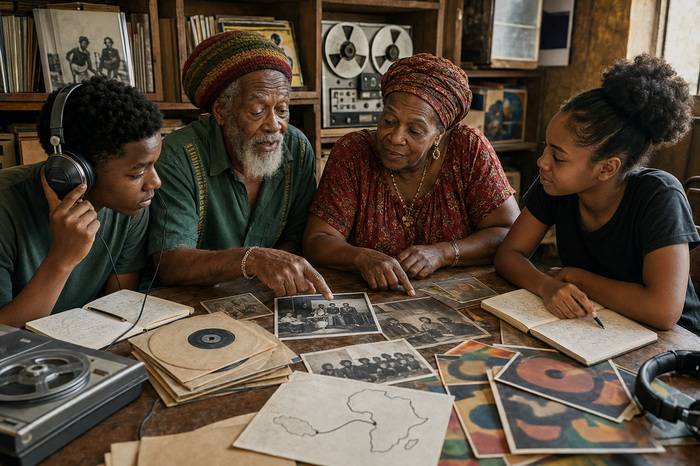
The curriculum should include oral histories. Elders do not merely confirm dates; they carry texture: how a room sounded, why a phrase mattered, who repaired the amplifier, what police did, how a session was paid, which musician changed the rhythm, what the neighborhood expected from the dance.
Young people should also create. They can interview family members, reconstruct local music maps, remix archival material with permission, build small sound systems, compare lyrical themes, and compose songs about contemporary conditions. Education becomes strongest when memory generates new work.
Credit as a Daily Practice
Not every act of remembrance requires an institution. Artists can name influences during interviews. DJs can identify musicians and producers, not only singers. Writers can link to primary sources. Fans can learn who played on beloved records. Brands can pay cultural consultants and community partners. Festivals can place historical information where audiences naturally gather.
Credit will not solve every economic inequality, but erasure grows through the absence of ordinary recognition. Daily practice can prepare the ground for larger reform.
Memory as a Future-Making Force
People sometimes treat historical consciousness as the opposite of innovation. In this view, memory pulls backward while creativity moves ahead. Reggae’s history offers another lesson. Jamaican innovators produced new forms precisely because they transformed what they had inherited. Memory was not a chain around imagination. It was material.
A future reggae grounded in memory does not need to sound like a copy of the 1970s. It may use African instruments, electronic production, new languages, visual media, immersive performance, and forms not yet invented. What makes it rooted is not nostalgia. It is an accountable relationship to people, place, struggle, and lineage.
The point is not to demand that every musician carry every theme. It is to protect an ecosystem where the full message remains possible. Romance can sit beside resistance. Wellness can include justice. Cannabis can be discussed with sacrament and law. International performers can participate while Jamaican creators retain authority and opportunity. Africa can become a living partner rather than a decorative word.
Reggae without memory can still produce a pleasant night. It can sell tickets, clothing, vacations, and calm. What it cannot do is explain why the bass once felt like a people recovering their own heartbeat.
That explanation belongs to no single legend. It lives among elders, records, studios, yards, churches, camps, dances, neighborhoods, and families. It lives in stories of creativity alongside stories of theft. It lives in the insistence that the poor were not merely subjects of history; they were thinkers making history audible.
To remember is not to close the gate. It is to place a sign at the entrance telling the truth about whose hands built the road.
The next movement in reggae will need new sounds, new partnerships, and new institutions. Before building them, we must know what cannot be abandoned. Rastafari cannot remain costume. Garvey cannot remain quotation. Babylon cannot become inconvenience. Jamaica cannot become scenery. The pioneers cannot become anonymous samples beneath somebody else’s future.
Memory is not the weight reggae must escape.
Memory is the root from which reggae can rise again.
Sources and Further Reading
Bob Marley Rasta Prophet


Rasta Roots Reggae Rhythms


Rasta Women Vibing


Fashion Revolution


