Between Places: Rasta Families Migration and Staying Connected
Across distance, relationships are maintained through calls, visits, music, food, memory and the work of caring for people in more than one place.
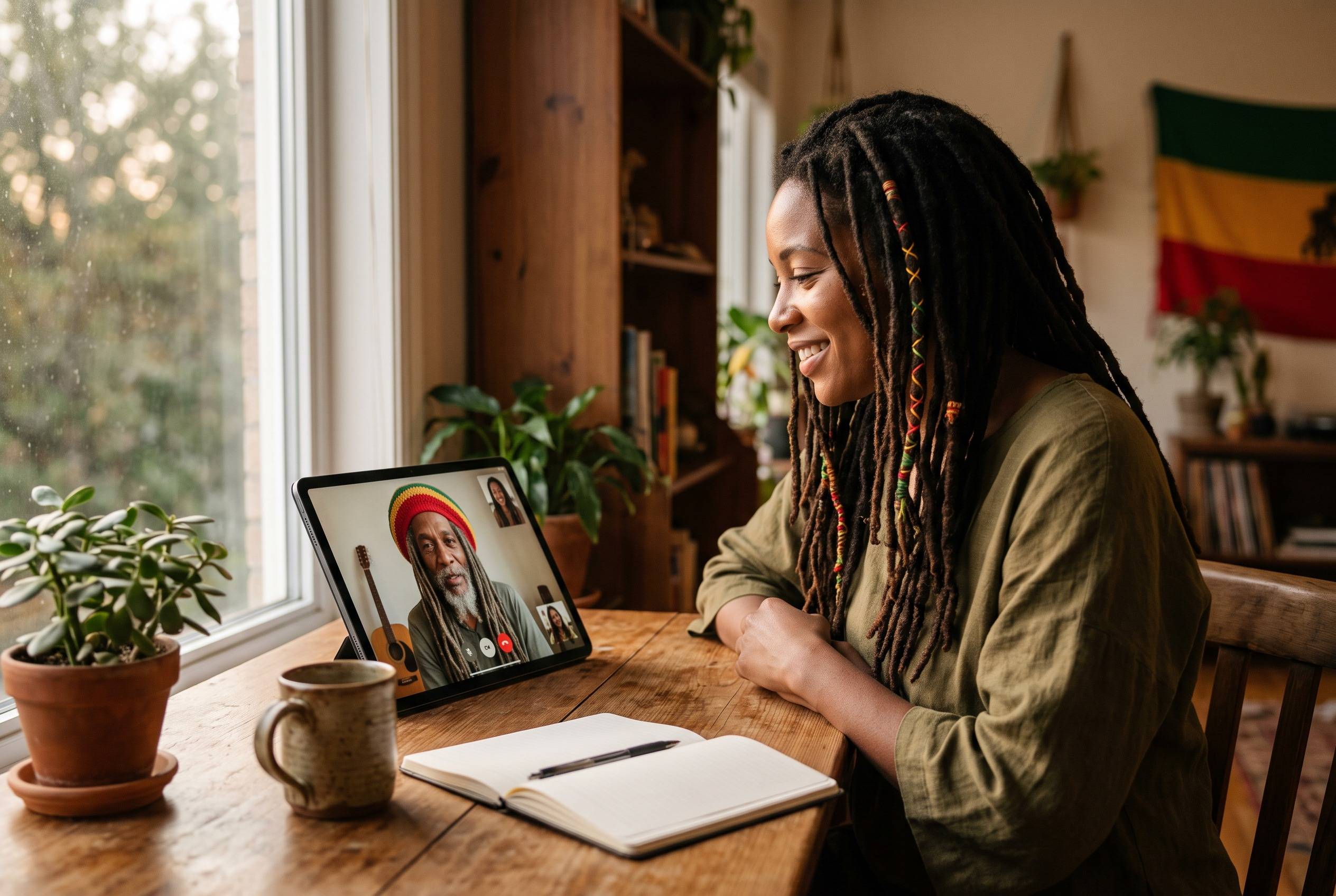
A family conversation may begin in one country and continue in another. Someone calls to ask about an elder’s health. A relative sends a photograph of a new child. A song is shared with the message that it used to play at home. Another person asks when everyone will be able to meet again.
For a Rastafari family living across borders, such exchanges may carry spiritual commitments, memories of Jamaica or Africa, and the everyday concerns of work, school and care. Distance can make a relationship more difficult to maintain, but the person who moved is not the only one whose life changes. Those who remain also adapt, make decisions and carry responsibilities.
There is no single Rastafari migration story. Some people move for work, education, family or safety; others remain where they were born or move within a country. Some grow up in Rastafari households, while others find their way to the movement elsewhere. A careful account begins with particular people and the places they call home.
A movement and families across places
Jamaica, Africa and the wider diaspora
Rastafari emerged among Black Jamaicans in the 1930s, during British colonial rule. Its history is connected to African identity, Black liberation and spiritual interpretations that differ among individuals and communities. As people traveled, settled and built relationships elsewhere, Rastafari also developed in places with their own histories and circumstances.
Britain, the United States, Ghana and other countries should not be treated as interchangeable destinations. A family may encounter different work, housing, educational and community conditions in each place. People born in those countries may also come to Rastafari through local relationships, study or spiritual experience.
The meaning of Africa can be profound in Rastafari history and thought. Individuals understand that relationship in different ways, including through spiritual connection, Pan-African politics, family ties, travel or aspirations for return. It would be inaccurate to assume that every Rastafari person has the same plans or that a person must move to demonstrate the strength of a belief.
Reggae Dread’s Rasta Livity in Everyday Life introduces the relationship between history, belief and daily practice. Here the focus is on the people whose relationships continue when a family lives in more than one place.
More than departure and arrival
A migration story is often told as a single journey: a person leaves home, arrives elsewhere and begins again. Family life is usually more complicated. A parent may move before a child; a relative may stay to care for an elder; someone who left may later return or move again.
The decision to move can bring hope and disagreement. One person may see a new opportunity, while another worries about separation from a familiar community. Children may experience the move differently from the adults who made it. Those differences do not mean the family lacks unity; they show that people occupy different positions within the same decision.
A careful account also asks who stayed and what work continued there. Someone may look after a house, visit an elder, maintain a garden or keep relatives informed. These contributions can remain invisible when the story follows only the person who boarded a plane.
What a family carries
People can carry possessions, but they also carry habits, stories, beliefs and relationships. A recipe may be adapted to ingredients available in a new city. A prayer or book may become part of a familiar routine. A record or a remembered song may connect a child to a relative they see only occasionally.
Not everything can or should remain unchanged. A family may have less space, a different work schedule or access to new communities. An elder may want a younger person to preserve one practice, while the younger person finds another way to express belonging.
The important question is not whether the new home looks identical to the old one. It is how the people involved describe what they value, what they change and what they miss.
Three accounts of connection

Aleema Gray: a family story across Jamaica and Britain
In the introduction to her research on Rastafari in Britain, historian Aleema Gray describes being born in Portland, Jamaica, to Rastafari parents. Her father was born in Britain and traveled to Jamaica in 1979; her mother was a local farmer. Gray recalls a rural childhood and the family’s later move to London. Read the University of Warwick repository record.
The direction of the journey matters. Gray’s father had already moved from Britain to Jamaica before the family later migrated to Britain. Her account therefore resists a simple picture of culture traveling only from Jamaica to Britain in a straight line.
Gray writes that history became a way to understand herself across those places. Her research draws on community oral histories as well as her own relationship to the subject. Her personal introduction is one part of a larger historical project; it is not evidence that every Rastafari family made the same journey or interpreted Britain in the same way.
Her story also reminds us that a move can be connected to work and material conditions. Spiritual commitments exist alongside the need to earn a living, find housing and care for children. A family can hold a powerful idea of a place while still having to make a difficult practical decision about where to live.
Sista Pama: a connection between Ghana and Jamaica
In her 2020 research on Rastafari in Ghana, scholar Shamara Wyllie Alhassan describes visiting a Ghanaian Rastafari woman identified as Sista Pama. Alhassan reports that Pama named her restaurant and juice bar Montego Bay after the Jamaican city where her mother had lived for about sixteen years. Read Alhassan’s study.
That detail connects a business name to a family history and a relationship between two places. It does not establish that Pama herself migrated from Jamaica, and the article should not be read as saying so. Her account belongs to a Ghanaian context with its own history, spiritual life and social conditions.
Alhassan’s research also describes how study of African and Pan-African figures informed Pama’s understanding of identity. A family connection, a place name and a process of study can coexist without being reduced to one story of departure or return.
The account invites a useful question: which names, objects or habits in a household point toward a relationship elsewhere? The answer needs to come from the people concerned, not from an outsider’s assumption about what an object must mean.
Dorothy Baker: family and Rastafari in the United States
The Smithsonian’s catalog description of an oral-history interview with Dorothy Baker records that she discussed her introduction to Rastafari, raising children and differences she perceived between Rastafari in Jamaica and the United States. The catalog also notes that her husband was born in Jamaica and grew up in New York.
The description identifies topics in an archived interview. It does not provide enough detail to invent a scene from Baker’s home or put words in her children’s mouths. Full access to the recording may require contacting the archive.
Even with that limit, the record points to the range of experiences contained within a family and community. Rastafari in the United States cannot be explained only through an imagined Jamaican migrant; people may have different birthplaces, routes and relationships to the movement.
Keeping relationships active across distance
The phone call is part of the work
A call can carry everyday information as well as major news: who needs a ride, how a child is settling into school, whether an elder has been able to visit a friend or what a family is planning for a gathering. Repeated contact can make it easier to notice when someone wants support.
Not everyone has the same access to devices, data, quiet space or time. Work schedules and time zones can make regular calls difficult. Rather than assuming a missed call means a person does not care, ask what kind of contact is workable and how often each person would like it.
A voice message, letter, scheduled video call or message through a trusted relative may suit different people. The choice should preserve privacy and allow the recipient to say when they do not want to talk.
A family can agree on a simple plan without making every conversation an obligation. One person might call an elder weekly; another might be the contact for a specific task. The plan should be reviewed if it places too much work on one person or no longer meets the elder’s wishes.

Sharing food and memory
Food can connect people who live apart. A relative may explain how they prepare a dish, describe a market ingredient or send a photograph of a meal. A person in another place may adapt the dish because the original ingredient is unavailable or because their household’s needs have changed.
Those adaptations do not erase the history of the food. They can become a new part of the family story, especially when the people who taught the recipe are named and asked what they want shared. One family member may prefer a written recipe; another may remember a method through observation and conversation.
Ital practices vary among Rastafari people and households. A shared family recipe should be described as that family’s account rather than a rule for everyone. Food belongs in that conversation, along with the labor of growing, buying, preparing and serving it.
Reggae Dread’s Ital Beyond the Recipe explores some of the connections among food, growing and daily livity. A family living across distance may encounter the same questions through different markets, climates and resources.
Music can travel with a person
A record brought in a suitcase, a song played on a phone or a recording recommended by a cousin can connect listeners across places. The person who moved may hear it differently after leaving; a child born elsewhere may associate it with a relative’s voice rather than with the place where it was recorded.
Reggae Dread’s Jamaica to Britain: How Reggae Records Connected Lives follows people and recordings across a particular route. A family conversation can add another scale of detail: who selected a song, where it was played and why someone remembers it.
Ask before recording or publishing a relative’s memory. A shared playlist or story can remain private if that is what the people involved prefer. A song’s meaning in one household should not be presented as the meaning it holds for every Rasta family.
Distance, responsibility and the people who stay
Care does not travel by itself
When an elder needs support, the family may need to coordinate several tasks: checking what the person wants, arranging a ride, obtaining food, helping with paperwork or finding a qualified local service. A relative abroad may contribute money or make calls, while someone nearby may do time-consuming work in person.
The people living closest should not be assumed to have unlimited availability. A person abroad should not be treated as an unlimited source of money. Discuss what each person can realistically do and make room for changes when work, health or finances shift.
The elder or other person receiving support should remain central to the decision. Ask what help they welcome, whom they trust and what information they want shared. Care is most respectful when it protects a person’s agency as well as responding to a need.
A family may also need formal services or public support. A caring relationship does not require relatives to perform medical or legal work for which they are not qualified. Where a need exceeds what the family can safely provide, seek appropriate local help.
Money can help, but it can also create pressure
Some relatives send money, contribute to a shared expense or help with a specific purchase. Others cannot. The amount a family member is able to give can vary over time and should not be treated as a reliable measure of love.
A conversation about money is easier to manage when the purpose and limits are clear. Is the contribution a gift, a loan or payment for a defined expense? Who will receive it, and who will report back if a report is expected? Does the person paying have enough for their own essential needs?
Avoid turning an uncertain promise into a permanent obligation. If circumstances change, say so early and discuss what alternatives might exist. Financial, tax and transfer rules depend on the places and people involved; consult an appropriate local professional or service for a specific question.
Money is only one form of contribution. Time, travel, listening, local knowledge and unpaid care can be equally important to the people depending on them. A family plan should recognize those contributions rather than counting only the funds that cross a border.
When a visit is not possible
Travel can be expensive, difficult to schedule or inaccessible for health and mobility reasons. A person may want to visit and still be unable to do so. The relative who remains may feel disappointment or may prefer a different kind of contact.
A family can acknowledge those feelings without assigning blame. Ask what connection is possible now: a regular call, a shared photo with permission, a letter, a local visit by someone trusted or a plan to discuss a future trip when circumstances permit.
Avoid promising that distance can always be overcome. Some losses and absences remain painful. Care can include listening to that pain without insisting that a quick solution will remove it.
Making a family connection plan
Map the relationship, not just the route
Choose one willing relative or trusted family friend. Explain that the purpose is to understand how the relationship has continued across places, and ask what they are comfortable discussing. A simple private record can include:
- People and places: Who is part of the story, and how do they
 describe the places they call home?
- The route: Which moves are confirmed, and which dates are remembered only approximately?
- The relationship: How did people keep in contact, share care or maintain a connection?
- The work: Who stayed, who moved, and what responsibilities did each person carry?
- The permission: What may be written down, shared with family or published?
A map can be useful, but it does not have to include addresses or private details. A few place names and an agreed description may be enough. If a person does not want a move or relationship recorded, leave it out.
A thirty-minute conversation
Begin with an open question: “Which place would you like to tell me about?” Let the person choose whether to discuss childhood, a move, a song or a relative. Ask how they know a detail and whether the date is certain, remembered approximately or unknown.
Before taking a photograph or recording audio, ask separately for permission. A person may agree to talk but prefer not to be recorded. If a public article or video is intended, explain that use and offer the person a chance to review the proposed material where possible.
Afterward, make a short note of what was agreed and any questions left open. Send a copy if promised. A family story can remain private and still be a valuable record.
Frequently asked questions
Did all Rastafari families migrate from Jamaica?
No. Rastafari originated in Jamaica, but people have different birthplaces, family histories and paths into the movement.
Do all Rastafari people want to move to Africa?
No single plan represents everyone. Connections to Africa can have spiritual, political, family and personal meanings, and individual aspirations differ.
What if relatives disagree about a family story?
Keep the accounts connected to their speakers and distinguish a remembered detail from a confirmed date. Further evidence may add context without resolving every difference.
Is sending money the only way to support family across distance?
No. Calls, local care, transportation, time and knowledge can all matter. Contributions depend on what people need and can offer.
Can I publish a relative’s migration story?
Discuss the intended use and obtain the person’s agreement. A private conversation is not automatically permission to publish a name, recording or image.
A home made through relationships
Home can be a place someone left, a place where children are growing up or a network of people who continue to care for one another across distance. It may hold more than one meaning within the same family.
Rastafari histories of African identity and liberation give that conversation depth, but no single journey explains every person’s life. The most useful account is one that names the people involved, listens to those who stayed as well as those who moved, and respects what each person chooses to share.
A call, a meal, a song or a practical plan cannot remove every difficulty created by distance. Together, they can keep a relationship active and give the next generation a more complete story of where they come from and who helped carry them forward.
Sources and further reading
- Aleema Gray, Bun Babylon: A Community-Engaged History of Rastafari in Britain, 1955–1992, University of Warwick, 2022. The introduction includes Gray’s account of her family in Jamaica and Britain.
- Shamara Wyllie Alhassan, “We Stand for Black Livity!”: Trodding the Path of Rastafari in Ghana, Religions, 2020. Includes a research interview with Sista Pama and the account of her restaurant’s name.
- Smithsonian Institution, catalog search containing Dorothy Baker’s oral-history interview. The catalog summarizes an archival interview; consult the repository about full access.
- British Library, Engaging children with testimonies of Caribbean migration. Discusses family separation and oral-history materials in a wider Caribbean context.
- Reggae Dread, Jamaica to Britain: How Reggae Records Connected Lives, Ital Beyond the Recipe and Rasta Livity in Everyday Life.