Rastafari, Work and Money: Earning a Living While Holding On to Your Values
From a market stall to a salaried job, the search for a livelihood brings spiritual conviction, family responsibility and economic reality into the same conversation.
A workday may begin with a journey to a market, a shift at a shop, a customer waiting for an order or a field that needs attention before the heat rises. It may also begin with a calculation: what must be paid this week, how much food is needed at home and whether the work ahead will bring in enough.
For many Rastafari, earning a living can raise questions that reach beyond the amount on a pay slip. How is the work done? Who benefits from it? Does it leave room for family, spiritual practice and responsibility to the community? What happens when the available choice falls short of what a person hopes to do?
There is no single Rastafari occupation or financial rulebook. People work for employers, operate businesses, grow food, teach, make art, care for others and combine several kinds of labor. Some are able to choose among opportunities; others must make difficult decisions within tight limits. Listening to those circumstances helps us understand what it means to hold on to values in a working life.
Work belongs in the story of livity
Belief meets the cost of a day
Rastafari emerged among Black Jamaicans in the 1930s, when the island was under British colonial rule. The movement’s spiritual and political life developed within a history of racial hierarchy, economic inequality and struggles for Black dignity and self-determination. Questions about work and livelihood belong within that history.
The idea of livity can describe the relationship between spiritual outlook and daily practice. For one person, this might include attention to how food is produced or how a customer is treated. Another might emphasize independence, care for family, honest dealing or the freedom to express a spiritual identity at work. Their explanations may overlap without being identical.
A wage, a sale or a crop is also part of material life. Rent does not disappear because someone is committed to a spiritual path. A parent still needs time and resources to care for children; an elder may need transportation; a business owner may need to replace equipment. Financial pressure is not evidence that a person has failed to live according to their beliefs.
Our earlier discussion of Rasta livity in everyday life began with these connections. This article follows one of them more closely: how people make a living within conditions they did not choose entirely for themselves.
Self-reliance has a history—and limits
For some Rastafari, working for oneself or developing community resources can express a desire for independence. Growing food, making a product, offering a service or sharing skills may create choices that are not available when every need depends on an outside employer or supplier.
But independence is not simply a matter of willpower. A grower needs access to land, tools, water and a way to sell or share the harvest. A vendor needs stock, transportation and customers. A craftsperson needs time, materials and a market that values their work. Those resources are distributed unevenly.
Working for an employer can also be a responsible and meaningful way to support a household. People may value a regular wage, health coverage, the work itself or relationships with colleagues. Someone should not be judged as less committed to Rastafari because their livelihood takes a different form from another person’s.
The useful question is not which occupation looks most spiritual from the outside. It is how an individual understands their work, what choices are actually available and whether the people who do the work are treated with dignity.
Work that does not appear on a pay slip
Cooking, transporting relatives, caring for children, helping an elder and keeping a household organized all require labor. Some of that work is unpaid, even when a family or community could not function without it. A business may depend on a relative answering calls, preparing food or caring for children while the owner travels to market.
Women in particular have often performed work that is treated as a natural obligation rather than recognized as a contribution. That assumption can hide both skill and cost. Asking who has time to earn, study, rest or take part in public life can make a household’s decisions more visible.
Reggae Dread’s article on Rasta women and everyday livity looks at women as thinkers, workers and community builders. It provides a useful reminder that a discussion of livelihood should include the people whose work is easiest to overlook.
People making livelihoods in different ways

A community brings several kinds of work together
The Rastafari Indigenous Village’s own description presents a community in Jamaica where families live and where invited visitors can encounter gardens, an Ital kitchen, craftwork and cultural activities. The village describes particular work and relationships in that place; it should not be treated as a model of every Rastafari community.
Its team biographies describe Queen Izeteh Berhan as a Rastafari artisan and teacher, and describe her work making products from plants. The same page identifies Cardolisa Wray as a chef, cultural curator and entrepreneur involved in the village’s food and events. These are the organization’s descriptions of individuals and their work, not interviews conducted for this article.
The details matter because they resist a narrow picture of what earning a living can involve. Teaching, preparing food, working with plants, planning events and welcoming visitors call for different knowledge. Several forms of skill can exist in the same person, and a community’s public work may depend on contributions that visitors do not immediately see.
The village is also a business welcoming visitors. Its example raises questions about who sets the terms of a visit, how cultural knowledge is presented and how revenue supports the people doing the work. Those questions should be asked of any cultural enterprise rather than answered by assumption from a promotional page.
The seller, the maker and the customer
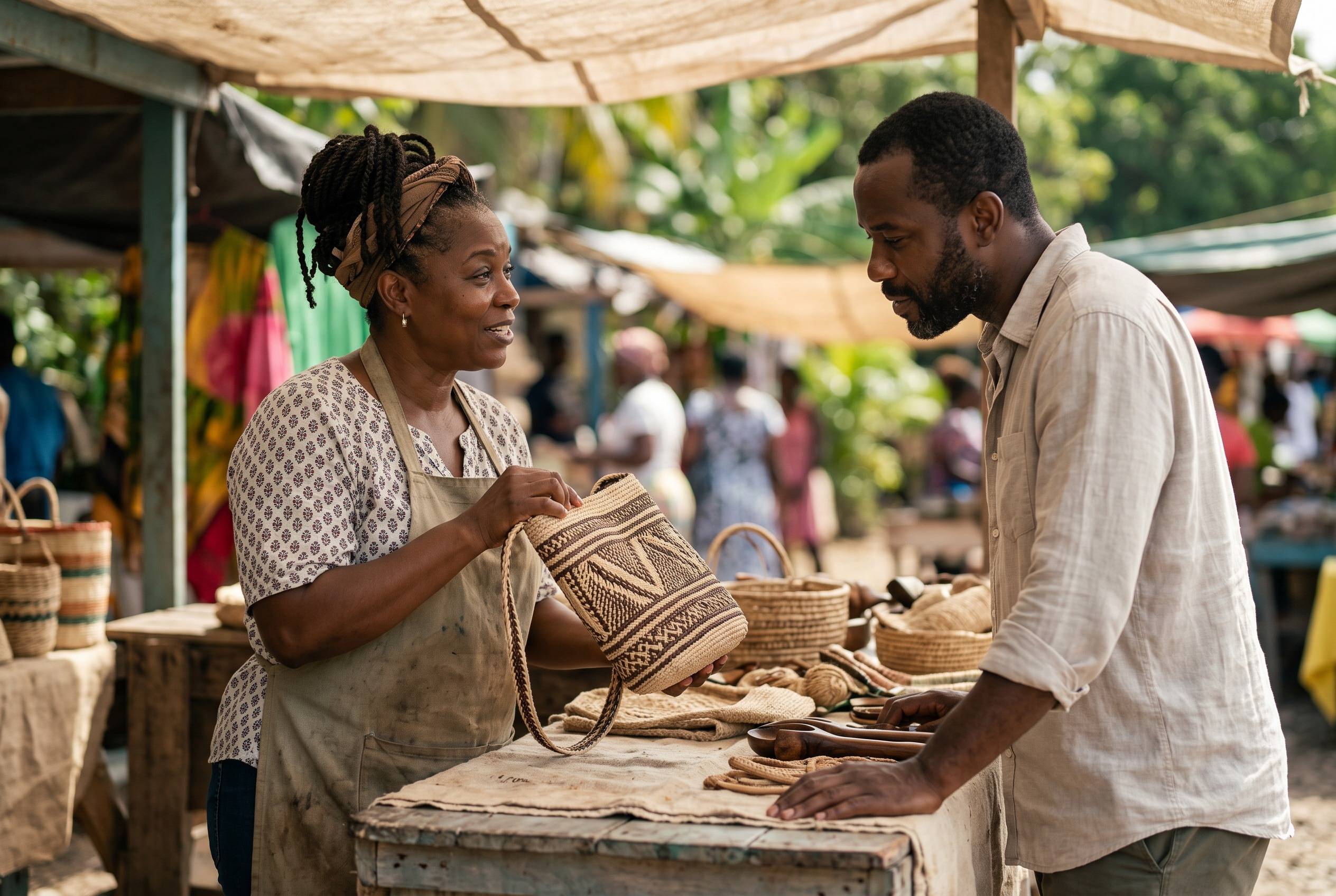
Consider a hypothetical example: a craftsperson makes a small number of woven bags and sells them through a local market and by personal order. A sale requires more than the finished bag. Materials must be obtained, a design made, the item produced, a price agreed and the product transported or delivered.
The maker may be asked for a discount because a customer knows the family, or for unpaid photographs because a business wants to promote an event. Generosity can be meaningful when freely chosen. It becomes a different matter when someone assumes that cultural work should be free or that a close relationship removes the need to pay.
A respectful customer can ask the price, understand what is included and honor the agreement. If the seller offers a reduced rate or gives an item away, the decision belongs to the seller. Care for community should not require a person to conceal the cost of their own labor.
The same principle applies to an Ital cook, musician, teacher or grower. The details of each trade differ, but the questions about time, materials, credit and fair payment remain practical parts of a relationship.
When a cultural contribution becomes a product
In 2025, the Jamaica Business Development Corporation described a campaign recognizing Rastafari influence in areas including food, craft and fashion. Its account presents the perspective of a business-development organization interested in Jamaican enterprise. Read the JBDC description.
That recognition opens a further question: when an idea, image or skill becomes commercially valuable, who controls its presentation and who receives the benefit? A visitor may pay to learn from an artisan; a company may use an image associated with Rastafari in advertising. Those are different arrangements, and neither should be judged without knowing who agreed to what.
A fair conversation can include payment, credit, consent, ownership and the right to decline. It can also distinguish a living spiritual tradition from a decorative brand. Recognition is a beginning; the terms under which people participate are what make the relationship concrete.
Looking at money without losing sight of people
Price is not the same as pay
A customer sees the price of an item. The person selling it must also consider what it cost to make and deliver, whether the item will sell, and how much of the sale remains for other needs. A busy day can bring in money without necessarily covering all the work behind it.
Here is a made-up example, using simple currency units rather than actual prices. A maker sells 12 items for 10 units each, bringing in 120 units in sales. Materials and packaging cost 36 units, and transport and a stall fee cost another 18. If the maker allows 40 units for the time spent producing and selling, 26 units remain before any other expenses, taxes or unexpected losses.
The example is only a way to see the parts of a price. It is not a recommended price, a profit guarantee or a complete business plan. If the maker has not actually paid themselves for the 40 units of work, that labor remains a cost even though no cash has left the account.
A more complete record might also consider equipment, storage, unsold stock, time spent finding customers and periods when no sales occur. The details depend on the work and local rules. A qualified local adviser can help with specific financial, tax or business questions.
Asking what a household needs
A family budget is more than a list of what one person wants to buy. It can include housing, utilities, food, transportation, school needs, medical costs and support for relatives. Income may arrive irregularly, so a household may need to think about timing as well as totals.
A conversation can begin with three questions: What must be paid first? What income is reasonably expected, and when? What would we do if that income arrives late? The answers will differ for a salaried worker, a seasonal grower and a person combining several jobs.
It can also help to ask who has access to the information. If one partner handles the money, the other still needs an opportunity to understand decisions that affect the household. A family member doing unpaid care work is part of the economic picture, even when their contribution does not appear as income.
There is no virtue in pretending the numbers are easier than they are. A plan can be revised when circumstances change. The aim is to make decisions with enough information and mutual respect, not to judge a family for having limited options.
The difference between support and exploitation
Communities often rely on people sharing skills, food, space and time. Such exchanges can be reciprocal and sustaining. But a request for help is healthiest when the person asked can say no, the commitment is clear and the work does not fall repeatedly on the same shoulders.
Before organizing an event, for example, a group can agree on who will prepare food, transport supplies, clean up and handle money. If payment is available, explain how it will be distributed. If someone volunteers, ask what they are willing to do and whether they need support to participate.
A person can believe in collective responsibility and still need to earn a wage. Recognizing that need protects the relationship from becoming an expectation of unlimited unpaid labor.
Work, identity and the wider world
When a workplace does not understand a practice
A Rastafari worker may encounter questions about locks, clothing, food, scheduling or spiritual observance. The meaning of those practices is personal and varies among individuals. A workplace concern should be discussed with attention to the actual job and the person’s circumstances, rather than assumptions about what a Rasta looks like.
Our companion article, Dreadlocks at Work: Identity, Dignity and Belonging, examines documented U.S. employment cases and links to agency guidance. Its discussion is specific to the circumstances and jurisdiction described there; workplace protections and procedures differ elsewhere.
Even where a rule can be resolved, a worker may carry the daily burden of explaining their identity. A colleague can help by focusing on the person’s work, respecting privacy and responding when a joke or assumption makes the workplace less welcoming.
The right to earn a living should not be discussed only as an individual challenge. Hiring practices, access to capital, transportation, land and public attitudes all shape the opportunities available to people and communities.
Working across generations
A skill often travels through a relationship. An elder may show a younger person how to tend a plant, prepare a dish or shape a piece of wood. A younger person may help with digital records, photographs or reaching customers. Both participants can be teachers, and neither should be assumed to have unlimited free time.
Before using a family skill in a public business, talk about the people who taught it and what they are comfortable sharing. A recipe or story may be meant for a household rather than an advertisement. If a person contributes to a project, ask how they would like to be credited and whether compensation is appropriate.
Not all knowledge should be sold or made public. A person or community can decide that some practices are private, sacred or simply not available for an outsider’s use. Respect includes accepting that boundary.
Making room for rest
Long hours can be necessary, especially when income is uncertain. Yet a livelihood that depends on one person being available at all times can leave little room for family, reflection or health. Rest is easier to discuss when people have enough money and support; many do not have that security.
A practical starting point might be to identify one task that could be shared, a time when a worker is not expected to answer messages or a customer agreement that makes deadlines clear. These are small possibilities, not universal solutions. They work only when the people involved have some control over their schedules and resources.
A community that values care can ask what makes rest possible: fair pay, shared domestic work, reliable transport, accessible services and neighbors who are willing to help. Those conditions are collective as well as personal.
Bringing values into a real decision
Five questions for the next opportunity
Whether considering a job, a sale or a partnership, a person might ask:
- The work: What exactly am I being asked to do, and does the agreement describe it clearly?
- The money: What will I receive, what costs will I carry and when will payment arrive?
- The people: Who else contributes, and how will their time, credit and care be recognized?
- The boundaries: Are there spiritual, family, safety or privacy concerns I need to discuss?
- The next step: If the arrangement is not workable, what alternative or support is realistically available?
These questions do not guarantee a good outcome. They can make a decision easier to examine and help people recognize where a choice is constrained by conditions beyond an individual’s control.
Frequently asked questions
Do Rastafari avoid earning money?
No single financial practice applies to all Rastafari. People earn and use money in different ways while considering their own beliefs and responsibilities.
Must a Rastafari person be self-employed?
No. Rastafari people work in many occupations and arrangements, including employment and self-employment.
Can a cultural business support a community?
It can, depending on how it is organized. Ask who sets the terms, who is paid, whose knowledge is used and whether participants have agreed to its presentation.
How can a customer support a maker respectfully?
Learn about the work, ask rather than assume, honor the agreed price and obtain permission before using a person’s image or story.
Where can I learn about a specific employment or business rule?
Rules differ by place and situation. Consult the appropriate local agency or a qualified adviser rather than treating an article about another jurisdiction as a personal answer.
A livelihood connected to life
Work is not separate from the rest of a person’s day. It affects the food a household can buy, the time available for children and elders, the ability to participate in a community and the freedom to practice a belief without concealment.
Rastafari perspectives on livity invite readers to consider those relationships with care. They also ask us to recognize the economic and historical conditions surrounding individual choices. A person can seek honest work, fair treatment and a sustainable livelihood while acknowledging that the path is rarely simple.
The next time we admire a handmade item, share a meal or hear a piece of music, we can ask whose work made it possible. Paying attention to that answer is one way to carry respect from an idea into an everyday transaction.
Sources and further reading
- Rastafari Indigenous Village, About and Team. The community’s descriptions of its activities and members; these are not independent interviews conducted for this article.
- Jamaica Business Development Corporation, “Tings Jah Mek Ya” campaign and Rastafari’s role in Jamaican enterprise, 2025. An institutional perspective on cultural enterprise.
- Shamara Wyllie Alhassan, “We Stand for Black Livity!”: Trodding the Path of Rastafari in Ghana, Religions, 2020. Research on Rastafari livity and identity in a particular Ghanaian context.
- Reggae Dread, Rasta Livity in Everyday Life, Rasta Women and Everyday Livity and Dreadlocks at Work.