Reggae History & Cultural Preservation
Jackie Jackson’s Basslines: How to Hear and Preserve a Reggae Legacy
Three recordings. The people behind them. A practical invitation to carry reggae’s musical memory forward.

Play a familiar record and give its bass your full attention. Let the singer remain in the room, but follow the low notes: their arrival, their repetition, the spaces between them. You may discover that a song you thought you knew contains another conversation.
That is a useful way to approach Clifton “Jackie” Jackson. The Jamaican bassist’s life invites us to connect musical pleasure with the people whose decisions made it possible. A listener can remember a chorus for decades without learning the name of someone who helped give that recording its movement.
Jackie Jackson reggae bass legacy will live on. Jackson died on 23 September 2026, aged 79, according to reporting by The Gleaner. His death gives preservation an immediate emotional weight. It also asks something of those still listening: what will we carry forward besides a tribute and a playlist? [1]
We can begin with a name, a recording and a question. From there, listening can lead to accurate credits, surviving interviews, family knowledge and more useful teaching. Enjoyment gives us a reason to care; attention gives that care somewhere to go.
Who Was Clifton “Jackie” Jackson?
Jackson’s career connects the recording room with the touring stage. The Gleaner describes a musician whose work crossed ska, rocksteady and reggae, naming associations with Alton Ellis, the Melodians, Desmond Dekker, Paul Simon and, over many years, Toots and the Maytals. That breadth provides several entrances into his story. [1]
Learning through people
In his 2016 interview with Angus Taylor for United Reggae, Jackson recalled growing up in central Kingston, taking piano lessons and becoming fascinated by the Skatalites’ bassist Lloyd Brevett. He also described his development with Tommy McCook’s Supersonics and his work at Treasure Isle. These are Jackson’s recollections of his musical formation. [2]
A young musician reading that account can ask a practical question: who makes learning possible? A teacher, an admired player, a rehearsal someone is allowed to attend, or a band willing to give a newcomer responsibility can change the direction of a life.
That question also changes how we write musical history. A biography becomes richer when it recognizes the relationships around its central figure. Skill has a personal dimension, but opportunities to develop it have a social dimension. Someone provides an example; someone listens; someone makes room.
A working musician’s knowledge
Think about the knowledge a bassist must bring to an ensemble: concentration, rhythmic awareness, an ear for the singer, and the judgement to decide when a phrase needs movement or restraint. These are useful categories for listening to Jackson, even when a surviving source cannot tell us exactly what happened during a particular rehearsal.
They also give young players something more useful than an unreachable legend. An admired musician becomes a person whose work can be studied patiently. You can ask how a part relates to the whole, compare performances and learn to explain what you hear.
Keep that sense of work in view as you read a biography. A list of celebrated records can establish scope, while questions about preparation, rehearsal and collaboration help us understand the skills behind the list. Both forms of attention belong in an account of musical achievement.
Three recordings offer a manageable beginning. Each brings a different listening question and a different opportunity to examine the evidence behind a credit.
Listen Again: Three Recordings, Three Ways to Hear His Work
For each selection, keep two things open: the recording and the source identifying the musician. A catalogue page helps you locate music. A personnel credit or participant’s account addresses who made it. These functions belong together, but they answer different questions.
Alton Ellis — “Girl I’ve Got a Date”
Jackson recalled this as his first Treasure Isle recording and described developing its introduction with guitarist Lynn Taitt. The account connects a recognizable musical moment to a remembered collaboration. [2]
Use the Alton Ellis & the Flames selection on Let’s Do Rocksteady: The Story of Rocksteady 1966–68. Begin before the voice enters. Follow the lowest part you can distinguish, then replay the opening while attending to the other instruments.
Ask whether your attention changes when you hear the parts together. Does a repeated figure become a point of recognition? Does another instrument clarify its shape? You do not need notation to record an observation. A description of an entrance, a pause or a return can be precise.
If the low part is difficult to follow, begin with a few seconds and replay them at a comfortable volume. Hum the shape you think you hear, then check it against the recording. Treat the exercise as an exploration. There is room to revise your description after another hearing.
The Maytals — “Pressure Drop”
Jackson’s interview places him at the session for “Pressure Drop” during his account of beginning work with Toots. [2] The Academy uses the track on Apple Music’s Funky Kingston listing as its listening destination.
Listen once without taking notes. On a second pass, follow the bass. On a third, notice its relationship with the drums and voice. Pick a short passage and describe what changes in your experience when you shift attention.
Keep the edition beside your notes. A compilation date or platform release date does not, by itself, establish when a historical session occurred. If you choose another version, record that choice and use its own timings.
Toots and the Maytals with Ben Harper — “Love Gonna Walk Out On Me”
For the 2004 True Love collaboration, Ben Harper’s official website names Jackson on bass and Paul Douglas on drums, alongside the featured singers and other instrumentalists. This is a published musician credit for that collaboration. [3]
Open the recording with Ben Harper and consider how the instrumental parts relate to the voices. Where does your ear go first? What becomes clearer on a second hearing? Keep these as listening questions; a performance cannot tell you every detail of its production.
A small exercise with lasting value
Write the artist, title and edition. Add one observation about the sound and one supported statement about a participant. Finish with a question you cannot yet answer. You now have a useful listening note: something another reader can revisit, investigate and improve. External audio access may require an account or subscription.
Behind Toots’s Voice Was a Community of Musicians
A singer gives listeners a powerful point of attachment. We remember a voice’s grain, a phrase’s feeling, or the way a line speaks to an experience of our own. Listening to the ensemble deepens that attachment by revealing the relationships that support it.
Jackson recalled session musicians becoming the touring band under the Toots and the Maytals name. His account connects studio collaboration with the practical decision to work together on the road. [2]
The road has its own history. In a tribute reproduced by Reggaeville, guitarist Carl Harvey remembered Jackson as a bandmate of more than four decades and recalled his reading, humour and companionship. Those memories preserve aspects of a working relationship that a track listing cannot convey. [4]
Hear the relationships
Imagine introducing a record to someone who has never heard it. You might describe the vocalist first. Then add a documented instrumental contributor and explain one relationship you want the listener to notice. That small change gives the ensemble a place in the story from the beginning.
There is no need to turn recognition into a competition over who mattered most. A singer’s achievement and a bassist’s contribution can occupy the same paragraph. The challenge is to make their relationship intelligible without assigning intentions or arrangements that the evidence does not establish.
A useful caption might identify Jackson’s published bass credit on the 2004 collaboration, then invite attention to bass and drums. It need not claim that he wrote the composition or owned the recording. Each additional claim would require its own support.
This is also an approachable classroom activity. Ask two readers to introduce the same recording, exchange their captions and check each named role. Discuss how the revised introductions change whose work becomes visible.
You can extend the exercise by drawing a small working map: vocalist, instrumentalists, producer, engineer and the sources available for each. Leave an empty space where a role remains unidentified. The map shows both what a researcher has established and where another interview or document could make a difference.
Why a Name in the Credits Matters
A credit gives curiosity somewhere to go. A listener who learns a bassist’s name can search for another recording, an interview, a photograph or a lesson. Without that name, the musical contribution may remain audible while the person becomes difficult to discover.
For Reggae Dread, this is part of cultural responsibility. An article or playlist can help readers recognize the people behind the music. That work begins with specific claims a reader can check.
Four questions, four kinds of evidence
| Question | Evidence to seek |
|---|---|
| Who performed? | Track-specific personnel credits, session documents or attributed participant testimony. |
| Who wrote the composition? | Songwriting credits and relevant agreements or registration records. |
| Who controls this recording? | Contracts and documented ownership or licensing history for that recording. |
| Who received payment? | Agreements, accounting statements and other relevant payment records. |
The US Copyright Office distinguishes a musical composition from a sound recording of it. That distinction helps explain why a performance credit alone cannot settle every ownership question. The applicable law and actual documents still matter in an individual case. [5]
We should therefore resist filling gaps in Jackson’s financial history with assumptions. Public admiration does not establish a royalty share. An incomplete platform display does not establish the absence of a credit on every physical release.
Who funds the work of remembering?
Cultural economics also concerns the people doing preservation today. An interview needs preparation. A recording needs description. A transcript needs checking. A damaged object may require professional attention. These activities consume time, materials and expertise even when the resulting resource is free to read.
A community project should make those costs visible. Its budget can include contributor time, Jamaican research expertise, transcription, storage and accessible copies for participants. If a later publication earns income, discuss how contributors will be recognized and what agreements govern the material.
Community participation becomes meaningful when people help decide the questions, access conditions and uses of their knowledge. Ask who chooses the story, who can correct it, and who receives something useful from the work.
A project could report these decisions as plainly as it reports a track list: who contributed, which materials were approved, what work was paid for and where the resulting copies can be consulted. Such reporting gives supporters something concrete to assess and contributors a clearer account of what happened.
These are practical design choices for a future preservation effort. Jackson’s story offers a reason to make those choices carefully, without pretending that an educational article has resolved anyone’s private financial arrangements.
What Disappears When Musical Memory Is Not Preserved
A finished recording contains sound. It may leave us wondering how a part developed, who suggested a change, what a rehearsal felt like or how musicians understood their working lives. Those questions invite other kinds of evidence.
The surviving interviews matter. Angus Taylor’s conversation preserves Jackson speaking about his career. Reggaeville’s Munchy also recalls interviewing him in Kingston in 2022 for Take Me Places; the memorial page directs readers to that conversation. These are existing contributions by their respective interviewers and publishers. [2] [4]
Keep the person attached to the memory
A recollection becomes more useful when its speaker, date and circumstances remain attached. A memory of a rehearsal and a later interpretation of that rehearsal are related, but they need not be identical. Preserve the wording of uncertainty when a person cannot recall a name or date.
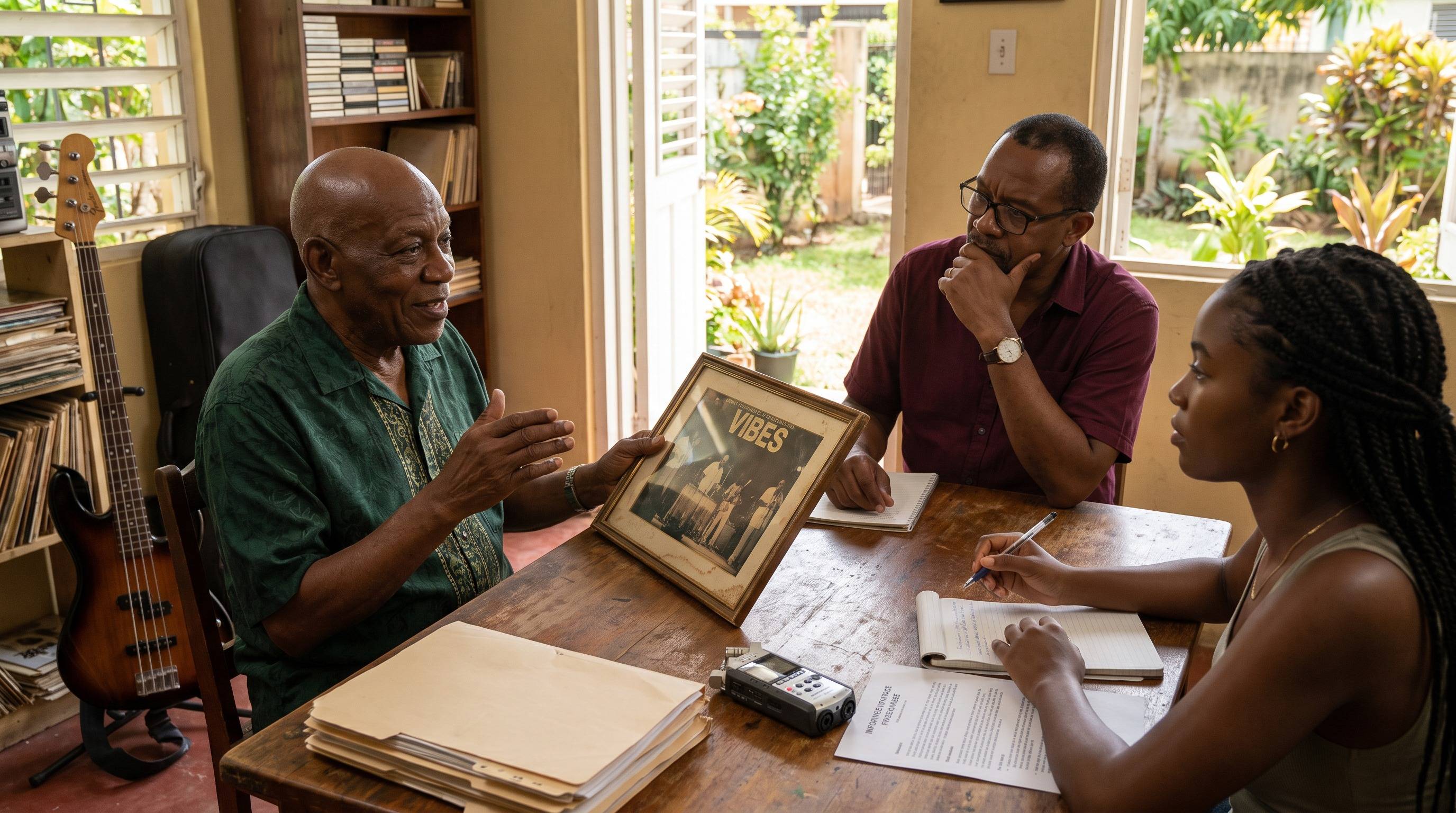
Consider an imagined family photograph showing several people beside instruments. The image survives, but its caption is missing. One relative recognizes two faces; another remembers the venue. Their accounts can be recorded separately. A third person may eventually connect the photograph with a dated programme.
The value grows through those connections. A guessed date, repeated as certainty, would make the next researcher’s task harder. An approximate date with an explanation leaves room for discovery.
Preservation is a relationship
The Oral History Association emphasizes collaboration, continuing consent and clear arrangements for preservation, access and use. Narrators should understand how an interview may circulate and explicitly authorize public access. Those principles place the people represented within the decision-making process. [6]
For a proposed reggae project, discuss the intended audience, whether recordings or transcripts will be shared, and how a participant can review material before an agreed release. Provide a usable copy. Keep private contact information separate from a public catalogue.
Families grieving a musician should be able to choose their own pace. A request can describe the project and leave time for a response. Urgency about historical loss should encourage preparation and care, while participation remains voluntary.
A photograph might be described now and considered for publication later. An interview might preserve a personal experience without settling a disputed session detail. Those limited contributions can still strengthen the record and help future readers ask better questions.
For an interview plan, prepare open questions: What do you remember about preparing for a performance? How were musical changes communicated? Which objects or documents might help explain that experience? Allow the narrator to introduce subjects you had not considered. A prepared question should make room for an answer that changes the direction of your research.
How Listeners Can Help Preserve Reggae History
Begin with one item you can describe responsibly. It could be a record sleeve, a concert programme, an identified photograph or a memory someone wishes to discuss. A small task completed carefully is a useful foundation for a larger collection.
1. Identify what you have
Write down the title or a brief description, the format and where the item came from. For a release, include the artist, label and catalogue number when available. For a photograph, record who supplied it and what they know about its date and setting.
2. Describe what it actually shows
Separate visible information from interpretation. “Three musicians beside a stage” may be supported by the image. “The band after its first overseas performance” requires additional evidence. Use a separate note for a possible identification and name the person who suggested it.
3. Support one claim
Choose a manageable question: one performer’s role, one venue or one release detail. Record the source and the date you consulted it. If two accounts differ, keep both alongside the question. A later reader should be able to understand why you reached your conclusion.
4. Agree on how it may be used
Before public reuse, establish what permissions are needed and what contributors have agreed to share. Owning a physical object does not settle every question about reproducing its contents. Write down the agreed attribution and access conditions so the next person handling the material understands them.
5. Keep useful copies and return them
Preserve the original and work from copies where practical. Keep more than one digital copy in separate locations, check that files open, and record changes. For physical recordings, the Library of Congress recommends careful handling, suitable enclosures and protection from damaging environmental conditions. Consult its format-specific guidance before undertaking cleaning or repair. [7]
Give contributors the copies you agreed to provide. Add a short description that can travel with the files. An image separated from its identification can become a mystery again, even when its resolution is excellent.
Make the first result easy to use
Try a one-page record with six fields: item, source, known details, open questions, agreed use and copy locations. Ask a friend to read it without your explanation. Their questions will show where another sentence would help.
For example, a record sleeve might support an exact spelling and a printed instrumental role, while leaving the session date unresolved. Record both outcomes. Add the edition details and where the sleeve can be consulted. If you later find stronger evidence, date the correction and retain the earlier note. Someone following your work can then understand how the account developed.
Choose one person to share the result with: a younger musician, a relative or a fellow listener. Ask whether the note helps them find the recording and understand the credit. Their response gives you a practical measure of success. Preservation begins to work when knowledge becomes easier for someone else to use with greater confidence.
The Academy’s worksheets, credit ledger and blank oral-history catalogue provide starting structures. Listeners, teachers, collectors and family historians can adapt them to material they are permitted to work with. The immediate achievement is a clear record that someone else can understand and build upon.
Continue the Work at Jackie Jackson Academy
The companion Academy course turns these ideas into practice. Its eight modules connect musicianship, the recording community, evidence, cultural economics and preservation. The six-selection listening guide expands the three encounters introduced here.
If you are primarily a listener, begin with one recording. Use the listening worksheet to describe a passage and the credit worksheet to connect a name with a source. You can make progress without specialist vocabulary or a musical instrument.
If you teach, the 60-minute “Who Makes the Groove?” lesson offers a sequence of listening, comparison, writing and peer checking. Students finish by making a claim another reader can investigate, while leaving an unresolved question visible.
If you are planning family or community research, start with the interview-planning and preservation worksheets. The downloadable credit ledger and oral-history catalogue help organize records. Prepare the project’s purpose, responsibilities and permission arrangements before approaching participants.
The course also connects with the Peter Tosh & Toots Hibbert Academy, where the discussion broadens to voices, collective work and the movement of Jamaican music. The connection gives learners another place to apply what they have noticed about Jackson.
Four printable worksheets and two research templates support the course. External listening services may require an account or subscription. If you use the course’s browser-based learning note, download your copy before clearing browser data or changing devices. Choose a starting point that fits the time you have, and aim to leave with one piece of work you can explain.
Carry the Name with the Sound
The next time a familiar reggae recording begins, give its bass a little more attention. Let curiosity lead you toward the musician, the collaborators and the evidence that keeps their work discoverable.
Jackie Jackson’s legacy can live in what we hear, what we teach and what we take the trouble to preserve. A named contribution, a careful caption or an agreed interview can give the next listener a stronger place to begin.
Continue with Jackie Jackson Academy. Choose a recording, follow the bass and turn your listening into a record someone else can learn from.
Explore Jackie Jackson Academy