Original Koffee: The Reggae Dread Artist Guide
Koffee’s voice made room for youthful joy, spiritual purpose and Jamaican rhythmic confidence inside global popular music. This guide follows the recordings, people and choices behind that journey—and keeps a verified watch on what comes next.
Official website Read the “OVA SO” review
A Jamaican voice that travelled without becoming generic
When Koffee emerged internationally, the first surprise was not simply her age. It was the scale she could create with economy. Her songs often reached their point without a long introduction, a crowded verse or a forced crossover feature. A bright melodic phrase, a change in cadence and a rhythm with enough open space could carry gratitude, warning, aspiration and youthful pleasure at once.
That compactness suited digital listening, but it did not originate as a platform trick. Jamaican popular music has long rewarded records that establish character immediately. Sound systems taught artists to value entrance, version, phrasing and crowd response. Deejays learned to make language percussive. Singers understood how melody could float above bass without fighting it. Koffee entered this tradition with a voice capable of moving between singing and rhythmic speech so naturally that the border often disappeared.
Her accessibility also carried place. Jamaican pronunciation, biblical thought, communal language and local rhythms were not edited out to make the songs travel. Instead, the specificity became part of their international appeal. Listeners could enter through the chorus, energy or emotional clarity, then discover the language and cultural references more deeply. This is a more durable form of crossover than sanding away identity for an imagined global average.
From Spanish Town beginnings to an international breakthrough
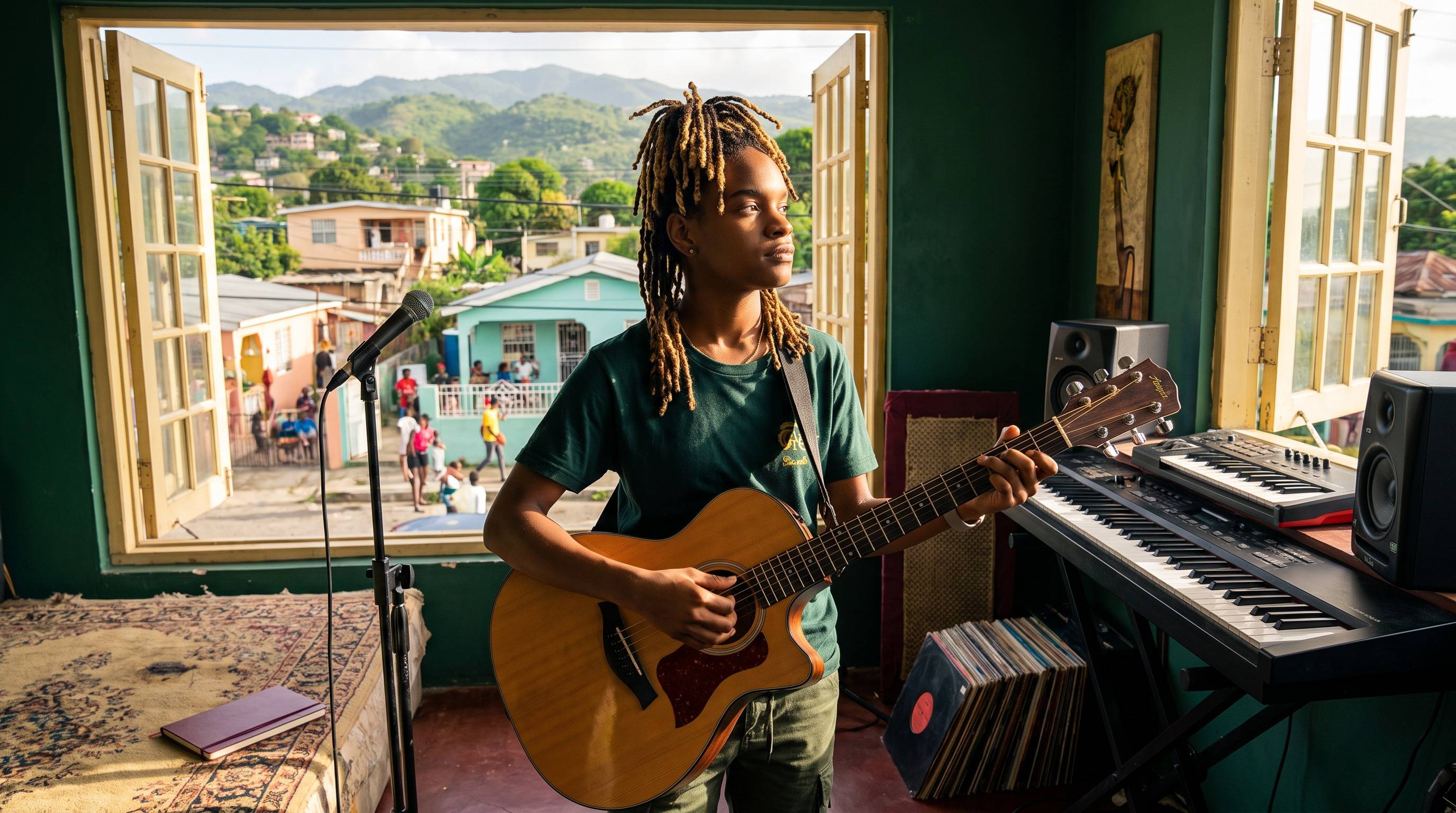
Koffee was born Mikayla Victoria Simpson and comes from Spanish Town in St Catherine. Accounts of her early development emphasize a household shaped by faith, a largely self-directed relationship with guitar, and the circulation of short performances online. Those elements help explain the combination heard in her first widely noticed recordings: spiritual vocabulary, instrumental curiosity and an instinct for communicating in a compressed visual-media environment.
“Legend,” an early tribute prompted by Usain Bolt, helped draw attention. “Burning” made the artistic proposition clearer. Here was a young Jamaican performer whose delivery could be light without being slight, positive without avoiding pressure, and modern without disguising the roots of her phrasing. “Raggamuffin” added competitive energy and sharper deejay technique.
Then “Toast” changed the scale. The song’s gratitude felt personal enough for private reflection and communal enough for weddings, graduations, dances, sporting celebrations and everyday victories. Its achievement was not merely catchiness. It gave listeners a language for recognizing help, survival and progress without pretending that success was automatic. The recording became a door through which a much wider audience encountered Koffee and contemporary Jamaican reggae.
Why Rapture mattered
The Rapture project was short enough to feel like a concentrated introduction. It placed gratitude beside ambition, melody beside deejay skill and present-day production beside reggae identity. “Toast” was the worldwide center, but the surrounding tracks prevented the project from becoming a one-song container. “Rapture” showed command. “Throne” strengthened the declaration of arrival. “Blazin” brought collective uplift into conversation with pressure and inequality.
Its 2020 Grammy win for Best Reggae Album became an institutional milestone. Awards do not create artistic value, and the category has its own history of narrow recognition. Still, this result altered who could be seen at the center of an international reggae narrative. A young Jamaican woman had won with a concise project rooted in contemporary production and unmistakably Jamaican vocal practice.
The most important interpretation is not that Koffee single-handedly opened reggae to women; women had long built the music as singers, instrumentalists, producers, selectors and organizers. The milestone instead exposed how overdue wider recognition was. It offered publishers and listeners a reason to move beyond exceptional-woman framing and examine the larger networks of women sustaining Jamaican music.

Gifted: expansion without abandoning the center
Koffee’s debut album Gifted arrived in 2022 with more room than the breakthrough EP. The arrangements drew on reggae while admitting touches of dancehall, R&B, pop and acoustic warmth. That wider canvas allowed Koffee to explore relationships, responsibility, uncertainty and success with less need to make every track function as an introduction.
The album’s title carried both confidence and obligation. To call oneself gifted can mean recognizing talent, but in Koffee’s musical language it also suggests something received and therefore something to use with purpose. That tension—celebrating ability while remembering its source—helps connect the project to the gratitude of “Toast” and the moral alertness present elsewhere in her catalogue.
Gifted earned a Best Reggae Album nomination at the 2023 Grammy Awards. More importantly for long-term listening, it proved that Koffee’s voice could sustain an album sequence. Some listeners will prefer the urgency of Rapture; others will value the debut’s breadth. The two projects work best as complementary documents: one captures the concentrated shock of arrival, the other explores the space that arrival created.
What makes the Koffee sound recognizable
Melody and cadence
Koffee can sing a generous hook, then compress the next phrase into precise rhythmic speech. The shift creates momentum without requiring an abrupt genre change.
Language with place
Jamaican speech remains structural: it shapes rhyme, timing, attitude and meaning. It is not added as exotic flavor after the song is built.
Gratitude with pressure
Uplift in Koffee’s work often remembers difficulty. The optimism feels earned because risk, labor and unequal conditions remain close enough to hear.
Economical writing
Hooks arrive early, verses rarely over-explain, and repeated phrases work rhythmically as well as semantically.
Reggae–dancehall fluency
Her records can lean toward a reggae skank, dancehall drum logic or pop clarity without treating those languages as mutually exclusive.
Generational dialogue
Samples, musicians and stylistic references make older Jamaican recordings active components of new work rather than background decoration.
Ten recordings for a first listening journey
- “Burning” — The early statement of purpose: bright tone, guitar awareness and determined forward motion.
- “Raggamuffin” — Hear the sharper edge of Koffee’s deejay phrasing and competitive control.
- “Toast” — The global breakthrough and still the clearest introduction to gratitude as communal rhythm.
- “Rapture” — A compact demonstration of arrival, melodic command and star presence.
- “Throne” — A confidence record that shows how economy can create scale.
- “W” featuring Gunna — An experiment in transatlantic crossover that retains Koffee’s vocal identity.
- “Lockdown” — A moment-specific song whose warmth and anticipation travelled beyond its original circumstances.
- “West Indies” — Caribbean location, intimacy and ease expressed without turning the region into scenery alone.
- “Pull Up” — A useful entry into the polished, expansive atmosphere of Gifted.
- “OVA SO” — The current return: concise, lively and connected to older dancehall memory through credited sampling.
This order is a pathway, not a ranking. It starts with origin and technique, passes through the breakthrough, widens into crossover and album work, then reaches the current chapter. A chronological playlist can follow once the listener recognizes the different artistic functions.
The Original Koffee chapter
Recent platform pages use the artist name “Original Koffee.” The presentation reconnects the performer to the force of her introduction while distinguishing the current era. Editorial pages should retain “Koffee” in explanatory copy because that is the name most listeners search, but use “Original Koffee” when reproducing the current credited artist name or linking official profiles.
“OVA SO,” released September 4, 2026, is the clearest current entry point. Produced by Cadenza, with Ticklah on keyboards and Reggie Stepper credited as a sampled artist, it brings sample culture and sound-system memory into a focused new performance. Apple Music, Shazam, Audiomack and the official campaign treat it as a single or song. Spotify places it in a four-track EP container alongside three earlier recordings. Our dedicated review maintains the live metadata table so readers do not have to resolve that conflict themselves.
Koffee has said that a new album is expected in October 2026 and has described a renewed intention to connect consistently after a quieter period. Until a title, exact date and track list appear through official channels, those details remain open. This page will record confirmed developments without turning anticipation into invented certainty.
Review “OVA SO” and see the credits Listen on your service
How to cover Koffee with cultural depth
Koffee’s international visibility makes quick celebrity coverage tempting. The stronger approach keeps the Jamaican creative network visible. Producers, musicians, engineers, sampled performers, video directors and songwriters should appear in release reporting. Jamaican language should be explained with context instead of reduced to novelty. Collaboration coverage should ask what each artist contributes, not treat the largest market as the source of legitimacy.
Her career also offers an opening to cover women in Jamaican music without isolation. A Koffee profile can lead readers toward women who preceded her, contemporaries building different sounds, women selectors and engineers, and the institutions that determine access to studios, touring capital, rights advice and media. The goal is not to turn one artist into a symbol responsible for every structural problem. It is to use attention responsibly.
Finally, the words “positive” and “uplifting” should not end the analysis. Koffee’s optimism works because it has rhythmic discipline and social context. Gratitude can acknowledge danger. Celebration can coexist with economic pressure. Youthful confidence can become a claim to space. Listening closely means asking how those ideas are carried by voice, bass, language and arrangement.
New-release and catalogue tracker
- Current focus: “OVA SO,” released September 4, 2026.
- Verified format guidance: describe the title as a song or single; explain Spotify’s four-track EP container when linking that service.
- Next expected milestone: a new album in October 2026; exact title, date and track list not yet confirmed in the sources reviewed.
- Update trigger: official artist, label or distributor announcement; verified pre-save; full liner credits; official video; tour or pop-up dates.
- Editorial rule: date-stamp corrections and preserve platform-specific spelling or format differences.
Follow Koffee’s next chapter
Register for one useful alert when the album date is confirmed, followed by the Reggae Dread track guide, credits and review. No invented countdowns and no recycled rumor.
Connect this form to the site’s email provider, consent record and privacy policy before publication.