The Women Behind Garvey’s Movement
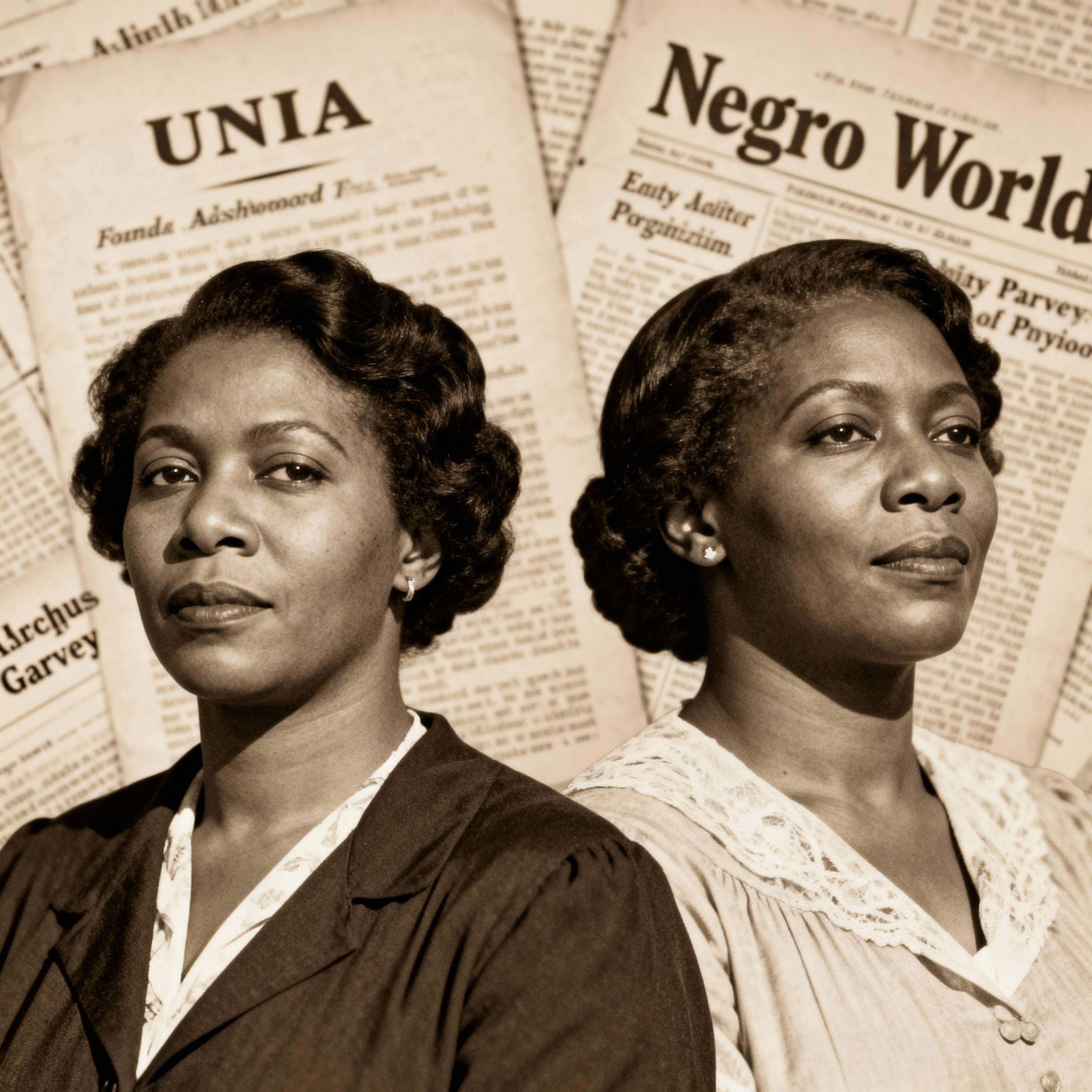
Before the parades, newspapers, and flags, there were two Amys — thinkers and builders who helped turn Garvey’s dream into a living reality.

Say “Garvey,” and most people picture the man in the plumed hat riding in a decorated car, saluting the crowd as UNIA bands play the march. But if you zoom in behind the spectacle — into the offices, back rooms, and late-night writing sessions — you will find two women whose names deserve to be spoken with equal reverence: Amy Ashwood Garvey and Amy Jacques Garvey.
They were not sidekicks in the story of Marcus Garvey. They were co-authors. One helped birth the movement and shape its first steps. The other became its voice, archivist, and conscience when its leader was jailed and exiled. Together, they turned Garveyism from a man-centered crusade into a living tradition that could outlast any one personality.
- Amy Ashwood Garvey co-founded the UNIA and insisted that women be recognized as political leaders.
- Amy Jacques Garvey edited The Negro World, compiled Garvey’s writings, and sustained the movement during his imprisonment.
- Both challenged patriarchy from inside a Black nationalist movement — decades before “Black feminism” had a name.
- Their influence stretches from Pan-African conferences to reggae lyrics and contemporary womanist thought.
- Amy Ashwood: Co-Founder in the Shadows
- Amy Jacques: Editor, Strategist, and Keeper of the Flame
- Fighting Patriarchy Inside a Liberation Movement
- Love, Conflict, and the Labor of Legacy
- Beyond Harlem: Global Work of the Two Amys
- Influence on Later Generations of Activists
- Why Their Story Still Matters Today
Amy Ashwood: Co-Founder in the Shadows
Amy Ashwood was born in 1897 in Port Antonio, Jamaica, into a family that prized education and ambition. As a young woman, she was already organizing debates and cultural events. When she met Marcus Garvey in 1914, the chemistry was intellectual as much as romantic. They shared frustration with colonial racism and a desire to build something bigger than protest — an institution that could uplift Black people worldwide.
Together, they founded the Universal Negro Improvement Association in Jamaica. Ashwood helped draft the early constitution, encouraged women to join as full members, and managed essential organizational tasks: minutes, membership rolls, correspondence. What looked like “behind-the-scenes work” was actually the foundation of a global movement.
“I was not content to be merely the wife of a great man. I wanted to share in the work.” — Amy Ashwood Garvey
When Garvey decided to test his ideas in the United States, Amy Ashwood went with him. In New York, she helped secure meeting spaces, organize Liberty Hall events, and plan the fundraisers that kept the UNIA afloat in its early American days. Her charm, fluency, and confidence impressed both rank-and-file members and visiting dignitaries.
Yet, as the movement grew, male-centered narratives pushed her into the background. Some accounts would later mention her only as “Garvey’s first wife.” The reality is far deeper: without her energy in those crucial early years, the UNIA might never have survived long enough to become a global force.
- Co-founded the UNIA in Jamaica in 1914.
- Helped write the organization’s early rules and mission.
- Organized Liberty Hall meetings and early fundraising in New York.
- Pushed for women’s visibility and leadership within the movement.
Amy Jacques: Editor, Strategist, and Keeper of the Flame
If Amy Ashwood lit the first torch of Garveyism, Amy Jacques carried it through the storm. Born in 1895 in Jamaica, Jacques was well educated, fluent in English and French, and drawn to politics and literature. She joined the UNIA in Harlem as a secretary but quickly revealed talents that went far beyond typing and filing.
Soon, she was working at the heart of Garvey’s communication machine: The Negro World, the UNIA’s international newspaper. There, she curated articles, edited Garvey’s speeches, and eventually took charge of entire sections. Her “Women’s Page” was not a soft corner of recipes and fashion — it was a training ground for political thought.
“We are tired of hearing Negro men say, ‘There is a better day coming,’ while they do nothing to usher it in.” — Amy Jacques Garvey
In that single line, you can hear her philosophy: hope without action is a lie. She called on women to educate themselves, manage businesses, and cultivate both moral strength and political awareness. She offered models of Black womanhood that went beyond victimhood or silent support.
When Garvey was arrested and later imprisoned on mail-fraud charges related to the Black Star Line, Amy Jacques stepped into a new role: movement custodian. She organized legal appeals, coordinated international support, and, crucially, gathered his prison writings into the two-volume work The Philosophy and Opinions of Marcus Garvey. Without her editorial labor, much of Garvey’s thought might have been scattered across private letters and lost speeches.
- Editor and columnist at The Negro World.
- Creator of a politically charged “Women’s Page” for Black female readers.
- Editor/compiler of The Philosophy and Opinions of Marcus Garvey.
- Public face and strategist of Garveyism during his imprisonment and after deportation.
Fighting Patriarchy Inside a Liberation Movement
Every liberation movement carries contradictions, and the UNIA was no exception. While it demanded freedom from white supremacy, it often reproduced patriarchal norms at home. Men dominated official titles and public speeches. Women cooked, collected dues, and ran auxiliaries in the background.
The two Amys refused to quietly accept that script. Ashwood insisted that women should speak from the podium and hold office. Jacques, pen in hand, challenged men who wanted racial justice but expected wives and sisters to remain politically silent. They argued, in different ways, that:
- A race cannot be uplifted if half of it is pushed to the margins.
- Organizational discipline should apply to men’s behavior in the home as well as on the platform.
- Women’s clubs and auxiliaries were not “side projects” but essential organs of the movement.
“The emancipation of our men is incomplete without the emancipation of our women.” — Amy Ashwood Garvey
Their stances brought criticism. Some male colleagues complained that they were “too outspoken.” Others accused them of sowing division. But in reality, they were holding the movement to its own highest ideals. If Garveyism preached dignity and self-mastery, then it had to apply those principles inside the home as fiercely as on the streets.
- The Amys confronted sexism while standing firmly for race pride.
- They broadened the meaning of liberation to include gender justice.
- Their critiques anticipated later Black feminist and womanist thought.
Love, Conflict, and the Labor of Legacy
The romantic entanglements of Marcus Garvey with the two Amys have often been reduced to gossip. The reality is far more complex and human. Amy Ashwood and Marcus married in 1919 in New York, but the marriage quickly came under strain — from the stress of leadership, financial pressure, and internal UNIA politics. Their union ended formally in 1922.
Later that year, Marcus married Amy Jacques. Their partnership blended affection with relentless work. She typed his speeches late into the night, edited his manuscripts, and ran the household while he traveled and faced mounting legal threats.
It would be easy to present this as a messy triangle. Yet what stands out, years later, is not a story of rivalry, but a story of continuity. Amy Ashwood did not abandon the cause after her marriage ended. She continued to work as a Pan-African organizer, especially in London and West Africa. Amy Jacques did not simply become “the second wife”; she became the movement’s enduring voice and interpreter.
“Whatever else history remembers, let it not forget the women who kept the torch burning.” — Reggae Dread Reflection
Love, in this story, is not just romance but commitment: to a people, to an idea, to a future one may never see. Both women spent decades after Garvey’s fall from prominence still writing, speaking, and mentoring young activists. Their loyalty was not to a man’s ego but to a global Black awakening.
Beyond Harlem: The Global Work of the Two Amys
After Garvey’s imprisonment and deportation, the center of Garveyism shifted. Harlem was no longer the only capital of the movement. The Amys stepped onto wider stages.
Amy Ashwood settled for periods in London, where she co-founded clubs, hosted salons, and brought together Caribbean, African, and British Black intellectuals. She participated in Pan-African congresses, advocated for workers, and spoke fiercely against colonial rule. In West Africa, she connected with activists in Nigeria and Ghana, helping create bridges that later figures like Kwame Nkrumah would walk across.
Amy Jacques, based largely in Jamaica, continued to publish and advise. She wrote essays on African independence, Caribbean federation, and the dignity of Black womanhood. She corresponded with leaders across the diaspora and guarded Garvey’s writings, ensuring they remained in circulation even when academics and politicians tried to forget him.
“Exiled or widowed, they turned their grief into fuel — and carried Garvey’s flame into new eras and new struggles.” — Reggae Dread Commentary
- Amy Ashwood helped link Caribbean and African activists in London and West Africa.
- Amy Jacques kept Garvey’s ideas alive in the Caribbean and beyond through writing and networking.
- Both participated in the early architecture of modern Pan-African politics.
Influence on Future Generations of Activists
The influence of the two Amys can be traced like a current through the 20th century. In the 1940s and 50s, Pan-African feminists and nationalists — from Claudia Jones and Shirley Graham Du Bois to Funmilayo Ransome-Kuti — drew from the model of women who spoke boldly in mixed company and insisted that gender and race were intertwined.
Later, in the 1960s and 70s, as Black Power, Rastafari, and decolonization reshaped the Black world, echoes of their thought appeared everywhere. Reggae artists sang about Garvey, but behind his name lay the steady, quieter labor of the women who had preserved his work. When students discovered The Philosophy and Opinions of Marcus Garvey in campus libraries, they were also discovering the pen of Amy Jacques.
Their lives offered an alternative model of leadership: not the lone, charismatic male savior, but a network of thinkers, writers, organizers, and caretakers — many of them women — who keep a movement alive through times of crisis.
“Without the Amys, Garveyism might have been a moment. Because of them, it became a tradition.” — Reggae Dread Archives
Why Their Story Still Matters Today
In a world where movements still rise and fall on the health or scandal of a single male leader, the story of Amy Ashwood and Amy Jacques is a necessary corrective. It reminds us that:
- Movements are built by many hands — most of them unseen.
- Editing, archiving, and organizing are as revolutionary as speeches and marches.
- Women’s leadership is not a side note; it is central to sustainable liberation.
For readers today — whether you’re running a grassroots group, a cultural project, or just trying to live more consciously — the Amys offer practical inspiration. They show how to:
- Balance vision with logistics.
- Hold leaders accountable without abandoning the cause.
- Turn heartbreak, exile, or marginalization into deeper commitment rather than withdrawal.
When we honor Marcus Garvey, we must also honor Amy Ashwood and Amy Jacques — not as supporting characters, but as co-authors of a chapter in Black history that still shapes our politics, our music, and our sense of ourselves as a global African family.
Continue the “Marcus Garvey in New York (1916–1924)” series: