Young Rastafari Voices: What the Next Generation Wants Us to Understand
Young people inherit family stories and spiritual traditions, but they also meet the world in their own time. Listening to their experiences can change the questions we ask about Rastafari.
A young person may hear one account of Rastafari at home and encounter another at school, online or in a workplace. A relative explains why a practice matters. A classmate asks about hair. A song raises a question about history. A teacher offers a description that does not sound like the life the student knows.
These encounters are not the same for everyone. Some young people grow up in Rastafari families; others come to Rastafari later. Some feel a strong connection to a particular house or community, while others are still asking what they believe. Their experiences vary with family, gender, place, opportunity and the wider society around them.
The voices in this article come from published interviews and personal writing. They include young adults speaking in a 2026 documentary project and people reflecting later on their younger years. They are individual accounts, not a survey of a generation. No new interviews were conducted for this article.
A history young people enter

Inheritance is more than an image
Rastafari emerged among Black Jamaicans in the 1930s, under British colonial rule. Its history includes spiritual beliefs, African identity, resistance to racial hierarchy and the pursuit of Black dignity. People who come to Rastafari today enter a conversation shaped by that history, even when their own lives are far removed from the conditions of its earliest years.
An elder may remember exclusion from a school, a workplace or public space. A younger person may encounter different opportunities and still face prejudice. Both accounts matter. A history of discrimination cannot be measured solely by whether a symbol has become familiar in popular culture.
At the same time, young people should not be described only as inheritors of hardship. They study, work, make art, care for family, laugh with friends and ask questions about the future. Their interests need not fit an outsider’s idea of what a Rasta life is supposed to look like.
Reggae Dread’s introduction to Rasta livity explores the relationship between belief and daily practice. The next step is to ask how specific people describe finding their own place within that history.
One young woman’s account of school
In photographer Janick Gilpin’s documentary portrait and testimony project, Rashada Azania Elliott is identified as a second-generation Rastafari and a nurse working with elders. In an account dated 2026, when the project lists her as 23, Elliott describes being teased from primary school through college and having her locks targeted by other students.
Her account deserves to be heard as her own. It shows that school can be both a place of learning and a place where a young person must deal with another person’s prejudice. It also shows why an adult’s reassurance that a child should simply ignore bullying may not address what happened.
The project notes that its testimonies were recorded in Jamaican Patois and that the published excerpts were translated and lightly edited. That is useful context when reading the words online. Elliott did not speak to Reggae Dread for this article, and her experience should not be treated as identical to that of every young Rastafari person.
Her work with elders also resists a narrow picture of youth as only a time of receiving knowledge. In the project’s description, she is already contributing care and skill to an older generation.
What another young adult wants schools to teach
The same project presents Iyandi Ion, identified as a second-generation Rastafari and listed as 27 in a 2026 account. Ion describes changes in public attitudes toward locks while also saying that discrimination remains. Ion calls for schools to teach more about Rastafari livity and African culture so that young people are better understood.
Ion’s observation is a personal assessment, not a statistical measure of how all schools or workplaces treat Rastafari. Its importance is that a person with direct experience identifies education as part of the response. A child should not have to become the sole teacher of their own identity in a classroom.
Taken together, Elliott’s and Ion’s accounts offer two different points of emphasis: one describes a history of bullying, while the other reflects on changing visibility and the need for better understanding. Neither voice cancels the other.
Finding a voice in family and community

Growing up with questions
A young person can love their family and still ask why a practice exists. Questions about food, hair, scripture, friendships or the future may be part of learning rather than a rejection of everything the family values.
In her 2020 research on Rastafari in Ghana, scholar Shamara Wyllie Alhassan begins with a personal reflection on growing up in a predominantly white rural community on California’s Lost Coast. She recalls struggling to understand her parents’ Rastafari commitments and describes how that question led her toward a deeper study of their spiritual communities. Read her article.
Alhassan writes as a Black Rastafari woman and scholar. Her account is a retrospective adult reflection, not a claim about what every young person feels. It shows that questioning inherited practices can become a path toward study and understanding, rather than simply a sign of disloyalty.
For a parent or elder, the challenge may be to explain the history and conviction behind a practice while allowing the young listener to respond. For the young person, the challenge may be finding language for questions that feel difficult to ask at home.
A different path is also a story worth hearing
Jamaican poet Safiya Sinclair has written and spoken about growing up in a strict Rastafari household, being treated differently at school and questioning restrictions she experienced at home. She later chose to leave Rastafari, a decision she discusses in a 2023 interview with Fresh Air.
Sinclair should not be presented as a current Rastafari spokesperson. Her testimony is relevant because it describes her own childhood and the path she chose afterward. Her account also should not be used to claim that every Rastafari family has the same rules or relationships.
Listening to Sinclair alongside people who continue to identify as Rastafari makes the discussion more honest. Young people can experience spiritual inheritance as a source of pride, a source of conflict or a combination that changes over time. The person telling the story gets to name that experience.
Reggae Dread’s Rasta Women and Everyday Livity considers several women’s contributions and differing experiences. Young women’s questions belong in that wider conversation about voice and authority.
Respect across generations
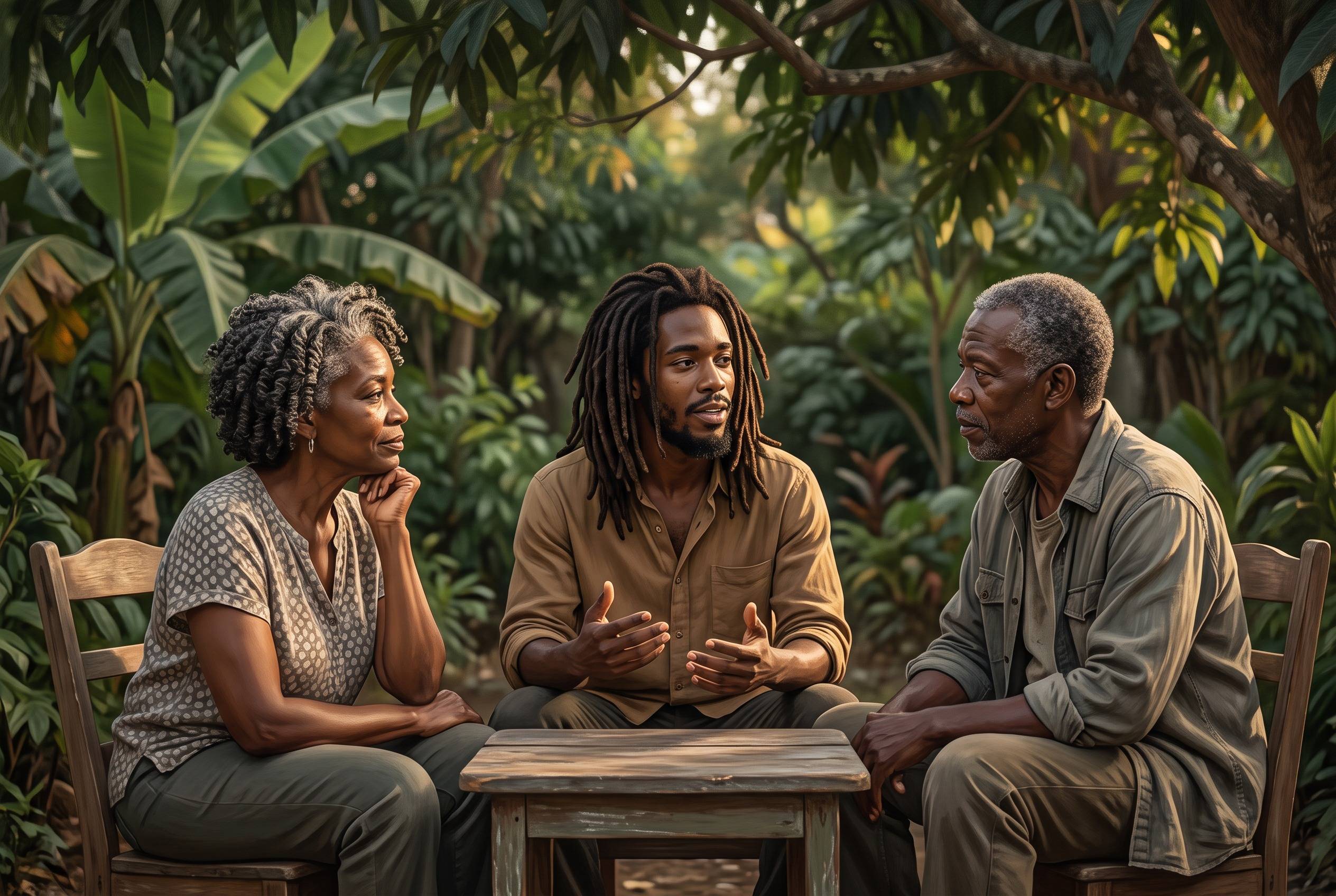
An elder may want to protect a young person from repeating painful history. A young person may want an elder to recognize the pressures of a school, job or online environment that did not exist in the same form before. Neither concern has to be dismissed for the other to be heard.
A useful exchange begins with specific questions. What does the older person remember? What does the younger person face now? Which experiences are similar, and where have conditions changed? A relationship becomes stronger when both people can answer without being told in advance what they must think.
Respect does not require a young person to agree with every decision an adult makes. It can include listening carefully, explaining a different view and setting a boundary when a conversation becomes harmful. Adults can model the same respect by acknowledging uncertainty and accepting correction.
Identity changes with place
A family story from Jamaica and Britain
Historian Aleema Gray describes growing up in Jamaica with Rastafari parents in the introduction to her research on Rastafari in Britain. Her father was born in Britain and went to Jamaica in 1979; her mother was a farmer in Portland. Gray recalls family work, rural childhood and a later family move to London. Read the University of Warwick repository record.
Gray explains that history became important to how she understood herself across those places. Her account complicates the idea that identity moves in only one direction. Her father’s journey, her mother’s local experience and the children’s later move were connected, but each person encountered those changes differently.
A child who moves may be asked to explain a name, accent, diet or family belief to new classmates. The same child may also find new books, friends and possibilities. Neither the difficulty nor the opportunity needs to stand for the whole experience.
Gray’s family story is one account. It cannot tell us what every Rastafari family experiences in Jamaica or Britain. Its value is that it gives names, places and relationships to a larger conversation about migration and belonging.
Being seen differently in different countries
In a 2017 interview, singer Keznamdi discussed growing up in a Rastafari household and being perceived differently as he moved between Jamaica, Tanzania and the United States. His account connects family identity with the changing racial labels people applied to him. Read the interview.
The interview is a snapshot of what he said in 2017. It should not be used to assume that his views or circumstances today are unchanged. It does, however, show how a young person’s understanding of identity can be shaped by the places in which others see them.
An accent, a hairstyle or a family name may prompt a question from a stranger. A young person can choose to answer, but should not be required to explain their entire community every time they enter a room. Belonging includes the freedom to participate in ordinary life without constant scrutiny.
A community has many points of entry
Some people are raised in Rastafari households, and others come to the movement through reading, relationships, worship, music or community life. There is no single childhood that qualifies someone to be heard.
The differences among households also matter. A person may live with relatives who share the same spiritual commitments or with people who follow different traditions. A young Rastafari woman, a man from a multigenerational family and a person who has recently begun to study may not encounter the same expectations.
Instead of asking one person to explain all of Rastafari, ask what the tradition means in their life and how their understanding has developed. Specificity allows the speaker’s voice to remain their own.
Music, technology and the right to define oneself
Music can open a door
A song may be the first place a young listener hears a name, a historical reference or a question about freedom. It can also be a record associated with a parent, a journey, a celebration or a difficult day. What the listener does with the song belongs to their own experience.
Reggae has carried Rastafari language and ideas to audiences around the world, but reggae is not the only music in every Rastafari household, and not every reggae musician is Rastafari. A playlist cannot establish a person’s beliefs.
An elder and a young listener might choose the same recording for different reasons. One remembers when it was released; another hears a question that feels relevant now. Asking what each person notices can begin a conversation without requiring either to agree on a single meaning.
Young artists also need space to create rather than only repeat what an older generation expects. Some will work in roots reggae; others may explore poetry, design, film, scholarship or a field unrelated to music. Their contribution to a community should not be measured by how closely they resemble a famous predecessor.

More visibility is not always more understanding
A photograph of locks, a red-gold-and-green design or a short video may circulate far beyond the person who made it. Visibility can introduce people to a tradition, but it can also detach an image from its spiritual and historical context.
Young people navigating digital spaces may face a familiar choice in a new form: how much to explain and how much to keep private. A creator may welcome questions about their work but not want their family life or spiritual practice treated as public property.
Before sharing someone’s image or account, ask permission and agree on how it will be used. A young person who participates in a community event has not automatically agreed to a public post. Credit and compensation matter when a person’s work is used for a commercial project.
What adults can change
Adults who want young people to participate can make that invitation practical. Schedule a meeting at a time young people can attend. Share information about the decision to be made. Make room for a person to speak without requiring them to represent every member of their generation.
Ask who handles food, transportation, sound, notes and cleanup, and whether that work is recognized. A young person who is repeatedly assigned a task but never invited into decisions may have reason to question what participation means.
When a young person offers a criticism, a useful response is to ask for an example and listen to the answer. The point is not to promise agreement. It is to make room for a person to describe what they have experienced and to consider what, if anything, needs to change.
Listening to the next voice
Questions for a willing conversation
These questions are invitations, not a script or a demand that someone disclose private beliefs:
- What do you wish people understood about your own experience?
- Who has influenced the way you think about Rastafari, and what did you learn from them?
- Where do you feel most able to ask questions or disagree?
- What do people assume about you because of your appearance, family or interests?
- What would you like elders and other adults to hear?
- Is there something important to you that has nothing to do with the questions outsiders usually ask?
If the person is a minor, a public interview or image also requires careful attention to the child’s wishes and appropriate parent or guardian consent. The child’s agreement to talk privately is not permission to publish their words. Explain where material might appear and what control the family and young person will have.
A practical listening exercise
Choose one public account linked in this article. Write down the person’s name, where the account appeared and its date. Then note one thing the person actually describes, one question you would like to ask and one conclusion the source does not support.
For example, Elliott’s account gives a particular person’s testimony about treatment at school and college. It does not tell us that every school or every young Rastafari student had the same experience. Ion’s account offers another perspective on changing attitudes, but it is not a substitute for a broader study.
This exercise can help a family or reading group move beyond the habit of collecting inspiring statements. It asks listeners to keep a voice connected to its speaker and to the circumstances in which it was shared.
Frequently asked questions
Do all young Rastafari share the same beliefs?
No. People and communities differ in their spiritual understanding, family practices and experiences.
Are all young Rastafari raised in Rastafari families?
No. Some are raised in the tradition; others find their way to it through different relationships and experiences.
Why include a person who later left Rastafari?
A person’s account of their own upbringing can illuminate an experience even if they later chose another path. Their present identity should be described accurately.
Is reggae the same thing as Rastafari?
No. Reggae and Rastafari have important connections, but they are not identical. Musicians and listeners have varied beliefs.
How can an adult support a young person’s voice?
Listen without demanding that the person speak for everyone, make participation practical and respect their privacy and right to disagree.
A future with room for questions
The next generation is not a single person waiting to repeat one agreed message. Young people encounter inherited beliefs through their own relationships, places and choices. Some experiences affirm their commitments; others lead to questions or different paths.
Listening to young Rastafari people means taking their knowledge seriously in the present. It also means hearing those who describe difficulty, recognizing women as thinkers and allowing a person to have interests beyond the image others expect.
A history becomes a living inheritance when people can bring their own questions to it. The responsibility of an older generation—and of anyone writing about that history—is to make room for the answer.
Sources and further reading
- Janick Gilpin, Rastafari documentary portrait and testimony project, including accounts attributed to Rashada Azania Elliott and Iyandi Ion, dated 2026. The project says excerpts were translated and lightly edited.
- Shamara Wyllie Alhassan, “We Stand for Black Livity!”: Trodding the Path of Rastafari in Ghana, Religions, 2020.
- Aleema Gray, Bun Babylon: A Community-Engaged History of Rastafari in Britain, 1955–1992, University of Warwick, 2022. The introduction includes Gray’s family account.
- Terry Gross, “Poet Safiya Sinclair reflects on her Rastafari roots and how she cut herself free”, Fresh Air, 2023.
- Noisey, “Keznamdi on How a Young Rasta Approaches Race in 2017”, 2017.
- Reggae Dread, Rasta Livity in Everyday Life and Rasta Women and Everyday Livity.