Who Controls the Stage Reggae at the Crossroads
White Reggae-Rock, Festival Economics, and the Displacement of Jamaican Musicians
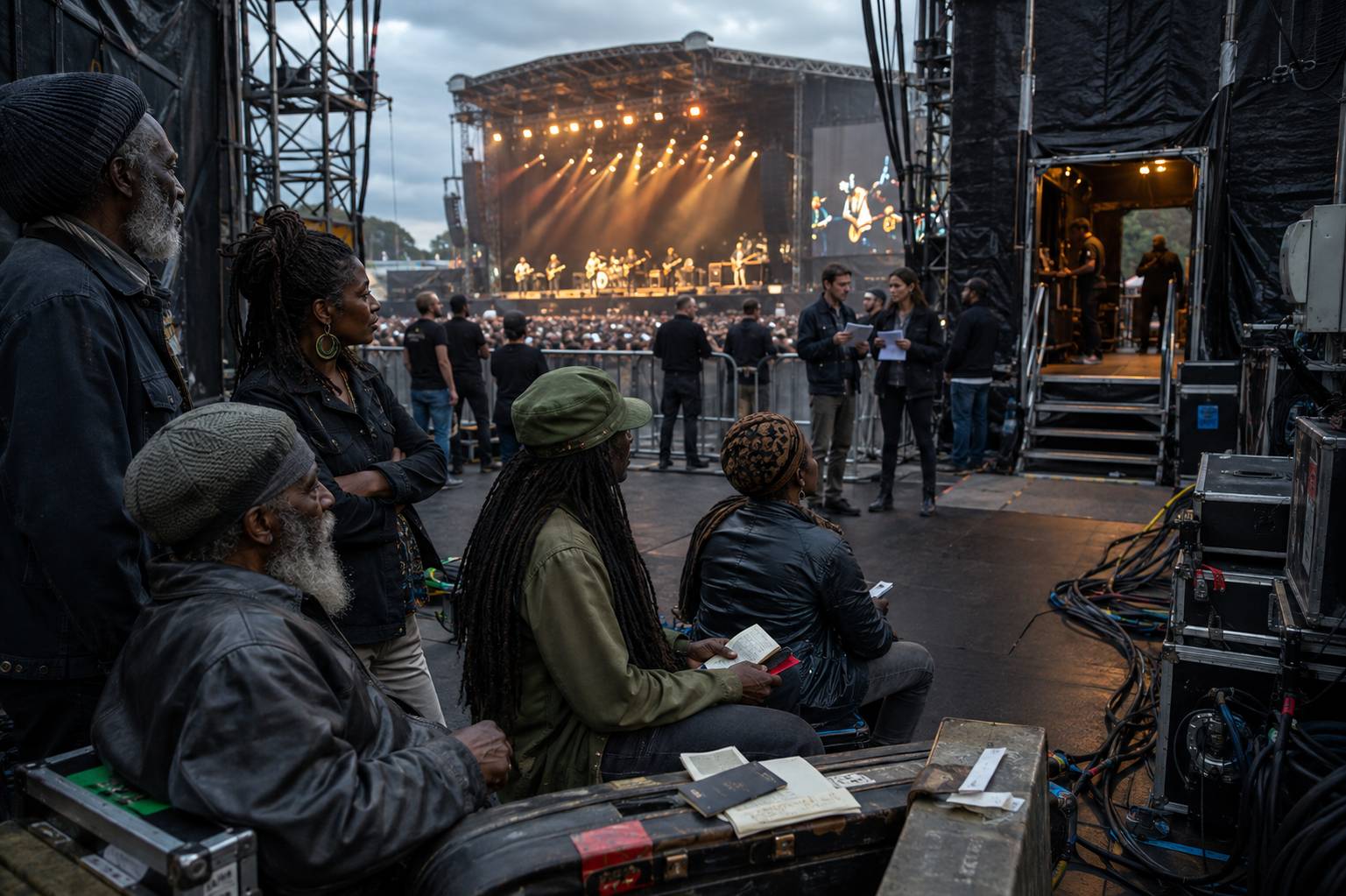
A festival poster is a small map of power. Who control the stage. The largest letters tell us who is expected to sell the most tickets. The middle rows reveal who is considered valuable but not decisive. The smallest names occupy the territory of discovery, obligation, and risk. Long before the first amplifier is switched on, the hierarchy has been printed.
Study enough reggae posters in the United States and a difficult question begins to form. How did bands from outside Jamaica—many led by white American musicians—become principal attractions within a music born from Black Jamaican experience? How did celebrated Jamaican singers and musicians, some carrying decades of history, come to appear as supporting acts beneath performers whose relationship to reggae began as admiration?
The quickest answers are rarely sufficient. It is too simple to say that every white band stole the music. It is equally inadequate to claim that audiences freely chose their favorites and therefore no structural issue exists. The real story lives in the machinery behind the stage: passports, visas, agencies, vehicles, rehearsal rooms, sponsorships, insurance, media networks, ticket data, management, capital, and the slow accumulation of an audience through repeated domestic touring.
Talent matters. Work matters. Songs matter. But no musician arrives at a festival as talent alone. Each one arrives through an infrastructure—or through the absence of one.
This article examines that infrastructure. Its purpose is not to remove international musicians from reggae. It is to understand why participation has produced such unequal visibility, and how a global reggae economy can welcome new expression without converting Jamaican originators into permanent guests within their own cultural house.
The Changing Face of the Festival Circuit
During the last two decades, North American reggae festivals expanded alongside a powerful homegrown reggae-rock scene. Bands built followings through clubs, college towns, beach communities, jam-band networks, digital fan groups, merchandise, and relentless touring. Their music frequently combined reggae rhythm with rock instrumentation, pop songwriting, punk energy, hip-hop, surf culture, and the informal fellowship of outdoor festivals.
This growth brought real benefits. Younger listeners encountered reggae-derived music. Festivals created jobs and gathering places. Some bands introduced audiences to Jamaican artists through collaborations and shared bills. A listener who entered through reggae-rock sometimes continued toward roots reggae, dub, ska, rocksteady, and dancehall.
But the bridge did not carry equal traffic in both directions.
Jamaican entertainment attorney and music-business consultant Lloyd Stanbury observed in a 2018 industry essay that American citizens playing reggae had come to represent a significant percentage of performers at United States festivals. He named the practical advantage directly: domestic artists do not need foreign work visas. He also noted the emergence of successful festivals and bands alongside the obstacles confronting foreign performers.
By 2019, Stanbury described concern over American reggae-rock being branded “modern reggae.” The phrase carries more weight than it first appears to. “Modern” is not simply a date. It establishes a relationship of time and authority. If American reggae-rock is modern, what is contemporary Jamaican reggae? Is it treated as old, traditional, specialist, or authentic but commercially secondary? A word can quietly relocate the center.
The shift is most visible when a Jamaican act with deep cultural recognition is marketed as a special guest of an American band. The phrase “special guest” sounds respectful. Economically, it can still mean lower billing, less production control, a shorter set, and less influence over the audience relationship. Honor and hierarchy can occupy the same poster.
Popularity Is Real, but It Is Not Self-Explaining
Many American reggae bands genuinely draw large crowds. It would be dishonest to deny their popularity or pretend promoters invented every fan. Years of touring have produced communities that know the lyrics, travel between festivals, purchase branded products, and sustain artists between album cycles.
Yet popularity is not a natural substance that appears outside history. It is cultivated. An artist who can perform repeatedly across domestic markets has more chances to convert a casual listener into a committed fan. A band able to travel by road, carry familiar equipment, work without immigration uncertainty, and maintain relationships with local promoters can build consistency. Each tour becomes promotion for the next.
A Jamaican artist may receive enthusiastic responses at isolated festivals while lacking the stable routing needed to turn those responses into a durable market. If every visit requires expensive petitions, advance commitments, international flights, additional accommodation, and uncertain processing, the artist cannot reproduce the same growth pattern. The audience sees the outcome—one band appears larger—and may never see the administrative conditions that helped produce it.

The Visa Wall Behind the Music
Foreign artists performing legally in the United States must enter through appropriate work-authorization processes. Depending on circumstances, petitions may involve classifications for extraordinary ability, internationally recognized groups, reciprocal exchange, or culturally unique programs. The details require time, documentation, professional knowledge, and money.
Stanbury’s 2018 analysis described applications taking weeks and costs reaching thousands of dollars. Since then, United States petition fees for international artists have risen sharply. Each additional musician or crew member can multiply the burden. Expedited processing, legal help, travel, and the risk of delayed approval add further pressure.
For a large pop tour, these expenses may be absorbed across arenas and major sponsorships. For a roots-reggae singer traveling with a band, the numbers can destroy the margin before the first ticket is sold. Promoters respond by limiting risk. They may hire a domestic backing band, reduce the number of Jamaican performers, postpone an engagement, or select a United States act that can arrive with fewer uncertainties.
When the Backing Band Changes the Cultural Economy
Hiring local musicians is not automatically negative. Skilled bands in Europe and North America have supported Jamaican singers with care and musical discipline. Local backing can make otherwise impossible tours viable. It can also create meaningful cross-cultural relationships.
But repeated dependence on foreign backing bands changes where musical employment accumulates. Jamaican instrumentalists lose touring income, international exposure, professional relationships, and opportunities to transmit performance knowledge. A singer may remain visible while the ecosystem that shaped the singer becomes invisible.
Reggae history is often narrated through vocal stars, yet its identity also lives in rhythm sections, horn players, keyboardists, percussionists, engineers, harmony singers, and bandleaders. If the voice travels but the musicians cannot, the international audience receives a thinner account of authorship.
This is especially urgent as foundational generations age. Knowledge of timing, feel, arrangement, and studio practice does not reside only in notation. It moves through rehearsal, observation, correction, and performance. When economic barriers interrupt that movement, cultural continuity is also interrupted.
The Domestic Touring Advantage
A successful live act is often a small traveling company. It needs transportation, scheduling, accounting, promotion, technical coordination, insurance, merchandise management, and personnel who can survive periods of uncertain income. American reggae-rock bands developed within an enormous domestic market where a tour can cross climates and regions without crossing an international border.
This geographical advantage joins several others.
Access to Capital
Musicians from relatively secure backgrounds may have family support, credit, equipment, rehearsal space, vehicles, education, and time to tour before earning stable profit. Race does not determine every individual circumstance, but racialized wealth patterns influence who can absorb early losses. The romantic image of a band “building from the ground up” often ignores the different floors from which people begin.
Access to Industry Language
Contracts, sponsorship proposals, tax requirements, performance analytics, digital advertising, and agency relationships reward familiarity. Jamaican creativity has never been the problem. Weaknesses in business administration, rights management, financing, and coordinated export support have repeatedly limited how much value remains with Jamaican creators.
An artist can produce globally influential music while lacking the institutional team required to collect its full economic return. Another performer can enter later with stronger administration and capture a larger share of the market. This is not proof of superior culture. It is proof that culture and business power are different assets.
Access to Repetition
Domestic acts can return to the same cities, support one another, trade audiences, and become part of recurring festival families. Fans experience them not as foreign visitors but as a continuous scene. Shared management and promotion networks strengthen this effect. One successful act can introduce another, creating an ecosystem whose members rise together.
Jamaican acts are often booked individually. Their country is famous, but the support system around each artist may remain fragmented. Global recognition of reggae does not automatically create coordinated market access for the people making it.

Who Owns the Infrastructure?
The stage is only the visible end of a longer chain. Before asking who performs, we should ask who decides.
Who owns or controls the festival? Who has access to ticketing data? Who selects the booking agency? Who negotiates sponsorship? Who receives beverage, cannabis, tourism, and apparel partnerships? Who controls the mailing list? Who owns footage captured at the event? Who sells the livestream? Who chooses which artist appears in the promotional video? Who holds the trademark and audience relationship after the performers leave?
An artist may receive a fee. The festival owner builds an asset.
This distinction is central to understanding cultural displacement. Representation onstage can improve while ownership remains unchanged. A promoter may book several Jamaican artists and still retain all long-term value generated by their cultural presence. The event uses Jamaica to establish legitimacy; Jamaica receives temporary wages rather than equity.
The Playlist as a Stage
Digital platforms reproduce similar hierarchies. A playlist title such as “modern reggae,” “sunshine reggae,” or “chill reggae” can define the genre for millions of listeners. Placement generates streams, discovery, and touring demand. Repeated selection makes certain themes and production styles feel normal.
If algorithms learn from already unequal listening patterns, they can deepen those patterns. The most promoted music receives more engagement; engagement justifies further promotion. Historical catalogues may remain visible while contemporary Jamaican artists struggle to enter the recommendation loop. Jamaica becomes represented by legends, while the present belongs to someone else.
Streaming has opened distribution, but distribution is not the same as attention. Almost anyone can upload a recording. Very few can secure the systems that cause strangers to hear it repeatedly.
Sponsorship and the Safe Rebellion
Brands favor predictable environments. Reggae offers attractive visual language: freedom, natural living, unity, summer, rebellion, and youth. Conscious roots reggae may also criticize corporate power, environmental destruction, racial injustice, policing, war, and economic exploitation. The industry solves this tension by retaining rebellion as style while reducing its political content.
A festival can therefore appear countercultural while operating through conventional commercial priorities. The consumer purchases the feeling of resistance without encountering a demand to change anything.
Race, Respect, and the Limits of Individual Blame
This conversation becomes unproductive when it is reduced to a verdict on individual white musicians. Some have studied Jamaican music deeply, credited their teachers, paid collaborators fairly, shared platforms, and used their voices against injustice. Others have borrowed surface elements without meaningful engagement. Most exist somewhere between these positions, shaped by both sincere love and structural advantage.
The question is not whether a white person can feel reggae. Music crosses human boundaries precisely because feeling cannot be licensed by ancestry. The question is what responsibilities accompany participation in a culture born from a history of racial domination and unequal exchange.
Respect must be more than praise for Bob Marley. It should include curiosity about the less famous creators, transparency about influence, refusal of caricature, fair economic relationships, and willingness to speak when the originating community is excluded.
Likewise, Jamaican identity alone does not guarantee ethical practice. Jamaican promoters, labels, managers, and artists can exploit other Jamaicans. National origin does not erase class, gender, or power. The goal is not a romantic picture in which every insider is righteous and every outsider is suspect.
The goal is accountable relationship.
From Guest Appearance to Shared Power
Fairness requires more than adding Jamaican names to a lineup. It means changing the terms of participation.
Headline Representation
Major festivals using “reggae” in their identity should include Jamaican and Caribbean artists in meaningful headline positions. This does not require excluding popular international bands. It requires refusing a future in which the originators are permanently placed beneath their inheritors.
Transparent Compensation
Artists need clear fee structures, payment schedules, travel responsibilities, performance lengths, media rights, and cancellation terms. Transparency cannot eliminate market differences, but it can expose patterns in which cultural prestige is requested at a discount.
Touring Support
Regional organizations, sponsors, governments, and diaspora investors can establish visa assistance, travel funds, shared equipment, rehearsal facilities, and coordinated routing. One isolated booking is expensive. A connected series of engagements can distribute costs and make full-band touring possible.
Shared Ownership
Jamaican and African-Caribbean partners should hold equity in festivals, labels, media properties, and touring companies—not merely advisory titles. Equity changes the relationship from cultural supplier to decision-maker.
Cultural Programming
Festivals can fund exhibitions, workshops, films, panel discussions, youth sessions, and oral histories. These programs should not become homework surrounding the “real” entertainment. They are part of the event’s cultural value and should receive serious production resources.
Emerging-Artist Pathways
A festival can pair every established international reggae-rock act with emerging Jamaican, Caribbean, or African artists across touring dates. Mentorship must include audience access, not only private advice. The scarce resource is often not knowledge but visibility.
What Artists and Audiences Can Do
International reggae bands possess leverage. They can request culturally balanced support acts, share production resources, commission Jamaican remixers and designers, credit influences from the stage, and negotiate collaborations that include publishing and ownership. They can help fans move through the bridge rather than keeping them inside a self-contained scene.
Jamaican artists and institutions can strengthen collective bargaining, professional training, data gathering, export strategy, rights administration, and regional cooperation. Individual brilliance cannot substitute forever for organized infrastructure.
Audiences can read posters critically. They can ask why a festival’s visual identity is Jamaican while its leadership and headliners are not. They can buy directly from artists, attend smaller cultural events, follow contemporary releases, support full bands, and refuse the idea that questions about power destroy unity.
Unity without honesty protects the strongest party. A more durable unity begins when participants can name unequal conditions without treating truth as hostility.
The Story the Numbers Cannot Yet Tell
One obstacle to reform is the lack of consistent public data. Anecdotes are plentiful: an artist whose visa arrived too late, a veteran offered an insulting fee, a Jamaican band replaced by local players, a festival where the cultural originators occupy the afternoon while reggae-rock closes the night. These accounts matter, but the industry also needs organized evidence.
Imagine an annual reggae equity report tracking major festivals across North America and Europe. It could record the national origin and billing position of performers, the number of Jamaican instrumentalists traveling with featured singers, the gender balance of lineups, the percentage of programming devoted to emerging artists, and the ownership of festivals and booking agencies. Where artists consent, it could compare fee ranges, media rights, set lengths, and travel support. It could also document cancelled appearances and identify whether visas, financing, health, management, or promoter decisions caused them.
Such a report would not reduce culture to a spreadsheet. It would allow the community to test its impressions. If Jamaican representation improves, the data would show progress. If a festival displays Jamaican symbols while reducing Jamaican bookings, the contradiction would be harder to hide. Promoters acting responsibly would have evidence of their contribution rather than relying on public relations language.
Data also matters inside Jamaica. How many musicians receive international performance income? How much publishing revenue is collected and how much remains unmatched? Which markets are growing? How many emerging acts can travel with a professional team? What training do managers and booking agents need? Without answers, policy follows crisis instead of preparing for opportunity.
The information should not belong only to private ticketing companies and streaming platforms. Artist organizations, universities, trade groups, cultural ministries, and diaspora institutions can cooperate to build independent knowledge. Privacy and commercial confidentiality can be protected while aggregate patterns are made visible.
Reggae has always trusted reasoning—the practice of gathering, questioning, interpreting, and speaking from lived reality. Industry data can become another form of reasoning when it serves the people rather than controlling them. The purpose is not to prove that every disparity results from racism. It is to stop structural inequality from surviving behind the claim that nobody can measure it.
Beyond Symbolic Diversity
Measurement must also distinguish presence from power. A festival could book many Jamaican performers while assigning them the smallest stages, shortest sets, and weakest promotion. Counting names alone might declare success. A better assessment would ask who receives prime time, who appears in advertisements, who has access to captured footage, who participates in planning, and who returns the following year with a stronger position.
The same principle applies to collaboration. A Jamaican vocalist appearing on one track may give an international album cultural credibility, but the meaningful questions concern authorship, publishing, payment, promotion, and long-term relationship. Was the collaborator treated as a co-creator or sampled as a certificate of authenticity?
Fairness lives in details. A just reggae economy will be built not only through warm statements about unity, but through contracts, schedules, credits, budgets, and decisions that can withstand public examination.
A Stage Wide Enough for Justice
Reggae’s global reach should be celebrated. The music’s ability to inspire people who did not inherit Jamaican history demonstrates that culture can create unexpected kinship. But kinship is not possession. Love for a tradition does not entitle the lover to become its sole public face.
The future festival can look different. An African band sings in a local language over a rhythm shaped in dialogue with Jamaican musicians. A white American reggae-rock group performs before an audience that has also encountered a workshop on sound-system history. A veteran Jamaican artist receives not a ceremonial tribute but a headline fee, publishing support, and an ownership share. Young Caribbean musicians travel with their own players because a regional route makes the economics possible. Fans enjoy the night without being asked to choose between pleasure and knowledge.
This is not an impossible purity. It is practical fairness.
The stage does not need fewer people loving reggae. It needs more people willing to understand that love has material consequences. It needs promoters who see cultural origin as a living relationship, not a vintage credential. It needs Jamaican institutions prepared to negotiate from strength. It needs international musicians confident enough to share power rather than merely sharing imagery.
A poster will always contain different letter sizes. Not every artist can headline every night. Yet over years, the pattern should tell a story of exchange, renewal, and respect—not the gradual disappearance of the people who first built the sound.
Reggae asked the world to examine power. The reggae industry cannot place itself outside that examination.
Before the lights rise, before the bass enters, before thousands of voices sing about freedom, someone has already decided who will stand at the center. The future begins when that decision is made with history in the room.
Sources and Further Reading
Bob Marley Rasta Prophet


Emperor Haile Selassie Ethiopean African Heritage


Products
Rasta Roots Reggae Rhythms


Rasta Women Vibing


Fashion Revolution


