How a Music of Resistance Became a Comfortable Lifestyle Soundtrack
When Good Vibes Replace Liberation When “Good Vibes” Replace
Liberation Yet something absence
The sun is going down behind an American festival stage. Palm trees are printed on banners even though the nearest Caribbean island is thousands of miles away. A white singer stands beneath red, gold, and green lights, guitar resting against his chest. Around him, the crowd lifts plastic cups and sings about peace, smoke, summer, and escaping the pressure of the week. The bass is warm. The guitar strikes the familiar offbeat. Nobody is fighting. Nobody is unwelcome. For a moment, the field feels easy.
Yet something else is present because of its absence.
There is little mention of Jamaica. Rastafari appears mainly as color and costume. Africa is a distant word, if it is spoken at all. Babylon no longer names an oppressive political, economic, and spiritual order; it has become a difficult boss, a negative thought, or anything that interrupts personal comfort. Zion is no longer a vision of restoration and collective freedom. It is a beach, a vacation, a private state of mind.
The music sounds like reggae, but what work is it being asked to perform?
That question stands at the center of this six-part series. It is not a demand that reggae remain trapped in one decade, one arrangement, or one national border. Music moves because people move. Jamaican music itself grew through encounter: African retentions, Caribbean forms, church traditions, mento, jazz, rhythm and blues, radio signals, local invention, studio experimentation, and the particular genius of working musicians. Reggae has never been a sealed room.
The concern begins when movement becomes removal—when reggae’s marketable surface travels while the people, memories, arguments, and spiritual commitments that produced it are left behind. In that condition, cultural exchange can turn into cultural co-option. A living inheritance becomes a collection of attractive signs. The beat is welcomed, but the history is treated as excess baggage.
This is not an accusation against every white musician who plays reggae, nor is it a claim that every Jamaican reggae song must carry an explicit political sermon. Jamaica gave the world lovers rock, dance records, comic songs, devotional songs, rude-boy warnings, sensual performances, and countless expressions that cannot be placed beneath a single banner. Pleasure belongs to the tradition too.
But pleasure is not the same as forgetting. Love does not require historical amnesia. Good feeling becomes a problem when it is marketed as the whole meaning of a music born among people who were also naming suffering, confronting power, praising God, remembering Africa, and demanding the right to exist with dignity.
Reggae Was Never Only a Sound
UNESCO’s recognition of the reggae music of Jamaica as intangible cultural heritage offers a useful starting point. Its description does not reduce reggae to a drum pattern. It identifies enduring social functions: a vehicle for commentary, a cathartic practice, and a means of praising God. It points to reggae’s contribution to international conversations about injustice, resistance, love, and humanity. Those words matter because they hold apparently different energies together. Reggae can resist and love. It can reason and dance. It can be sensual, spiritual, cerebral, and political without becoming less itself.
The music emerged from a society shaped by colonial rule, plantation wealth, racial hierarchy, forced displacement, emancipation without full economic justice, rural hardship, migration to Kingston, and the uneven promises of national independence. These conditions were not background decoration. They entered the music through language, rhythm, memory, and social position.
Reggae’s foundational artists did not all share one ideology. Still, a broad pattern became audible. The poor were no longer silent objects in somebody else’s report. They became narrators. The sufferer interpreted the system. The Rasta, once despised and persecuted, spoke with scriptural authority. Africa, long distorted by colonial teaching, appeared as a source of ancestry, dignity, history, and future belonging. Marcus Garvey’s call for African redemption passed through records and dances long after official institutions tried to confine his importance to the past.

The Working-Class Intelligence of the Music
To describe reggae only as protest music would also be too narrow. Its power came from the density of life inside it. A song might contain biblical language, street observation, political analysis, humor, mourning, romantic desire, and practical warning within a few minutes. The music treated ordinary people as capable of receiving complexity. It did not assume that a vendor, mechanic, domestic worker, farmer, unemployed youth, or schoolchild needed history made empty before it could be understood.
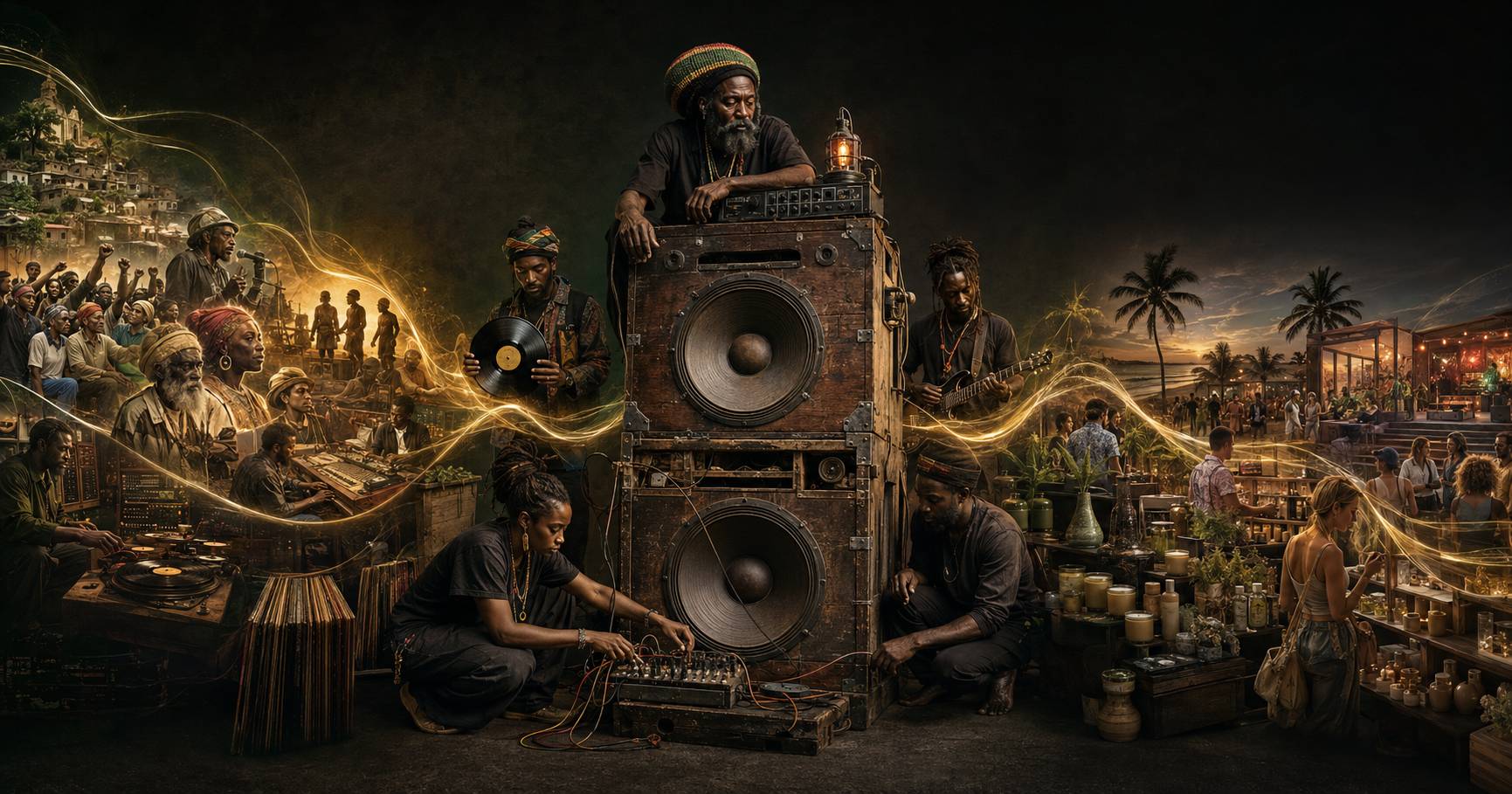
The sound system helped create this public intelligence. A dance was entertainment, but it was also circulation, testing ground, neighborhood assembly, news channel, fashion space, technical laboratory, and economic network. Selectors, operators, engineers, deejays, singers, producers, record-shop owners, and dancers all contributed to the culture. A record did not live only on a shelf. It entered a social field where people answered it with their bodies and their voices.
Reggae therefore carried more than lyrics. The heavy bass and open spaces could create a feeling of gravity, room, and collective attention. Dub taught listeners that absence could speak. A dropped vocal line, an echo, a sudden drum strike, or a bass phrase returning from silence could turn studio equipment into a way of thinking. Jamaican engineers and producers did not merely copy an imported form. They transformed limited resources into new musical architecture.
When the international market takes the skank but leaves behind this history of working-class invention, it does not merely simplify a genre. It changes who is allowed to appear as an author of modernity.
How Reggae Entered the Global Marketplace
Reggae’s worldwide reach is one of the great cultural achievements of postcolonial Jamaica. A small Caribbean nation produced music that became legible in neighborhoods, liberation movements, dance halls, dorm rooms, clubs, protests, and spiritual communities across the earth. People heard something in reggae that could travel: the insistence of the bass, the spacious rhythm, the prophetic singer, the promise that suffering could be named without surrendering joy.
International growth, however, always involves selection. Foreign labels, broadcasters, promoters, journalists, and retailers decide which faces, songs, and messages can be sold to their audiences. The process does not require a secret meeting. It can happen through thousands of ordinary commercial judgments. A label believes a love song will cross over more easily than an anticolonial song. A radio programmer prefers English that requires no explanation. A festival sponsor wants rebellion as color but not as criticism. A tourism campaign wants Jamaica to signify pleasure without confronting the conditions under which Caribbean labor serves other people’s leisure.
Over time, these choices form a pattern. The approachable image is repeated. The difficult history is shortened. The artist’s spiritual and political commitments become interview footnotes. The smile is placed on the poster; the warning is removed from the playlist.
This did not begin with the twenty-first-century reggae-rock circuit. The international repackaging of Jamaican music has a longer history. Songs were remixed, overdubbed, renamed, covered, and promoted according to foreign expectations. Bob Marley’s global image was often narrowed toward universal peace, even though his work also addressed state violence, class power, colonial psychology, African liberation, and organized resistance. The market learned that it could sell the language of “one love” more easily when it detached love from demands for justice.
What changed over the last two decades was the scale and infrastructure of homegrown reggae scenes outside Jamaica—especially in the United States. Domestic bands developed loyal audiences, recurring festivals, management networks, brand partnerships, merchandise operations, and reliable touring routes. Many were musically capable and hardworking. Some expressed genuine respect for Jamaican traditions and collaborated with Jamaican artists. Their success cannot be explained by race alone.
Yet commercial success also changed the center of visibility. In parts of the North American market, the foreign student of reggae became more economically secure than the Jamaican bearer of the tradition. “Modern reggae” increasingly meant American reggae-rock, while living Jamaican reggae could be classified as heritage, niche, or supporting material.

The Creation of Lifestyle Reggae
Lifestyle reggae is not one formal musical genre. It is a commercial frame that gathers several themes and images into a predictable promise. The listener is invited to feel relaxed, positive, natural, unburdened, and mildly rebellious without being asked to confront the social sources of anybody’s burden.
Beach Culture
The beach is not foreign to Caribbean life, and reggae has every right to celebrate sea, sun, rest, and beauty. The problem comes when beach imagery turns an entire region into scenery. Jamaica becomes an atmosphere available for consumption rather than a nation of people with history, conflict, labor, art, and political agency.
In lifestyle branding, the beach often performs the same work that “exotic” landscapes performed in older colonial advertising. It offers escape to the consumer. Local people are present mainly as providers of rhythm, service, or authenticity. The sea is beautiful, but no one asks who owns the shoreline, who works in the resort, who has access to the land, or how tourism economies reproduce inequality.
Reggae then becomes the soundtrack to leaving reality rather than a way of hearing reality more clearly.
Cannabis Branding
Cannabis has genuine religious, medicinal, legal, and cultural histories within Rastafari and Jamaican society. It has also been a source of criminalization, police violence, imprisonment, stigma, and economic exclusion. Commercial branding frequently removes this history. The sacrament becomes a logo. The persecuted cultivator disappears behind a profitable product line.
When privileged businesses can sell cannabis culture while communities punished for association with the plant remain excluded from ownership, “legalization” can reproduce the same inequality in a new form. Reggae imagery helps make the product feel rebellious and authentic, even when little revenue returns to Jamaican artists, Rastafari communities, or small farmers.
The issue is not whether reggae may celebrate herb. The issue is whether the celebration remembers sacrament, struggle, law, land, and ownership—or simply sells smoke.
Romance, Wellness, and Personal Peace
Romance belongs fully within reggae. So do healing, rest, mental balance, and care for the body. These themes can carry profound social meaning. A people denied safety have every right to sing tenderness. A community enduring violence needs practices of restoration.
But wellness language can also privatize political suffering. If Babylon becomes only a negative mindset, then liberation becomes an individual breathing exercise. If poverty is reframed solely as poor personal energy, the system escapes examination. The listener is encouraged to adjust inwardly to conditions that may require collective outward change.
This is where “good vibes only” becomes an instruction to silence. Grief is bad energy. Anger at injustice disturbs the atmosphere. Historical memory is judged too divisive for the party. The wounded person must become pleasant before being heard.
Roots reggae offered another understanding. It knew that healing and truth must meet. It did not ask the sufferer to smile before naming the wound.
Good Vibes Are Not the Enemy
It is important not to build a false opposition between joy and consciousness. Jamaican music has never accepted such a narrow choice. A dance can be joyful and politically meaningful. A love song can restore dignity. A humorous lyric can expose hypocrisy more sharply than a speech. A spiritual chorus can hold a community together through conditions it cannot immediately change.
The enemy is not happiness. The danger is compulsory happiness—the commercial demand that reggae remain comforting to audiences with the greatest purchasing power.
When anger, history, and Black political thought are removed because they might make a consumer uncomfortable, positivity becomes a form of control. The market welcomes the fruits of the culture while refusing the testimony of the tree.
We should therefore ask not whether a song sounds pleasant, but whether the larger industry permits the full range of reggae to be heard. Are conscious Jamaican artists given headline opportunities alongside lifestyle bands? Do playlists place historical and contemporary roots music before younger listeners? Are festival discussions, exhibitions, and workshops funded as seriously as beverage sponsorships? Are audiences invited to understand where the symbols come from?
A healthy global reggae culture can contain romance, beach music, sacred music, protest, dub experimentation, dancehall energy, African-language reggae, reggae-rock, and forms not yet named. The problem is not variety. The problem is a hierarchy in which the least historically demanding version receives the widest infrastructure and is then presented as the genre’s natural future.
How Co-option Works Without Announcing Itself
Cultural co-option is often misunderstood as a question of personal intention. A musician says, “I love reggae,” and assumes that love ends the discussion. Sincerity matters, but structures can produce unequal outcomes even when individuals feel respectful.
Co-option becomes visible through a sequence:
- A marginalized community creates a form from its own conditions.
- Outsiders discover the form and participate in it.
- Participants with greater access to capital, citizenship, media, and venues scale their version more easily.
- Their version becomes the industry’s current or universal form.
- The originators are treated as historical influences, specialty acts, or sources of authenticity.
- Revenue, authority, and attention move away from the originating community.
No single performer must intend this outcome for it to occur. That is why the conversation must move beyond guilt and defensiveness toward material questions.
Who owns the label? Who books the festival? Who has the passport that permits easy touring? Who can lose money on early tours while building an audience? Who receives press coverage? Who controls publishing? Who is hired as a headliner, and who is asked to open? Who can use Jamaican language as style without experiencing the discrimination directed at Jamaican speakers?
These questions do not declare every successful non-Jamaican artist illegitimate. They reveal that cultural markets are not neutral stages where talent alone determines outcome.

Evolution, Appreciation, and Extraction
Reggae must evolve. Any tradition protected by freezing it will eventually become a museum object. The more useful task is distinguishing responsible evolution from extraction.
Evolution
Evolution occurs when artists transform reggae through their own experiences while acknowledging its Jamaican foundation. They may use new instruments, languages, production methods, and local political concerns. The result does not need to imitate Kingston in 1976. It should carry an honest relationship to the source and offer something accountable from the artist’s own location.
Appreciation
Appreciation includes study, credit, collaboration, humility, and reciprocity. An appreciative artist learns who developed the sound, hires and pays Jamaican collaborators fairly, supports originating communities, avoids turning Rastafari into costume, and speaks openly about reggae’s history when given a platform.
Extraction
Extraction keeps what is profitable and abandons what creates obligation. It uses patois as flavor, Rasta colors as packaging, cannabis as merchandise, and Jamaica as fantasy. It may praise legendary artists while doing little to support living ones. It converts collective history into private brand equity.
Skin color alone cannot settle these distinctions. A white artist can act with deep responsibility; a Jamaican company can exploit Jamaican musicians. Yet race remains relevant because colonial history shaped who accumulated wealth, mobility, institutional access, and the authority to define other people’s culture. Refusing simplistic racial judgment should not require pretending that racial power has vanished.
Restoring the Full Meaning of Reggae
The answer is not to police every guitar stroke. It is to build a richer and fairer cultural field.
Festivals can guarantee meaningful Jamaican and Caribbean representation, including headline positions rather than ceremonial appearances. They can host reasoning sessions about sound-system history, Rastafari, Garvey, dub technology, and the business of music. International bands can bring Jamaican and African artists on tour as equal collaborators, not decorative guests. Media outlets can cover new roots releases with the same consistency given to commercially established reggae-rock acts.
Cannabis companies using reggae imagery can invest in communities harmed by prohibition and create ownership opportunities for Caribbean and African growers. Wellness brands can acknowledge that individual peace and social justice belong together. Tourism campaigns can present Jamaica as a living country rather than a serviceable paradise.
Listeners also have power. A ticket, stream, playlist, merchandise purchase, subscription, or shared article helps construct the market. Fans can move beyond familiar catalogues, learn the names behind the records, support independent Jamaican releases, and ask festivals why certain artists remain permanently below the headline.
Most importantly, Jamaican and Caribbean institutions must strengthen their own capacity. Cultural respect without business infrastructure will not secure the future. Publishing administration, management education, archiving, touring support, digital distribution, legal knowledge, and investment are not separate from the cultural mission. They determine whether the community that created the music can continue living from it.
The Rhythm Must Carry Its Memory
Reggae’s journey into the world is not a mistake to reverse. The fact that people across races and nations recognize themselves in the music confirms its greatness. A cultural form can be rooted and generous at the same time. It can invite participation without surrendering its name, history, or authorship.
The challenge is to make the invitation reciprocal.
If an international audience receives peace from reggae, it should also be willing to hear why peace was necessary. If it enjoys the language of Babylon and Zion, it should learn the political and spiritual worlds those words carry. If it wears red, gold, and green, it should know that colors can hold sacrifice, sovereignty, and hope. If it profits from the image of Rastafari, it should respect Rastafari people as living communities rather than marketing material.
Good vibes are not too small because they are joyful. They become too small when they are used to contain a tradition that has always held more: lamentation and laughter, judgment and mercy, Africa and Jamaica, the street and scripture, intimate love and collective freedom.
Reggae did not become universal by saying nothing. It became universal because a particular people spoke from a particular history with such musical force that others could locate their own struggles inside it.
The future does not require silencing the beach song. It requires making room again for the warning, the testimony, the drum of remembrance, and the voice that refuses to call oppression natural. The party can continue, but history must be allowed through the gate.
Because when the rhythm survives and the memory disappears, the world has not received the whole gift. It has received the part that asks the least of it.
And reggae, at its deepest, has always asked more.
Sources and Further Reading
Bob Marley Rasta Prophet


Emperor Haile Selassie Ethiopean African Heritage


Products
Rasta Roots Reggae Rhythms


Rasta Women Vibing


Fashion Revolution


