
Reggae Roots We Live With: Music in the Rasta Home
Songs can accompany a meal, carry a family memory or raise a question about freedom. Listening closely helps us hear both the music and the people who give it a place in their lives.
A song can enter a home in the middle of an ordinary day. Someone puts on a record while preparing food. A younger listener hears a familiar voice from another room. An elder recognizes a bassline and remembers where they first heard it. The conversation may begin with a musical detail and continue into a story about family, work, faith or another place.
For some Rastafari households, reggae is part of that daily sound. It can carry spiritual ideas, Black history and a sense of connection. It can also be enjoyed for a voice, a rhythm or the pleasure of listening together. Those meanings are made by people in particular places, not guaranteed by the presence of a record on a shelf.
There is no single soundtrack for every Rasta home. Rastafari people listen to different artists and genres, and not every reggae artist or listener is Rastafari. The relationship between music and faith is important, but it is not a shortcut for identifying a person’s beliefs.
Where music meets daily life

A song enters a room
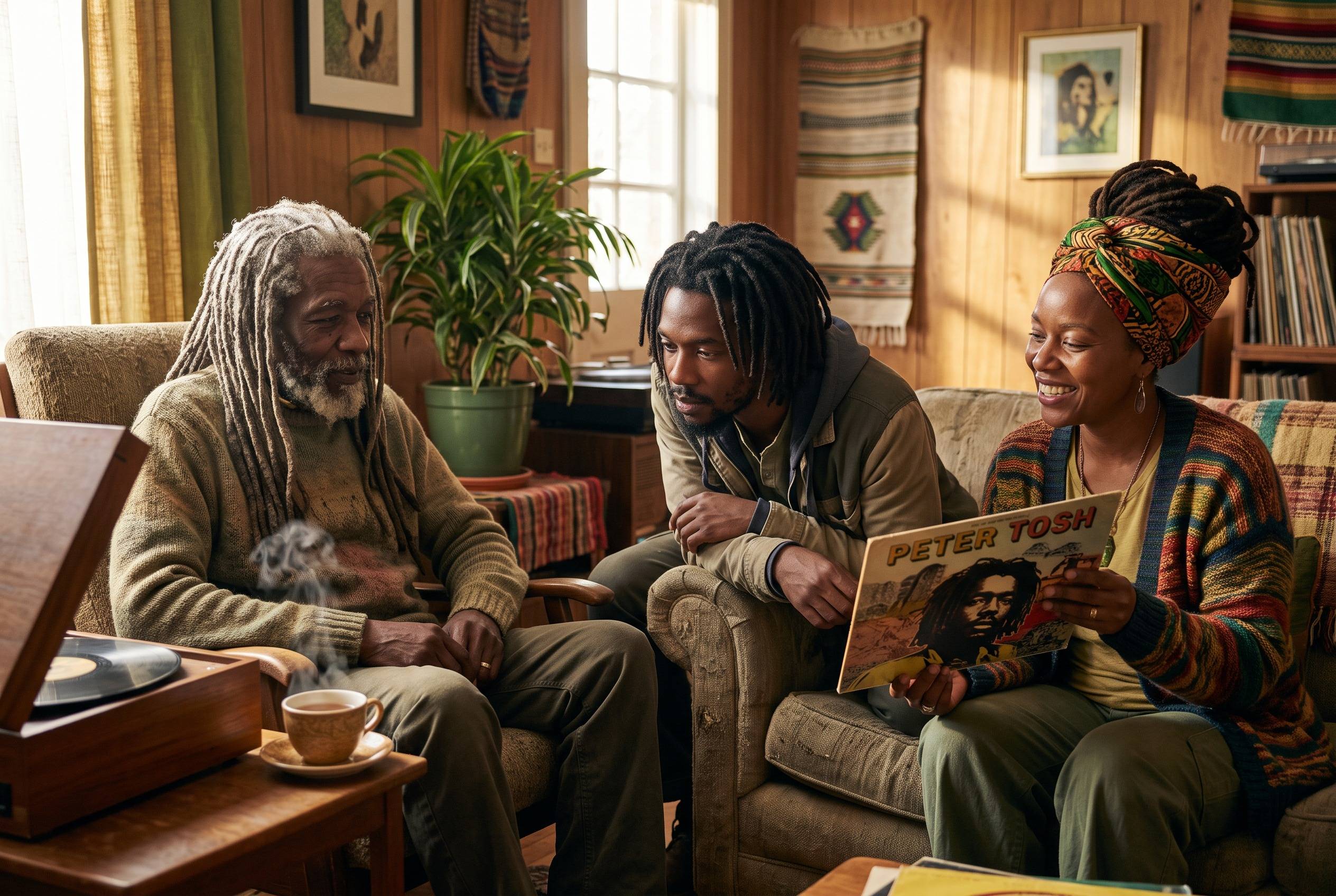
Imagine an illustrative scene, not a report of a particular family. An adult is cooking while a recording plays. A younger relative asks who is singing, and an elder recognizes the group. The answer might lead to a story about the first time the elder heard the song—or simply to a request to turn the volume down.
The scene is ordinary, which is part of its value. Music does not need a special occasion to become connected to memory. A sound heard repeatedly during meals, journeys or visits may later bring back the people and places surrounding it.
Those memories belong to the listeners. One person may associate a song with comfort; another may connect it to a difficult period. A family should not be expected to hear the same message in the same way simply because they share a home.
For some Rastafari listeners, a recording may also raise questions about spiritual practice, African identity or the struggle for dignity. Another listener may begin with the drum sound, the harmony or the story of the musicians. A thoughtful conversation can make room for both.
Rastafari and reggae: related histories
Rastafari emerged among Black Jamaicans in the 1930s, under British colonial rule. Reggae developed later from several Jamaican musical traditions and wider influences. Rastafari people and ideas helped shape important strands of reggae, but the movement and the music are not interchangeable.
Scholar Ennis B. Edmonds discusses Rastafari’s influence on Jamaican popular music as part of a broader history of the movement’s changing public position. Read the chapter description. The relationship includes spiritual expression, social critique, performance and the commercial circulation of cultural symbols.
That history helps explain why a song may lead to a question about more than the artist. Who wrote it? Who played on the recording? What was happening when it was released? How did it reach a listener in another country? Each question can reveal another person or relationship behind the sound.
Reggae Dread’s Rasta Livity in Everyday Life offers a companion introduction to the connection between spiritual outlook and daily practice. Music is one possible part of that conversation, not a test of a household’s identity.
Not every meaningful sound is a commercial recording
A home may include singing, prayer, conversation, silence, radio or music played by someone in the family. Some Rastafari communities also have sacred musical practices that should be understood in their own settings and on the terms of the people involved.
A visitor should not assume that a private gathering is a performance for an audience. Ask whether an event is public, and obtain permission before recording or sharing. A person’s willingness to sing with family does not automatically mean they want that moment posted online.
Respect also means allowing people to choose silence. A home can be full of spiritual and cultural life without music playing all day. The question is what a particular sound—or the choice not to play it—means to the people who live there.
Three recordings and three ways to listen
The following selections are starting points for a listening activity, not a claim that every Rastafari family plays them. Use an authorized recording and check which edition or version you have chosen. Different mixes, live performances and reissues may sound different.
Culture: hearing a vocal group in “Two Sevens Clash”
Culture’s album Two Sevens Clash is associated with 1977. In its description of a later deluxe edition, VP Records identifies the original vocal trio as lead singer Joseph Hill and harmony vocalists Albert Walker and Kenneth Dayes, working with producer Joe Gibbs.
For a first listen, choose the title track on a clearly identified edition. Pay attention to how the lead voice and the other voices relate. When do they appear close together? When does a phrase feel like a statement offered to the listener? Notice what the rhythm section is doing while your attention moves between the voices.
On a second listen, ask what the title and the recording’s historical setting lead you to investigate. The label’s account connects the album to events and expectations surrounding 1977. That description is a source’s interpretation; a careful reader can follow the historical claim to additional evidence rather than assuming a song title explains every listener’s response.
A family member who remembers the record may offer a different kind of knowledge: where it was heard, who owned a copy or why it mattered in a particular room. That memory is valuable as an account of a person’s experience. It is not automatically a credit for the musicians or a record of every event surrounding the release.
Judy Mowatt: making space for a woman’s voice
Judy Mowatt’s Black Woman offers another place to begin. Shanachie Entertainment’s album page lists its edition as 1980 and includes tracks such as “Black Woman” and “Sisters’ Chant.” Release histories can differ by edition, so identify the copy you are discussing rather than assuming every issue has the same date or sequence.
Choose one track and listen first to Mowatt’s voice. How does she shape a phrase? What do you notice about the relationship between her voice and the accompaniment? If other voices are present in the version you choose, listen for how they support or answer the lead.
Then look at the credits available for that particular edition. A singer’s name on the front cover is a starting point, not a complete account of everyone who made the record. Songwriters, musicians, producers and engineers deserve attention where their contributions can be documented.
Mowatt’s place in the conversation also challenges a listening habit that centers only men. Rastafari women have been thinkers and cultural workers as well as family members and listeners. Reggae Dread’s Rasta Women and Everyday Livity provides a broader context for considering whose voices are heard.
Bob Marley and the Wailers: hearing space in “Redemption Song”
The official Bob Marley album page lists “Redemption Song” on Uprising, released in 1980. The album version offers a different listening setting from a full-band roots arrangement: the acoustic presentation places close attention on voice and guitar.
Listen for the space between phrases. How does the guitar support the pacing of the voice? What changes when a listener is not following a prominent bass-and-drum pattern? Those questions can be answered by listening to the chosen recording, without assuming that another version has the same arrangement.
A song about freedom can prompt a family to discuss the historical ideas that inform it. The conversation may move toward reading, memory or disagreement. It need not end with everyone giving the same interpretation, and a song should not be treated as a complete history lesson by itself.
The recording is also one person’s artistic work, made within a wider musical community. To explore another arrangement or later performance, identify it as a separate version and listen for the choices made there.
The people behind the sound

A record is made by more than its front cover
When music becomes familiar, the artist’s name may be the only credit a listener remembers. Yet a recording can depend on songwriters, instrumentalists, harmony singers, arrangers, engineers, producers, label workers and people who distribute it.
Start with a physical sleeve or the credits supplied for a digital release. Compare those details with a reliable label, archive or musician’s account. If two sources disagree, record the disagreement instead of selecting the most convenient answer. Some releases omit credits, and not every contribution can be established from the information available.
The VP Records description of Culture’s trio, for example, provides names for lead and harmony singers on the album. It does not by itself establish the identity of every musician on every recording or mix. A good listening note keeps that distinction visible.
This attention is part of listening with respect. It recognizes that a sound which feels like the expression of one voice may have been built by many people working together.
Women are part of the history and the household
A family record collection can carry the choices of mothers, sisters, daughters, fathers, brothers, elders and friends. If one person always chooses the music, ask whose favorites have been left out. If a history names only male performers, look for women as singers, producers, selectors, writers, organizers and listeners.
The question is not to add a woman’s name as decoration. It is to ask what she made, how her work circulated and what she has said about it. Mowatt’s solo recordings, for example, deserve attention on their own terms as well as in relation to her work with the I-Threes.
Listeners are knowledge holders too. A woman who bought a record, hosted a gathering or taught a child a song may remember details that never appeared on a sleeve. Ask before recording or publishing that account, and keep the memory connected to the person who shared it.
Selection is a form of participation
Choosing what plays in a room can shape who feels welcome. One person may want a devotional recording; another may prefer a love song, a classic vocal group or music from a different tradition. A shared household can make space for more than one choice.
An invitation to choose a song can give a younger person a role beyond listening to what an adult selects. It can also lead an elder to explain why a recording matters. The conversation becomes more interesting when no one is required to prove that their choice is the most authentic.
Volume, timing and accessibility are practical parts of the decision. A neighbor may need quiet; a person with hearing differences may prefer headphones, captions for a video or a written description. Care for the music includes care for the people sharing the space.
Memory, meaning and the limits of a song
A recording can carry more than one story
A listener may remember a record because of a journey, a relative or a gathering. Another may know the same song from a later reissue or a video. Those different encounters do not have to be forced into one definitive family story.
If someone is willing to share a memory, ask where they heard the recording and what they remember about the people present. Let them say when they are uncertain. A date on a sleeve can help identify an edition, but it does not prove the exact day a particular family first played it.
A useful note might say: “A relative remembers hearing this song at a family gathering in London, probably in the early 1980s; the date has not been confirmed.” That kind of description preserves a memory while keeping an estimate visible.
Permission matters. A relative who talks about a song at home has not automatically agreed to a public article, video or social-media caption. Ask what may be recorded, who may hear it and whether names should be used.
Music can raise a historical question
A song may mention a person, a place or a spiritual idea. Treat that reference as an invitation to learn more: look for a reliable history, a musician’s account or a relevant archive. Compare the source with what you heard and note whether you are describing a fact or offering an interpretation.
A recording can communicate emotion and argument with great force. It can also use metaphor, allusion or a point of view that requires context. A lyric should not be treated as a substitute for every source on the event it evokes.
The same care applies to Rastafari language. Ask how a speaker or artist uses a term in that setting; avoid turning words into decorative slogans. The people whose spiritual and cultural life gives language meaning deserve to be credited.
Joy is part of the picture
An article about music and livity should make room for pleasure. People dance, sing along, rest, laugh and introduce friends to a favorite recording. A song can be important because it makes a room feel alive as well as because it invites reflection.
Joy does not erase the histories carried in the music. It is one of the ways people live with those histories and with one another. A child choosing a record, an elder remembering a dance and a cook moving to a rhythm can each be part of a family story—when the people involved choose to share it.
A listening session to try at home
One recording, three questions
Choose one authorized recording and identify the artist, title, release or edition and source. Invite each person to listen without needing to agree. Afterward, ask:
- What did you hear? Name a voice, instrument, rhythm or change you noticed.
- What did it bring to mind? Share a memory or question if you want to; passing is welcome.
- What would you like to learn? Choose one credit, historical reference or musical detail to investigate.
Write a short note with the recording’s details and the date of the session. If a person offers a memory, record their name only with permission and make clear whether the account is private. Leave uncertain dates or credits open until a reliable source helps resolve them.
A second session can compare a studio recording with an authorized live version. Keep the versions distinct and ask what changed in the arrangement or performance. The goal is not to declare a winner; it is to hear the choices musicians and producers made.
A simple family listening card
A shared listening card can include:
- Artist and title: As credited on the version you used.
- Edition and source: Label, year or platform, with a link or note that identifies it.
- What I noticed: One audible detail, described in your own words.
- What the recording brought to mind: An optional memory, shared with permission.
- What I want to check: A credit, historical claim or question for another listen.
A family can keep the card private, add it to a collection or use it to start another conversation. It does not need to contain quotations from the song to be meaningful.
Frequently asked questions
Does every Rastafari household listen to reggae?
No. Musical choices vary by person, family and community.
Is every reggae artist Rastafari?
No. Reggae and Rastafari have significant shared history, but artists and listeners have diverse beliefs.
How can I identify the people who made a recording?
Start with the credits for the specific edition, then compare them with reliable label, archive or musician sources. Keep uncertainty visible when sources disagree.
Can a family memory establish a recording credit?
A memory can be an important source, especially when the speaker has direct knowledge. Explain who provided it and check supporting documentation where available.
Should I record a relative talking about music?
Only if they agree. Discuss whether the recording will remain private or be shared, and respect their choice.
The music remains in relationship
A recording is a meeting point between the people who made it and the people who hear it. In a home, it can become connected to work, meals, family stories, faith, questions and joy. Those relationships give the music a life beyond a track list.
Listening closely means noticing the bassline and the harmony, but it also means asking who chose the song, whose work is credited and what a listener wants to share. One recording can open several conversations without requiring them all to end in the same place.
Choose a song. Identify the version. Listen with someone whose experience differs from yours. The next part of the story may begin with the question they ask after the music stops.
Sources and further reading
- VP Records, Culture’s Two Sevens Clash deluxe edition. Label account of the album and original vocal trio.
- Shanachie Entertainment, Judy Mowatt: Black Woman. Track listing for the label’s edition, dated 1980 on the page.
- Bob Marley official website, Uprising (1980). Album track listing and official listening links.
- Ennis B. Edmonds, “Rastafari Rules: Bearers of Jamaican Popular Culture”, Oxford University Press. Chapter abstract; full text may require access.
- Reggae Dread, Rasta Livity in Everyday Life and Rasta Women and Everyday Livity.