
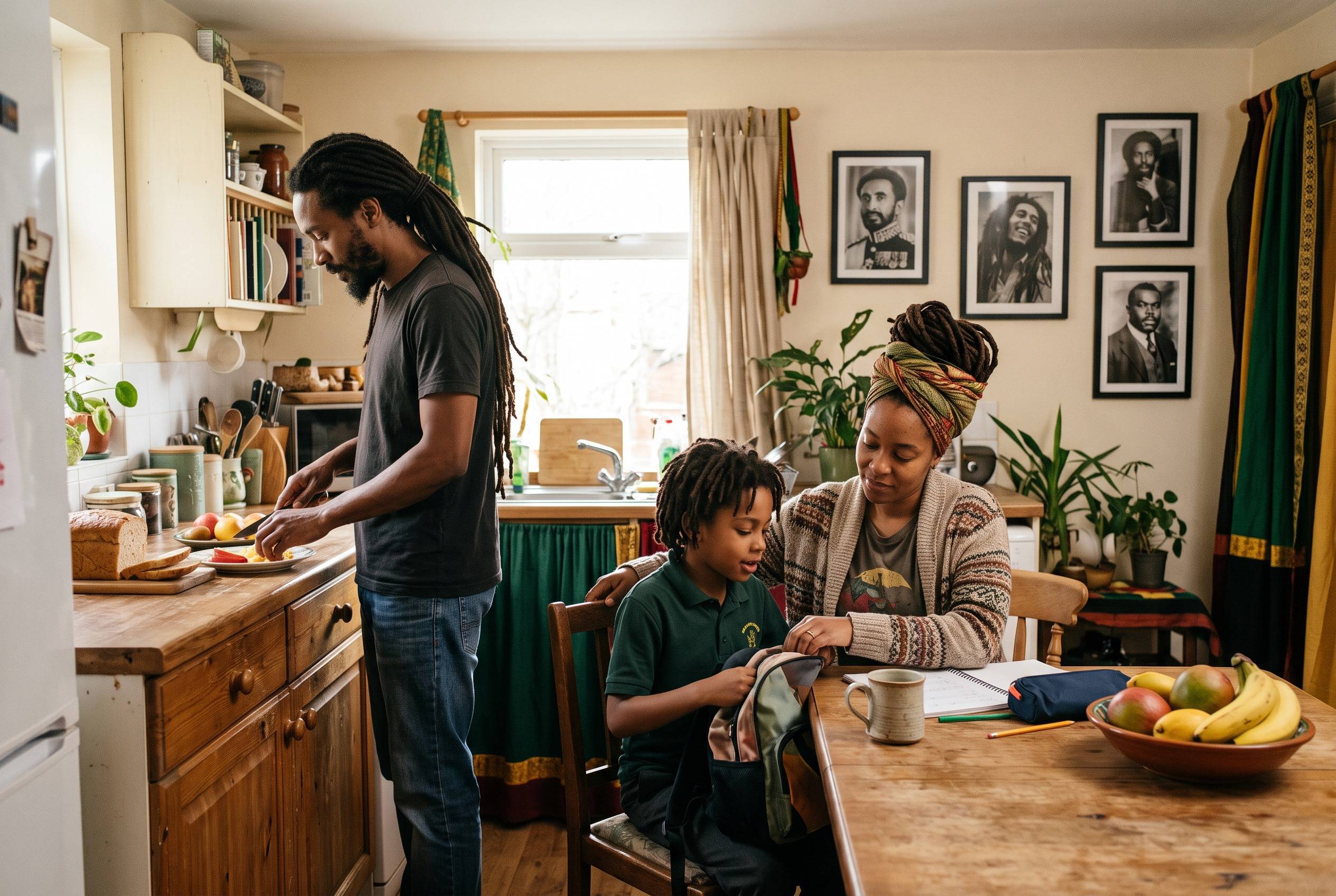
A Rasta Morning: Beginning the Day With Purpose
The beginning of a day can bring prayer, food, work and family into the same space. Rastafari people describe those moments in different ways, shaped by their beliefs and circumstances.
Before a household is fully awake, someone may already be thinking about the day ahead. Breakfast needs to be prepared, a child has to reach school, a shift is about to begin or a garden needs water. For some Rastafari, those responsibilities sit alongside a moment of prayer, gratitude or reflection.
In a 2010 interview, the late Dominican singer Nelly Stharre described giving thanks when she woke, then preparing her children for school and finding time for vocal exercises. Her account brings spiritual awareness and ordinary work into the same morning. It is one woman’s description at a particular time in her life, not a timetable for every Rasta home.
That distinction matters. Rastafari includes different communities, houses, generations and personal practices. Some people begin the day with scripture or prayer; others may describe their morning differently. A person working overnight, raising children, living with illness or managing a long commute may have very different possibilities from someone with a quiet hour at home.
To explore a Rasta morning, then, is not to assemble a universal routine. It is to ask how belief, history and responsibility can meet the first decisions of a day.
Waking into a way of life

Gratitude and the beginning of a day
Stharre’s account began with giving thanks. She described that practice before moving into the practical details of breakfast, school transport and her work as a singer. The order is revealing: a spiritual expression did not replace family responsibilities; it accompanied the beginning of them.
Gratitude can be spoken aloud, expressed in prayer or held privately. Its meaning depends on the person. One individual may address Jah, another may reflect on family and community, and another may not describe their morning in those terms. An observer should not assume that a visible ritual tells the whole story of a person’s faith.
Stharre’s interview was published in 2010, and she died in 2015. Reading it today gives us access to a particular voice at a particular moment. It does not establish what she did every day throughout her life or what another Rastafari parent would choose to do.
The account is useful because it resists a false division between the sacred and the ordinary. A person may move from prayer to packing a school bag without feeling that one activity belongs to spiritual life and the other does not.
Livity is larger than the morning
The term livity is often used for the relationship between spiritual outlook and lived practice. It can include the way a person understands food, speech, work, relationships and care for the natural world. Interpretations differ, and the word cannot be reduced to a set of habits selected from a list.
Rastafari emerged among Black Jamaicans in the 1930s, under British colonial rule. Its history includes spiritual affirmation, African identity and resistance to racial hierarchy. A discussion of a peaceful morning should not detach those practices from the movement’s history of Black dignity and liberation.
For many Rastafari, Emperor Haile Selassie I and Empress Menen Asfaw have spiritual significance. People and houses understand and express that significance in different ways. A family may explain its beliefs to children through prayer, books, stories or example; another may place emphasis elsewhere.
Reggae Dread’s Rasta Livity in Everyday Life offers a foundation for these ideas. The morning gives us one period of the day in which to consider them more closely.
There is no perfect beginning
A work schedule may require someone to leave before sunrise. A parent may be interrupted by a child’s needs. A person with limited mobility or chronic illness may need more time and support. Another person may be returning from an overnight shift while others are beginning their day.
None of these circumstances can be used to measure the sincerity of a person’s belief. An image of a tranquil home, a garden and an uninterrupted hour may be appealing, but it can leave out the people whose labor and schedules make such a morning impossible.
A serious discussion of purpose makes room for fatigue, uncertainty and the need for rest. It asks what a person values and what conditions shape their choices, rather than judging them against an imagined ideal.
Food, water and the work of a household
Breakfast begins before the plate
Someone must decide what food is available, prepare it and clean up. In a busy household, those tasks may happen while a person is also finding school clothes, answering a call or planning transportation. The finished meal does not reveal all the work behind it.
For some Rastafari, food choices are connected to Ital, a way of thinking about life, nourishment and the natural world. Practices differ. Some people follow plant-based diets and avoid certain ingredients; others understand or apply Ital differently. The way a particular household prepares breakfast should be described on its own terms.
A person may prefer fresh fruit, grains, cooked food, tea or another familiar meal. Availability, cost, health needs and the time to prepare food all matter. There is no single plate that an outsider can use to decide whether a person is living Rastafari.
Food belongs in that conversation because it connects the body to growers, sellers, cooks and the people who share a table. It also raises a practical question about fairness: who had time to sit down, and who was still working after everyone else had eaten?
Stharre’s school morning
In the 2010 interview, Stharre described waking her children, preparing food and driving them to school before returning to other responsibilities. She also mentioned trying to find time for vocal exercises. These details show how artistic work and family care could occupy the same morning.
The interview does not tell us how every task was divided in her household or whether every morning followed the same pattern. What it does provide is a woman’s own account of the work she was managing at that time.
That specificity matters. Discussions of spirituality sometimes celebrate what a family shares without asking who makes sharing possible. Shopping, cooking, transportation and cleaning are forms of work. They deserve recognition whether they are paid or unpaid.
A partner, older child, relative or neighbor may share some of those tasks. The arrangement differs by household and can change with work schedules, age and health. Asking rather than assuming is a better way to understand how a family makes its morning possible.
Water, plants and the conditions of care
A person may begin the day by checking a garden, watering a plant or preparing food grown nearby. The action can express a relationship to the earth and to the labor required to sustain life. It can also be a practical task that needs doing before the day grows hotter.
Not everyone has land, safe outdoor space or a reliable water supply. A person in an apartment may buy herbs from a market; someone else may have no opportunity to garden at all. Land ownership, housing and climate shape what is possible.
The Rastafari Indigenous Village describes one Jamaican community through connections among its garden, Ital kitchen, craft and family life. Its public description is one community’s account, not evidence that every Rastafari household begins with a garden or welcomes visitors in the same way.
A glass of water or a pot of tea can still raise a useful question: who worked to make this available, and how can it be shared responsibly? The answer will be different in a well-supplied home, a drought-affected area or a household facing an interrupted service.
Study, reflection and creative work

A poet’s morning at a particular time
In research on Jamaican dub poets, scholar John D. Galuska described Cherry Natural beginning a day with spiritual acknowledgment, tea, meditation and writing. His dissertation brings those activities into the same view as parenting, household tasks and artistic work. Read the research record.
This is a researcher’s account based on fieldwork and conversations from an earlier period. It should not be presented as a claim about Cherry Natural’s current routine. Nor does it establish a schedule for other poets or Rastafari women.
What the account makes visible is the relationship among different forms of work. Time to write did not exist in isolation from the needs of a household or the demands of performance. Reflection and creativity occupied a place within a day that also contained practical obligations.
The example also challenges the assumption that women’s spiritual lives are confined to domestic roles. A woman can be a parent, artist, thinker and person with her own commitments. Those identities may overlap, but none should erase the others.
Reading and asking questions
Some Rastafari people read the Bible or other texts as part of spiritual study. The books selected, the way they are interpreted and the time set aside for reading vary. A passage may be considered alongside history, a family conversation or a question about the present.
For a child, reading can begin with a story or a question: Why does this person matter to our family? What happened in Jamaica or Ethiopia? What did an elder mean by a word used at home? An adult does not need to know every answer; looking for a source together can be part of learning.
Reading is not limited to a quiet room. It may happen on public transport, during a work break or after the main morning responsibilities are complete. A person who has no time to read at dawn has not failed a spiritual test.
Study can also create disagreement. Family members may interpret the same text differently, and a younger person may ask a question that an adult has not considered. Listening to those questions can make a relationship stronger even when the answer takes time.
Silence and sound
A morning may include music, a spoken greeting, prayer or silence. One person may want to hear a recording while preparing food; another may need a quiet room. A household can contain different preferences without those differences becoming evidence that one person is more committed than another.
A song can prompt reflection or carry a memory of someone absent. It can also simply be enjoyed. Reggae and Rastafari have important historical connections, but not every Rastafari person listens to the same music and not every reggae musician is Rastafari.
If a family chooses to share a recording or a private conversation beyond the home, permission matters. A person’s willingness to sing or pray with relatives is not automatically permission for someone else to post that moment online.
Carrying the morning into the wider world
The journey to school or work
A morning does not end at the front door. A child moves from family life into school; an adult meets colleagues, customers or public institutions. Those settings may or may not understand a person’s appearance, food choices or spiritual commitments.
A child who is asked about locks or a family practice deserves support without being made responsible for educating an entire classroom. An adult can ask what happened, listen to the child’s own account and decide with them what help would be useful.
Workers may face different pressures: a schedule that leaves little room for family care, a workplace rule about appearance or the cost of traveling to a job. The companion article Dreadlocks at Work: Identity, Dignity and Belonging explores documented employment cases and the importance of considering a person’s actual circumstances.
These experiences show why a morning routine is not simply a matter of personal discipline. Access to transportation, fair treatment, housing and flexible work affects the choices people can make before the day has properly begun.
A child’s memory of a household
In her essay “Revisiting My Rastafari Childhood”, poet Safiya Sinclair recalls her mother rising early, doing household and yard work, and getting children ready for school. Her account makes a parent’s labor visible through a child’s memory.
Sinclair also describes pressures and restrictions she experienced in her family and the wider society. She later left Rastafari, a decision she has discussed publicly. Her experience belongs to her; it should not be used to characterize every Rasta home or to describe her as a current Rastafari spokesperson.
Reading Stharre’s interview alongside Sinclair’s recollection shows why individual voices matter. They describe different households and different periods. Together they invite us to notice both spiritual meaning and the unequal or demanding work that can sit behind an apparently ordinary morning.

Care can be a small agreement
A neighbor may need a ride or a reminder about an appointment. A relative may welcome a call after a difficult night. An elder may prefer to prepare their own breakfast but appreciate someone checking whether groceries are available.
The first task is to ask what support is wanted. Care can become intrusive when one person assumes they know what another needs. A practical agreement—who will call, when, and what information may be shared—respects both the person receiving support and the person offering it.
A morning of purpose does not need to be grand. Keeping one promise, sharing a task or listening to a child’s concern can be meaningful precisely because it affects another person’s day.
Bringing intention into a real morning
Questions to consider
These questions are for reflection, not a prescribed Rastafari practice:
- What responsibilities must be met before the day begins, and who carries them?
- Is there a moment for the kind of prayer, study or quiet that the people involved actually want?
- How are food, water and transportation obtained, and what limits do cost or access create?
- Is a child or elder being heard about the help they need?
- What can be shared, changed or left for another time so that one person is not carrying everything?
The answers may change from one day to the next. A family can discuss them without pretending that every problem has a quick solution or that all members share the same beliefs.
A short shared exercise
Choose one morning task—a meal, a school journey, a phone call or a garden chore. With the people involved, make a brief list of what has to happen and who currently does it. Ask whether the arrangement works for them and whether any task could be shared or simplified.
This exercise is a general way to notice household work. It is not a ritual or a method for proving that a household follows Rastafari. A person can decline the conversation, and a family may have constraints that cannot be solved by rearranging a list.
If the discussion reveals that someone needs outside support, consider which local service, trusted person or qualified professional might help. Rest and care should not depend entirely on one person being able to do more.
Frequently asked questions
Do all Rastafari wake early to pray?
No single schedule applies to all Rastafari people. Prayer and other practices vary, as do work and family circumstances.
Is there one Rasta breakfast?
No. Food choices and Ital practices differ among individuals and households.
Must a person have a garden to live Rastafari?
No. A relationship to the earth can be expressed in different ways, and access to land and water is unequal.
Can a child question a family practice?
Children can ask questions and express their experience. Families may answer differently, but listening helps adults understand what a child needs.
Can someone outside Rastafari learn from these accounts?
Yes. Begin by respecting the speakers, the spiritual meaning of their practices and the history of Black liberation that informs the movement.
The day continues
A morning can bring many kinds of work into view: prayer or reflection, food preparation, care for children, creative practice, a journey to a job and attention to a neighbor. The order and meaning of those activities belong to the people who live them.
Nelly Stharre’s account, Cherry Natural’s documented creative work and Safiya Sinclair’s childhood memory offer different windows into particular lives. None supplies a universal timetable. Each reminds us that an ordinary day is shaped by relationships, resources and choices.
Beginning with purpose may mean making space for gratitude. It may also mean sharing the school run, respecting a child’s question or recognizing the work another person has already done. What matters is how that attention continues as people move through the rest of the day.
Sources and further reading
- Nelly Stharre interview, 20 Questions With The Lime, 2010. Stharre describes her morning and family responsibilities at that time.
- Nelly Stharre found dead, Jamaica Observer, 2015.
- John D. Galuska, Mapping Creative Interiors: Creative Process Narratives and Individualized Workscapes in the Jamaican Dub Poetry Context, Indiana University dissertation, 2007. Describes Cherry Natural’s creative and daily practices during the research period.
- Safiya Sinclair, “Revisiting My Rastafari Childhood”, The New Yorker, 2023. Personal essay; access may be restricted.
- Rastafari Indigenous Village, About. The community’s own description of its activities.
- Reggae Dread, Rasta Livity in Everyday Life and Dreadlocks at Work.