When most people hear “plant-based,” they think calories, macros, and maybe a hashtag. When a Rasta says “Ital”, they’re talking about something much deeper than a diet. Ital is food as freedom, food as spiritual discipline, food as a quiet rebellion against Babylon’s system.
To understand the Rasta Ital diet, you can’t start with a supermarket. You have to start with plantation rations, colonial poverty, and a people searching for a way to live clean in a dirty world. Only then does Ital reveal itself as a full livity—a way of being that transforms the plate, the body, and the mind.
This first chapter in the series lays the foundation:
- Where Ital comes from.
- What makes food “Ital.”
- Why it’s spiritual, not just “healthy.”
- How it differs from modern “clean eating” trends.
- Why Ital still matters in the age of fast food and fake wellness.

From Plantation Rations to Ital Livity
Food Under Empire: Rations, Scraps & Survival
Before there was Ital, there were rations: salted fish, cheap flour, leftover meat, and whatever scraps the colonial system pushed onto enslaved and poor Black people. The Caribbean table of the past was shaped by plantation logic— feed the workers just enough to keep them going, never enough to let them thrive.
After emancipation, the basic pattern continued. Imported foods, tinned goods, and salty, heavily processed items became everyday staples. What we now call traditional Caribbean food is often a mix of African memory and colonial economics:
- Saltfish and meat cured to last long in barrels.
- Refined white flour and sugar as cheap energy.
- Tinned meats and processed fats marketed as “modern.”
People made miracles with what they had, but the system wasn’t designed for their wellness. It was designed for their labor.
Early Rasta Reasoning: Food as Resistance
When Rastafari rose in 1930s Jamaica, it brought more than dreadlocks and drumbeats. It brought a question: “If Babylon controls the food, the land, and the store shelves, how can we truly be free?”
One of the answers was Ital. Early Rastas saw what colonial foods were doing—high blood pressure, sickness, spiritual dullness—and started to separate themselves from it. They turned toward:
- Ground provisions – yam, cassava, sweet potato, dasheen.
- Fresh fruits and vegetables – whatever the land offered.
- Simple preparations – boiled, steamed, lightly cooked.
- Minimal seasoning – especially reduced or no salt.
The goal wasn’t to follow a trend. It was to protect the temple (the body) and keep the mind clear enough to hold a higher vibration. Eating this way became part of what Rastas call livity—a word that combines life, vitality, and spiritual flow.
Ital was born at the crossroads of poverty, spirituality, and resistance. It was a way to say:
- We won’t let Babylon decide what we put in our bodies.
- We won’t live on dead food, canned food, poisoned food.
- We will eat from the earth, like our ancestors did before the plantation.
What Makes Food “Ital”? Core Principles & Practice

“Vital” and “Natural”: The Root of Ital
The word “Ital” is often explained as coming from “vital”—that which is alive, life-giving, and pure. Ital food is meant to be as close to its natural state as possible, free from heavy processing and chemical interference.
Common Ital principles include:
- Natural and unrefined – whole foods over processed foods; fresh produce over canned items.
- Plant-centered – many Rastas avoid meat entirely; some may still eat small amounts of fish, but always with intention.
- Reduced or no salt – flavor comes from herbs, spices, and natural aromatics, not heavy sodium.
- No artificial chemicals – preservatives, artificial colorings, and lab-made seasonings are avoided.
- No alcohol and hard drugs – these cloud the mind and weaken spiritual focus.
Ital is not identical in every yard or community. There are stricter and looser interpretations, but the heartbeat is consistent: clean, natural, life-giving food that strengthens livity.
Ital and the Energy of Food
In the Ital worldview, food is not just nutrients. It also carries energy. Meat, especially red meat and highly processed meat, is often seen as:
- Heavy and hard to digest.
- Carrying the vibration of violence, fear, and death.
- Pulling the mind down into dense, aggressive states.
Plant foods—especially fruits, vegetables, roots, and herbs—are seen as:
- Light, yet strong.
- Carrying the energy of the sun, soil, and rain.
- Supporting clarity, compassion, and higher reasoning.
This is why many Ital followers prefer simple cooking methods:
- Steaming instead of deep-frying.
- Light sautéing instead of heavy, oily frying.
- Gentle boiling of roots and greens, not soaking them in fat.
The idea is to preserve the food’s natural vibration, not drown it in oil, salt, and sugar.
Ital and the Land: Eating What You Plant
Another core element of Ital is connection to the land. Rasta communities emphasize farming, gardening, and self-reliance. Growing your own food means:
- Less dependence on Babylon’s supermarkets.
- Fresher, seasonal ingredients.
- A direct relationship with soil, rain, and the rhythm of nature.
An Ital plate often reflects the local ground:
- Sweet potato, yam, green banana, breadfruit.
- Callaloo, pumpkin, okra, string beans.
- Mango, papaya, coconut, guava.
This isn’t just about flavor. It’s about developing a rooted identity— knowing where your food comes from, and by extension, where you come from.
Food as Spiritual Practice, Not Just Nutrition
The Body as Temple
In Rastafari, the body is often understood as a temple—a living shrine that houses the divine presence, or I-and-I. Just as you wouldn’t burn trash inside a sanctuary, you don’t load the body with chemical-laced, over-processed food.
The Rasta Ital diet becomes a daily ritual of respect:
- Respect for the body as a sacred vessel.
- Respect for the earth as a sacred provider.
- Respect for the ancestors whose struggles made survival possible.
Eating Ital becomes a prayer without words. Every choice—what to buy, what to cook, what to refuse—is a small act of devotion.
Ital and Nyabinghi: Food at Gatherings
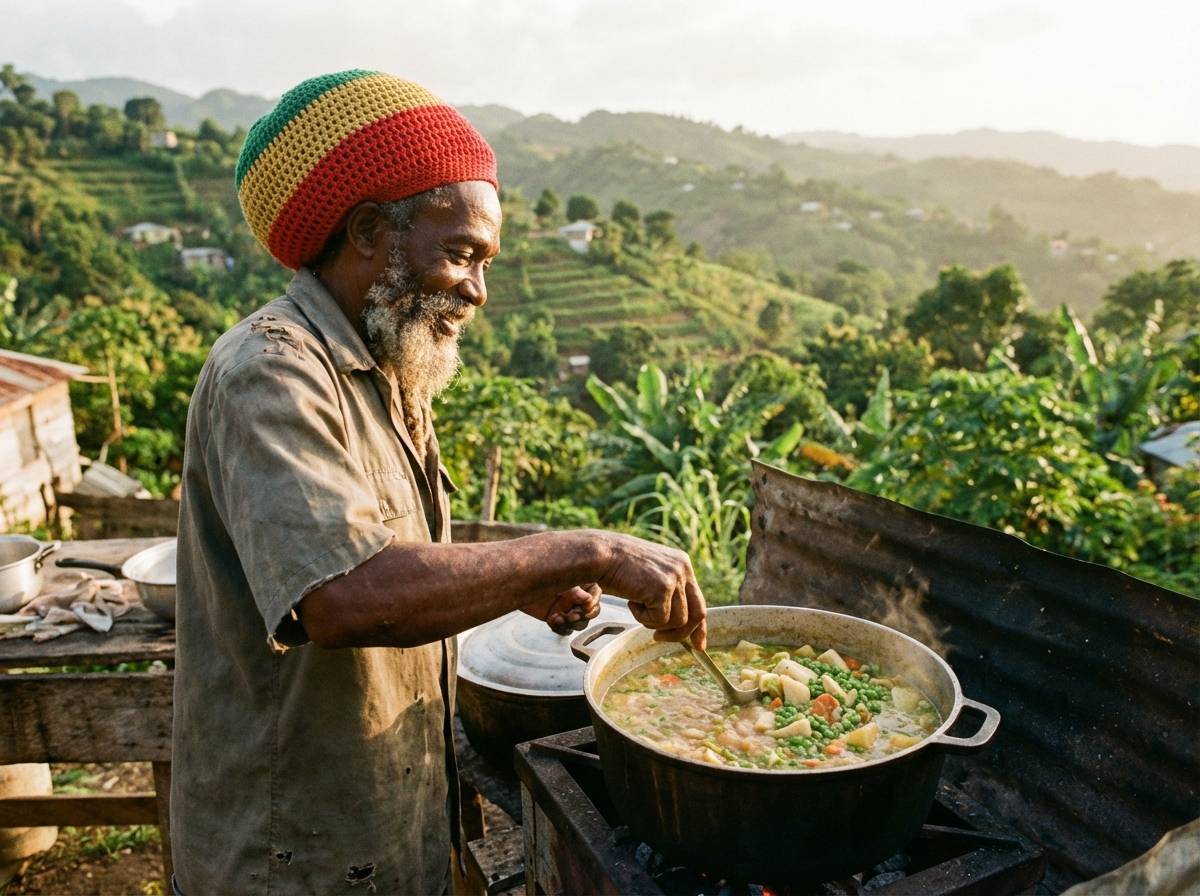
At Nyabinghi gatherings—where Rastas drum, chant, and reason together— food plays an important role. Large pots of Ital stew, one-pot meals with peas, greens, and ground provisions, are shared among the community. These meals are:
- Communal – everyone shares the same pot.
- Simple – no luxury, just nourishment.
- Symbolic – unity in the bowl, unity in the chant.
Food is not separate from the spiritual work. It fuels the singing, the drumming, and the reasoning about liberation and righteousness. The same principle extends to the everyday: an Ital meal eaten in silence, with gratitude, can feel as sacred as a formal ritual.
Clarity of Mind and the Role of Herbs
Because Ital avoids heavy, clogged foods, it is said to bring:
- Better mental clarity.
- Heightened sensitivity to spiritual insight.
- A calmer nervous system.
Herbs and bush teas play a big role:
- Ginger, turmeric, and garlic for cleansing.
- Fever grass (lemongrass), cerasee, and other bush teas for detox and balance.
- Roots tonics for strength and endurance.
The Rasta Ital lifestyle is a spiritual technology: what you eat, what you drink, and how you live all work together to keep the channel between the physical and the divine clean.
Ital vs “Healthy Eating” Trends
When Wellness Becomes a Trend
In the modern world, “healthy eating” has become an industry. Smoothie bowls, detox teas, plant-based burgers, nutrition apps—wellness is marketed, branded, and sold back to people who are often stressed, overworked, and disconnected from their culture.
Much of this is surface-level:
- Focused on appearance: flat stomach, “glow,” summer body.
- Focused on numbers: calories, macros, grams of protein.
- Focused on products: powders, supplements, pre-packaged “health” snacks.
There’s nothing wrong with wanting to feel or look better. But for Rasta, the question goes deeper: “Is your food freeing you, or just decorating Babylon’s cage?”
Ital’s Deeper Motivation
What makes Ital different from many modern food trends is the why behind it. Ital is not simply:
- A way to lose weight.
- A cleanse before a vacation.
- An aesthetic choice for social media.
It is:
- A spiritual commitment.
- A political statement.
- A cultural memory carried through the kitchen.
When you choose Ital, you’re not just saying, “I want to be healthy.” You’re also saying:
- I don’t trust Babylon to feed me right.
- I honor my ancestors by treating my body better than the plantation treated theirs.
- I want to live in a way that reflects my highest understanding of truth.
Ital, Cultural Roots & Appropriation
In recent years, Ital-style dishes—veggie stews, coconut-based plates, Caribbean plant-based recipes—have appeared in mainstream cookbooks and wellness blogs. While this can spread awareness, it also raises a serious issue: cultural erasure.
When Ital flavors and recipes are:
- Stripped of their Rasta context.
- Rebranded as “exotic plant-based bowls.”
- Used for profit without crediting the communities that created them.
…something essential is lost.
Respectful engagement means:
- Naming Rastafari and Ital explicitly when drawing from this tradition.
- Learning at least the basics of the history behind the recipes.
- Recognizing that these dishes come from a people who used food to resist a violent system.
A bowl of Ital stew is not just “vegan comfort food.” It is a story of survival, faith, and rebellion.
Why Ital Still Matters Today
Babylon’s Food System in the 21st Century
Look around the modern supermarket:
- Shelves stacked with ultra-processed foods.
- Long ingredient lists filled with chemicals.
- Sugary drinks and salty snacks pushed as everyday staples.
The same system that once rationed salted fish and flour now rations cheap junk food to poor communities, while selling “premium wellness” to those who can afford organic labels and boutique brands.
The consequences are visible:
- Rising rates of diabetes, hypertension, and heart disease.
- Food deserts where fresh produce is scarce.
- Overworked people surviving on drive-thru meals and microwaved dinners.
In this environment, the Rasta Ital diet stands as an old yet radical idea:
- Eat close to the earth.
- Eat what feeds life, not profit.
- Eat in a way that keeps your spirit clear and your conscience clean.
Ital as a Blueprint for Future Food Freedom
As conversations about plant-based diets, sustainability, and food justice grow louder, Ital offers a grounded, time-tested model:
- Plant-centered long before “plant-based” became a marketing term.
- Rooted in community, not in corporate branding.
- Tied to the land and small-scale agriculture.
- Aligned with spiritual values, not just body image or trends.
Ital shows that a truly conscious diet:
- Looks at who grows the food and under what conditions.
- Considers who has access to clean food and who is left with scraps.
- Questions why certain foods are so cheap and others so expensive.
Ital for People Who Aren’t Rasta
You don’t have to be formally Rastafari to learn from, or be inspired by, Ital principles. But approaching Ital requires respect.
If you are:
- A vegetarian or vegan looking for deeper cultural grounding.
- A health-conscious person drawn to more natural food.
- A diaspora soul reconnecting with Caribbean or African roots.
You can:
- Adopt Ital-inspired meals and cooking styles.
- Explore herbs, roots, and spices central to Ital cooking.
- Learn the history and give credit to Rastafari communities.
The key is to see Ital not as a trend to copy, but as a teacher to learn from.
Looking Ahead: From History to Comparison
In this first chapter, you’ve walked through:
- The journey from plantation rations to Ital livity.
- The core principles that make food Ital—natural, plant-centered, spiritually aligned.
- The idea of food as spiritual practice, not just fuel.
- The difference between Ital and surface-level “healthy eating” trends.
- The reasons Ital still holds power in a world flooded with processed food.
From here, the series moves from foundation to comparison—from philosophy to the wider plant-based landscape.
In Part 2 – “Rasta Ital vs. Vegetarian & Vegan: Same Plate, Different Spirit”, you’ll compare Ital with modern vegetarian and vegan diets in detail. You’ll explore:
- Where they overlap in practice.
- Where their motivations diverge.
- How culture, spirituality, and history shape the way we understand plant-based eating.
This is where the conversation widens—from Ital as a specifically Rasta path to Ital as a voice inside the global dialogue on vegetarian, vegan, and plant-based lifestyles.