The history of a community lives in memories of work, faith, food, migration and care. A thoughtful conversation can help keep those memories connected to the people who share them.
An elder may remember a shop that disappeared years ago, a song heard on a neighbor’s radio or the relative who taught them how to prepare a meal. They may remember a time when a family moved, a community gathered or a belief carried a cost in the wider society.
Such memories are easy to postpone. There is always another visit to make and another question to ask. Then a photograph loses its names, a familiar place changes, or the person who knows a story is no longer available to tell it in their own words.
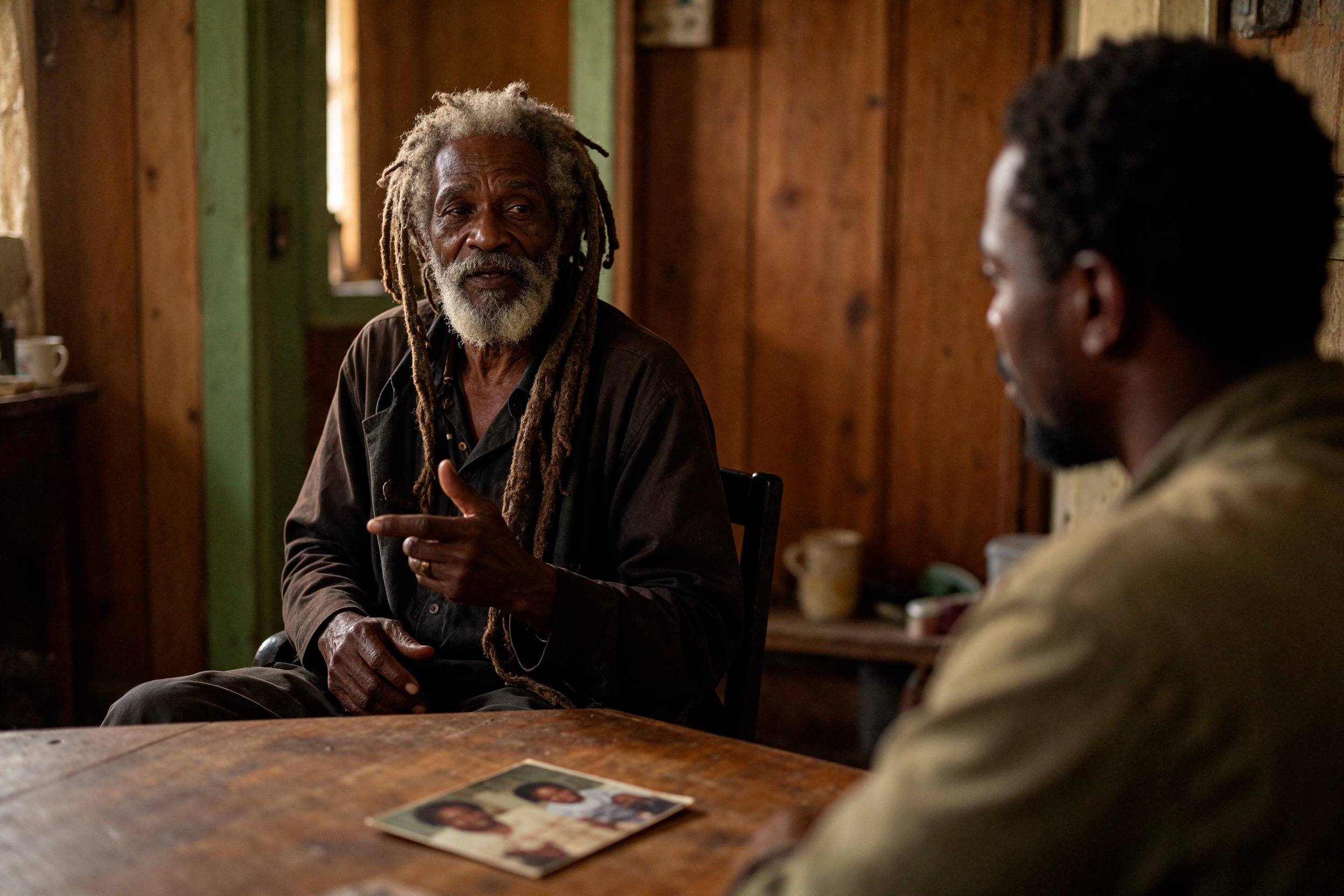
Listening is one way to care for that knowledge. It begins with a person rather than a recording device: someone whose time, privacy and choices matter. For Rastafari families and communities, a conversation with an elder can open a path into histories of faith, Black identity, resistance, family life and the ordinary work that holds a community together.
No elder speaks for every Rastafari person, and age alone does not make one account the final word. The value of an individual memory is its particular point of view—what this person saw, heard, learned or experienced, in a place and time that can be identified as carefully as the evidence allows.
Why an elder’s account matters
History is made in everyday places
Public histories often give the most space to leaders, famous recordings and events that entered official documents. Those subjects matter, but they do not capture everything. Someone prepared the food, cared for children, found work, maintained a home and kept relationships alive when a community faced hardship.
An elder’s account can bring those activities into view. A story about a market may reveal how a household obtained food and earned money. A memory of school may show how children were treated. A description of a gathering may name people who rarely appeared in photographs or newspaper reports.
For Rastafari, the connection between history and daily life can also be spiritual. An elder may explain what livity means to them, how they came to understand a scripture or why a particular practice matters in their household. Another person may describe the same subject differently. The purpose is to hear the explanation in its own context.
A family account does not have to include an extraordinary event to deserve care. The story of a weekly meal, a journey to work or a conversation with a neighbor can tell future generations how life was organized and what people valued.

Mama Irone and the work of remembering
In an essay on early Rastafari women, scholar Shamara Wyllie Alhassan describes interviewing Mama Irone, who had lived at Pinnacle, a Rastafari community in St. Catherine, Jamaica. Alhassan recounts Mama Irone’s memories of women farming, making clothing, cooking, building and helping operate a school and bakery. Read Alhassan’s essay.
Those memories widen the picture of Pinnacle. A history centered only on a prominent leader might leave readers unable to see the people and work that sustained the community. Mama Irone’s account directs attention to everyday labor alongside spiritual life and the community’s encounters with repression.
The essay is a published interpretation of an interview. A reader should distinguish Alhassan’s description from the full interview itself and avoid presenting invented dialogue as Mama Irone’s words. Her recollections deserve to be considered alongside other records, without treating the need for context as a reason to dismiss memory.
Her example also reminds us to seek women’s voices. Mothers, sisters, workers, growers, thinkers and organizers may have carried knowledge that was never included in the most familiar public account. Listening changes the questions a history can ask.
An archive can hold a beginning
The Smithsonian’s catalog lists interviews with Rastafarian elders, including a 1988 recording associated with research on Jamaica. The catalog identifies the recording and notes restrictions concerning access and publication. It does not make every interview available for unrestricted use.
A catalog entry is useful because it tells us that a record exists and may identify its creator, date and repository. It is not the same as listening to a complete recording. If you want to use an archived interview, ask the repository about access, permissions and any conditions that apply.
Another Smithsonian catalog description summarizes Dorothy Baker’s account of Rastafari, family life and her children’s experiences at school. Together, these records show the range of subjects an oral history can contain. Each belongs to the people and circumstances in which it was created.

Begin with a relationship, not a microphone
Ask whether the person wants to talk
An invitation can be simple: “Would you be interested in telling me about your childhood?” or “I would like to understand more about this photograph. Is there a time you would want to talk about it?” The person may prefer a different subject, a different day or no interview at all.
Explain why you are asking. Are you hoping to keep a private family record, write an article, create a school project or deposit a recording with an archive? Each purpose raises different questions about who will listen and how the material might be used.
Permission to talk is not automatically permission to record. Permission to record is not automatically permission to publish an audio clip, photograph or quotation. Discuss each intended use separately, in language both people understand, and agree on any limits before proceeding.
The Oral History Association’s best practices emphasize informed consent, clear expectations and opportunities for narrators to review material before public release when possible. They also recognize a person’s right to decline a subject or restrict access. Those principles can guide a family conversation even when it remains entirely private.
Let the elder set the pace
Choose a place where the person can sit comfortably, hear the questions and stop when they wish. A quiet room may help a recording, but comfort matters more than producing perfect audio. Ask whether the person prefers a phone call, an in-person visit or a shorter conversation on another day.
Some memories are joyful; others involve loss, discrimination or family conflict. Do not assume that a person wants to revisit a painful event because it interests a younger relative. “Would you like to talk about that?” leaves room for a choice. If the answer is no, move on.
Avoid treating the elder as a source from whom information must be extracted quickly. They may want to hear about your life, look at a photograph together or correct the question itself. A conversation is a relationship between people, not just a list of facts to collect.
Think about reciprocity
Ask what would make the exchange useful to the person sharing their story. Would they like a copy of the recording, help labeling photographs, a printed transcript or simply time together? If there are costs or labor involved in a public project, discuss them honestly instead of assuming the person’s contribution is free.
Keep promises. If you agree to send a copy, set a reasonable date and follow through. If you agree to keep a story private, do not share it with another relative or post it online because you believe the story is too valuable to withhold.
An elder may change their mind about a proposed use. Listen and revisit the agreement before proceeding. Public archives and formal projects may have specific legal and practical procedures, so make any limits clear and consult the repository when relevant.
Questions that invite a story
Start with a place or an object
A broad request such as “Tell me your whole life story” can feel overwhelming. A familiar object can make the conversation easier: a photograph, a recipe, an old record, a letter or a picture of a former home. Ask the person what they recognize and what they would like you to know about it.
An object is a starting point, not proof of every story associated with it. A photograph may show a group of people without establishing the date, the occasion or the name of each person. Ask how the person knows a detail and record the answer alongside the identification.
The Library of Congress offers guidance on preserving family stories, including preparing open questions and considering how an interview will be recorded. The best question is often short enough to leave space for the answer.
Family, childhood and everyday work
Choose a few questions that fit the relationship rather than trying to complete a checklist:
- Where did you grow up, and what do you remember about the place?
- Who were the people you spent the most time with as a child?
- What work did people do to support the household?
- What foods, songs or activities do you associate with that time?
- Is there a person whose contribution you think should be remembered?
A response about a kitchen may lead to a story about wages, migration or a neighbor who helped. Follow the person’s interest. An interview does not have to proceed in chronological order to be valuable.
Faith, community and change
If the elder wants to discuss Rastafari, invite them to describe their own experience:
- When did Rastafari become important in your life, and who influenced you?
- What does livity mean to you in an ordinary day?
- Were there gatherings, books, songs or conversations that shaped your understanding?
- How have family or community practices changed during your lifetime?
- What do you wish younger people understood, and what would you like to learn from them?
These questions allow for pride, disagreement, uncertainty and change. Do not assume every elder belongs to the same house, uses the same language or holds the same view on gender, food or religious practice.
A young listener can share their own perspective too, while keeping the speaker’s wishes in mind. Learning across generations is not a one-way transfer in which younger people are expected only to receive instructions.
Questions about migration and belonging
For someone who moved, a conversation might begin with what they chose to carry, what they missed or how they stayed in touch with people at home. Ask about work, housing, food and friendship as well as the journey itself.
Do not assume migration was a single departure followed by a simple arrival. People may move more than once, maintain relationships across borders or describe more than one place as home. The elder’s language for those experiences should guide the account.
If the person prefers not to discuss immigration status, family separation or another sensitive subject, respect that boundary. An unfinished answer is not a failure. It may be the most honest record of what the person wished to share.
Keep the story and its context together
Record only with agreement
A phone or small recorder can preserve a voice, but recording is optional. Some people are more comfortable with handwritten notes or an unrecorded conversation. Ask before turning on a device and explain who will keep the file.
If recording is agreed, test the sound briefly, reduce background noise where practical and place the device where it can hear both people. Begin by noting the date, general location and participants’ agreed names. Avoid recording sensitive identifying information unless it is necessary and the person understands why it is being collected.
An illustrative file name might be Family-Story-2026-11-15-audio.m4a, adjusted to the actual date and format. The name should help the family find the file without exposing private information to people who should not have it.
Make a simple record
After the conversation, write a short note while the details are fresh. Keep it with the recording or notes:
- Speaker: the name or description the person agreed to use.
- Conversation: date, place and the people present.
- Topics: a short description of what was discussed.
- Files: names and locations of the recording and any transcript.
- Permission: what may be kept, shared privately or published, and any restrictions.
- Open questions: names, places or dates that need checking.
This record does not require a complicated database. A clear document that another trusted person can understand is more useful than a folder of recordings with no explanation.
Offer the speaker a chance to review a transcript, summary or proposed quotation before public use where possible. Ask whether a correction, clarification or restriction should be added. Preserve the original recording separately from an edited version so the relationship between them remains clear.
Separate memory from confirmation
A person may remember an event clearly while being uncertain about its date. Another relative may remember it differently. A newspaper, family letter or school record may help establish a detail, but documents also have limits and can contain mistakes.
Record what each source actually contributes. “She recalled the move as happening before the big storm” is different from “The family moved in a confirmed year.” If a date remains uncertain, say so. The uncertainty can be valuable information for someone who later continues the research.
Do not quietly change a speaker’s words to make an account more dramatic or more consistent with a preferred version of history. A transcript can include an editor’s clarification, but the clarification should be distinguishable from the original statement.
Protect copies and privacy
Keep the original photograph or paper item after making a digital copy. Store files in more than one safe place, and make sure the agreed access restrictions travel with the material. The U.S. National Archives describes a 3-2-1 backup approach: three copies, on two kinds of media, with one copy elsewhere.
A backup is useful only if someone can find and open it. Check the files periodically and tell a trusted person where the record and its permission notes are kept. If a recording is private, protect it appropriately; sending it to a public platform may conflict with the original agreement.
For a companion activity focused on objects, see Reggae Dread’s Who Keeps Reggae’s History? Flyers, Family Photographs and Living Memory. The same care with names, dates and permissions can support a family story.
One conversation can begin today
A practical forty-five-minute visit
This is a flexible starting point, not a timetable the speaker must follow:
- First ten minutes: Settle in, explain your purpose and ask what the person wants to discuss. Agree on whether notes or a recording are welcome and how they may be used.
- Next twenty minutes: Ask one or two open questions. Listen for names, places and experiences the speaker chooses to describe. Follow the story instead of rushing through a list.
- Next ten minutes: Ask whether the person wants to add or correct anything. Discuss how they would like the account to be named, stored and shared.
- Final five minutes: Thank them, arrange any promised copy and note a possible follow-up only if they welcome one.
The conversation may take less time or become several visits. The relationship and the speaker’s comfort matter more than completing a recording in one session.
If the person is no longer available
A family can still gather knowledge from several sources without pretending to recover a voice that was never recorded. Ask others what they remember and identify who supplied each account. Look for letters, photographs or documents, keeping their ownership and privacy in mind.
Different memories do not have to be forced into one smooth narrative. A note can preserve two accounts and explain what is known about each. Where a question cannot be answered, leave it open for a future conversation or a new source.
Community archives and libraries may also hold material relevant to a place or period. Contact a repository before assuming it can accept, identify or digitize an item. If it can help, ask about access, ownership and the conditions attached to a donation or copy.
Frequently asked questions
Do I need special equipment to begin?
No. A quiet conversation and clear notes can be valuable. A phone can record audio if everyone agrees and the sound is checked.
Should I publish the recording so it will not be lost?
Not necessarily. Preservation and public access are different decisions. A private, backed-up record may be the use the speaker prefers.
What if two relatives remember an event differently?
Keep the accounts associated with their speakers and distinguish memory from independently confirmed details. Further research may add context without eliminating every difference.
What if an elder does not want to answer?
Respect the decision and move to another subject or end the conversation. The person sharing a story has the right to set boundaries.
Can one elder explain what all Rastafari believe?
No. A person’s account offers insight into their own experience and community. Rastafari includes different traditions, generations and interpretations.
Leave room for the person behind the history
A family story is more than information saved for later. It is a chance to recognize the person who carries it: their humor, convictions, uncertainties, work and relationships. Some stories will be shared widely; others may remain within a trusted circle.
Listening to an elder can connect a younger person with Rastafari history in a way no summary can replace. It can also give the elder an opportunity to decide what they want remembered and what they prefer to leave private.
Begin with one invitation. Ask one question. Listen carefully to the answer, and keep the story connected to the person who shared it. That is how a conversation can become a lasting act of care.
Sources and further reading
- Shamara Wyllie Alhassan, “Rastafari women’s early-twentieth-century world-making”, The Immanent Frame, 2022. Includes the author’s account of interviewing Mama Irone.
- Smithsonian Institution, catalog search including interviews with Rastafarian elders. Consult the archive about access and publication restrictions.
- Smithsonian Institution, catalog search containing Dorothy Baker’s oral-history interview. A catalog description, not a full transcript.
- Library of Congress, Preserving Family Stories.
- Oral History Association, Oral History Best Practices and Statement on Ethics.
- U.S. National Archives, Digitizing Family Papers and Photographs.
- Reggae Dread, Who Keeps Reggae’s History? Flyers, Family Photographs and Living Memory.