
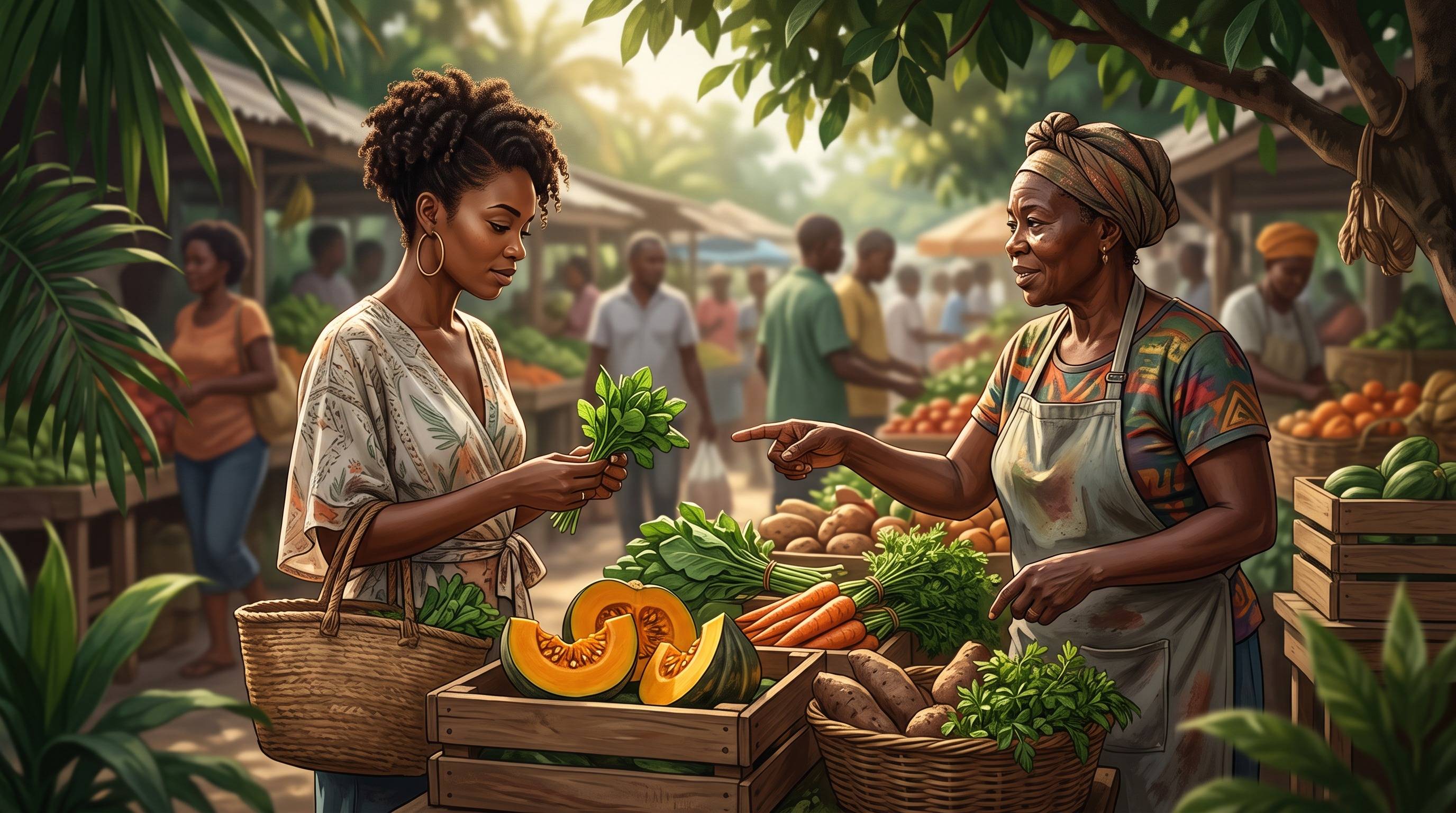
What happens when spiritual principles meet a shopping list, a limited budget and the food available close to home?
A trip to the market begins long before the food reaches the table. There may be a list on the kitchen counter, money counted carefully, a bus to catch and a decision about which seller to visit first. At the market, the choices continue: which greens look fresh, how much produce can be carried home, and whether the price leaves enough for the rest of the week’s meals.
For someone who follows an Ital way of eating, those decisions can also be connected to spiritual beliefs and a relationship with the natural world. The shopping basket is a place where daily life and deeper values meet.
But there is no single Ital shopping list that speaks for every Rastafari person. People live in different places, follow different practices and make decisions within different circumstances. A grower in rural Jamaica, a cook shopping in Kingston and a family in London or the United States may approach food in related but distinct ways.
This article takes a closer look at those choices, the people and labor behind the food, and the practical questions that arise when ideals meet the realities of time, access and money.
Before the basket: what Ital can mean
Food, life and spiritual purpose
Ital is a Rastafari concept often associated with fresh, plant-centered food and a concern for life. For many people who practice it, Ital eating is connected to spiritual principles rather than simply a preference for a particular menu.
The meaning can reach beyond the ingredients in a dish. A person may care about how food is grown, how it is prepared, what has been added to it and the relationship between nourishment and the wider living world. Another may emphasize sharing food, supporting a grower or paying attention to the body. These concerns overlap, but individuals do not necessarily explain them in identical terms.
Joseph Powell’s research with Rastafari in Jamaica and the United Kingdom examines the theological foundations of dietary practice. The people in his study generally described predominantly plant-based ways of eating, although some reported consuming certain animal products at times. The findings describe the people who participated; they should not be turned into a universal rule for every Rasta household. Read Powell’s study.
That distinction is important when outside descriptions offer a simple answer to a complicated question. Some people avoid salt; others make different choices. Some avoid particular packaging or processed ingredients; others weigh those concerns against what they can obtain. If a meal is offered, the most reliable guide is to ask the person who will be eating it about their own preferences.
Ital and vegan are related, but not identical
A vegan meal can be entirely plant-based without being prepared or understood as Ital. The word vegan generally describes the exclusion of animal products; Ital carries a Rastafari history and, for many practitioners, spiritual meanings about life and creation.
At the same time, it is unhelpful to appoint ourselves judges of someone else’s plate. Commercial menus, family practices and individual understandings differ. Rather than declaring which person is the most authentic, listen to how a cook or diner explains the food they prepare and choose.
For more on the relationship between food and daily discipline, see Reggae Dread’s Ital, Livity & Clean Living. The market adds another part of that conversation: how a person gets from a principle to a meal when prices, transport and time all matter.
Walking through the market

The first question: what is available?
Imagine an illustrative shopping trip. A person has come for ingredients for several meals and finds leafy greens, pumpkin, carrots, onions, fresh herbs and dried beans. There are other choices too, but not everything looks equally fresh or fits the budget. The shopper pauses, compares and begins to adjust the original list.
This is an example, not an account of a particular Rastafari shopper. Its purpose is to make the decisions visible. Someone choosing food is not merely selecting items from a spiritual checklist. They are working with the season, the seller’s stock, the distance home and the needs of the people who will eat.
A fresh bunch of greens may become lunch with rice one day and part of a larger stew the next. A firm piece of pumpkin may be useful because it can stretch across several meals. A small amount of herbs may add flavor when a household chooses to use less salt or none at all. These are possibilities, not requirements.
Food writer Riaz Phillips has written about Caribbean natural eating and the people behind it, including a Jamaican market vendor he met while reporting. His Wellcome Collection essay places food within histories of migration, belief and commercial change. It reminds us that every market conversation happens within a wider story.
Questions a shopper might ask
The questions will differ from person to person and place to place, but a trip to a market can involve decisions such as these:
- Freshness: Will the food be used before it spoils, and how will it be stored?
- Price: Can this ingredient be bought without sacrificing another household need?
- Source: Is there an opportunity to learn who grew it or how it reached the seller?
- Preparation: Does the household have the time, equipment and fuel needed to prepare it?
- Personal practice: Does the item fit the shopper’s understanding of Ital and the needs of the people eating?
- Sharing: Can some of the food be used for a neighbor, guest or family member?
These are not conditions someone must satisfy to call a meal Ital. They are examples of the kinds of practical and ethical questions a person might consider while shopping.
A market is made of people
Behind each pile of produce are growers, transport workers, market vendors and others whose labor is often overlooked. The seller may have arrived early, paid for transportation, arranged the stall and spent hours answering questions while trying to earn enough to return the next day.
Buying from a local seller can be a way to build a relationship, but it should not be romanticized. Vendors need fair prices and reliable customers. A shopper with a limited income also needs food they can afford. Both realities deserve attention.
A useful conversation might begin with a simple question: what is especially good or plentiful this week? The answer can help a customer discover a new ingredient while respecting the seller’s knowledge. Not every exchange has to become an interview; people are at work, and their time has value.
When the ideal meets the budget

Good intentions still need money
Discussions about conscious eating often assume that everyone can shop at the same places. In practice, a household may have one nearby store, an irregular work schedule or limited transportation. Food prices can change, and an ingredient that is affordable in one place may be expensive somewhere else.
A person may want produce grown a particular way and still need to choose a less expensive option. They may prefer to buy from a market but rely on a neighborhood shop because it is within walking distance. They may cook from scratch when time permits and use a convenient ingredient when it does not.
These choices should be understood in context. There is no dignity in telling a family that care for life is available only to people who can afford premium groceries. A serious conversation about food should ask why access differs, whose labor is undervalued and what communities need in order to feed themselves well.
It should also make room for pleasure. A meal is not only a calculation of prices and principles. People enjoy familiar flavors, experiment with a new ingredient, laugh while cooking and remember the dishes associated with home.
Buying for more than one meal
One practical approach is to think about ingredients that can serve several purposes. The exact choices depend on personal practice, local availability and dietary needs, but the following example shows how a flexible list might work:
- A staple: rice, oats or another grain the household uses.
- A protein source: dried or canned beans, peas or lentils, prepared according to safe cooking instructions.
- Vegetables: a combination suited to the season, budget and storage available.
- Flavor: fresh herbs, onion, garlic or other seasonings the cook prefers.
- Fruit: whatever is accessible and likely to be eaten before it spoils.
A cook could use some vegetables in a soup, add others to a grain dish and save the remaining ingredients for another meal. The point is flexibility rather than a fixed formula. For households managing allergies, medical conditions or particular nutritional needs, individual advice from a qualified professional can be useful.
Fresh, frozen, dried or canned?
Fresh food is central to many understandings of Ital, but access is not equal. A shopper may find that frozen vegetables are easier to store, dried beans cost less per serving, or canned foods are the only practical option for a busy week. Whether an item fits a person’s food practice is a decision for that person.
Powell’s research describes participants in the United Kingdom discussing the difficulty of finding some foods readily available in Jamaica; preserved versions could present an additional question for people who avoid canned foods. That observation concerns the participants in that study, not all Rastafari shoppers in Britain.
Labels can help a shopper decide. They may reveal added salt, sweeteners, preservatives or other ingredients a household prefers to avoid. A label does not tell the whole story of how food was grown or what it means to a person, but it can provide useful information at the shelf.
The goal is informed choice, not a contest in purity. There are circumstances in which the most accessible food is the food a family needs to use. Listening begins by allowing people to explain their own decisions.
From the market to the table

An example of a flexible pot
Picture a household preparing a simple vegetable-and-bean stew. The cook begins with onion, garlic and herbs, adds vegetables that need longer cooking, and then adds properly cooked beans and enough liquid for the desired texture. Softer greens can go in later. Rice or another staple might be served alongside.
This is an illustrative idea, not a claim that there is one traditional Ital recipe. The cook might use coconut milk, different vegetables, more pepper or no pepper at all. Some households will season without salt; others will make another choice. Ask guests what they eat and what ingredients they avoid.
The choices made while cooking carry forward the questions raised at the market. How much food is needed? Who is coming to eat? Is there enough time to cook safely? Can leftovers be cooled and stored appropriately for another meal?
Perhaps someone in the household prefers a different dish. A shared meal does not require everyone to have identical beliefs. It may involve cooking separate components, setting aside a portion or having an honest conversation about what is possible. Respect is expressed through attention to the people at the table.
Who does the cooking?
The market is only one stop in the food journey. Someone carries the bags, washes the produce, plans the meal, cooks and cleans up. When a family speaks about the meaning of a shared table, it is worth asking how that work is divided.
Rastafari women have contributed knowledge, labor and leadership to families and communities, but those contributions should not be treated as proof that women are naturally responsible for feeding everyone else. People make different arrangements, and women have also challenged expectations that limit their choices.
The question can be practical: who has time to cook tonight? It can also open a wider discussion about fairness, recognition and whether each person’s needs are being heard. Livity is lived through relationships, and relationships include the work that is easy to overlook.
Passing knowledge from one generation to another
Food memories often live in details that are missing from a written recipe: how an elder knew a fruit was ready, which herb was added at the end of cooking, or why a particular dish mattered at a gathering.
Ask a willing relative or friend to explain a food they remember. What was available where they grew up? Who taught them to prepare it? Has the dish changed since they moved or started a family? With permission, record the answers and the cook’s own description of the ingredients.
The purpose is not to claim that one person’s method represents every community. It is to preserve the knowledge of a particular person, in a particular family and place. That specificity is what makes the story valuable.
Food choices are also community choices
Looking beyond the individual shopper
It is easy to talk about food as if every choice belongs entirely to an individual. Yet a shopper’s options depend on growers, transportation, land, wages, markets and public decisions. A household cannot buy affordable fresh produce if none is available nearby, and a grower cannot continue if the work cannot support a livelihood.
Those questions matter in Jamaica and throughout the diaspora, though the details are different in each place. A neighborhood market can be a source of food, employment and connection. A community garden can make space for learning and growing, even if it cannot provide everything a household needs.
Supporting those efforts may include purchasing from local growers when possible, listening to vendors, sharing surplus food or asking local organizations what help they actually need. None of these actions substitutes for addressing larger inequalities. They are ways to begin paying attention to the systems that make a meal possible.
The connection to livity
Ital is often most visible to outsiders when a finished plate appears in a photograph. The market shows another view. Before the plate comes a series of decisions made in relationship with growers, vendors, family members, money and time.
For a Rastafari person, those decisions may be part of a spiritual commitment to honor life. For another, the emphasis may fall differently. The meaningful question is not whether an observer can identify a perfect basket. It is what the food, the choices and the relationships mean to the people involved.
Frequently asked questions
Is all Ital food vegan?
Many Ital meals are plant-based, and some practitioners avoid all animal products. Individual Rastafari practices differ, so it is best to ask about the particular cook’s or diner’s choices.
Does Ital food always avoid salt?
Some people avoid added salt, while others make different decisions. A recipe or a restaurant menu cannot speak for every Rastafari household.
Does Ital food have to be expensive?
No single price or shopping method defines it. Staples, seasonal foods and shared meals can help some households manage costs, although access and prices vary considerably.
Can I prepare a meal for a Rasta guest?
Ask the guest what they eat, which ingredients they avoid and whether there are preparation preferences you should know about. A respectful question is more useful than assuming all Rastafari follow the same rules.
How can I learn more?
Listen to Rastafari cooks and growers, read their work, and seek out sources that explain the spiritual and historical context. Support their businesses and credit their knowledge when you share what you learn.
The next time we go shopping
A market basket holds more than a collection of ingredients. It reflects the work of people who grew and sold the food, the choices available to the shopper, and the needs of the household waiting at home.
When we consider Ital in that setting, we can see why food cannot be separated from faith, history, economics and community. The conversation begins with what is on the stall, but it continues through the preparation of the meal and the people who gather to share it.
Food belongs in that conversation. So do the voices of the people whose traditions and labor give it meaning.
Sources and further reading
- Joseph Powell, “Ital Hermeneutics: The Innovative Theological Grounding of Rastafari Dietary (Ietary) Practices”, Black Theology, 2021. Based on interviews and observations in Jamaica and the United Kingdom; access may depend on the publisher.
- Riaz Phillips, “Natural eating in Jamaica and the Caribbean”, Wellcome Collection, 2022.
- “Ital, Livity & Clean Living: Food as Discipline in Rastafari”, Reggae Dread.
- Joseph Powell, Stepping in Iration: Rastafari Ital Livity, Ecologies and Ecotheologies in Saint Lucia/Iyanola, University of Cambridge, 2022.