Burning Spear Biography Part 7 Grammy Era & Global Recognition

🔥 Introduction: The Messenger Becomes a Monument
Throughout the 1970s and 1980s, Burning Spear never chased awards, fame, or institutional validation. His mission was too serious, too sacred, too rooted in history and struggle to be evaluated by mainstream industry standards. But by the time the 1990s arrived, the world outside the reggae community began to understand what fans had long known — that Winston Rodney was one of the greatest musical and cultural figures of the 20th century.
In this era, Burning Spear earned multiple Grammy nominations and eventually two Grammy wins. But the awards themselves were only symbols. The real story was the worldwide acknowledgment of his truth — and the recognition of his decades-long commitment to Garveyism, African identity, and spiritual liberation. In a world overflowing with noise, the Spear had cut through.
Part 7 chronicles the decades when Burning Spear transitioned from under-recognized prophet to global elder — not by changing for the world, but by holding steadfast until the world changed for him.
🏆 First Grammy Nominations: Validation Without Corruption
Burning Spear received his first Grammy nomination in 1986 for the album Resistance, released during the early years of his independent label. This nomination was significant for several reasons:
- It recognized an album Spear produced outside the major-label system
- It acknowledged that roots reggae was not fading — it was advancing
- It validated Spear’s decades-long commitment to message over marketing
The nomination did not change Spear’s philosophy. Interviews from the era highlight his calm, almost detached response. Awards were peripheral. Work — steady, sacred, uncompromising work — was the true measure of a messenger.
🌍 Global Touring Expands the Audience
Through the 1990s, Burning Spear’s touring intensified and expanded. This global visibility played a major role in the industry’s growing recognition of his contributions. Large festival audiences saw him for the first time. Journalists wrote long-form essays calling him “the voice of the ancestors.” Universities invited him for cultural talks.
Key factors in his expanding influence:
- Consistent high-quality live performances
- Independent touring model that reached underserved regions
- Growing interest in African history and diaspora identity
- The reemergence of roots reggae as a global genre
📀 Albums of the Grammy Era
The 1990s and 2000s were marked by a series of critically acclaimed albums that displayed both continuity and evolution in the Spear sound.
🔥 Mek We Dweet (1990)
A powerful affirmation of African pride and solidarity, “Mek We Dweet” displayed an energetic and confident Burning Spear. Tracks like “African Woman,” “One People,” and “Columbus” showed Spear's ability to blend historical critique with modern production values.
🔥 Jah Kingdom (1991)
This album offered deeper spiritual reflection, exploring themes of faith, discipline, and moral clarity. It presented Spear as a guardian of ancestral truth — a voice that sought not admiration, but awakening.
🔥 The World Should Know (1993)
This record continued to expand Spear’s global message. Its assertive tone — both musically and lyrically — announced that the message of Garveyism was not merely Jamaican culture, but world culture.
🔥 Spirited (1997)
A profoundly meditative album recorded during mature years, “Spirited” felt like a sonic temple. Critics praised its spiritual weight, describing it as “scripture in sound.”
🔥 Calling Rastafari (1999)
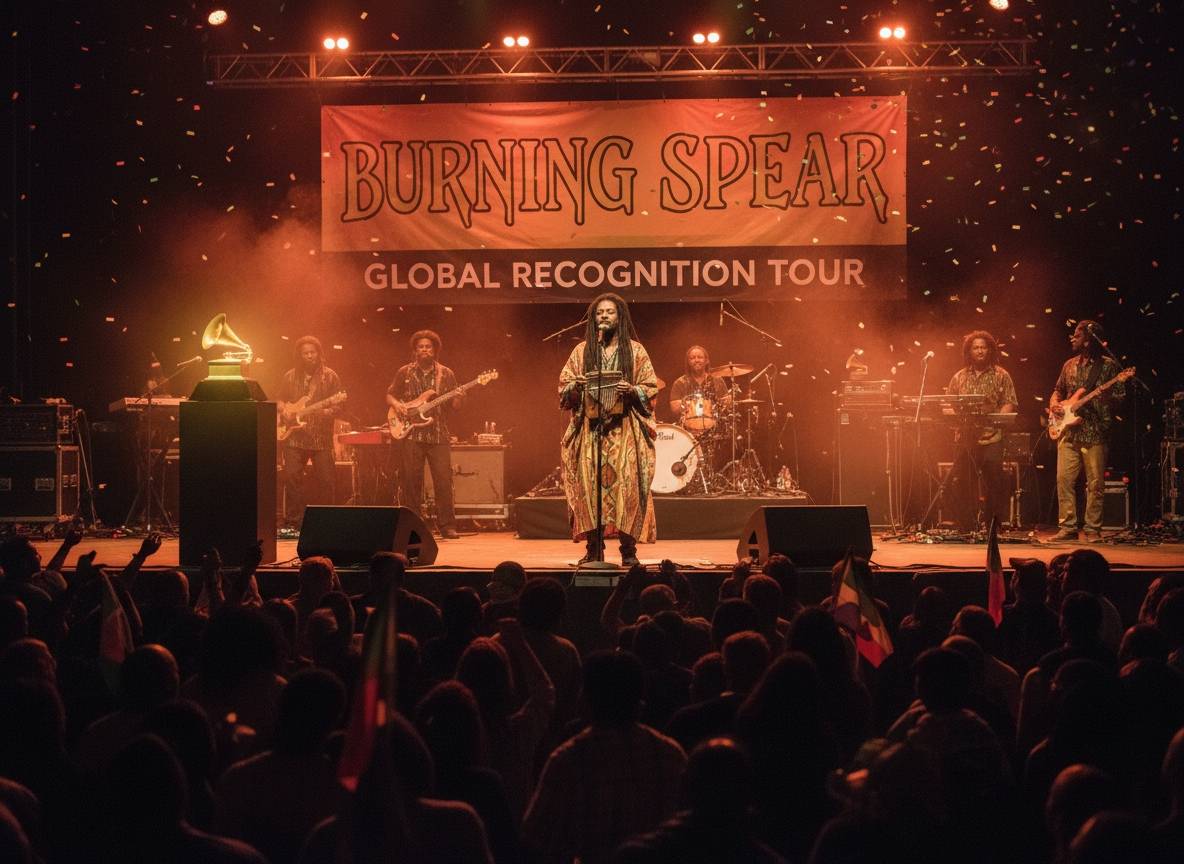
This album marked a turning point. With its rich arrangements and ceremonial energy, “Calling Rastafari” earned Burning Spear his first Grammy Award.
The honor was historic — not because it elevated Spear, but because it elevated the message.
🏅 The First Grammy Win: Calling Rastafari (1999)
When Burning Spear won his first Grammy for “Calling Rastafari,” it was a watershed moment for roots reggae. For decades, the deeper, message-centered artists had been largely overshadowed by commercial reggae or lighter crossover acts. But the Grammy win made an unmistakable statement:
“The world is ready to remember its history.”
During interviews, Spear made it clear that the award did not change him. If anything, it reinforced his independence. He declined to attend the award ceremony, preferring to stay grounded in work. To him, a Grammy was acknowledgment, not mission.
📣 Media Recognition & Academic Respect
By the 2000s, Burning Spear had become a subject of academic research, scholarly essays, and cultural conferences. Anthropologists, musicologists, and historians frequently quoted his interviews and lyrics. University libraries categorized his albums as essential texts in courses on:
- African diaspora studies
- Postcolonial history
- Rastafari philosophy
- Cultural resistance movements
- Reggae and global musicology
Many major newspapers and magazines — The New York Times, Rolling Stone, The Guardian, and academic journals — published in-depth profiles praising him as a “global elder” and “keeper of the ancestral archive.”
📀 The Second Grammy Win: Jah Is Real (2009)
Ten years after his first Grammy, Burning Spear received his second major award for the album “Jah Is Real”. Recorded with Spear in full control of production through his independent label, this album blended traditional roots power with modern clarity.
“Jah Is Real” is notable for its:
- Masterful vocal warmth
- Refined horn arrangements
- Lyrical maturity
- Celebration of spiritual discipline
- Unshakeable grounding in Garveyite thought
The second Grammy win affirmed what Spear’s followers already understood — the messenger was not only consistent, but increasingly formidable.
🌍 Cultural Honors, Awards & Lifetime Recognition
Academic Invitations
Universities in the United States, Europe, and Africa frequently invited Spear for lectures, discussions, and cultural panels. Even though he rarely accepted, the invitations themselves reflected his status as a thinker, not merely a musician.
National Awards in Jamaica
Jamaica honored Spear with several cultural distinctions, acknowledging him as:
- A national treasure
- A global ambassador of reggae
- An educator and historian through music
His Garvey-centered message resonated especially deeply in Jamaican intellectual and cultural circles.
International Honors
Spear’s global influence earned him recognition from African governments, Caribbean institutions, and diaspora cultural organizations. He became a symbol of historical preservation.
📡 Why Recognition Took So Long
Many wonder why Burning Spear — one of the most respected figures in world music — did not receive major awards earlier. The reasons are complex:
- He never compromised his message for commercial appeal
- He rejected industry gatekeeping
- Roots reggae was marginalized during the dancehall-dominant era
- Spear’s work is philosophical, not mainstream entertainment
- He refused to play industry games or seek favor
But over time, the world caught up to Spear — not the other way around.
👑 The Meaning of Awards to the Messenger

Burning Spear acknowledged awards, but never centered them. In interviews, he always expressed gratitude while quietly reminding interviewers that external validation was not his compass.
“Awards don’t make the work. The work make the awards.”
To Spear, trophies and ceremonies were simply reflections — never destiny.
💬 Influence on Future Generations
The Grammy era solidified Spear’s impact on artists across genres:
- Roots revivalists (Chronixx, Protoje, Midnite/Akae Beka)
- Conscious hip-hop (Dead Prez, Talib Kweli, Mos Def)
- World music innovators (Angelique Kidjo, Baaba Maal)
- Reggae elders (Steel Pulse, Israel Vibration)
Unlike many artists whose influence fades with age, Spear’s influence expanded as he grew older. Younger artists saw him not as a relic, but as a north star.
📌 Summary: The Messenger Crowned by the World
The Grammy era represents the decades when the globe officially recognized Burning Spear’s unmatched contributions to culture and history. This era saw him transform from an outsider within the industry to a widely acknowledged elder — not because he changed, but because his truth became unavoidable.
From the 1990s to the 2000s, Burning Spear:
- Earned multiple Grammy nominations
- Won Grammy Awards for Calling Rastafari and Jah Is Real
- Became a central figure in global roots festivals
- Received national and international cultural honors
- Achieved scholarly and critical recognition
These decades elevated Burning Spear from prophet to icon — not by softening his message, but by standing firm.
📎 Transition to Part 8
After securing institutional respect and global acclaim, Spear entered a new frontier — the digital age. How would a message rooted in tradition adapt to the internet era, new technologies, and the changing shape of the music world?
Continue to Part 8: Digital Independence