Once upon a time, Ital was mostly a hillside word—spoken in yards, camps, and modest kitchens where pots of peas bubbled over coal stoves. Today, you can feel its echo in places that may never have heard the word “Rastafari” at all:
- Trendy vegan cafés serving “Caribbean coconut curry bowls.”
- Yoga retreat menus offering plantain, callaloo, and roots stews.
- Plant-based influencers posting one-pot lentil recipes with thyme and coconut milk.
- Global food festivals where Ital-inspired dishes sit beside sushi, tacos, and falafel.
At the same time, modern plant-based movements are booming: vegan restaurants, environmental campaigns, animal rights activism, and celebrity-led wellness brands. Somewhere inside this swirl of green branding and hashtag activism, Ital sits—older, quieter, born from a different fire.
This chapter explores how Ital:
- Traveled with the Caribbean diaspora into cities worldwide.
- Influenced and intersected with global vegetarian and vegan movements.
- Became part of fusion cuisine—for better and for worse.
- Raises urgent questions about credit, appropriation, and respect.
- Offers a blueprint for future food movements grounded in justice, not just trends.
The aim is not to gatekeep Ital, but to see it clearly as both a spiritual practice and a cultural contribution—one that deserves its name when its wisdom feeds the world.

How Ital Traveled: Diaspora Pathways & New City Kitchens
Ital didn’t board planes and ships by itself. It traveled in the bodies, minds, and grocery bags of Rastas and Caribbean people moving across the world:
- From Kingston to London and Birmingham.
- From Spanish Town to Brooklyn, Toronto, Miami.
- From small Caribbean towns to European capitals and African cities.
From Yard to Flat: Ital in Diaspora Homes
In these new locations, Ital had to adapt:
- Yam and breadfruit might be expensive or hard to find.
- Callaloo becomes spinach or kale; gungo peas become lentils or chickpeas.
- Traditional markets are replaced by supermarkets and ethnic grocery stores.
Still, the core livity remained:
- Plant-centered plates with peas, beans, grains, and roots.
- Herb-heavy cooking with thyme, garlic, scallion, ginger, and hot pepper.
- Conscious avoidance of heavy meat, processed foods, and chemical-laced snacks.
A small city kitchen in London could become a yard in spirit when a pot of red peas soup, thyme, and dumplings steamed up the windows. Ital was no longer tied to Jamaican soil alone; it was anchored in memory, practice, and intention.
Ital Shops, Rastaurants & Community Hubs
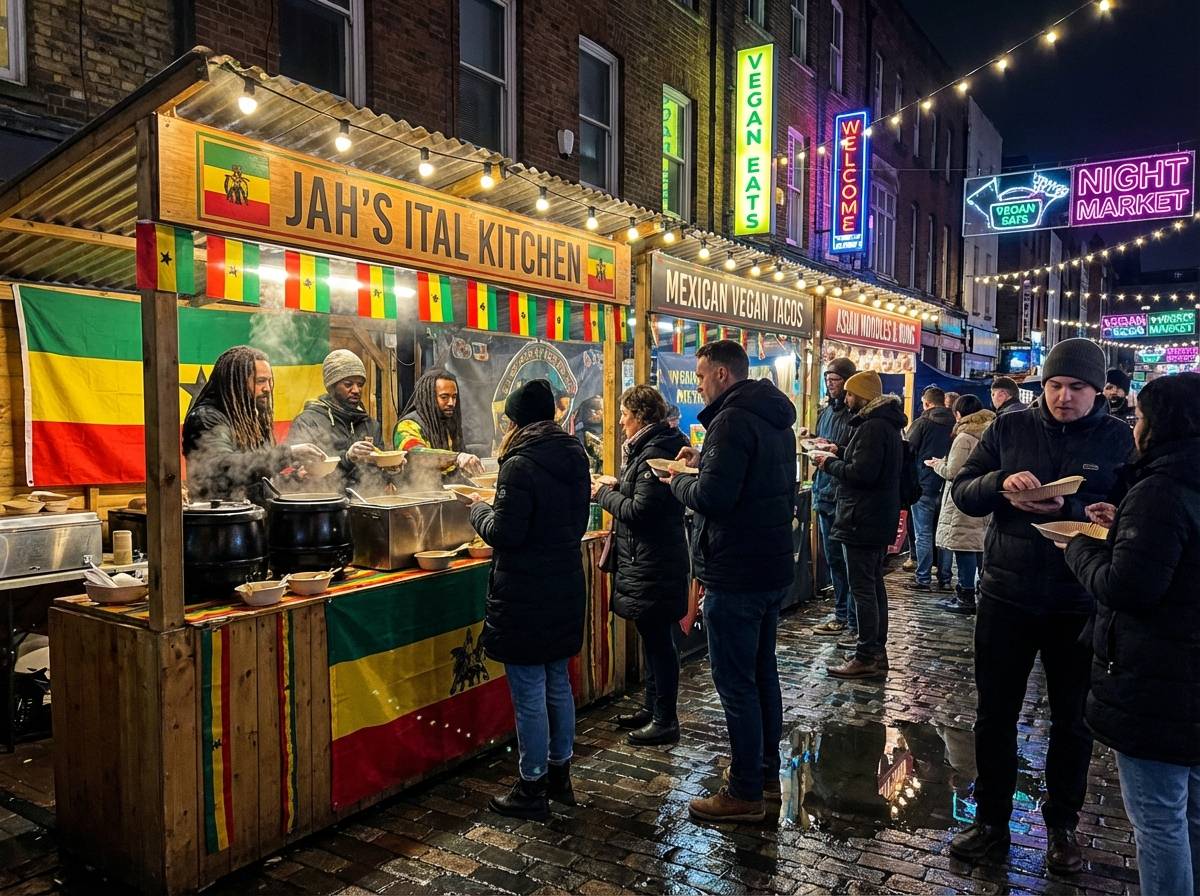
Over time, Ital left the home and entered public spaces in diaspora communities:
- Ital restaurants and “rastaurants” serving stews, patties, juices, and roots tonics.
- Community events where Ital plates were sold beside music, books, and crafts.
- Pop-up stalls at markets, festivals, and reggae shows.
These spaces often functioned as much as cultural centers as food businesses: places to reason, hear roots music, learn Rasta philosophy, and feel a little closer to home—even in the middle of a cold foreign city.
Ital & the Rise of Modern Vegan & Vegetarian Movements
As Ital was spreading quietly through diaspora communities, modern vegan and vegetarian movements were finding their own voice worldwide. Some came from:
- Animal rights and ethical concerns.
- Environmental activism and climate awareness.
- Health and wellness trends, especially among urban professionals.
- Religious or spiritual traditions (Buddhism, Hinduism, etc.).
Shared Ground: Where Ital and Veganism Meet
On the plate, Ital often overlaps with plant-based diets:
- Both emphasize fruits, vegetables, legumes, and grains.
- Both reject heavily processed meat products and high animal fat intake.
- Both can advocate for reduced harm to animals and ecosystems.
In some cities, Ital eateries became early anchors of plant-based food before “vegan” was a mainstream label. People seeking meatless options found themselves in Rasta-owned spaces, tasting Ital stews, juices, and patties—sometimes without even knowing the word Ital.
Different Roots, Different Reasons
Yet, as we explored in Part 2, the motivation behind Ital remains distinct:
- Ital is rooted in Rastafari spirituality, African memory, and resistance to Babylon.
- It critiques not just animal suffering, but colonial food systems, capitalism, and cultural erasure.
- It views the body as a temple and food as a means of keeping spiritual channels clear.
Many modern vegan movements, especially in Western mainstream spaces, are more:
- Brand-driven – products, influencers, and celebrity endorsements.
- Body-image focused – weight loss, aesthetics, and performance.
- Individualistic – centered around personal choice rather than collective liberation.
This doesn’t invalidate their work; it simply highlights that Ital is not just a Caribbean flavor of veganism. It’s its own philosophical and spiritual stream.
Fusion or Confusion? Ital in Global Plant-Based Menus
As plant-based eating became fashionable, chefs and brands began to pull from many traditions—Caribbean, Indian, Middle Eastern, East Asian, African, Latin American— to create “fusion” dishes. Ital-influenced recipes began showing up as:
- “Tropical coconut stew with plantains and beans.”
- “Island-style vegan curry.”
- “Reggae bowl” or “Rasta bowl” on café menus.
When Fusion Honors Ital
Fusion can be beautiful when it:
- Names Ital and Rastafari as inspirations, not just “exotic flavor.”
- Respects the core values of Ital—natural ingredients, minimal processing, spiritual awareness.
- Collaborates with or supports Rasta and Caribbean creators, not just imitates them.
- Acknowledges the history of struggle behind Ital food—plantation rations, resistance, self-reliance.
A chef might say, for example: “This coconut root stew is inspired by Ital cooking from Jamaica and Rastafari traditions.” That one sentence restores the lineage.
When Fusion Erases Ital
Problems arise when:
- “Rasta” themes are used on menus or in décor while no Rasta voices are present or credited.
- Ital-style dishes are relabeled as trendy vegan food with no mention of their origins.
- Caribbean culture is reduced to colors and music while the philosophy behind the food is ignored.
- Black and Caribbean creators are sidelined in favor of “marketable” faces selling similar food.
At that point, fusion becomes confusion—a blurring that benefits businesses but wipes out the names of the people who created the path.
Ital in Environmental & Social Justice Conversations
As conversations about climate change, factory farming, and food justice intensify, Ital’s long-standing concerns with land, life, and Babylon’s food system suddenly sound very contemporary.
Ital as an Early Eco-Conscious Practice
Long before “eco-friendly” and “sustainable” became brand language, Rasta communities:
- Promoted small-scale farming and growing your own food where possible.
- Respected natural cycles of land, seasons, and weather.
- Questioned industrial agriculture and the pesticides, chemicals, and exploitation it brings.
- Encouraged eating lower on the food chain through plant-based plates.
Many modern environmental arguments for plant-based diets echo ideas Ital has carried for decades, but often without naming this lineage.
Food Justice, Access & Community
Ital also intersects with food justice—concern about who gets access to good food and who is left with only unhealthy options. Rasta critiques of Babylon’s food system line up with:
- Campaigns against food deserts in low-income neighborhoods.
- Movements for community gardens and urban agriculture.
- Efforts to support local farmers over massive corporations.
When environmental and plant-based movements acknowledge Ital, they add a Black, Caribbean, and spiritual dimension to conversations that are often dominated by white, Western voices.

Ital in the Digital Age: Content, Creators & Visibility
In the age of social media, Ital has gained both new visibility and new risks. On one side, you see:
- Rasta and Caribbean cooks sharing recipes on YouTube, Instagram, and TikTok.
- Online shops selling Ital seasonings, tonics, and cookbooks.
- Global audiences discovering Ital for the first time and becoming curious.
On the other side, you see:
- Non-Caribbean creators copying Ital recipes without credit.
- Brand campaigns using Rasta aesthetics for marketing while ignoring actual Rasta perspectives.
- Algorithms pushing polished, commercial content over grassroots Ital voices.
Centering Ital Voices Online
To honor Ital in the digital age, audiences and creators can:
- Seek out and follow Rasta and Caribbean Ital cooks and educators.
- Share and credit their work when posting Ital-inspired dishes.
- Support financially when possible—buying their books, merch, or food.
- Link history and recipes together, so Ital is seen as both tasty and meaningful.
In this way, Ital doesn’t just trend—it thrives, with its originators visible and respected.
The Future of Ital in Global Plant-Based Culture
Looking ahead, we can imagine several possible futures for Ital in the global food conversation:
1. Ital as a Named Pillar of Plant-Based History
In this future, mainstream vegan and vegetarian narratives:
- Include Rastafari and Ital alongside other influential traditions.
- Recognize Caribbean contributions to plant-based cooking as equal, not secondary.
- Teach Ital not as a trend, but as a spiritual, cultural, and political lineage.
2. Ital as a Model for Justice-Centered Food Movements
Environmental and health movements could look to Ital for:
- A framework that integrates spirit, body, and liberation.
- Examples of communities using food to resist oppressive systems.
- Proof that plant-based eating can emerge from working-class and oppressed contexts, not just affluent wellness culture.
3. Ital as a Living, Evolving Practice
At the same time, Ital will continue to evolve:
- New generations of Rastas experimenting with global ingredients.
- Diaspora cooks bridging Ital with other ancestral foodways.
- Creative collaborations between Ital practitioners and other justice-minded food movements.
As long as the core remains—natural, life-giving food aligned with livity and resistance to Babylon—Ital can grow without losing its root.
From Global Movements Back to Your Plate: What Comes Next
In this chapter, you’ve seen Ital step onto the global stage:
- Traveling with the Caribbean diaspora into new cities and kitchens.
- Interacting with modern vegan and vegetarian movements—sometimes in harmony, sometimes in tension.
- Appearing in fusion cuisines, raising questions about credit and cultural respect.
- Offering early models of eco-conscious, justice-minded eating.
- Navigating the digital age, where Ital can be amplified or appropriated depending on whose voices are centered.
The big picture is important—but ultimately, Ital still comes back to something very small: the choices you make at the stove, in the shop, and at the table.
That’s why the next chapter turns inward again, focusing not on movements or menus, but on your personal journey.
In Part 11 – “Journey to Ital: Exploring Dietary Choices Step by Step”, we will:
- Map out different paths toward Ital and Ital-inspired eating (from curious beginner to committed livity).
- Help you identify your motivations: health, spirit, culture, environment, or all of the above.
- Offer stepwise transitions—how to move from your current diet into more Ital livity without overwhelm.
- Share reflection prompts so your food journey becomes a conscious, grounded practice.
You’ve seen Ital in history, family life, and global movements. Next, you’ll see it as a path you can walk, at your own pace, one choice and one pot at a time.