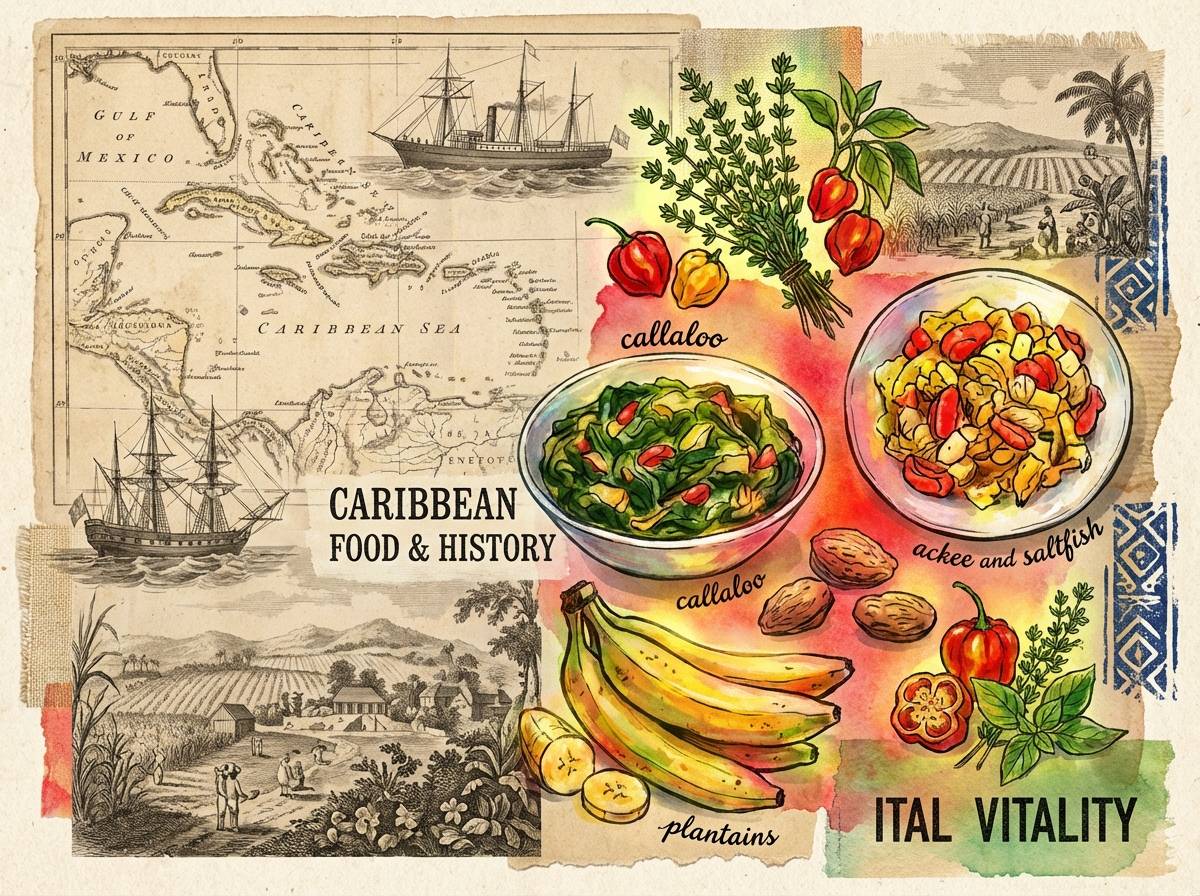
Put two plates side by side and you will see more than recipes—you will see history. One plate might carry roast beef and potatoes, the other rice and peas with callaloo and plantain. Another might be a plain burger and fries, while beside it sits a bowl of pumpkin soup and boiled yam. Each plate answers quiet questions: Who had land? Who had power? Who controlled the ships, the ports, the markets?
Rasta Ital does not just offer a different menu. It offers a different story about how food, empire, and identity intertwine. Where Babylon uses food to control bodies and erase cultures, Ital uses food to remember, resist, and rebuild. To understand cultural food differences through Ital is to see that “normal” food is not neutral—it is shaped by the long shadow of colonialism.
In this chapter, we sit down with the politics on the plate. We’ll explore:
- How empire built global food hierarchies—whose foods were praised, whose were shamed.
- Why Ital calls out Babylon’s “standard” diet as a system, not just a preference.
- How Ital re-centers African and Caribbean memory through roots, peas, and herbs.
- What it means to choose Ital or Ital-inspired eating in a world of cultural appropriation and fast food.
- How your daily meals can become acts of identity, solidarity, and self-definition.
By the end, you’ll see that the question isn’t just “What do you eat?” but “Who wrote the rules for what food is supposed to look like?”

Empire on the Plate: How Colonialism Shaped “Normal” Food
Every culture has its food traditions, but not every culture had the power to declare their food the standard. One of the quiet weapons of empire was the ability to decide:
- What counts as “proper” meals.
- Which ingredients are “civilized” or “primitive.”
- Whose cooking is “peasant food,” whose is “fine dining.”
Plantation Logic and Food Hierarchy
Under plantation systems, the European colonizer’s diet—wheat bread, salted meats, dairy-heavy dishes—was held up as the food of the elite. Enslaved Africans and their descendants were given:
- Rations – salted fish, cheap cuts of meat, flour, sugar.
- Scraps and offal – parts of the animal considered low-status by the master class.
- Low-cost imports – food that was shelf-stable and profit-friendly, not health-centered.
At the same time, many indigenous plants and African foodways were:
- Dismissed as “bush food” or “slave food.”
- Restricted or controlled through land access.
- Erased from official cookbooks and documents.
Over time, a hierarchy of food emerged:
- White flour over ground provisions.
- Imported salted meat over local peas and beans.
- Canned goods over fresh produce from small farms or yards.
These hierarchies did not disappear with formal independence. They linger in the way many people still look down on their own traditional staples while praising Western “standard” meals.
Globalization, Fast Food, and Cultural Flattening
In the 20th and 21st centuries, fast food chains and processed food companies expanded the empire’s reach. Burgers, fried chicken, sugary sodas, and packaged snacks became symbols of modernity and convenience. In many places, you can find:
- A global fast food outlet on the corner.
- Imported packaged snacks in small shops.
- TV ads teaching children to crave foods their grandparents never ate.
Local food traditions, especially those rooted in subsistence agriculture and community cooking, often got pushed to the side. The message—sometimes loud, sometimes quiet—was: “Modern people eat like this now.”
Against this backdrop, Rasta Ital stands out. It refuses to accept Babylon’s version of “normal” and insists that normal can be yam, callaloo, peas, pumpkin, banana, and bush tea.
Ital as a Critique of Babylon’s “Standard Diet”
From the beginning, Ital was not just a personal health choice. It was a critique—a direct challenge to the foods and feeding patterns pushed by colonial and post-colonial systems.
“Babylon Food” vs Ital Food
In Rasta reasoning, people often talk about “Babylon food”:
- Overly salty, sugary, and oily meals.
- Meats full of hormones, antibiotics, and suffering.
- Canned and boxed products with long lists of chemicals.
- Alcohol, sodas, and stimulants that dull or agitate the mind.
Ital food, by contrast, is:
- Close to the earth—roots, fruits, greens, herbs.
- Minimally processed—boiled, steamed, lightly cooked.
- Low in salt and free of synthetic additives.
- Aligned with spiritual clarity and respect for life.
Ital “calls out” Babylon’s food system as a system, not just an individual weakness. It recognizes that when communities are flooded with cheap, unhealthy options and blocked from land and resources, illness is not an accident—it's an outcome.
Food as Consent or Refusal
When a Rasta chooses Ital, it is not just about the fork. It is about consent and refusal:
- Refusing to accept that sickness is inevitable.
- Refusing to let colonizer foods define what a “proper meal” looks like.
- Refusing to feed the body with what feels spiritually dead.
- Consenting instead to an older, earth-based knowledge of nourishment.
In this sense, Ital is a form of quiet protest. It does not need a sign or a march; it uses the pot as the protest banner.
Food and Identity: Who Are You at the Table?
Food is one of the most intimate ways culture lives in the body. The smell of a stew, the feel of boiled yam on the tongue, the way your hand reaches automatically for lime or hot pepper—these are small rituals of identity.
Carrying Africa in the Pot
For African-descended people in the Caribbean and diaspora, many traditional dishes are fragments of Africa remixed under slavery and survival. When you:
- Cook peas and rice with coconut and thyme.
- Steam callaloo with garlic and scallion.
- Boil green banana and serve it with pumpkin or ackee.
You are participating in a long, creative act of cultural survival. A Rasta Ital meal makes this especially visible by doubling down on:
- Ground provisions instead of imported flour and pasta.
- Peas and beans as the main protein instead of foreign meats.
- Herbs and bush teas as medicine instead of pharmacy pills alone.
Ital turns African memory from background flavor into the main storyline of the plate.
Hybrid Identities and Mixed Plates
Many people today live in hybrid cultures: Caribbean in a North American city, African in Europe, Latin American in Asia. Their daily menus might include:
- Yard-style food on weekends.
- Fast food or cafeteria meals during workdays.
- Global fusion experiments at home.
Ital does not demand that everyone move to a hillside farm overnight. But it offers a question: “Which parts of your food story are truly yours, and which were handed to you by systems that don’t love you?”
Each time you choose to:
- Cook peas instead of buying processed meat.
- Boil yam instead of ordering another burger.
- Season with thyme and scallion instead of relying only on bottled sauces.
you tilt your daily identity slightly back toward roots and away from empire.
Appropriation, Erasure & the Ital Contribution
As global plant-based movements grow, many dishes that resemble Ital food appear on menus and in cookbooks: coconut stews, vegetable curries, one-pot bean dishes, “Caribbean-inspired” bowls. This can be a bridge—or a problem.
When Ital Is Borrowed Without Its Name
Problems arise when:
- Ital flavors are used, but Rastafari is never mentioned.
- Caribbean plant-based traditions are rebranded as generic “tropical vegan recipes.”
- Chefs and influencers profit from Ital-inspired dishes without acknowledging the movement that carried them.
This is a form of cultural erasure. It takes the labor, creativity, and spiritual discipline of Rasta communities and turns it into anonymous “content.”
How to Engage Ital Traditions Respectfully
If you are inspired by Ital cooking, you can:
- Name the source: Call a dish “Ital-inspired” when it clearly draws from this tradition.
- Learn the context: Read, listen, and reason about Rastafari history and livity.
- Credit the culture: Especially if you are monetizing recipes or teaching others.
- Support living communities: Buy from Rasta-owned establishments, farmers, and creators when possible.
Respectful engagement turns food into a bridge rather than a theft. It acknowledges that Rasta Ital diet is not just a Pinterest trend but a living spiritual practice born in struggle.
Reading Cultural Food Differences Through an Ital Lens
Once you start seeing food through Ital eyes, cultural differences on the plate become deeper than “spicy vs mild” or “rice vs bread.” You begin to read each meal as a text.
Questions You Can Ask Any Plate
Take any dish in front of you and ask:
- Where did these ingredients come from? – Land, sea, factory, lab?
- Who historically ate this food? – Rulers, laborers, enslaved people, farmers?
- What systems keep this dish possible? – Local farms, global shipping, corporate contracts?
- What’s missing that used to be there? – Herbs, roots, whole grains replaced by quick substitutes.
- How does this food treat the body? – Heavy, light, clear, dull, jittery, grounding?
Viewed this way, cultural food differences are not about superiority but about storylines that have been running for centuries.
Ital’s Questions Back to Babylon
Ital asks Babylon’s standard diet some hard questions:
- Why should food that makes people sick be called “normal,” and food from the earth be called “alternative”?
- Why do low-income communities have so much processed food and so little fresh produce?
- Who benefits when people are too tired and foggy to think clearly about their conditions?
These are not conspiracy theories—they are honest inquiries about power, profit, and health. Ital does not claim to solve everything, but it refuses to pretend that food choices live outside of politics.
Your Plate as a Practice of Identity & Alignment
You may not be able to control every ingredient or situation—especially if you live in a food desert, work long hours, or share space with people who don’t share your values. But within those limits, you still have small zones of choice.
Small Ital-Inspired Shifts with Big Meaning
Even modest changes can become powerful identity practices:
- Choosing peas and beans more often in place of processed meats.
- Adding ground provisions and greens to your weekly rotation.
- Replacing one sugary drink a day with bush tea or water with lime.
- Seasoning more with thyme, scallion, garlic, and ginger instead of only bottled sauces.
- Setting aside one day per week for an Ital-style meal in honor of roots and livity.
None of these steps demand perfection. They simply move you closer to a plate that carries your values instead of Babylon’s convenience.
Food as a Daily Mirror
Over time, your plate becomes a mirror:
- Are you eating by default or by intention?
- Are you repeating inherited patterns or choosing new ones?
- Are you feeding only the body, or also your sense of history and purpose?
The Rasta Ital lifestyle invites you to check that mirror gently, without shame but with honesty. Some days you may eat far from your ideal. Other days you may feel proud of how closely your food matches your spirit. Both are part of the path.
From Cultural Differences to Daily Practice: What Comes Next
In this chapter, you’ve seen that food is never just flavor:
- Empire used rations, imports, and food hierarchies to shape what was considered “proper” or “poor” food.
- Rasta Ital diet emerged as a critique of this system, reclaiming roots, peas, and herbs as power.
- Every plate tells a story about land, labor, culture, and identity.
- Appropriation and erasure happen when Ital’s contributions are used without its name and context.
- Your own food choices can become quiet acts of remembrance, respect, and self-definition.
The next step in this series brings the conversation even closer to home: how do you translate all of this—history, politics, culture—into practical healthy eating in the middle of a busy, modern world?
In Part 8 – “Healthy Eating Tips: Living Ital in a Modern World”, we will:
- Break Ital principles into realistic, step-by-step habits for everyday life.
- Offer time-saving strategies for people juggling work, family, and responsibilities.
- Explore how to shop, cook, and eat Ital-inspired meals even in non-Caribbean or urban settings.
- Share mindset tools for staying committed without falling into guilt or all-or-nothing thinking.
You’ve seen the cultural and political layers. Next, we bring Ital down to the breakfast table, the lunch break, and the late-night kitchen—where real change begins, one plate at a time.