Review scope. This is a research-based buying review and reading guide, using the listed edition, publisher catalogue and museum resources. The complete book was unavailable; prose, references and accuracy across all chapters were not tested. The advertised overlap is verified, but full texts were not compared.
The verdict: a useful pairing, with a buying caveat
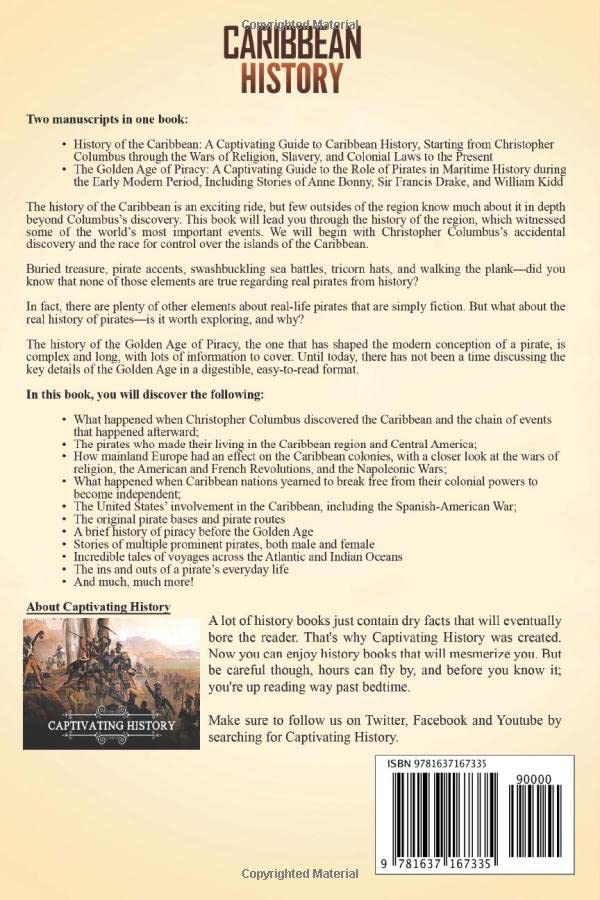
Caribbean History: A Captivating Guide to the History of the West Indies and the Golden Age of Piracy has an appealing proposition: use a regional history to establish the setting, then follow a more focused maritime subject. For a reader who wants an introduction to the Caribbean and also wants to investigate piracy, that combination is worth considering. Its strongest buying argument is the pairing itself; this assessment does not establish the quality of the complete text.
The important caveat concerns another book in our Amazon reading list. This volume advertises two manuscripts, one called History of the Caribbean and the other The Golden Age of Piracy. The first bears the same full title as the standalone Captivating History book reviewed separately here. Readers should therefore expect substantial subject overlap rather than assume that buying both provides two independent regional surveys. We have not compared their complete texts or checked whether particular editions contain revisions. [1]
Our recommendation is conditional but practical: consider this combined book if both subjects interest you; consider the standalone regional volume if piracy is a secondary interest. Either choice should begin a reading journey. A compact overview cannot carry every island, language, political experience and historical debate with equal depth.
What the listed edition actually promises
| Detail | Verified information |
|---|---|
| Credited author | Captivating History |
| Amazon product identifier | 1637167334 |
| Print ISBN | 9781637167335 |
| Listed paperback | 220 pages; publication date 1 November 2022 |
| Contents advertised | A Caribbean history manuscript and a Golden Age of Piracy manuscript |
These details come from the listed product page. [1] They identify the edition being discussed, rather than every format or future reprint. The page count is useful as a measure of the space available: this is a short combined introduction, so a buyer should not expect the scale of a multivolume regional history.
A two-part book also creates a structural question. Does the piracy section develop connections introduced in the regional section, or does it begin again with its own background? The listing establishes the combination, but it cannot answer how smoothly the manuscripts work together. Use any available sample to inspect the transition and the contents pages before making that a reason to purchase.
Images: the edition and its wider context
The cover above and the three images below provide visual references for the reading guide. Captions distinguish product artwork from historical and educational context. Context images are separate from the book’s interior pages.

Credit: Library of Congress, Geography and Map Division.
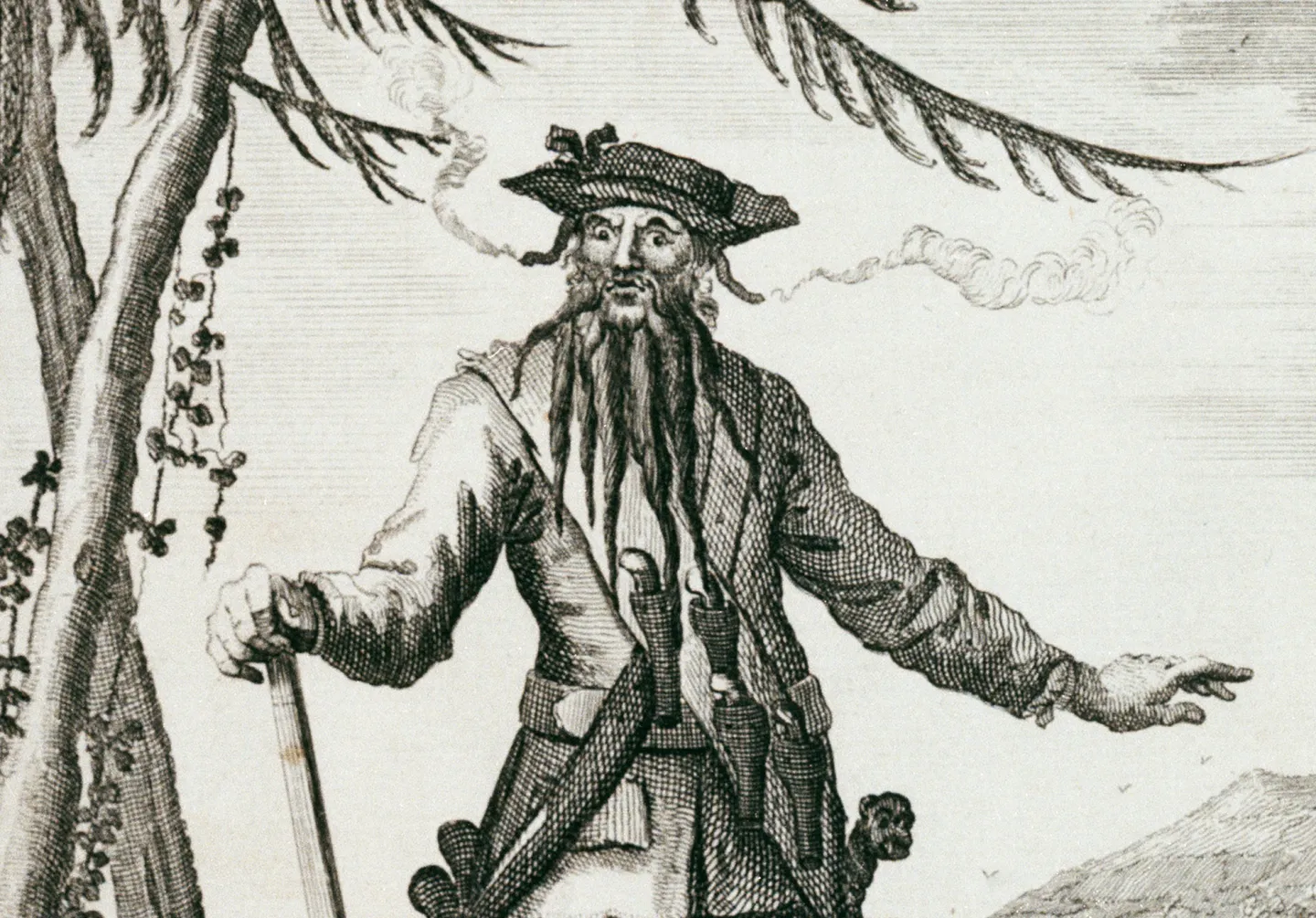
Credit: National Maritime Museum, Greenwich, London; PBE0598.
Related museum lecture; separate from the book
Watch: Pirate Queens with Dr Rebecca Simon
Royal Museums Greenwich links this recording of Dr Rebecca Simon’s lecture on Anne Bonny and Mary Read. It adds a focused Caribbean piracy discussion to the combined volume’s advertised subject pairing.
 Play on YouTube ↗
Video preview: Royal Museums Greenwich. Original source.
Watch on YouTube ↗ · Published by Royal Museums Greenwich. Use this link if the embedded player does not open.
Use the lecture alongside your source notebook. Which statements rest on dated records, which involve interpretation, and which remain uncertain? Compare one claim with a passage and citation in the book after reading it.
Read the West Indies as a region of distinct experiences
A broad history becomes more useful when the reader keeps a map beside it. Make a habit of asking which island, coast or imperial jurisdiction a passage concerns. A statement about one territory should not silently become a statement about the entire Caribbean. The same applies to dates: events that happen close together are not necessarily stages of one shared national story.
The regional manuscript's title foregrounds Columbus, European conflict, slavery and colonial law. That provides a clear advertised route into the subject. [1] The reader's task is to keep asking how the narrative distributes attention. Which people make decisions? Who works? Who is displaced? Who leaves records, and whose experiences must be reconstructed from records written by others?
One helpful companion is the Smithsonian's Taíno gallery guide, which addresses Native heritage and identity as a living Caribbean subject. [3] Place that material alongside the introduction rather than treating European arrival as the beginning of Caribbean existence. This is a suggested reading approach, not a finding that the unseen manuscript omits Indigenous history.
For Reggae Dread readers, the value of regional orientation lies in becoming more precise about place and historical context. A reference to the Caribbean is not automatically a reference to Jamaica, and a reference to Africa is not automatically a reference to one society. Better geographical habits make later cultural reading more attentive.
The piracy section needs an economic setting
The piracy manuscript is the reason this combined edition stands apart from the standalone regional title. The useful question is not simply which famous captains appear. It is whether the reader comes away better able to connect maritime violence with the movement of goods, the exercise of state power and the people forced into those systems.
Royal Museums Greenwich places the commonly named Golden Age in the 1680s–1720s and describes activity extending beyond the Caribbean. Its account also cautions against a comfortable liberation story: pirates attacked slave-trading ships and commonly sold enslaved captives rather than freeing them. [4] That context matters when assessing any entertaining introduction to piracy.
An engaging captain's biography can be a useful doorway, but it should lead to harder questions. What was aboard a captured vessel? Who owned the cargo? What happened to crew members and captives? Where could stolen goods be sold? What did merchants, officials and coastal communities gain or lose? Asking these questions prevents a reading notebook from becoming only a list of colourful personalities.
The book's combined format could support that shift if the reader deliberately connects the two halves. When a maritime episode appears, return to the regional notes and identify the relevant political setting. This is an opportunity created by the subject pairing; the complete book would need to be read before we could judge how consistently its prose makes those connections.
Distinguish a memorable story from strong evidence
Piracy is a particularly good subject for practising source criticism because an exciting account can survive long after its evidential basis has become uncertain. Royal Museums Greenwich discusses the influence of early newspapers and the 1724 pirate history associated with Captain Charles Johnson, while warning that sensational accounts helped shape later popular images. [4]
Keep three kinds of statement separate in your notes: an event supported by a record, an interpretation offered by a historian, and a story presented with acknowledged uncertainty. These categories need not compete. Interpretation gives facts meaning; uncertainty can make a subject more interesting. Trouble starts when a vivid anecdote is repeated as a settled event without explaining its source.
The distinction between a pirate and a privateer also deserves attention. A privateer operated under a state's commission against designated enemies, whereas piracy was not the same authorised activity. [4] When a narrative uses either term, record the date, the authority claimed and the evidence offered. A person's reputation alone cannot settle the question.
During a sample check, look for citations close to substantial claims and a bibliography that identifies works you can pursue. We cannot grade those features in this complete edition. They are the most useful features for a reader to inspect because they determine whether the book can support further study after the introductory narrative ends.
What is attractive, and what remains untested
The verified strength of the package is its clear subject pairing. A reader does not need to commit to two unrelated titles to begin exploring regional history and maritime history together. The format also offers a natural reason to compare a broad narrative with a narrower topic: does the larger explanation still make sense when examined through one type of event?
The main limitation is compression. Two expansive subjects share 220 listed pages, including whatever front and back matter that edition contains. We cannot infer an exact allocation between the manuscripts. We can reasonably advise buyers to expect selection rather than comprehensive coverage, and to inspect which periods and territories receive the most space.
Prose quality, accuracy across every chapter, the completeness of the references and the usefulness of maps remain untested here. Product descriptions establish what is being offered; they do not demonstrate that the offer has been fulfilled. A reader seeking detailed archival argument should inspect a sample particularly carefully before choosing this as a principal reference.
There is also a distinction between convenience and value. A combined edition may be convenient, but without current prices and a verified comparison of the available formats, it is not responsible to call it the cheaper option. Decide first which material you need, then compare the actual editions offered in the list.
Should you also buy History of the Caribbean?
Not automatically. The combined listing names the standalone regional work as one of its manuscripts, and Captivating History's own catalogue confirms that standalone title and the supplied Amazon identifier B0BH18X2W8. [1][2] That is enough to flag an overlap, though it does not prove that the text of every edition is identical.
| Your priority | Practical choice |
|---|---|
| Regional history and piracy | Consider this combined volume after checking its sample and edition. |
| Regional orientation alone | Consider the standalone title; compare format and current offer. |
| You already own the standalone work | Check whether the piracy material adds enough to justify duplication. |
| Two independent regional accounts | These listings do not establish that; seek a differently authored companion. |
A second copy can still serve a purpose: a different format, a shared household copy or a revised edition. Those are concrete reasons. The number of titles on a shelf is less important than whether the next purchase adds material, perspective or a way of reading that you actually need.
An Academy exercise: connect one voyage to a wider history
Choose one episode after you have the book. The aim is a short, sourced explanation of how that episode fits the regional setting, rather than a dramatic retelling. Allow room for a conclusion that remains uncertain.
- Locate it. Record the place, approximate date and political authority relevant to the episode. Put the location on your map and identify which details the narrative actually supplies.
- Track the interests. Identify the people, cargo and institutions involved. Separate information stated in the book from questions you still need to investigate.
- Follow one citation. Inspect the referenced source if accessible. Ask who produced it, for which audience, and whether it supports the particular claim being made.
- Test the framing. Write the episode once from the captain's viewpoint and once by focusing on a worker, captive or coastal resident. Mark where evidence permits that change and where it does not.
- Return to the overview. Explain which broader claim the episode illustrates, then name one reason it might be an unusual case.
A successful exercise produces a better question as well as an answer. If you can explain what remains unknown and what kind of source might resolve it, the introduction has become a useful starting point for independent study.
Who this purchase may suit
This is a plausible choice for a curious general reader who wants both advertised subjects, for a reading group willing to compare the narrative with museum resources, or for an Academy learner who needs an initial route into more specialised material. Its appeal is strongest when the reader has a plan for using both manuscripts.
A reader seeking a deeply documented study of one island, a comprehensive account of Indigenous Caribbean societies or a specialist history of maritime labour should assess the sample against that precise need. This review cannot certify those forms of coverage. The buying decision should turn on the work's actual contents and evidence, not the breadth of the title alone.
Our editorial position is to consider the combination for orientation and focused follow-up, while keeping the duplication warning visible. Used with a map, a source notebook and a clear awareness of what has not yet been checked, it can support a purposeful beginning rather than an assumption that the subject has been mastered.
Find the book in my Amazon reading list
Books & Academy Reading
Choose your next reading step
Visit my curated Amazon book list to find this title alongside the other selections. The list link opens the collection; the product link opens the edition supplied for this review. Confirm the selected format, seller and edition before ordering.
Affiliate disclosure: As an Amazon Associate, I earn from qualifying purchases. These shopping links include my affiliate tag.
Sources and review method
Book research: 5 October 2026. Image and video references checked on 7 October 2026. Edition facts and advertised contents are distinguished from our editorial assessments and proposed reading exercises. No star rating or verified-purchase claim is supplied.
- Amazon: Caribbean History, paperback 1637167334. Edition identification and the two manuscripts named in the product description.
- Captivating History: History of the Caribbean. Official standalone-work catalogue and product identity; used to flag the overlapping work title.
- Smithsonian National Museum of the American Indian: Taíno gallery guide. Companion educational resource on Native Caribbean heritage and identity; not evidence of the book’s contents.
- Royal Museums Greenwich: History of pirates. Independent maritime context, source criticism and the distinction between piracy and privateering.
- Watch: Pirate Queens with Dr Rebecca Simon. Related museum lecture; separate from the book
- Library of Congress: West Indies map, 1755. Seale / Hinton historical map; companion source, not a reproduced page from the book.
Four credited source images and one related video accompany this review. Product artwork is distinguished from historical and educational context. The video also has a clickable preview and original watch link. These media do not establish the quality of the complete book. Price, stock and delivery estimates are not asserted.