How Rastafari Share Knowledge Across Generations
Reasoning can bring history, spirituality and daily life into conversation. To understand it, we need to listen to the people, places and relationships that give it meaning.
A question can begin with something close to home. Why did an elder choose a particular path? What does a passage of scripture mean in the present? How should a community respond when someone needs support? What part of a story has been left out?
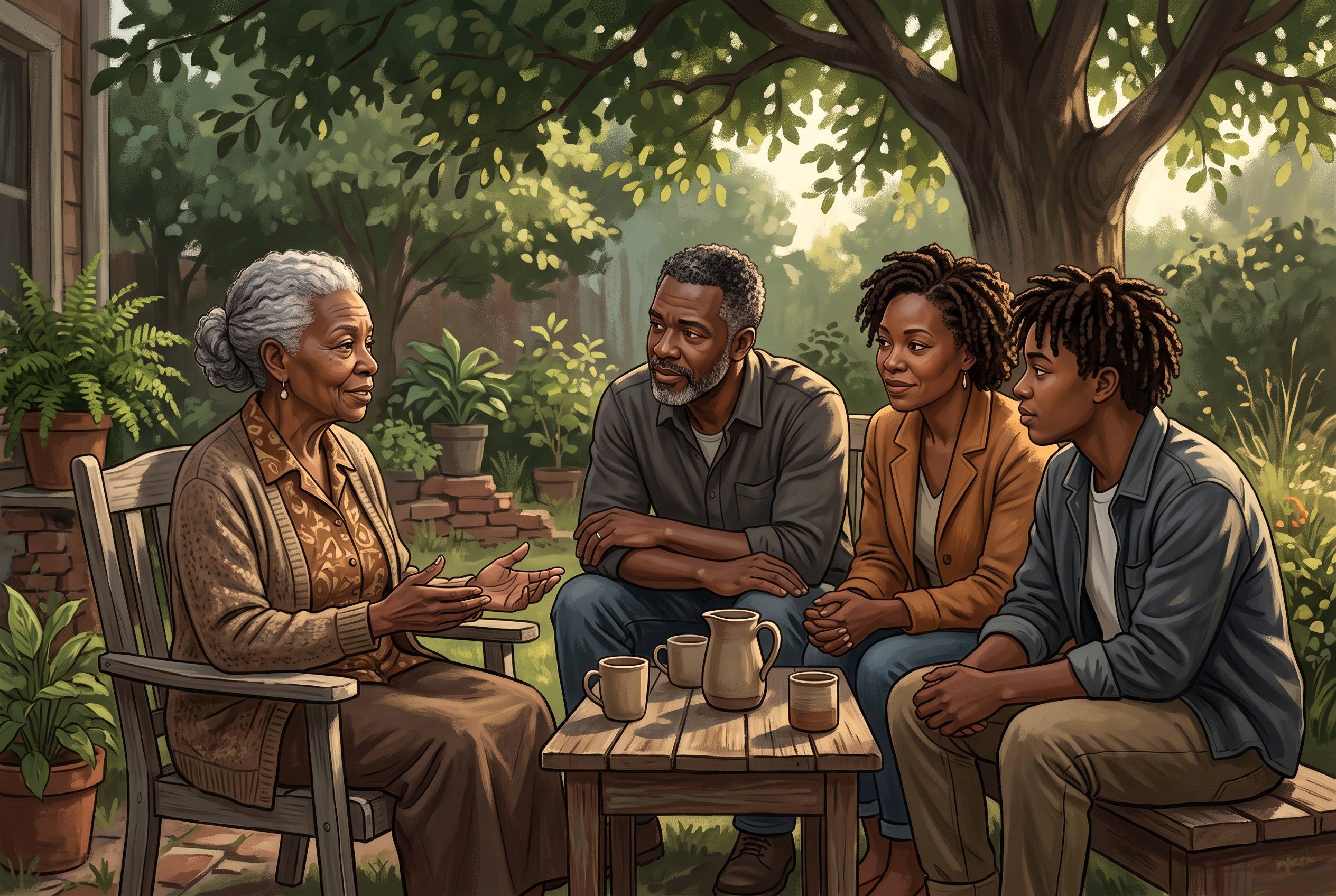
In Rastafari contexts, such questions may become part of reasoning: a practice of reflection and exchange through which people consider spiritual, historical, political and everyday concerns. An elder may bring a memory; a younger person may ask a question; another participant may offer a different interpretation. What happens depends on the people and the setting.
Reasoning is not one fixed meeting format, and no single article can describe every gathering. It can be informal or take place within a more structured spiritual setting. Its significance reaches beyond a general lesson about good conversation. To understand it, we need to begin with Rastafari history and with the people who practice and interpret it.
What is Rastafari reasoning?
Conversation with a history behind it
Rastafari emerged among Black Jamaicans in the 1930s, under British colonial rule. Its history includes spiritual belief, African identity and resistance to racial hierarchy. The movement has developed through different houses, communities and individuals; it has never been adequately represented by one voice.
Reasoning belongs to that living history. People may discuss scripture, African history, community affairs, current events or the responsibilities of daily life. A topic can be approached through memory, interpretation and disagreement rather than through a single prepared lesson.
For many participants, the discussion can carry spiritual as well as intellectual meaning. A reasoning should therefore not be reduced to a debate technique or borrowed as a decorative label for any conversation. The word belongs to communities with their own relationships, beliefs and ways of gathering.
Our introduction to Rasta livity described reasoning as a form of reflection and exchange connected to lived practice. Here the focus is closer: how knowledge moves between people, how participation varies and why careful listening matters.
More than one setting
Reasoning may happen between a few people or among a larger group. Some exchanges arise during ordinary social life; others are connected to gatherings with specific spiritual customs. Who is present, what is discussed and how participants understand the occasion can differ.
The Smithsonian’s catalog describes Rastafari Voices, a film documenting aspects of prayer, communal reasoning and music among Rastafari in Jamaica. The catalog also identifies a particular setting in which reasoning was accompanied by sacramental use of ganja. That description concerns the filmed material; it does not mean cannabis is required at every reasoning or used by every Rastafari person. Explore the Smithsonian catalog.
An archival description tells us what a collection says it contains. It does not by itself show us everything that happened before or after a recorded scene. Access and permission to use archival material can also be restricted, so a researcher should consult the holding institution.
A place to ask, interpret and listen
One person may raise a question about a passage; another may connect it to a historical event; someone else may describe what the question means in their own life. The exchange can lead people to reconsider an assumption or recognize a disagreement that needs more attention.
It would be a mistake to promise that every reasoning follows a neat sequence or ends in consensus. Relationships, authority and the purpose of a gathering matter. Participants may have different understandings of a subject and different opportunities to speak.
A careful account therefore asks whose perspective is being described. Who was present? What kind of gathering was it? Was the discussion public, private or part of a spiritual observance? Without those details, a reader may mistake one experience for a universal rule.
How knowledge can move between generations
Elders carry experience, not a single answer
An elder may bring memories of family, work, discrimination, migration, worship or community organizing. Those memories can make a historical question concrete. A younger person may have read about an event and want to know how it was experienced by someone who was there.
But age alone does not make an individual the spokesperson for every Rastafari community. Elders can disagree with one another, and memories can require context or comparison with other records. Respect for a person’s experience includes identifying it accurately rather than turning it into an answer for everyone.
A younger participant also brings knowledge. They may understand a digital tool, a contemporary school environment or a new way a question appears in public life. A genuine exchange gives younger people room to contribute without pretending that every setting distributes authority in the same way.
Learning between generations is a relationship, not simply the transfer of a finished lesson from one person to another. It depends on time, attention and the willingness to hear what the other person considers important.
What a specific study can show
Researchers Nathan Glace and Anna Waldstein describe taking part in reasonings about hair at Fairfield House in Bath, England. In their study of Rastafari and hair, they discuss small groups, participant-led exchanges and the importance of context and consent. They also note that hierarchies and power conflicts may arise. Read their accepted manuscript.
Their account is useful because it is situated. It concerns particular encounters at particular sites during the researchers’ fieldwork. It does not establish a rule for all reasonings in Britain or elsewhere. It also makes clear that researchers must consider the practices of the people involved, including whether note-taking or recording is appropriate.
The subject of hair itself can open several lines of discussion: spiritual meaning, public treatment, personal choice and differences among communities. A conversation about one visible feature can lead to questions about history and belonging that are not visible at first glance.
Study can strengthen a voice
In research on Rastafari in Ghana, scholar Shamara Wyllie Alhassan includes the perspective of a woman identified as Sista Pama. The article describes how studying Marcus Garvey and learning about Emperor Haile Selassie I and Empress Menen informed her understanding of Black identity and her confidence in speaking about her beliefs. Read Alhassan’s study.
That account comes from a research interview; it should not be represented as a transcript of a reasoning. It does show how reading, reflection and a person’s own voice can be connected. Study may support participation in a wider conversation rather than replace lived experience.
Ghana is not merely a backdrop to a Jamaican story. Rastafari people there bring their own histories and circumstances to the movement. Sista Pama’s account is valuable as one person’s perspective within that setting, not as a description of every Ghanaian Rastafari woman.
Whose voice is heard?

The work of making a gathering possible
A gathering requires more than the moment when people speak. Someone may find a place, organize transportation, prepare food, look after children, contact participants or clean up. If those tasks fall repeatedly on the same people, their opportunity to take part in discussion can be limited.
Women have contributed to Rastafari history as thinkers, organizers, workers and spiritual participants, even when accounts have centered men. They have also described and challenged restrictions on their authority. The question is not only whether women are present; it is whether their knowledge and decisions are treated seriously.
Historian D. A. Dunkley’s research on women and resistance in early Rastafari examines women’s agency alongside the pressures they faced within the movement and in the wider society. It offers a reason to ask careful questions about gender without assuming that every community has the same rules or conflicts.
Reggae Dread’s Rasta Women and Everyday Livity follows several documented voices. Read alongside this article, it helps broaden the picture of who creates and carries knowledge.
Respect does not require silence
An elder may expect a younger person to listen carefully. A younger person may also need space to question an interpretation or describe an experience an elder has not had. These expectations can create a productive exchange, but they can also produce tension when authority is used to close discussion.
The same is true across gender and family roles. Someone who prepares a meal or cares for a child may have an important contribution to make about the subject being discussed. A community cannot assume that being physically present automatically means every person has been heard.
A question worth carrying into any account is: who could speak, who was listened to and who did the work that allowed the conversation to happen? The answer will differ from one gathering to another. It can also change over time as people challenge expectations and create new opportunities to participate.
The limits of an outsider’s view
A visitor may be invited to listen, but an invitation to attend does not automatically include permission to record, quote, photograph or publish. Some gatherings or discussions may not be open to outsiders at all. Ask the people responsible what is appropriate and respect the answer.
Even with permission, a short visit cannot reveal everything about a community. A participant may have relationships and knowledge that are not visible to an observer. A single exchange should not become the basis for declaring what all Rastafari believe.
The best account identifies its sources and limitations. If a writer has spoken with one person, say so. If a description comes from an archival catalog rather than a full recording, make that distinction. If a question remains unanswered, leave room for future learning.
Bringing ideas into daily life
From a large question to a particular decision
Reasoning can involve broad ideas about freedom, identity and justice. Those ideas may also meet practical questions: how a family shares work, how a school treats a child, how a business values labor or how neighbors respond when an elder needs help.
Consider an illustrative example, not a report of an actual reasoning. Several family members are deciding how to support a relative who can no longer travel easily. One person remembers how the relative helped others in the past. Another knows the bus schedule; a younger member can make calls; the relative explains which help is welcome and which would feel intrusive.
The family might leave with a simple plan and a date to check whether it works. The example does not define a Rastafari ritual. It shows how listening, memory and responsibility can meet in an ordinary decision—the kind of relationship that livity can bring into view.
Large ideas do not disappear when the conversation turns to a ride or a meal. They become more demanding. Respect must account for the wishes of the person receiving help, the time of the people offering it and the conditions that made help necessary.
Language carries relationships
Rastafari language includes expressions whose meanings are connected to spiritual and historical ideas. The expression I and I, for example, is discussed by different writers and practitioners in relation to self, divinity and human connection. Its meanings should be understood in context, not treated as a slogan with one mechanical translation.
A person who is learning about Rastafari does not need to imitate speech to show respect. Listen to how the speaker uses a word, ask a thoughtful question when appropriate and credit the person or source who provides an explanation. Words should not be detached from the people whose lives give them meaning.
Reggae Dread’s Beliefs, Scripture & Reasoning offers a companion introduction to the relationship between interpretation and discussion. Reading it with individual accounts can help a reader see both a broad theme and its different expressions.
When people disagree
Disagreement can reveal differences in experience, interpretation and power. An older participant may remember a practice one way; a younger participant may ask how it applies today. Women may challenge assumptions about who speaks or makes decisions. A family may have different views on a practical obligation.
Listening does not require pretending every position is equally supported or that harm has not occurred. It means allowing people to state their experiences, asking what evidence supports a claim and remaining open to correction. A respectful exchange can still include a firm boundary.
Some questions will not be resolved in one conversation. A decision may need more information, a private discussion or the participation of someone who is absent. Recognizing that limit is part of taking the subject seriously.
A reader’s listening practice
An exercise for learning from a public source
The following is a general reading exercise, not a ceremony or a substitute for participating in Rastafari reasoning. It can help a reader approach a public account with care:
- Choose a source. Select a public interview, a community-authored account or a reputable archive description. Note the author, speaker, place and date if available.
- Identify the voice. Ask who is speaking and whether you are reading their words, a researcher’s interpretation or a catalog summary.
- Write one observation. Record a detail the source actually supports. Keep it separate from what you infer.
- Name an open question. What would you need to know before extending the claim to other people or another time?
- Consider a response. Is there another source to consult, a person to credit or an action you can take without intruding on anyone’s privacy?
For example, Alhassan’s published interview with Sista Pama supports a discussion of that woman’s relationship to study and Black identity. It does not tell us that every Rastafari woman in Ghana follows the same path. That distinction preserves the value of her particular voice.
Preparing for an invited conversation
If a Rastafari person agrees to speak with you, explain your purpose and ask how they wish to be identified. Decide together whether the conversation is private and whether any recording or quotation is welcome. Allow the person to decline a question or change the subject.
Offer the speaker an opportunity to review a proposed public quotation where possible. Credit their contribution as agreed, and discuss payment if the work is for a commercial project or requires substantial time. Permission to talk is not automatically permission to publish.
Most of all, do not arrive with a conclusion that makes the person’s answer irrelevant. An unexpected response can reveal that the original question was too narrow.
Frequently asked questions
Is every conversation between Rastafari a reasoning?
Not necessarily. People understand and use the term in context; settings and spiritual significance vary.
Does a reasoning require a particular number of people?
There is no single number that describes every setting. Published research discusses both small groups and larger gatherings.
Is ganja required?
No universal requirement can be inferred from accounts of particular gatherings. Practices and beliefs vary, and some recorded contexts include sacramental use.
Can someone who is not Rastafari attend?
That depends on the gathering and the people responsible for it. Seek an invitation or ask about public events, and respect any boundaries around participation and recording.
Must everyone agree?
No single outcome describes every exchange. Participants can hold different interpretations, and some questions may remain unresolved.
A conversation that continues
Reasoning gives us a way to consider knowledge as something carried by people in relationship: through study, memory, spiritual interpretation, disagreement and attention to the conditions of daily life.
To listen well is to recognize both the value and the limits of what one person tells us. An elder’s memory, a woman’s interpretation and a younger person’s question each belong to a particular life. None needs to be flattened into a single voice for the whole movement.
The conversation continues when we credit the people we learn from, make room for those who have been left out and allow a question to lead us toward a more careful understanding of one another.
Sources and further reading
- Nathan Glace and Anna Waldstein, “Spiritual hair: dreadlocks and the bodies multiple in Rastafari”, accepted manuscript, Journal of the Royal Anthropological Institute, 2022. Includes discussion of reasonings at Fairfield House.
- Shamara Wyllie Alhassan, “We Stand for Black Livity!”: Trodding the Path of Rastafari in Ghana, Religions, 2020. Includes a research interview with Sista Pama.
- Smithsonian Institution, catalog search for Rastafari Voices. Consult the repository about access and reproduction permissions.
- D. A. Dunkley, Women and Resistance in the Early Rastafari Movement, LSU Press. Publisher description; book access may require purchase or a library.
- Reggae Dread, Beliefs, Scripture & Reasoning, Rasta Livity in Everyday Life and Rasta Women and Everyday Livity.