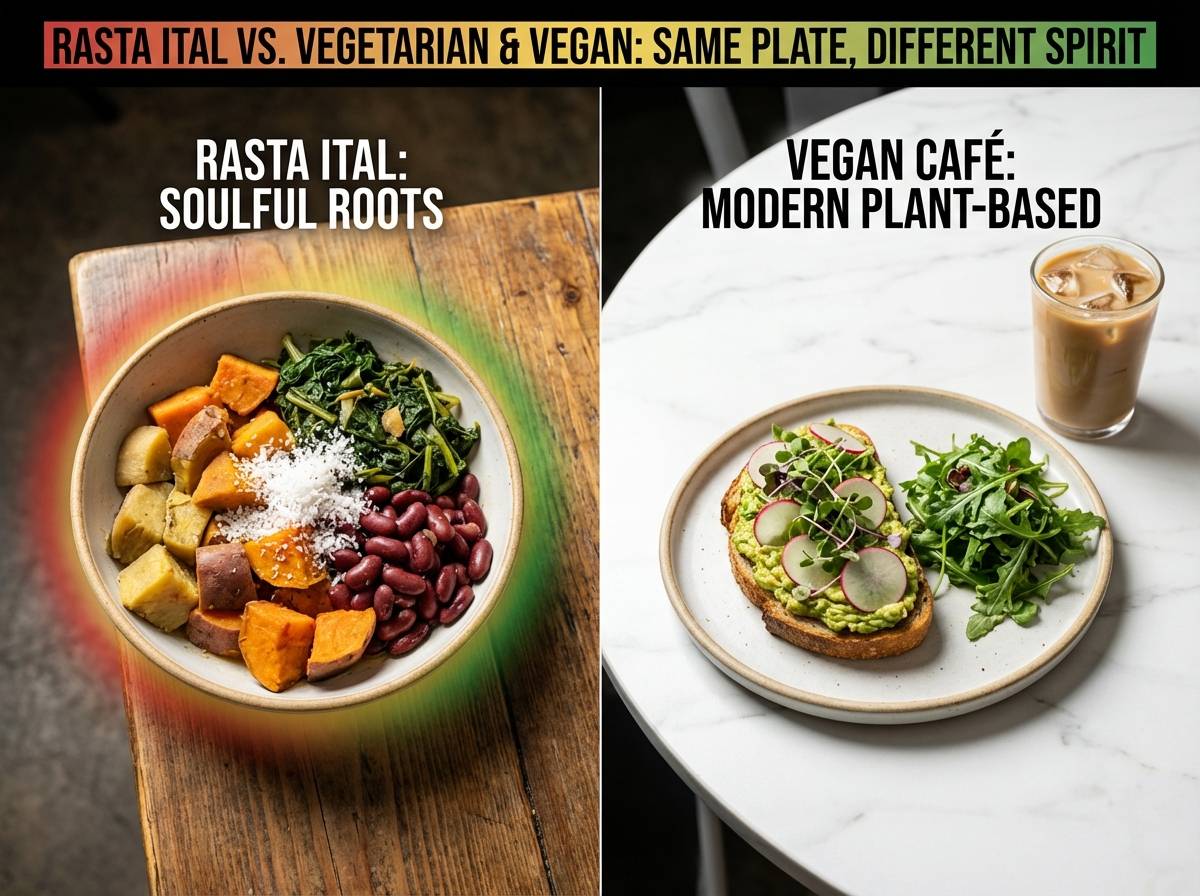
At first glance, a Rasta Ital meal and a modern vegetarian or vegan plate can look almost identical: no meat, vibrant vegetables, legumes, herbs and spices, and plenty of plants. But beneath the surface, these ways of eating are driven by very different stories, motivations, and worldviews.
This chapter explores how the Rasta Ital diet compares with contemporary vegetarian, vegan, and plant-based diets. You will see where they overlap, where they diverge, and how culture and spirituality shape what ends up on the plate.
Defining the Diets: Ital, Vegetarian, Vegan and Plant-Based

Before comparing motivations and lifestyles, it helps to define the main dietary patterns we are dealing with. Although there is overlap, each has its own history, logic, and boundaries.
What Is the Rasta Ital Diet?
Ital comes from the word vital. In Rasta reasoning, Ital food is food that supports life, clarity, and spiritual strength. While practices vary from person to person and community to community, the Rasta Ital diet generally:
- Emphasizes natural, minimally processed, plant-based foods.
- Uses fresh fruits, vegetables, herbs, roots and grains as staples.
- Often avoids meat, especially red meat and pork; some Rastas eat small amounts of fish.
- Minimizes or excludes salt, refined sugar, artificial additives and alcohol.
- Values food that comes from the earth, not from a factory.
Ital is not just about ingredients. It is deeply tied to Rasta Ital lifestyle and livity—a holistic way of living that includes spirituality, community, music, and a conscious relationship with Babylon’s system.
What Is a Vegetarian Diet?
A vegetarian diet is typically defined by what it does not include:
- No meat (no beef, pork, chicken, etc.).
- Most vegetarian diets still include dairy and eggs.
- Some variations include or exclude fish (pescatarian, ovo-vegetarian, etc.).
Vegetarianism is often practiced for health, ethical, cultural, religious, or environmental reasons. In many modern contexts, it is seen as a personal health choice or an ethical stance regarding animals.
What Is a Vegan Diet?
A vegan diet excludes all animal products:
- No meat, poultry or fish.
- No dairy (milk, cheese, butter, yogurt).
- No eggs.
- Often no honey and avoidance of other animal-derived ingredients.
Veganism is frequently tied to animal rights, environmental concerns, and a desire to reduce harm. Many vegans also avoid non-food items made from animals, such as leather or wool, making it more of a lifestyle choice than just a dietary plan.
What Are “Plant-Based Diets”?
The term plant-based diet has become popular in health and wellness circles. It usually means:
- Food choices centered mainly around plants (vegetables, fruits, grains, legumes, nuts and seeds).
- Some people are fully plant-based (no animal products), others still include small amounts of animal foods.
- The focus is often on health outcomes more than ethical or spiritual beliefs.
In practice, a plant-based eater may have a very similar plate to a vegetarian or vegan, but the motivation might be lower blood pressure, weight management, or improved digestion, rather than spiritual or cultural commitments.
Spiritual Roots vs. Secular Wellness
One of the biggest differences between Rasta Ital vs vegetarian or vegan diets lies in the why. The plates may share ingredients, but the spiritual, cultural, and political roots are not the same.
Ital as Spiritual Path and Protest
For Rastafari, Ital is part of a wider spiritual walk. It is tied to:
- Viewing the body as a temple where the divine presence (I-and-I) dwells.
- Seeking mental clarity and spiritual sensitivity through clean, natural foods.
- Resisting Babylon by rejecting its processed, chemical-laden food system.
- Staying connected to land, ancestors and African memory through what is planted and eaten.
An Ital plate is a daily act of devotion and defiance: devotion to the Most High and defiance against systems that profit from sickness and disconnection.
Vegetarian and Vegan Diets as Personal Ethics
Many vegetarians and vegans are also driven by values:
- Compassion for animals and a desire to avoid causing harm.
- Environmental concerns about industrial animal agriculture.
- Health, longevity and disease prevention.
These motivations can be deeply heartfelt, but they are often framed as individual choices in a consumer society. A person might say: “I am vegan,” in the same way someone might say “I do CrossFit” or “I shop organic.”
Plant-Based as Wellness Branding
In the modern wellness industry, “plant-based” is frequently used as a marketing label:
- It appears on snacks, supplements, frozen meals and packaged foods.
- It is used to signal “healthy” even when a product is highly processed.
- It is often disconnected from culture, history or deeper spiritual practice.
Here, the focus is more on personal performance—energy, appearance, productivity—than on collective liberation or spiritual livity.
In contrast, Rasta Ital lifestyle views food as part of a sacred responsibility to self, community and creation. It is not a temporary challenge or a brand identity. It is a way of aligning everyday life with a higher spiritual and cultural purpose.
Rules Around Meat, Dairy, Fish and Processed Foods
Another key part of the vegetarian diet comparison is how each approach treats specific food groups. Here, Ital can look close to veganism on some days and closer to flexible plant-based eating on others, depending on the individual Rasta and community.
Meat and Flesh Foods
In Ital reasoning:
- Red meat and pork are widely avoided because they are seen as heavy, toxic, and spiritually dulling.
- Many Rastas avoid all meat and practice a lifestyle essentially identical to vegetarian or vegan on most days.
- Some may still eat small amounts of fish, especially in older or more rural traditions, but often with strict limits.
The concern is not just physical health. Rastas often speak about the energy of death in flesh foods and how it can affect the mind, emotions and spiritual clarity.
In vegetarian diets:
- Meat is excluded, but fish may be allowed depending on the variation.
- There is usually less emphasis on spiritual energy and more on ethics or health.
In vegan diets:
- All animal flesh is removed, often alongside a strong ethical commitment to avoid exploitation of animals in any form.
Dairy, Eggs and Animal By-Products
Ital views on dairy and eggs are not fully standardized, but many Rastas:
- Avoid or minimize cow’s milk and dairy products.
- See dairy as mucus-forming and linked to poor health.
- Prefer plant milks (coconut, almond, oat) when available.
Vegetarian diets generally allow dairy and eggs, and these can be central protein sources for many vegetarians. Vegan diets exclude both, often on ethical grounds.
Salt, Sugar and Chemical Seasonings
One of the biggest practical differences in daily cooking lies in the attitude toward salt and chemical seasonings:
- Ital cooking often aims for low or no added salt, relying instead on herbs, spices, onions, garlic, scallion, pimento and natural aromatics.
- Monosodium glutamate (MSG), artificial bouillon cubes, and lab-made flavor powders are typically rejected as Babylon additives.
- Refined sugar is often reduced or replaced with natural sweeteners, fruits or unsweetened preparations.
Many vegetarian or vegan eaters still rely heavily on salty processed foods, sugary snacks, and flavored meat substitutes. They may meet the label of “vegetarian” or “vegan” without practicing the deeper form of healthy eating tips that Ital emphasizes.
Ultra-Processed Plant Foods
Modern vegetarian and vegan markets are full of:
- Fake meats and plant-based burgers.
- Highly processed vegan cheeses.
- Ready-made meals with long ingredient lists.
Ital reasoning is cautious about these. Even if something is “vegan,” it may still be considered Babylon food if it is highly artificial, chemical-laden, or disconnected from the land. From an Ital point of view, a simple stew of red peas and pumpkin carries more livity than a lab-engineered soy patty, even if both are technically meat-free.
Cultural Food Differences and Respectful Adoption
It is impossible to compare Rasta Ital vs vegetarian diets without talking about culture. Ital is not merely a set of nutritional rules: it is part of a larger cultural and spiritual movement born in specific historical conditions.
Ital as Caribbean and African Diaspora Memory
Ital grew out of:
- The experience of slavery, plantation life and colonial oppression.
- The recognition that colonial food systems were designed for labor, not health.
- A desire to reconnect with African roots and respect for the land.
Many Ital dishes use familiar Caribbean staples—yam, cassava, green banana, callaloo, breadfruit—but prepared in ways that emphasize simplicity, purity and spiritual intent. In this way, the Rasta Ital lifestyle transforms everyday Caribbean cooking into an instrument of liberation.
Global Vegetarian and Vegan Movements
Modern vegetarian and vegan movements have their own histories:
- Religious traditions like Hinduism, Jainism and Buddhism.
- 19th and 20th century European reform movements focused on temperance and health.
- Contemporary animal rights activism, climate activism and wellness culture.
These histories are important and powerful. But they are different from the specific Caribbean, Black and Rastafari roots that gave birth to Ital.
Avoiding Cultural Erasure
As Ital-style recipes appear in cookbooks, wellness blogs and social media, there is a risk of cultural erasure when:
- Ital dishes are rebranded as “exotic vegan bowls” without mentioning Rasta at all.
- Caribbean flavors are used as trendy seasoning, stripped of their history.
- Chefs and influencers profit from Ital aesthetics while ignoring Rasta voices.
Respectful adoption means:
- Naming Rastafari and Ital when drawing from those traditions.
- Learning at least basic history about how Ital emerged as a response to oppression.
- Supporting Caribbean and Rasta creators, cooks and teachers when possible.
In this way, a person living a vegetarian lifestyle or a modern plant-based diet can honor Ital as an elder and a teacher, not just a source of flavors.
Choosing Your Path: Which Way of Eating Fits Your Livity?
After exploring these similarities and differences, it is natural to ask: Where do I fit? Should you be fully Ital, vegetarian, vegan, or just more plant-based than before? There is no one-size-fits-all answer, but there are guiding questions.
Questions to Ask Yourself
To align your diet with your deeper values and lifestyle, you can reflect on:
- Spirituality: Is food part of your spiritual practice? In what way?
- Culture: Which cuisines, memories and ancestors do you want to honor?
- Health: How does your current diet make your body feel day to day?
- Ethics: How important are animal welfare and environmental impact to you?
- Community: How does your way of eating relate to the people around you?
Blending Ital Principles into Your Vegetarian or Vegan Life
You do not have to choose a rigid label overnight. Many people find strength in blending Ital principles into an existing vegetarian or vegan pattern:
- Keeping your plate mostly whole foods, minimally processed.
- Reducing salt, refined sugar and artificial additives.
- Using more herbs, roots and traditional seasonings instead of bottled sauces.
- Adding simple Ital-style meals on certain days—like a weekly Ital Sabbath or roots day.
- Making time to give thanks and eat more mindfully, not just quickly.
In doing this, a vegetarian or vegan can move from a purely nutritional script to a more holistic livity, where food is tied to inner life, community and purpose.
Respecting Ital While Walking Your Own Road
If you are not Rasta, you can still be deeply inspired by Ital. The key is respect:
- Recognize Ital as a rooted, Black, Caribbean spiritual tradition.
- Avoid claiming Ital as your invention or diluting it into a marketing buzzword.
- Learn from Rasta voices, books, music and lived examples.
Your vegetarian lifestyle or plant-based diet can be strengthened by Ital wisdom without pretending that the two are identical. They share ingredients, but they do not share the exact same soul.
From Comparison to Craft: What Comes Next
In this chapter, you explored how Rasta Ital vs vegetarian and vegan diets differ in motivation, rules and cultural depth. You have seen that:
- Ital is a spiritual, cultural and political path, not just a way to cut meat.
- Vegetarian and vegan diets often focus on ethics, environment or personal health.
- Plant-based trends can easily become another wellness product, disconnected from roots.
- Respectful borrowing requires naming and honoring Ital’s Rasta origins.
The next step is to move from theory to flavor—to look closely at the herbs and spices that give Ital its healing power and distinctive taste. These ingredients not only make food delicious; they carry stories of land, lineage and livity.
In Part 3 – “Herbs & Spices in Rasta Ital: Healing, Flavor & African Memory”, we will dive into:
- The core herbs and seasonings that define Ital cooking.
- Bush teas, roots tonics and traditional remedies.
- How to build deep flavor with little or no salt.
- Simple Ital-inspired herb and tea ideas you can begin using right away.
With the comparison between Ital, vegetarian and vegan diets now clear, you are ready to step into the Ital kitchen itself—where the pot becomes a place of healing, history and spiritual craft.