
How Rasta travels: not by conquest, but by resonance
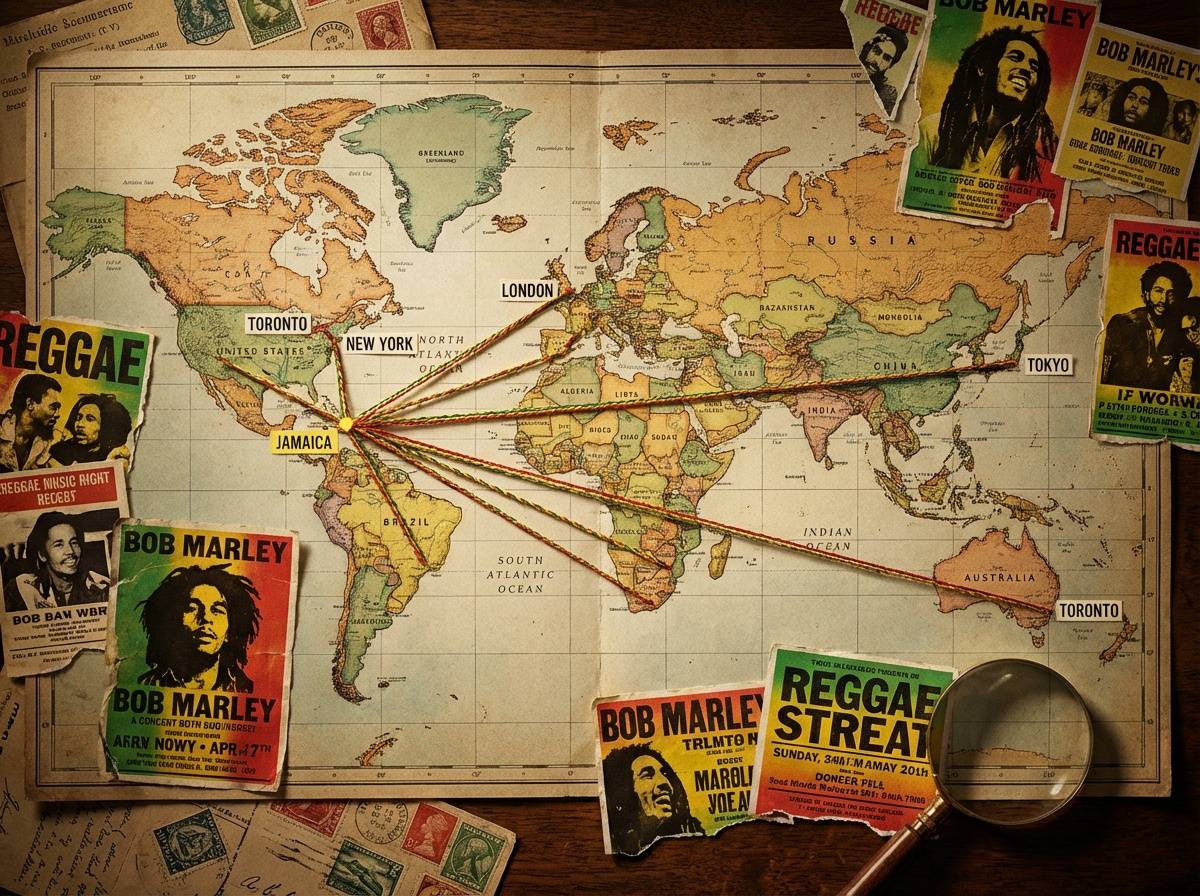
Rastafari didn’t expand like an empire. It expanded like a signal. People heard a frequency in reggae—truth, dignity, resistance, spiritual seriousness— and they went looking for the root behind the sound.
The diaspora helped carry that signal. Jamaican migration, Caribbean migration, and Black global networks created living bridges between islands, cities, and continents. Add touring musicians, sound systems, record shops, radio, and later the internet—and a once-local movement gained global reach.
But every time a culture spreads, it enters new conditions. Different laws. Different economies. Different racial politics. Different religious landscapes. Different temptations. That’s where the transformation happens—sometimes beautiful, sometimes messy.
ReggaeDread lens: A culture can travel far, but the question is always: did the meaning travel with it?
Diaspora as survival: carrying identity across borders
The diaspora experience is often survival in motion: leaving home to feed family, leaving home to escape pressure, leaving home because opportunity is uneven and history is heavy. When people move, they carry culture like luggage—sometimes carefully, sometimes loosely.
Rastafari in diaspora often becomes a way to keep identity intact. In foreign systems that try to rename you, Rasta offers a self-definition. In environments that pressure assimilation, Rasta offers a backbone.
This is why you find Rasta communities and reggae scenes far beyond Jamaica: not only because the music is loved, but because the worldview meets a real need.
What diaspora Rasta often protects
- Language and expressions: cultural speech as identity anchor.
- Food and Ital practice: clean living as spiritual continuity.
- Music and sound system culture: community gathering as survival.
- Reasoning and community ethics: moral structure in unfamiliar environments.
Caribbean spread: family resemblance, local flavor
Across the Caribbean, Rastafari and reggae often land with a certain “family resemblance.” The region shares histories of slavery, colonial rule, resistance, and cultural retention. So Rasta themes—freedom, dignity, African consciousness—can resonate quickly.
Yet each island has its own rhythm, politics, and spiritual landscape. In some places, Rasta blends into existing African-derived spiritual traditions. In others, it faces strong church opposition. In others, it becomes fused into youth identity. The root stays similar, but the expression shifts with the soil.
Africa: return, recognition, and complex homecomings
Africa holds a unique place in Rastafari imagination: Zion, origin, dignity, spiritual home. In many African contexts, reggae and Rasta consciousness can connect strongly with anti-colonial memory and Pan-African identity.
At the same time, Africa is not one thing. It contains many cultures, languages, and religions. Rasta arriving in Africa is not a simple “return” story. It can be recognition and it can be friction, because the diaspora’s idea of Africa sometimes meets the living complexity of Africa itself.
The healthiest exchange happens when it’s humble: diaspora learns from Africa, Africa learns from diaspora, and the relationship becomes real instead of romantic.
Important clarity: “Return to Africa” is a powerful Rasta theme, but real homecoming is complex. Respect requires listening more than projecting.
Europe: reggae scenes, anti-racism, and subculture crossroads
In Europe, reggae often found fertile ground inside youth subcultures and diaspora communities. The music carried both warmth and resistance—two things many people craved in environments marked by racism, class tension, and identity anxiety.
Reggae scenes in European cities became places where Black diaspora identity could breathe, where solidarity could form, and where a spiritual-political message could circulate outside mainstream media. At the same time, Europe also became a stage where commercialization and surface-level appropriation could accelerate. Festivals, fashion, and tourism can sometimes turn living culture into themed entertainment.
Europe’s double-edge effect
| What grows | What gets risky | Why it matters |
|---|---|---|
| Reggae community | Culture becomes scene-only | Message can be reduced to “party” |
| Anti-racist solidarity | Identity gets commodified | Symbols sold without root |
| Cross-cultural exchange | Misrepresentation | Rasta becomes stereotype |
The Americas: Black identity, immigrant life, and spiritual hunger
In the Americas, Rastafari often intersects with multiple streams: Black liberation thought, immigrant identity, Caribbean diaspora communities, and a broad spiritual hunger that grows when people feel alienated from mainstream institutions.
Reggae scenes appear in major cities, college towns, coastal spaces, and underground circuits. Some scenes stay close to roots message and cultural literacy. Others drift into “island vibes” marketing. This is the constant tension: the more popular the aesthetic becomes, the more protection meaning requires.

Global reggae scenes: where sound becomes a meeting place
The global reggae scene is not one unified culture; it’s a network of local scenes connected by shared rhythm. Each scene reflects its local struggles. That’s why reggae can feel “native” in places far from Jamaica: the message adapts to local reality.
But adaptation is only healthy when it keeps respect for root. If the music becomes detached from cultural literacy, the scene can become a costume party for people who never had to carry the struggle.
Signs of healthy adaptation vs dilution
| Healthy adaptation | Dilution | Practical difference |
|---|---|---|
| Learning the history | Only copying the look | Root honored vs root erased |
| Message-centered music | Vibe-only branding | Teaching vs marketing |
| Community ethics | Exploitation for profit | Uplift vs extraction |
| Respectful symbolism | Stereotype performance | Culture vs caricature |
Authenticity challenges: when Babylon sells the surface
When Rasta culture goes global, Babylon does what Babylon does best: it packages. It sells dreadlocks as fashion. It sells red-gold-green as a brand. It sells “irie” as a slogan. It sells reggae as a playlist mood—often without context, without struggle, without respect.
This doesn’t mean cultural exchange is wrong. It means exchange requires ethics. It requires humility. It requires listening. It requires giving credit and honoring boundaries. Otherwise, what looks like “love” becomes exploitation wearing a smile.
Respect note: If a culture is loved only when it’s entertaining, and rejected when it asks for respect, that’s not appreciation—that’s consumption.
How Part 10 prepares Part 11: misconceptions, stereotypes, and appropriation
Once we see how Rasta spreads, we can also see how it gets distorted. Part 11 goes directly into the myths—media distortion, tourism narratives, stereotypes, and how to engage respectfully instead of exploiting a sacred culture.
FAQ: Rastafari around the world
Why did Rastafari spread globally?
Through diaspora communities, reggae’s worldwide reach, touring artists, sound system culture, and the universal resonance of a message about dignity, resistance, and spiritual alignment.
Does Rasta culture look the same everywhere?
No. The core principles can remain recognizable, but local conditions shape expression—religion, politics, economy, and cultural context all influence how livity is practiced.
What is the difference between adaptation and dilution?
Adaptation keeps respect for root while expressing the culture in new conditions. Dilution copies surface aesthetics while removing context, struggle, and meaning.
Can non-Jamaicans be part of Rastafari?
People worldwide connect with Rastafari, but respectful engagement requires cultural literacy, humility, and care—especially because the movement emerged from specific histories of oppression and resistance.
Next (Part 11): Misconceptions, Stereotypes & Cultural Appropriation — popular myths, media distortion, tourism narratives, and a clear guide to engaging with respect.
Continue the series: Part 11 — Misconceptions, Stereotypes & Cultural Appropriation