
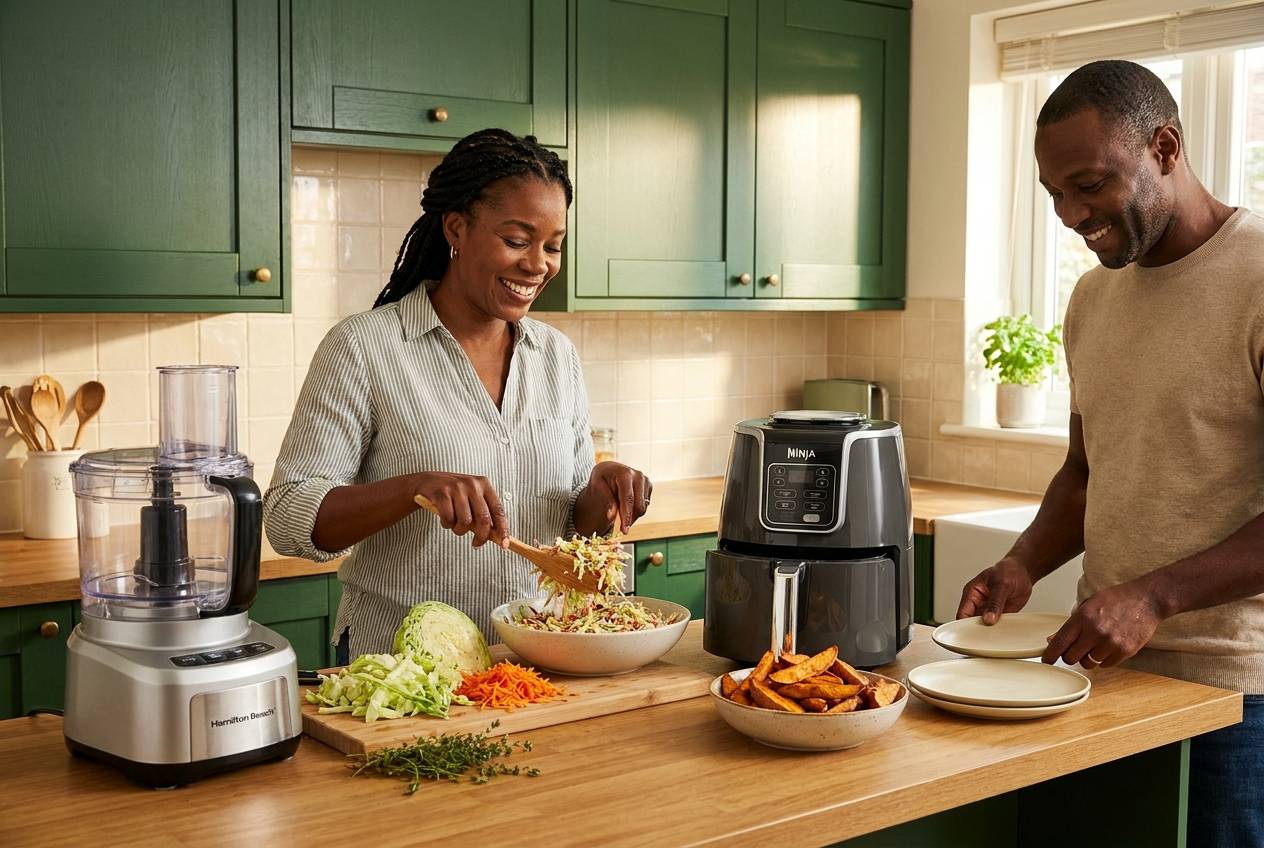

A Saturday supper begins with a smaller plan
In this imagined kitchen, Saturday arrives carrying the leftovers of a busy week: unopened messages, a shopping bag beside the door and a familiar question about dinner. Maya looks at the vegetables on the counter and can already picture the meal. Getting from that picture to something everyone can eat feels like the difficult part.
Leon has invited two friends over. Nobody expects a grand occasion. They want food, conversation and a little music before the evening gets away from them. Still, a simple invitation can become a long private list: peel this, chop that, find another bowl, watch the stove, clear somewhere to sit.
Maya decides to make the list smaller. There will be rice and beans, sweet-potato wedges, cabbage-and-carrot slaw and a white-bean dip brightened with lime and herbs. Some parts can be prepared ahead. One component needs the air fryer. Everything can be served in bowls that invite people to help themselves.
The Hamilton Beach 70730 food processor and Ninja AF181 air fryer have clear places in that plan. The processor will help with the prepared vegetables and dip. The air fryer will handle the wedges. A knife, cutting board and saucepan still have work to do. Maya assigns each tool a job before taking anything apart.
That small decision changes the mood. She is arranging a meal she wants to eat, with equipment chosen around its needs. The kitchen no longer looks like a collection of unfinished demands. It looks like several manageable stages, each with somewhere to begin and somewhere to stop.
Leon clears the table and puts on a roots reggae selection at a comfortable volume. The music leaves room for talking. He washes the vegetables while Maya checks what is already in the cupboard. They find cooked beans, a lime and enough rice. The shopping bag becomes a starting point rather than an instruction to use everything immediately.
They sort the ingredients by where they are going: slaw beside its bowl, beans beside the herbs, sweet potatoes on the board. Leon opens a window and folds the reusable shopping bag. These small movements help the room feel ready. Dinner begins with making somewhere for the work to happen.
Their first useful preparation is an empty space. They move the post, put out receiving bowls and choose a suitable place for the hot air-fryer basket. They follow the appliances’ placement and electrical instructions, using the processor before beginning the air-fryer stage. The counter has a direction now: ingredients arrive, get prepared and move toward the meal.
For a reader trying something similar, the invitation is modest. Pick one vegetable to cook, one fresh accompaniment and one familiar staple. Add a dip if it suits your appetite and available time. A smaller menu gives you room to notice what tastes good and what makes the work feel comfortable.
Maya writes those parts on a scrap of paper. Leon adds “sit down” at the bottom. They laugh because it is the item they most often forget. This evening, enjoying the finished food belongs in the plan from the beginning.
The food processor gives preparation a rhythm
Start with the texture you want
The cabbage and carrots come first. Maya trims them to fit the feed chute and sets up the processor for the appropriate slicing or shredding job. She uses the food pusher as directed. A receiving bowl waits nearby, so the prepared vegetables have a destination instead of becoming another thing to juggle.
Hamilton Beach documents a chopping blade and a reversible slicing/shredding disc for model 70730, alongside two speeds and pulse. These attachments give different results. Maya chooses the disc for the slaw and reserves the blade for the dip.[1] The bowl scraper must be removed when the slicing/shredding disc is fitted.[2]
In the story, the pleasure comes from seeing the meal take shape. Orange meets pale green in the bowl. Leon turns the vegetables with a spoon and offers an opinion about how much lime they need. The task has become something they can share, with a visible result between them.
The dressing remains a separate decision. They add it gradually, tasting as they go, because a machine cannot judge the balance they prefer. One friend likes a sharper slaw; another reaches for a little more pepper. Leaving some dressing aside makes the table more welcoming without requiring a second complete dish.
Give the bowl room to work
The processor’s ten-cup label describes its bowl capacity, while suitable working amounts depend on the task. For chopping fruits and vegetables with the blade, the manual recommends two to three cups of roughly one-inch pieces. Maya checks the relevant instructions for each preparation rather than treating the bowl’s size as a universal allowance.[2]
That distinction keeps a large shopping bag from becoming one oversized processing job. Working in manageable stages also gives her a chance to decide what belongs in tonight’s meal. Some trimmed vegetables stay aside for another day. There is satisfaction in preparing enough, then stopping while the counter still feels under control.
Once the disc work is finished, she switches off and unplugs the processor before changing attachments. For the dip, she follows a suitable recipe using cooked white beans, herbs and lime. The chopping-blade setup returns the appliance to a different role: bringing ingredients together instead of producing separate strands and slices.
The manually operated scraper can move ingredients away from the bowl walls in its compatible chopping setup. It is a handle Maya controls, with the lid in place; it does not make texture decisions for her. She checks the developing mixture and stops when it suits the dip she has in mind.[1][2]
Let the last adjustment stay personal
Leon tastes a spoonful and asks for more lime. Maya agrees, then keeps a small portion mild before adding pepper to the rest. That little accommodation costs less effort when it happens during preparation. It also reminds them that feeding people means paying attention to preferences, not simply producing a large bowl.
The finished dip goes into a serving dish. The processor is switched off and unplugged, and its parts are set aside for cleaning as directed. There has been assembly and there will be washing. What feels easier is the organization: a few related jobs completed together, with ingredients and bowls already within reach.

The air fryer takes one part of dinner
Choose the cooking mode around the food
Maya cuts the sweet potatoes into reasonably similar wedges with a knife. They are the warm side, so she wants a batch she can watch and learn from. She follows a suitable air-fryer recipe for preparation and settings, keeping the seasoning consistent enough to judge the result before making changes next time.
The Ninja AF181 has one 6.5-quart basket and six functions: Max Crisp, Air Fry, Roast, Bake, Reheat and Dehydrate. For these fresh wedges, she chooses the recipe’s appropriate adjustable mode. Max Crisp uses a fixed 450°F setting on this US model, and Ninja particularly recommends it for suitable packaged frozen foods.[3][4]
Knowing that difference removes a small uncertainty. The prominent MaxCrisp name does not require her to use that setting for every meal. She can choose around the ingredients in front of her. The useful question becomes what this particular food needs, rather than which button sounds most impressive.
She arranges the food as the recipe and guide direct, with room for air circulation, and checks progress during cooking. If the intended quantity needs more than one batch, she adjusts the meal plan. The basket’s volume does not promise that every shape and amount of food will cook equally well together.[4]
Keep the rest of the meal simple
One basket also means one cooking environment at a time. Maya does not ask it to finish unrelated dishes at different temperatures together. The rice and beans have their own place in the meal. The slaw and dip are already prepared. That division gives the air fryer a useful job without making dinner depend on several complicated basket changes.
While the wedges cook, the kitchen feels different. There is a chance to wipe the counter, set out plates and talk. Leon brings the serving spoons to the table. Maya checks the food when needed, then returns to the conversation. The evening has pauses in it, and those pauses are part of the pleasure.
A friend arrives carrying a small bunch of herbs from home. They discuss whether to scatter them over the beans or offer them separately. This is the kind of decision Maya enjoys: a small possibility that grows from what someone brings. Having the basic preparation organized leaves room to consider it.
When the wedges are ready according to the recipe and doneness checks, they go into a serving bowl. Leon brings the slaw alongside it, and Maya adds the dip. Together, the dishes look like the supper she pictured when she unpacked the vegetables. She has reached that point through a sequence she can remember.
Maya makes a short note about the batch and setting she used. Next time, she will have somewhere to begin. Learning a familiar meal can gradually make equipment feel more approachable, especially when the first project is small enough to understand.

Food preparation becomes part of the gathering
Share the small jobs
By the time everyone is in the kitchen, the work has become light enough to share without a long explanation. One person carries the slaw. Another puts water on the table. Leon finds a spoon for the dip, while Maya offers a taste of the beans. Nobody needs to perform a complicated new technique. Everyone has something to offer.
Nobody has to take charge of the entire evening. A clear plan lets each person recognize a useful next step, and a completed bowl offers an encouragement. The pleasure gathers through those ordinary moments, long before the first plate is filled.
The appliances have supported that change by handling particular parts of the preparation. They have not supplied the welcome. That comes from making room at the counter, listening when someone mentions a preference and accepting help with an ordinary task. A useful kitchen tool earns its place inside those human arrangements.
There is still a little disorder. A lime half has rolled beside the chopping board. Someone has put the serving spoon in the wrong bowl. Maya has to look twice for the cloth. The evening is enjoyable because these things remain small, and because nobody has mistaken a relaxed supper for a demonstration of perfect housekeeping.
At the table, the separate bowls make the meal flexible. One person builds a plate around the beans and slaw. Another wants more wedges and a generous spoonful of dip. Leon remembers family dinners when the best conversations happened while someone was still finding enough chairs. One friend admits that she often postpones cooking because she imagines every dish needing attention at once. Maya points to the bowls. Tonight, they have made the different parts take turns.
Conversation moves between the food, the music and the week. The preparation has given them something pleasant to gather around without taking over the whole visit.
Bring the same care to cleaning
After eating, they return to the kitchen together. The air fryer has been switched off, unplugged and allowed to cool before cleaning. Maya follows each appliance’s care instructions, keeping motor bases out of water and handling sharp processor attachments carefully. Leon clears the table while the removable parts are dealt with.
Hamilton Beach specifies top-rack dishwasher care for removable parts and excludes the SANI setting. Ninja lists its basket and crisper plate as dishwasher safe; its guide recommends hand-washing the basket to help extend its life. These choices still involve washing, drying and putting things away.[2][3][4]
The remaining food has a destination too. They follow appropriate storage guidance rather than leaving the bowls on the table through the rest of the evening. Preparing a little for another meal can be welcome, provided storing it becomes part of finishing dinner. Nobody wants tomorrow’s lunch to begin with a forgotten bowl.
The counter gradually reappears. Maya puts the processor attachments in their usual place. Leon checks that the serving bowls are back where both of them can find them. The next cooking session is becoming easier at the same time as this one is ending.

Carry the easier parts into an ordinary week
Keep the meal, then adapt it
On Monday, Maya remembers the supper less as an appliance project than as a workable combination: something warm, something fresh, a staple and a shared table. That is a useful memory to keep. It gives her a structure she can adapt without repeating the entire Saturday menu.
A different week might bring carrot slaw instead of cabbage, another cooked bean for the dip or a vegetable side chosen from what is available. Each change needs suitable preparation and cooking guidance. Familiarity gives her a starting point, while tasting and observation keep the meal connected to the ingredients she actually has.
She also remembers which tasks were worth using the equipment for. A little garnish may be simpler with a knife. Several related preparation jobs may justify assembling the processor. A suitable air-fryer batch may fit an evening meal; a much larger gathering may call for another cooking plan. Experience helps her choose proportionately.
She keeps a short kitchen note with the meals she would make again. Beside each one, there is room for a useful adjustment: prepare the slaw earlier, set the serving bowls out first, or make a smaller batch. It becomes a record of what helps this household enjoy cooking.
Before buying either appliance, readers can ask the same practical questions. Which foods do you prepare repeatedly? Where will the machine work and be stored? How much assembly and washing feels reasonable? The answers connect a product’s features to a real household, where convenience includes putting everything away.
A small routine worth repeating
Their reminder for the next supper is short:
- Choose the meal first. Give each appliance a clear, suitable job.
- Prepare the space. Put ingredients, receiving bowls and utensils within reach.
- Work in manageable stages. Follow attachment instructions and appropriate batch sizes.
- Stay with the food. Taste, watch texture and check cooking progress.
- Finish together. Include serving, storage and cleanup in the shared work.
For Reggae Dread, a conversation about everyday living includes what happens before the plate reaches the table. Food belongs in that conversation. Choosing ingredients, reducing avoidable fuss and sharing the work can make an ordinary meal feel more considered. Useful equipment can support those choices when its capabilities match the task.
Maya folds the paper with Leon’s final instruction still at the bottom. “Sit down.” Next Saturday may be busier. The vegetables may be different. What they hope to repeat is the feeling of having enough space to cook, talk and enjoy what they have made together.