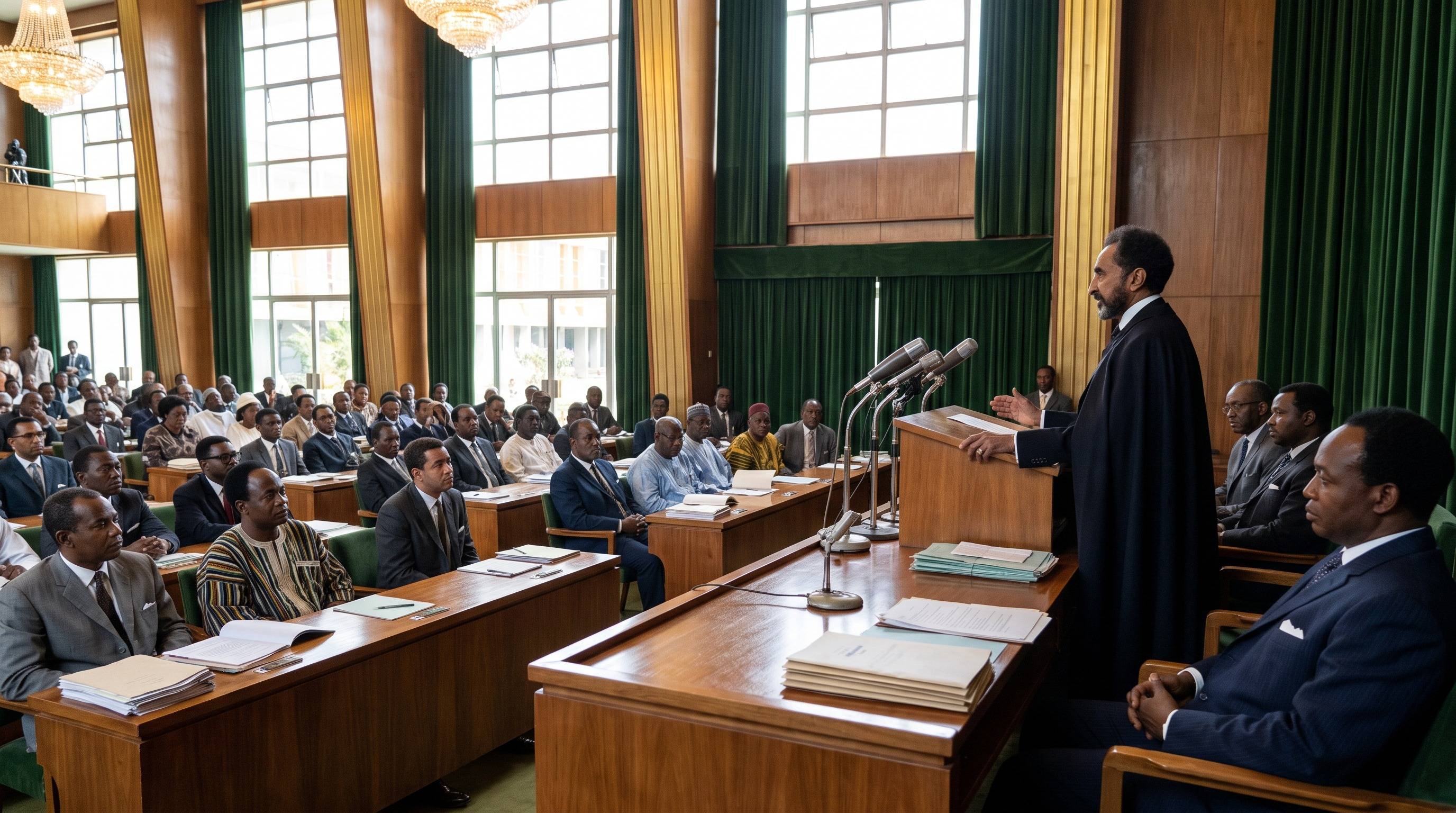

On 25 May 1963, representatives of 32 independent African states established the Organization of African Unity in Addis Ababa, Ethiopia. The achievement gave newly independent countries a permanent continental institution through which they could defend independence, support liberation and address shared problems. Its creation also exposed a difficult question: how much authority would African governments place in common institutions to make African unity effective? [1]
Kwame Nkrumah, Patrice Lumumba and Haile Selassie illuminate that question from different directions. Nkrumah brought a forceful argument for continental political union. Haile Selassie helped bring governments with competing views into a common organization. Lumumba’s struggle in Congo demonstrated how quickly independence could be threatened when political institutions, territorial unity and external power collided.
One distinction must remain clear throughout this history. Lumumba was assassinated on 17 January 1961. He did not attend the founding summit, negotiate its final charter or sign it. His place in the OAU’s creation belongs to its political background and moral urgency. Nkrumah and Haile Selassie were participating founders; Lumumba was an influential predecessor whose fate made the problem of protecting African freedom impossible to dismiss. [2]
This article draws on African Union records preserved in Ethiopia and historical material published by South African History Online. The founding speeches are primary evidence of what leaders advocated, while the charter records what governments actually accepted. Reading them together makes it possible to honor African leadership without turning disagreements into an imaginary consensus.
African unity before the organization
The OAU emerged from a much longer struggle against the denial of African freedom and equality. Pan-Africanism connected the experiences of people living under colonial rule with those confronting racism and exclusion in the diaspora. Its advocates differed in their politics, but shared an insistence that African people had histories, institutions and futures that could not legitimately be controlled by racial hierarchies.
South African History Online places figures including W E B Du Bois, Marcus Garvey and Nkrumah within this evolving movement. Garvey emphasized Black independence and collective organization; Nkrumah helped carry the demand for solidarity into the politics of African statehood. The connections were transatlantic, even though the institution eventually created in Addis Ababa was an organization of African states. [3]
That distinction helps explain the scale of the founding challenge. A movement can unite people around a shared injustice without settling every question of administration. A continental organization must decide who represents whom, who contributes money, how disputes are settled and what happens when members disagree. The passage from Pan-African aspiration to an operational institution therefore required negotiation over power.
It also required a practical understanding of diversity. African unity could not reasonably mean that every language, religion or political tradition would disappear into one culture. A workable form of solidarity had to permit difference while making cooperation possible. Otherwise, the demand to overcome colonial fragmentation could itself become a demand that smaller communities surrender their voice.
The OAU’s founding should consequently be understood as an attempt to give an existing movement an institutional home. The organization did not invent the desire for freedom, and the summit participants did not create that desire on behalf of passive populations. They inherited struggles whose success gave their governments the opportunity to meet as independent representatives.
Nkrumah and the transformation of Ghana into a continental meeting place
Ghana became independent on 6 March 1957 under Nkrumah’s leadership. His preparation for that moment included political organizing abroad, involvement in the 1945 Manchester Pan-African Congress and years of work in the Gold Coast. The Convention People’s Party, established in 1949, helped turn demands for self-government into a mass political campaign. [4]
The importance of Ghana’s independence extended beyond its borders. It made African self-government visible as an immediate political possibility. For activists confronting colonial authorities elsewhere, an independent African government offered something different from sympathy expressed at a distant meeting: a potential diplomatic partner with offices, officials and the ability to convene other people.
Nkrumah used Accra to advance this continental role. In 1958, Ghana hosted both a conference of independent African states and the All-African Peoples’ Conference, which brought together nationalist and liberation organizations. These were distinct kinds of gathering. One connected governments; the other connected movements, including people whose countries had not yet achieved independence. [5]
The relationship between those two constituencies was fundamental. If unity belonged only to existing states, people still under colonial domination would have to wait outside its principal institutions. If unity belonged only to movements, it would lack the resources and diplomatic standing that independent governments could contribute. Accra helped create a political meeting ground between liberation still being fought for and sovereignty already obtained.
This was one of Nkrumah’s lasting contributions to the road toward the OAU. He treated national independence as a platform for wider action. The significance lies less in the ceremonial prestige of hosting conferences than in the connections they made possible: activists could compare experiences, governments could identify shared interests, and African freedom could be discussed across the boundaries colonial rule had reinforced.
What Nkrumah wanted African unity to accomplish
At the 1963 summit, Nkrumah argued for a union government. His proposals included common economic planning, a common market, monetary institutions, coordinated foreign policy and defense, and common African citizenship. He regarded political union as the means of securing economic independence rather than something that should wait until economic cooperation had matured. [6, Nkrumah speech]
The underlying problem can be explained through the difference between possessing a legal right and having the capacity to exercise it. A country may have the legal right to choose its development priorities while lacking the finance, infrastructure or bargaining strength needed to carry them out. Formal independence creates an indispensable authority to decide. It does not automatically remove the constraints surrounding that decision.
Consider, as an illustration, several neighboring countries trying separately to develop industries that need reliable electricity, trained workers and access to a large market. Each government might find the project too expensive on its own. Cooperation could spread the costs and connect producers with more customers. Yet such cooperation also requires agreements over where facilities will be located and how benefits will be distributed.
Political integration therefore raises a question that cannot be solved by enthusiasm alone. Who has the authority to decide when the continental interest appears to conflict with a national preference? A common development institution might choose a location that benefits the wider region while disappointing a government that expected to host the investment. Shared power needs accepted rules precisely because shared interests never eliminate every disagreement.
Nkrumah’s position placed this problem at the center of the debate. Its enduring strength is the recognition that fragmented authority can weaken collective bargaining. Its unresolved difficulty is how to establish a larger authority that people regard as legitimate, accountable and fair. To admire the ambition seriously is to examine both the capacity it promised and the consent it would require.
Lumumba and the struggle to make Congolese independence meaningful
Patrice Lumumba became the first prime minister of independent Congo in June 1960, with Joseph Kasa-Vubu serving as president. His nationalism sought a political community that could extend beyond separate ethnic and regional loyalties. Almost immediately, the new country faced an army mutiny, provincial secession and a struggle over the authority of the central government. [2]
The country in this history is Congo-Léopoldville, now the Democratic Republic of the Congo. It should not be confused with neighboring Congo-Brazzaville. The distinction matters because both states appear in the history of African independence and in the founding records of continental diplomacy. [7]
Lumumba’s political significance came from the insistence that independence had to belong to the Congolese people. The crisis surrounding his government makes the meaning of that claim especially important. A transfer of office is insecure if institutions cannot maintain public authority, if rival centers of power can break away, or if foreign involvement shapes which domestic actors survive.
There is also a danger in reducing Congo to a lesson for other countries. Congolese people were experiencing the consequences directly. Territorial conflict meant disrupted livelihoods and insecurity, while competition for government authority affected the possibility of building public services. The lives at stake were not merely evidence in somebody else’s argument for unity.
For a continental history, Lumumba’s experience raises a demanding standard. Solidarity has to be measured by whether it helps people retain control over their political future. Admiring a leader after his death is different from possessing the institutions needed to support a threatened population while a crisis is unfolding. The gap between commemoration and effective protection became one of the most painful questions inherited by the OAU.
The assassination and the limits of retrospective certainty
After being removed from effective power during the Congo crisis, Lumumba was detained and ultimately killed. His assassination turned him into an enduring symbol of African struggles against domination. South African History Online records his death on 17 January 1961 and explains his subsequent importance to advocates of African solidarity. [2]
It is tempting to describe the OAU as a direct answer to his murder. That is too simple. African unity had a longer history, and the states that founded the organization did not share one reading of the Congo crisis. The more defensible interpretation is that Lumumba’s fate intensified an already urgent problem: how could African independence be protected when national institutions were vulnerable and outside powers were involved?
Nor can history demonstrate that an earlier continental union would certainly have saved him. That claim depends on assumptions about the authority, resources and political agreement such a union would have possessed. A body that existed on paper but remained divided might have been unable to act. Effective protection would have required decisions that member governments were prepared to support and enforce.
This qualification makes the lesson more useful. The relevant question is not simply whether an African organization existed. It is whether that organization had trusted procedures for responding to danger, reliable information, the means to act and sufficient legitimacy to avoid becoming another participant in the struggle for power.
Lumumba belongs in this history because those questions remain inseparable from the meaning of independence. His absence from the founding room must not become absence from the explanation. Equally, his influence should not be converted into a fictional role as a charter signatory. Historical accuracy preserves the particular force of his legacy.
Haile Selassie and the task of securing agreement
Haile Selassie arrived at the project of African unity through a different political experience from Nkrumah’s. He ruled an established monarchy and had faced the invasion of Ethiopia by Mussolini’s Italy in 1935. Exile, an unsuccessful appeal for effective protection through the League of Nations, and his return in 1941 placed the vulnerability of independent statehood within his own experience. Ethiopia’s history offered evidence that possessing sovereignty did not guarantee protection against aggression. [9]
This background gives particular weight to the meeting in Addis Ababa. An African capital associated with resistance to conquest became the place where independent governments established their own continental organization. The shift was significant: African leaders were participating in the design of an institution rather than simply petitioning institutions whose decisive power lay elsewhere.
Haile Selassie’s contribution was closely connected to the challenge of bringing competing approaches into one institution. Ethiopia hosted the summit, and the emperor urged participants to leave with an agreed charter. He accepted gradual progress toward unity while pressing for an immediate organization through which African governments could act together. [6, Haile Selassie speech]
This was substantive leadership. A conference can fail even when every participant endorses its stated goal. Delegates may disagree about the powers of a proposed institution, fear domination by other members, or prefer an arrangement whose advantages accrue mainly to their own government. Convening a meeting begins the work; obtaining an agreement requires making cooperation acceptable to those who remain uncertain.
The emperor’s approach can be understood as an effort to separate what could be accomplished immediately from what required further consent. Such a method has clear advantages. It allows states to establish working relationships, learn from cooperation and develop procedures before assuming wider obligations. It also prevents disagreement over an ultimate destination from stopping every available step.
There is a corresponding danger. Governments can become comfortable with a limited institution and postpone deeper cooperation indefinitely. A transitional arrangement may become permanent because the people who would have to surrender authority find the existing system convenient. Gradualism succeeds only when its first steps make further progress possible and when there is a political commitment to take them.
Seen in this light, Haile Selassie’s achievement and Nkrumah’s warning belong in the same account. One helped make a common organization achievable; the other challenged Africans to consider whether that organization would possess enough power to solve the problems that justified its creation. The historical value of their encounter lies in the tension between those questions.
Respect for the emperor’s continental contribution does not require overlooking the character of his domestic rule. South African History Online also records restrictions on political opposition and the concentration of authority under his monarchy. [9] The distinction between a state’s independence and the political freedom of its citizens is therefore relevant to the founders themselves. Continental leadership should be assessed through its achievements, while domestic government remains open to its own critical examination.
The disagreement over sovereignty
Before Addis Ababa, competing groupings had emerged, commonly identified with Casablanca and Monrovia. Nkrumah and other advocates of deeper integration pressed for a stronger political union. Many other governments favored cooperation that preserved national sovereignty. The OAU developed through a compromise between these approaches. [5]
The disagreement should not be reduced to a contest between people who loved Africa and people who did not. Recently independent governments had reasons to protect their authority. Sovereignty represented release from external government and the right to choose a national future. Asking a state to share that authority raised questions about representation, responsibility and the possibility of domination within Africa itself.
At the same time, sovereignty could be defended in ways that weakened its practical value. A government might retain complete formal discretion while finding its choices restricted by economic dependency or insecurity. The difficulty was that both positions addressed real vulnerabilities. Uncoordinated states could be weak externally; poorly designed collective institutions could be unaccountable internally.
Nigeria’s Abubakar Tafawa Balewa emphasized sovereign equality and practical cooperation at the summit. Julius Nyerere of Tanganyika stressed action on agreed objectives without waiting for a single continental government. Their participation demonstrates why the organization cannot be explained through three personalities alone. [6, Balewa and Nyerere speeches]
The choice facing the founders was therefore institutional as well as ideological. They had to decide which obligations enough governments would accept to sustain an organization. An ambitious constitution without support might have produced immediate division. A modest agreement could secure broad membership but leave crucial powers unavailable. The OAU’s form reflected the judgment that establishing common machinery was possible even where agreement on political fusion was absent.
What was created in Addis Ababa
The charter established an organization whose purposes included African solidarity, better living conditions, the defense of independence and the elimination of colonialism. It also made sovereign equality and non-interference central principles, alongside peaceful dispute settlement, non-alignment and condemnation of political assassination and subversion. Its principal organs included an assembly of leaders, a council of ministers, a secretariat and a mechanism for mediation, conciliation and arbitration. [8]
The assembly was the supreme organ and was to meet at least annually. The charter also identified fields for policy coordination: diplomacy; economic activity, including transport and communications; education and culture; health and nutrition; science and technology; and defense and security. These details matter because the founding agenda extended beyond ceremonial political solidarity to the practical conditions of African life. [8]
These provisions created an intergovernmental institution. They did not establish a continental government with general authority over the citizens of member states. The distinction explains much of the OAU’s subsequent position: governments had a permanent place to coordinate, but the organization remained dependent on the commitments and choices of those governments.
This dependence does not make the institution meaningless. Diplomatic coordination can produce outcomes that individual states would struggle to achieve. A common position can strengthen a campaign, a standing secretariat can preserve institutional memory, and repeated meetings can provide opportunities to manage disputes before relations break down completely.
Nevertheless, coordination has limits when participants disagree about the most important action. A shared declaration cannot by itself supply resources, compel a reluctant government or reconcile incompatible objectives. Readers evaluating the OAU should therefore distinguish its ability to express a continental position from its ability to implement that position.
The charter also exposes a tension between the security of governments and the security of people. Protection from outside interference can defend a population’s independence. But an appeal to non-interference can also be used to resist scrutiny of domestic conduct. The difficult question is how to protect collective self-government while ensuring that the government remains answerable to the people in whose name sovereignty is exercised.
Liberation as a test of solidarity
At the OAU’s birth, colonial rule and white minority domination remained major African realities. Supporting liberation was therefore an immediate responsibility, not a ceremonial reference to a finished past. The organization established a Liberation Committee and provided a continental framework for assistance to liberation movements and opposition to apartheid. [5]
Its contribution should be placed alongside the agency of the movements themselves. People living under oppressive systems organized, endured repression and developed strategies for their own freedom. Independent states could assist them, but outside support did not replace that struggle. A history that credits only presidents and summits would reproduce the very distance between political authority and ordinary lives that liberation sought to overcome.
There were practical reasons for organizing support collectively. Individual governments could differ in resources, proximity and diplomatic relationships. Common arrangements offered the possibility of making assistance more sustained and less dependent on a single relationship. They also gave liberation questions a regular place in continental politics.
Yet support requires judgments: which movements should receive recognition, what forms of help are appropriate and how disagreements should be managed. Solidarity is not exempt from political difficulty merely because its purpose is morally compelling. Its credibility depends on how responsibly those decisions are made.
This aspect of the OAU’s history is essential to a balanced assessment. A limited institution can still perform valuable work. Its inability to realize continental government does not erase its support for liberation. Equally, valuable liberation work does not remove the need to examine shortcomings in governance, conflict response and economic cooperation.
The people beyond the founding photograph
The familiar focus on founding leaders makes the OAU’s creation easier to narrate, but it can narrow our understanding of where political power came from. Nkrumah’s own ascent depended on organizing and electoral support, not simply an individual vision. The broader history of Pan-Africanism included intellectual networks, nationalist associations and political movements across national boundaries. [3][4]
A people-centered reading asks what the new continental institution could mean for those outside government. Would cooperation improve access to education? Could coordinated development create opportunities across borders? Would independence bring a meaningful voice in public decisions? These questions connect institutional history to the everyday purposes for which institutions should exist.
They also caution against measuring unity only through ceremonies. A successful summit is an event. A durable relationship between African communities requires repeated practices: learning about one another, exchanging knowledge, resolving conflicts and treating neighboring populations as partners with rights and interests of their own.
For readers interested in African and Caribbean connections, this distinction is especially useful. Cultural identification can sustain attention to African freedom, but historical understanding requires attention to African arguments themselves. Nkrumah, Lumumba and Haile Selassie should be encountered through their different political circumstances rather than treated as interchangeable symbols.
Respecting those differences strengthens the connection. It allows admiration to become study, and study to become a more responsible form of solidarity. The African continent appears in its own history as a place of debate, decision and political invention, rather than merely a source of inspirational portraits.
An institution built and an argument left open
The African Union was launched in Durban in July 2002 as the OAU’s successor. The AU’s account of that transition identifies a renewed emphasis on integration and development, building on the earlier struggle against colonialism and apartheid. [1]
That succession does not settle the founding debate retrospectively. An organization can be necessary and insufficient at the same time. The creation of a common institution was an achievement because it established something governments could use and develop. Its limitations mattered because the problems confronting African societies required more than agreement that those problems existed.
Nkrumah’s contribution asks whether Africa can obtain sufficient collective capacity while remaining politically fragmented. Lumumba’s legacy asks whether independence can be protected when power over a country’s future is contested. Haile Selassie’s contribution asks how governments with different interests can be persuaded to build and sustain common institutions.
These questions remain analytically connected. Capacity without accountability can concentrate power. Sovereignty without capacity can offer limited practical freedom. Cooperation without commitment can produce repeated promises with little consequence. A durable project of African unity must address all three difficulties together.
The OAU’s creation deserves to be remembered as an act of African political agency undertaken amid disagreement and unfinished liberation. Nkrumah and Haile Selassie helped shape the institution that emerged; Lumumba’s struggle and death formed part of the historical experience that gave the demand for protected independence its urgency. The organization belonged to a wider African effort, and its deepest promise was that Africans would increasingly possess the means to determine their future together.
African sources and reading notes
The source base combines African primary records with an African-based historical publisher. Some South African History Online entries themselves reference scholarship published outside Africa; continental publication is not a claim that every underlying reference originated there. Interpretive passages in this article explain the institutional choices and their implications rather than claiming access to the leaders’ private intentions.
[1] African Union, About the African Union. Institutional history of the OAU’s founding and the AU’s launch. Read source
[2] South African History Online, Patrice Émery Lumumba. Used for the broad political chronology and his posthumous significance. The page’s death record gives 17 January 1961; a conflicting date in its narrative is not followed. Read source
[3] South African History Online, Pan-Africanism. Background on the movement’s continental and diaspora connections. Read source
[4] South African History Online, Dr Kwame Nkrumah. Used for his political organizing, the CPP and Ghanaian independence. Read source
[5] South African History Online, Organisation of African Unity. Used selectively for the Accra conferences, competing approaches and liberation activity. Read source
[6] African Union, Speeches and Statements Made at the First Organization of African Unity Summit, May 1963. Primary records: Haile Selassie, PDF pages 6–12; Nkrumah, pages 44–53; Balewa, pages 94–97; Nyerere, pages 116–118. Page numbers refer to the PDF sequence. Read source
[7] South African History Online, Democratic Republic of the Congo. Used to distinguish Congo-Léopoldville from Congo-Brazzaville. Read source
[8] Organization of African Unity, OAU Charter, 1963, preserved by the African Union. Primary record, especially Articles II, III and VII. Read source
[9] South African History Online, Haile Selassie I. Used selectively for Italy’s invasion, exile, return and the distinction between continental diplomacy and domestic government. Read source